Chapter 6 · WatersLesson 6.5Humanities track
The water cycle: how the hydrosphere connects the atmosphere, lithosphere and biosphere
How long does a drop of water spend in the air, a river or the ocean before moving on?
Before you read: what do you think?
If all the water in the atmosphere, vapour and clouds together, fell at once, how deep would the layer covering Earth be?
See the answer
2.5 cm. At any moment, the air holds just 12,900 cubic kilometres of water. Yet almost 40 times as much falls as rain and snow in a year, because water spends an average of nine days in the air and is continually replaced.
All the water in the atmosphere, in vapour and clouds combined, amounts to 12,900 cubic kilometres. If it all fell at once, it would cover Earth in a layer just 2.5 cm deep. Yet almost 40 times as much falls as rain and snow in a year: around 495,000 cubic kilometres of water pass through the air.
A drop spends nine days in the air and 3,000 years in the ocean
A drop evaporated from the sea spends little time in the air: water stays in the atmosphere for nine days on average, then falls as rain or snow. It spends a few weeks in rivers. In the ocean it stays for around 3,000 years, and in the ice sheets of Antarctica and Greenland for thousands to hundreds of thousands of years.
The average time a water molecule spends in a reservoir is called its residence time. It is found by dividing the amount of water in the reservoir by the amount entering or leaving in a year. These are averages: one drop may fall back into the sea after a few hours, while another stays deep in the ocean for far longer than the average.
Five processes and two forces
Two forces keep water moving. The Sun’s heat evaporates water and lifts it. Gravity brings it back, making drops fall and rivers flow downhill.
This continuous journey of water between ocean, atmosphere and land is called the water cycle. It has five main processes. Through evaporation, liquid water becomes vapour; plants add vapour through transpiration. Through condensation, cooled vapour becomes droplets and ice crystals, forming clouds. Through precipitation, water falls as rain, snow or hail. On land, some flows over the surface towards rivers (runoff), while some enters soil and rock (infiltration).
Much of the water evaporated from the ocean falls back into it: this is the small water cycle. When wind carries the vapour over land and the water returns to the sea through rivers and underground, this is the large water cycle. Of the precipitation that falls on land, more than half evaporates again and only 39% reaches rivers and underground layers.
For the curious
Almost 90% of the vapour in the air comes from evaporation from oceans, seas and other bodies of water, and most of the rest comes from plant transpiration.
The hydrosphere and atmosphere: water carries heat
To evaporate, water takes heat from its surroundings. When vapour condenses in a cloud, that heat is released back into the air, often thousands of kilometres from where the water evaporated. The ocean warms and cools slowly, so winters are milder and summers cooler on the coast than in the middle of a continent.
For the curious
Evaporation and condensation carry energy from the tropics towards higher latitudes; storms draw their energy from the same source.
The hydrosphere and lithosphere: water shapes the land
Flowing water breaks off pieces of rock, carries them away and deposits them. Rivers cut valleys and gorges in the mountains and form floodplains, plains and deltas where they slow down. Water containing carbon dioxide dissolves limestone and leaves caves behind. Ice carved the glacial cirques in high mountains, while waves cut back cliffs. Rock in turn determines the path water takes: water infiltrates sand and gravel, but runs over the surface of clay.
The hydrosphere and biosphere: life uses water and returns it
Every living thing needs water. Plants draw it from the soil through their roots and release it into the air through their leaves. A forest holds rain in its canopy, leaf litter and soil, slows runoff and reduces floods caused by ordinary rainfall; a deforested slope sends water quickly downhill, taking soil with it.
Worked example
How long water stays in the air, a river and the ocean
The atmosphere contains 12,900 cubic kilometres of water, and 495,000 cubic kilometres pass through it in a year. The residence time is 12,900 ÷ 495,000 = 0.026 years, or 0.026 × 365 ≈ 9.5 days.
All the world’s rivers hold 2,120 cubic kilometres of water in their channels and discharge approximately 117 cubic kilometres into the ocean each day. The residence time is 2,120 ÷ 117 ≈ 18 days.
The ocean holds 1,338,000,000 cubic kilometres. If all 495,000 cubic kilometres that pass through the air each year came from the ocean, the residence time would be 1,338,000,000 ÷ 495,000 ≈ 2,700 years. Since some vapour comes from land, the actual value is higher, at over 3,000 years.
In Romania
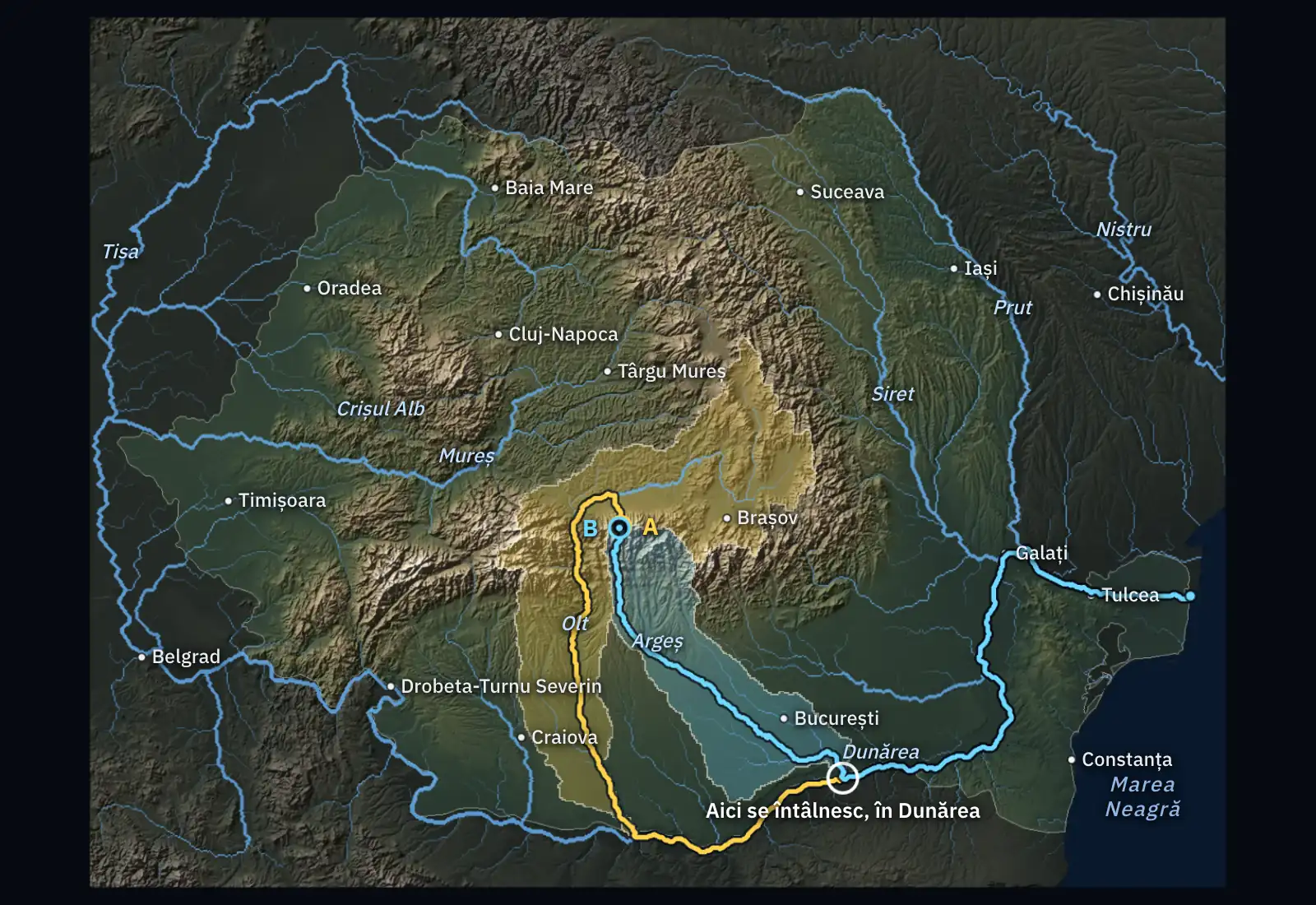
Rain in the Carpathians reaches the Black Sea
The Danube basin covers 97.4% of Romania’s area, so nearly all the water that drains from the country reaches the Black Sea through the Danube. At the entrance to the delta, the river has an average discharge of 6,437 m³/s. Over a year, that amounts to approximately 203 cubic kilometres of water, collected from 19 countries.
Lakes show traces of the connection between water and rock. Lakes Bâlea and Bucura sit in cirques carved by glaciers. Lake Zăton, in Mehedinți county, occupies a karst depression formed by water dissolving limestone. Lake Roșu formed behind a natural dam. The Danube Delta is made of sediment carried by the river and deposited where it meets the sea.
In brief
- The water cycle is the continuous journey of water between ocean, atmosphere and land through evaporation, transpiration, condensation, precipitation, runoff and infiltration.
- The cycle is driven by the Sun’s heat, which evaporates water, and by gravity, which brings it back.
- The hydrosphere and atmosphere: through evaporation and condensation, water carries heat from place to place, while the ocean moderates coastal climates.
- The hydrosphere and lithosphere: water erodes, transports and deposits material, forming valleys, gorges, caves, floodplains and deltas.
- The hydrosphere and biosphere: living things need water, plants return it to the air through transpiration, and forests slow runoff.
- Residence time is the amount of water in a reservoir divided by the amount passing through it: approximately nine days in the atmosphere, a few weeks in rivers and around 3,000 years in the ocean.
Common mistakes
WrongAll water evaporated from the sea passes over land and returns through rivers.
RightMuch of it falls back into the ocean without reaching land. Only some vapour is carried by wind over the continents.
WrongIf the residence time in the atmosphere is nine days, every drop stays in the air for exactly nine days.
RightNine days is the average. Some molecules fall back after a few hours; others remain in the air for weeks.
WrongAll rain that falls on land reaches rivers.
RightMore than half returns to the air through evaporation and plants; only 39% reaches rivers and underground layers.
Test yourself
Six questions. For the first five you see the explanation at once, with the paragraph of the lesson that supports it; for the ones with a written answer you compare with a good answer.
Which two forces keep the water cycle moving?
Answer
b) The Sun’s heat and gravity. The Sun supplies the energy for evaporation; gravity makes water fall and flow downhill. Wind moves vapour from place to place.
What percentage of precipitation falling on land reaches rivers and underground layers?
Answer
a) 39%. The rest, more than half, evaporates again from soil, water and plants.
How is the residence time of water in a reservoir calculated?
Answer
d) Divide the amount of water in the reservoir by the amount passing through it each year. A large reservoir with little exchange, such as the ocean, has a long residence time; a small one with a high rate of exchange, such as the atmosphere, has a short one.
Which landform results from water dissolving limestone?
Answer
c) Cave. A delta forms as sediment is deposited, a glacial cirque is carved by ice, and a cliff is cut back by waves.
A lake holds 600 million cubic metres of water, and the river flowing through it brings in and carries out 200 million cubic metres a year. What is the water’s residence time in the lake, in years?
yearsAnswer
3 years. 600 ÷ 200 = 3 years. Divide the stock by the annual flow.
A forest is completely cleared from a hillside. Describe how three water cycle processes change on that slope and what effects the changes have on the river in the valley.
A good answer
Transpiration decreases because there are no longer trees releasing water into the air. Infiltration decreases because the canopy and leaf litter no longer hold back rain, and the soil becomes compacted. Surface runoff increases and speeds up. The river in the valley receives water faster: floods peak higher, the water carries more soil, and flow falls between rains because less water reaches the water table.
A complete answer names transpiration, infiltration and runoff, says how each changes and links the changes to floods and erosion.
Terms
- water cycle
- The continuous movement of water between ocean, atmosphere and land, changing its state and location.
- evaporation
- The change of water from liquid to vapour.
- transpiration
- The release of water vapour by plants through their leaves.
- condensation
- The change of water vapour into droplets as it cools; this is how clouds and fog form.
- infiltration
- The entry of surface water into soil and rock.
- runoff
- The flow of water over the land surface towards streams and rivers.
- residence time
- The average time a water molecule spends in a reservoir: the amount of water in the reservoir divided by the amount passing through it per unit of time.
Sources and link to the programme
- NASA Earth Observatory – The water cycle – 12,900 km³ of water in the atmosphere (2.5 cm if it all fell); about 495,000 km³ passes through the atmosphere annually, almost 40 times the stock; almost 90% of moisture comes from evaporation, the rest mainly from transpiration; volumes of the ocean (1,338,000,000 km³) and rivers (2,120 km³)
- UCAR Center for Science Education – The water cycle – residence times: over 3,000 years in the ocean, nine days on average in the atmosphere, thousands to hundreds of thousands of years in ice sheets
- Steven Earle – Physical Geology, ed. a 2-a, cap. 13.1 The hydrological cycle (manual universitar deschis) – method for calculating residence time (stock divided by flow); river discharge into the ocean, 117 km³ per day
- FAO AQUASTAT – Water use – of precipitation over land, 56% and 5% evapotranspire, while 39% becomes runoff and groundwater
- ICPDR – Romania și Danube River Basin (pagini arhivate la IW:LEARN) – 97.4% of Romania lies in the Danube basin; the basin includes territory from 19 countries
- Administrația Națională „Apele Române” – Planul de management al riscului la inundații, ciclul II, fluviul Dunărea – the Danube’s long-term average discharge at Ceatal Izmail, 6,437 m³/s
- INS – Anuarul statistic al României, capitolul 1 Geografie (tabelul 1.5, lacuri naturale; copie arhivată) – lake types: Bâlea and Bucura (glacial cirques), Zăton (karst depression), Lacul Roșu (natural dam)
From the programme: “The relationship between the hydrosphere and the other geospheres” (specialisation curriculum, humanities track). Programme competences covered: 1.3, 2.3, 3.3.