Chapter 6 · WatersLesson 6.3
Managing inland waters: who uses a river’s water and who shares it out
Who decides how much water from a river goes to taps, turbines and fields, and how much stays in the channel?
Before you read: what do you think?
Romania has a water resource of 134.6 billion cubic metres a year, including the Danube and groundwater. How much can be used?
See the answer
Less than one third. About 40 billion cubic metres can be used. Rain does not fall when and where water is needed, and spring water flows downstream in a few weeks. Only the water stored in lakes, soil and underground layers remains for summer.
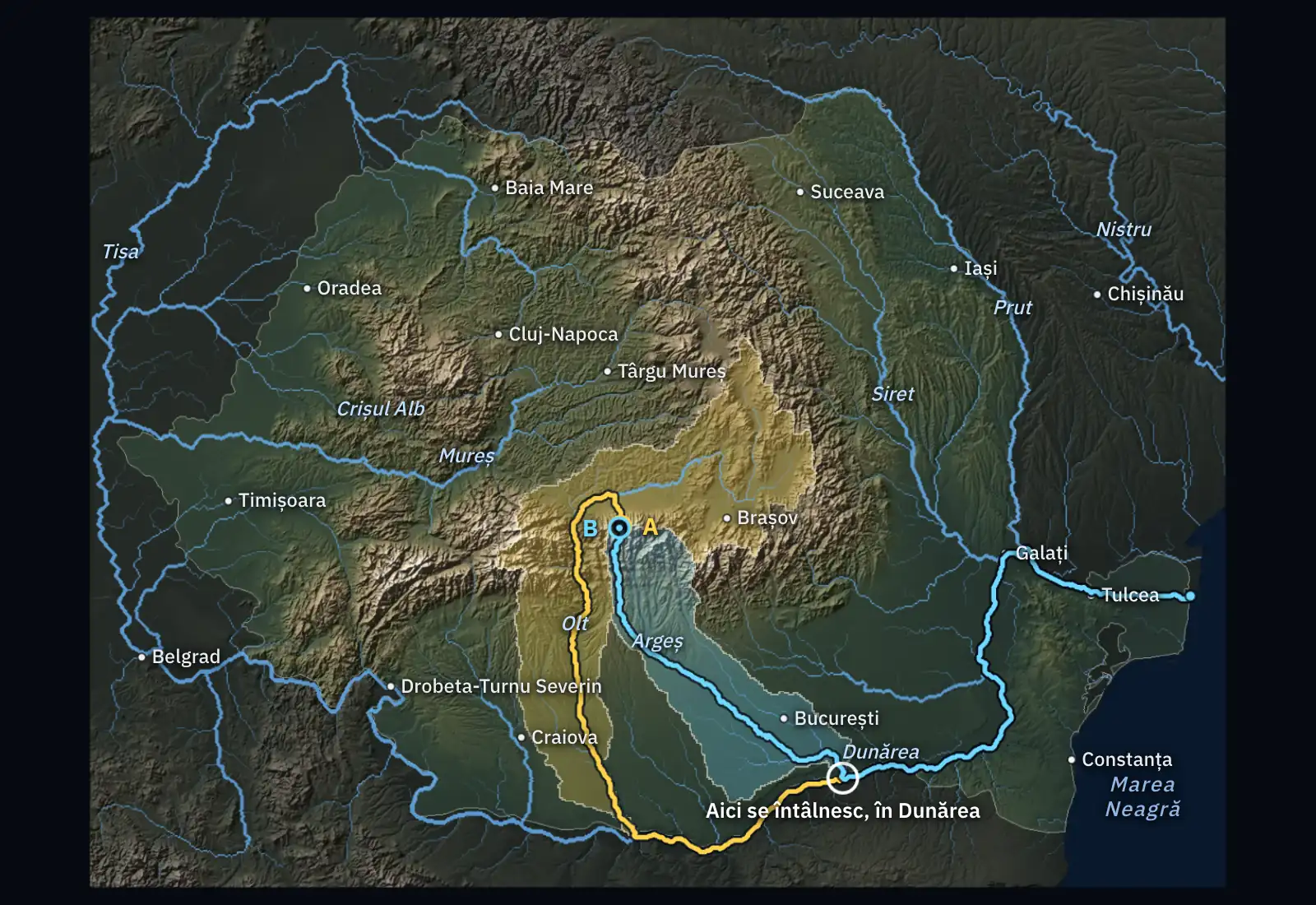
On 1 August 2025, the draining of Lake Vidraru on the Argeș began, the first complete emptying since 1974. The lake holds 465 million cubic metres of water, and people in Bucharest drink water from the same river further downstream. An operation like this shows how many activities depend on a single river.
Many users want the same water
Water from the Argeș first passes through the turbines of Vidraru hydroelectric power station. Further downstream, people in Bucharest drink water from the same river. Almost every river is shared like this among four main uses. People need drinking water. Agriculture uses it for irrigation and livestock. Industry uses it as a raw material, for washing and especially for cooling. Energy production needs water for hydroelectric turbines and for cooling thermal and nuclear power stations. Add navigation, fishing and tourism. The river itself needs a minimum discharge so that the creatures in it can survive.
The uses differ. A hydroelectric station uses the water and lets it flow on. Much irrigation water is consumed: it evaporates or enters plants. Water from taps returns to the river dirty. Water management therefore concerns both quantity and quality.
Everyone takes a share of the renewable water resource: the water replenished on average each year in rivers, lakes and underground layers. Only part of it is accessible to people.
For the curious
Nearly 110,000 cubic kilometres of precipitation fall on land each year. More than half returns to the air through evaporation and plants. Only 39%, around 43,000 cubic kilometres, reaches rivers, lakes and underground layers: this is humanity’s renewable water resource.
Works that move water through time and space
Rain does not fall when and where water is needed. A dam blocks a river and forms a reservoir behind it, storing water from rainy months for dry ones. A large reservoir usually serves several purposes at once: it generates energy, supplies towns, provides irrigation water and holds back part of a flood.
Canals and pipes carry water where it is scarce. Irrigation systems bring it to fields, while levees protect floodplains from overflowing rivers. Before reaching the tap, water passes through a water treatment plant. After use, wastewater must pass through a wastewater treatment plant, which removes dirt before the water returns to the river.
The basic rule: manage the whole river basin
What happens upstream affects the river downstream. A town that does not treat its wastewater spoils the drinking water of the town below it; a reservoir that holds back water during drought leaves the channel downstream empty. The working unit is therefore the drainage basin, with all its tributaries, regardless of counties and borders.
In the European Union, the rule is set out in the Water Framework Directive (2000/60/EC). It requires each basin to have a management plan, reviewed every six years, and all waters to reach “good status”: enough clean water, with aquatic life preserved.
In Romania, water is managed by the National Administration “Apele Române”, the national water authority, through 11 river basin water administrations, each responsible for its rivers. The Danube passes through too many states for one to manage it alone: its basin covers 801,463 square kilometres across 19 countries, and Danube states work together through the International Commission for the Protection of the Danube River (ICPDR).
For the curious
The 11 river basin water administrations are Someș-Tisa, Crișuri, Mureș, Banat, Jiu, Olt, Argeș-Vedea, Buzău-Ialomița, Siret, Prut-Bârlad and Dobrogea-Litoral.
Conflicts and solutions
Conflicts arise especially during drought, when there is not enough water for everyone. They occur between uses (irrigation or turbines?), between upstream and downstream, and between people and the river. Dams have costs too: the reservoir covers villages and land, traps sediment the river carried towards the sea and, without a fish passage, blocks migrating species.
Choose solutions by comparing the benefits and costs for each party. The cheapest are saving water and repairing leaking pipes. Others include treating and reusing water, drip irrigation, preserving floodplains and wetlands that retain water, and restriction plans that decide in advance who receives water first during drought. Supplying the population usually takes priority.
Worked example
How much energy is in Vidraru’s water?
The Vidraru scheme has a total head, or height of fall, of 324 metres. For a simple calculation, assume that every cubic metre of water falls the full height. One cubic metre of water has a mass of 1,000 kg. The energy it can provide as it falls is E = m × g × h = 1,000 × 9.81 × 324 ≈ 3,180,000 joules. One kilowatt-hour is 3,600,000 joules, so one cubic metre of water can provide about 0.88 kWh.
The lake’s usable volume, the part that can be sent to the turbines, is 320 million cubic metres. Its energy is 320,000,000 × 0.88 ≈ 280 million kWh, or 280 GWh. This is an estimate: the lake level falls as it empties and the turbines lose some energy, so the electricity generated is less.
The calculation shows why emptying a reservoir has a cost: water released past the turbines is energy that will not be generated.
In Romania
Lake Vidraru on the Argeș
Vidraru hydroelectric power station began operating on 9 December 1966. The scheme uses the Argeș along a 28 km stretch between Cumpăna and Oiești, with a total head of 324 metres. The reservoir has a total volume of 465 million cubic metres, of which 320 million is usable.
After nearly 60 years of operation, the dam and power station entered modernisation under a contract worth 188.4 million euros. The work required the lake to be drained, beginning on 1 August 2025; refilling began on 1 April 2026. The power station generated no electricity during this time. Bucharest also draws water from the Argeș downstream; the director of the city’s water company said in May 2026 that Bucharest had felt no effects from the draining.
Romania has little water: of the total resource of 134.6 billion cubic metres a year, including surface waters, the Danube and groundwater, about 40 billion is usable.
In brief
- Renewable fresh water is needed by people, agriculture, industry and energy production, and the river needs a minimum discharge.
- Dams and reservoirs store water from rainy periods for dry ones and serve several purposes: energy, water supply, irrigation and holding back floods.
- Water is treated before consumption and cleaned in wastewater treatment plants after use.
- Water is managed by drainage basin because everything that happens upstream reaches downstream; this is the rule of the Water Framework Directive (2000/60/EC).
- In Romania, water is managed by the National Administration “Apele Române”, through 11 river basin water administrations.
- Lake Vidraru on the Argeș holds 465 million cubic metres and has a head of 324 metres; it was drained in 2025 for modernisation.
Common mistakes
WrongA hydroelectric station consumes the river’s water.
RightThe station uses the fall of the water and lets it flow on. It does, however, change when water reaches downstream and traps sediment in the reservoir.
WrongIf a river has plenty of water in spring, there cannot be a shortage in summer.
RightSpring water flows downstream in a few weeks. Only water stored in lakes, soil and underground layers remains for summer.
WrongWater is managed by county.
RightWater is managed by drainage basin because rivers do not follow county boundaries: Romania has 11 river basin water administrations.
Test yourself
Six questions. For the first five you see the explanation at once, with the paragraph of the lesson that supports it; for the ones with a written answer you compare with a good answer.
Which use lets water flow on in the river without consuming or polluting it?
Answer
c) A hydroelectric station. Turbines use only the fall of the water. Irrigation consumes water, while towns return it to the river as wastewater.
By what territorial unit is water managed under the Water Framework Directive?
Answer
a) Drainage basin. The basin connects upstream to downstream; administrative boundaries cut the river into pieces that cannot be managed separately.
How many river basin water administrations does the National Administration “Apele Române” have?
Answer
d) 11. There are 11, one for each basin or group of basins. 41 is the number of counties and 19 the number of countries in the Danube basin.
What does a wastewater treatment plant do?
Answer
b) Cleans wastewater before it returns to the river. Wastewater is cleaned after use. Drinking water is prepared at a water treatment plant before consumption.
One cubic metre of water falling 324 metres can provide about 0.88 kWh. How many GWh can a reservoir with a usable volume of 100 million cubic metres and the same head provide?
GWhAnswer
88 GWh. 100,000,000 × 0.88 kWh = 88,000,000 kWh = 88 GWh, before turbine losses.
In a dry summer, a reservoir has enough water left for one of two demands: irrigating crops downstream or producing energy at peak hours. The river below the dam is almost dry. What would you propose, and what would each side lose?
A good answer
First reserve water for the population and a minimum discharge in the river, then share the rest. Water sent through the turbines flows on and can be taken for irrigation downstream, so both demands can be met if the turbines run when farmers need water. The energy producer loses because it no longer generates at the most expensive hours; farmers lose if the water comes too late or in too small a quantity.
A good answer sets priorities, notices that water passing through the turbines remains in the river and states clearly who bears the cost. There is no single correct solution.
Terms
- renewable water resource
- Fresh water replenished each year by precipitation in rivers, lakes and underground layers.
- reservoir
- An artificial lake formed behind a dam, storing water for energy, supply, irrigation or flood storage.
- irrigation
- The supply of water to farmland through canals, pipes or sprinklers.
- wastewater treatment plant
- A facility that cleans wastewater before returning it to the river.
- Water Framework Directive
- The European law of 2000 (2000/60/EC) requiring water management by drainage basin and good status for all waters.
- upstream and downstream
- Upstream means towards the source, up the river; downstream means towards its mouth, down the river.
Sources and link to the programme
- FAO AQUASTAT – Water use – precipitation on land of nearly 110,000 km³/year; 39% (43,000 km³) becomes renewable resources; types of water withdrawal
- EUR-Lex – Directiva 2000/60/CE (Directiva-cadru a apei), textul în română – management by river basins and districts, good-status objective, six-year plan reviews
- Ministerul Mediului, Apelor și Pădurilor / ANAR – Sinteza națională a planurilor de management al riscului la inundații, ciclul II – the 11 river basin water administrations of the National Administration “Apele Române”
- ICPDR – Danube River Basin (pagină arhivată la IW:LEARN) – Danube basin: 801,463 km², 19 countries
- Digi24 – Hidroelectrica începe golirea lacului Vidraru, pentru prima dată după anul 1974 (comunicatul Hidroelectrica, 31 iulie 2025) – Vidraru: commissioned 9 December 1966, 28 km stretch, 324 m head, total volume 465 million m³, usable volume 320 million m³, contract of 188.382 million euros, draining from 1 August 2025
- Digi24 – Începe procesul de umplere controlată a lacului Vidraru (comunicatul Hidroelectrica, 1 aprilie 2026) – refilling the lake from 1 April 2026
- Profit.ro – declarația directorului Apa Nova despre golirea barajului Vidraru (23 mai 2026) – Bucharest did not feel the effects of draining Lake Vidraru
- Economica.net – declarațiile Administrației Naționale „Apele Române” despre resursele de apă – total resources of 134.6 billion m³, of which about 40 billion usable (1,894 m³ per person per year)
- Copernicus DEM GLO-30 – model digital al terenului (ESA, Copernicus Data Space) – terrain used to calculate flow directions, basin boundaries and rivers on the map
- OpenStreetMap – date © colaboratorii OpenStreetMap (ODbL) – river courses and names on the map
From the programme: “Management of inland waters” (common core). Programme competences covered: 1.3, 1.4, 4.5, 5.3.