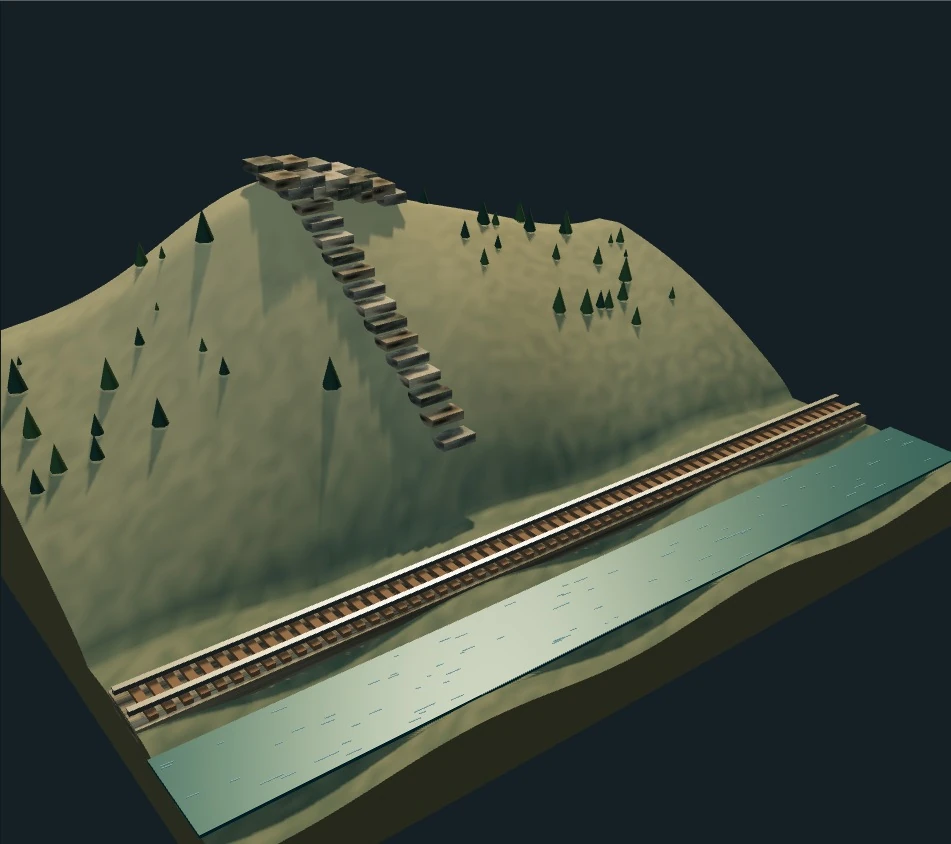
A cross-section of the Ghimeș hillside showing masonry, stairs and a railway.
The valley from the river side

Ghimeș, Bacău

Steps and rails at Ghimeș

At Ghimeș, there is little room between the Trotuș and the slope above it. A road ran through here, followed by a railway. The masonry of a former customs post still stands on a spur overlooking them. 1 2

Climb from the track to the wall and see how the two structures make different use of the slope.

Start the story

The valley crossing

Why the guards stood above the road

Travellers could cross at river level. The spur gave the guards a longer view down the valley and put them above the point where people entered. 1 2

Move the viewpoint up the hillside. From the wall, the route below comes into view as a whole.

Position on the slope
0 %

1897

A railway cuts across the foot of the slope

The 2015 field report cites earlier research saying the lowest stairs were dismantled during construction of the railway in 1897. The two periods of construction still meet at the crossing. 1

Switch between the two states. The interrupted stair in the model marks the loss of lower access, whose precise form is unknown.

At the foot of the hill

The 2015 excavation

How thick was the surviving wall?

Archaeologists recorded a thickness of 1.20 to 1.30 metres in one of the walls they studied. It is a dimension from a specific place, useful even without the outline of the whole fortification. 1

Turn to a section through the wall. The faces and fill take up space where, from below, you might see a single line.

The wall

Ghimeș today

Two levels, one crossing

From below, the tracks seem to follow the only way through. The climb to the masonry shows another use for the hillside. From here people could watch the travellers on the road.

Walk a short way uphill and you can see two ways of making use of the same valley.

Sources

The model shows the river, hillside, stairway and railway in relation to each other. Terrain proportions are schematic and the lost plan is not reconstructed. The wall dimension is from the field report.

  1. 2015 archaeological field report

    Observed remains, measured masonry and the reported relationship to the construction of the railway.

  2. Former customs post, Bacău County

    The site of the former customs post and the monument visible today.