mariuscomper.ukRomână
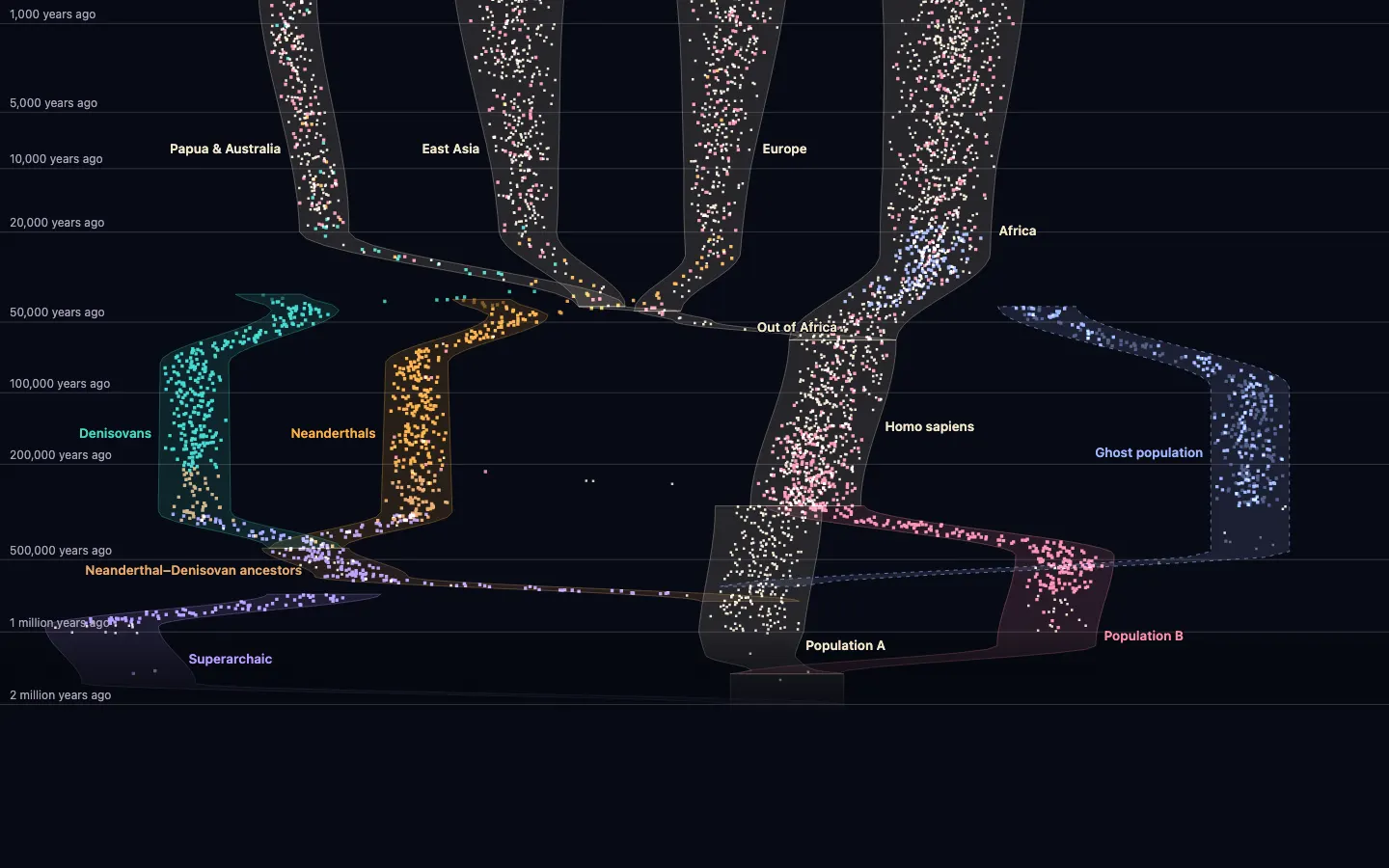
A river of glowing points flows from two million years ago at the bottom to today at the top. Streams split, narrow and rejoin; side streams for Neanderthals, Denisovans and unknown populations flow into it.
The river of ancestors, from two million years ago (bottom) to today (top).

Two million years of your ancestors

You carry DNA from people nobody has ever found

Your ancestors nearly died out, more than once. On the way they had children with Neanderthals, Denisovans and peoples known only from the traces they left in our genes. The further down the river, the further back in time.

Two million years down ↓

Modern genomes

Today: eight billion people, and very little variety

There are about eight billion of us. Genetically, though, we are a small species. Any two people differ at only about one DNA letter in a thousand, and for most of the past few hundred thousand years our ancestors behaved like a population of roughly ten to twenty thousand breeding adults.

Geneticists call that figure the effective population size: the number of breeding adults an idealised population would need to leave the variety we see today. The real headcount was larger. But the figure falls hard whenever numbers crash, so a crash leaves a mark in everyone descended from it.

Each point of light is one line of ancestry. Each stream is a population, and its width shows its effective size. The scale is logarithmic: a stream twice as wide stands for an effective size about ten times larger. Lower on the river is further back in time.

Width: effective population size, logarithmic. Between published estimates the streams are drawn smooth; the paths sideways only separate them.

1000 Genomes Project, Nature, 2015; Li and Durbin, Nature, 2011

Modern genomes and fossils

Almost all non-African ancestry passes through one small group

Modern humans had left Africa before, and their fossils turn up in Arabia and the Levant, but those earlier groups left little or no detectable trace in people alive today. Between about 70,000 and 50,000 years ago another small group left, and this one lasted. The genomes of every non-African alive today still carry the marks of that squeeze: in the tens of thousands of years that followed, an effective size of roughly 1,000 to 3,000 breeding adults.

Populations whose lines stayed in Africa never went through that founder squeeze. That is one reason people within Africa differ from each other more than people anywhere else do.

Li and Durbin, Nature, 2011; Gravel and colleagues, PNAS, 2011; Hallett and colleagues, Nature, 2025

Ancient DNA

Then they met the Neanderthals

The group that left Africa soon met Neanderthals, who had lived in Europe and western Asia for hundreds of thousands of years. They had children together. The mixing was centred on about 47,000 years ago and lasted several thousand years (about 7,000 by the best estimate), before the people who left Africa split up.

The result is in every non-African: about 2% of the genome is Neanderthal, between 1.8 and 2.6% depending on the population. Pieced together from living people, more than 1.3 billion letters of the Neanderthal genome survive: about 40% of it.

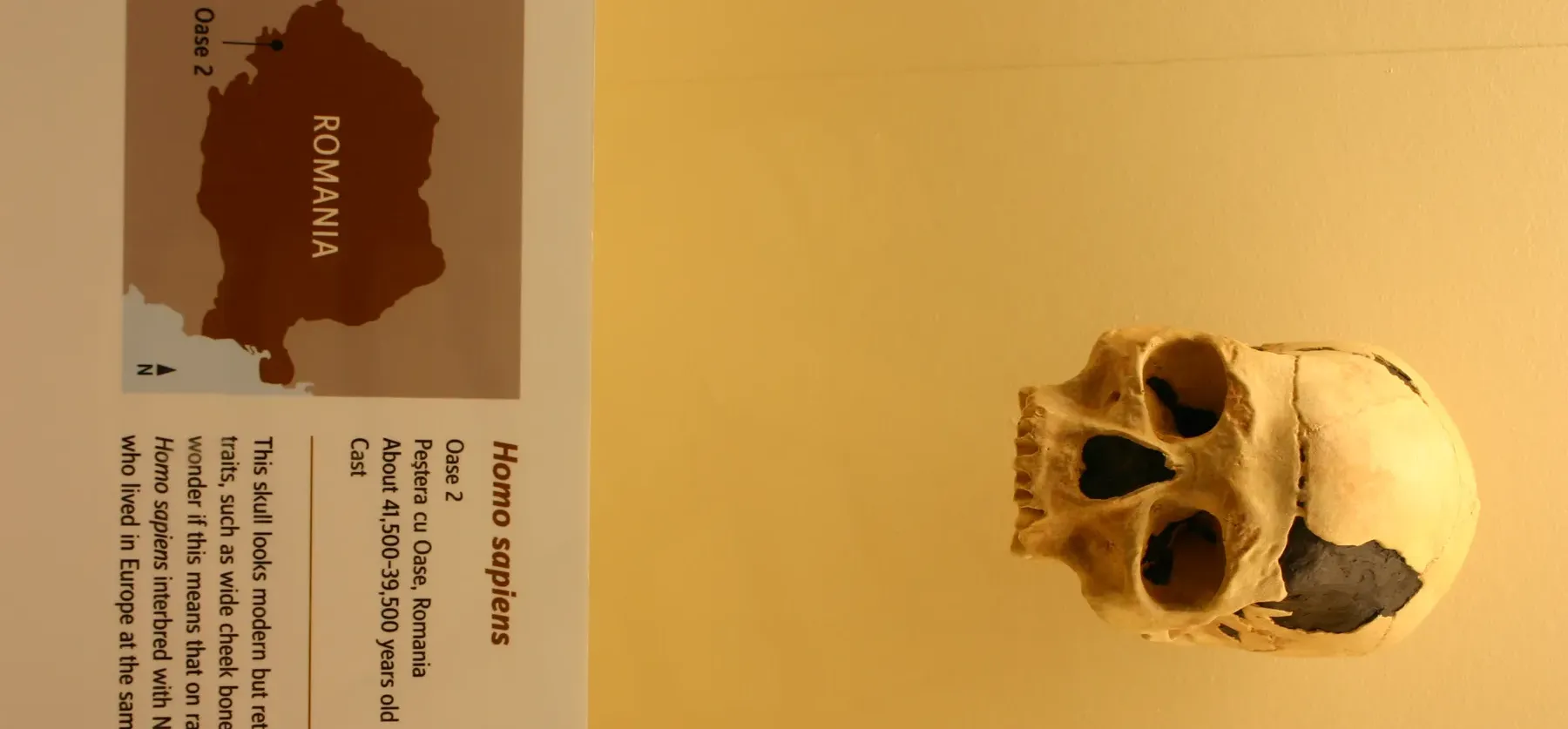
One of the clearest cases was found in Romania. Oase 1, a man whose jaw lay in a cave near Anina and who lived about 40,000 years ago, was 6 to 9% Neanderthal. His Neanderthal ancestor had lived only four to six generations before him. His people left little or no detectable ancestry in later Europeans.

Iasi and colleagues, Science, 2024; Prüfer and colleagues, 2014 and 2017; Vernot and colleagues, 2016; Fu and colleagues, Nature, 2015

Ancient DNA and proteins

And the Denisovans, now found from Siberia to the Tibetan Plateau, Taiwan and southern China

In 2010 DNA from a fingertip found in a Siberian cave turned out to belong to people nobody had described: the Denisovans. They were cousins of the Neanderthals. Since then their remains have been identified, from proteins or DNA, on the Tibetan Plateau, in the sea off Taiwan and in China. In September 2026 a cave in Yunnan gave the richest haul outside Siberia: skull fragments, part of a forearm bone and teeth, about 167,000 to 134,000 years old.

Papuans, Aboriginal Australians and some peoples of the Philippines carry the most of them: a few per cent of the genome, 4 to 6% by the first estimate, from at least two different Denisovan groups. East Asians carry a much smaller share.

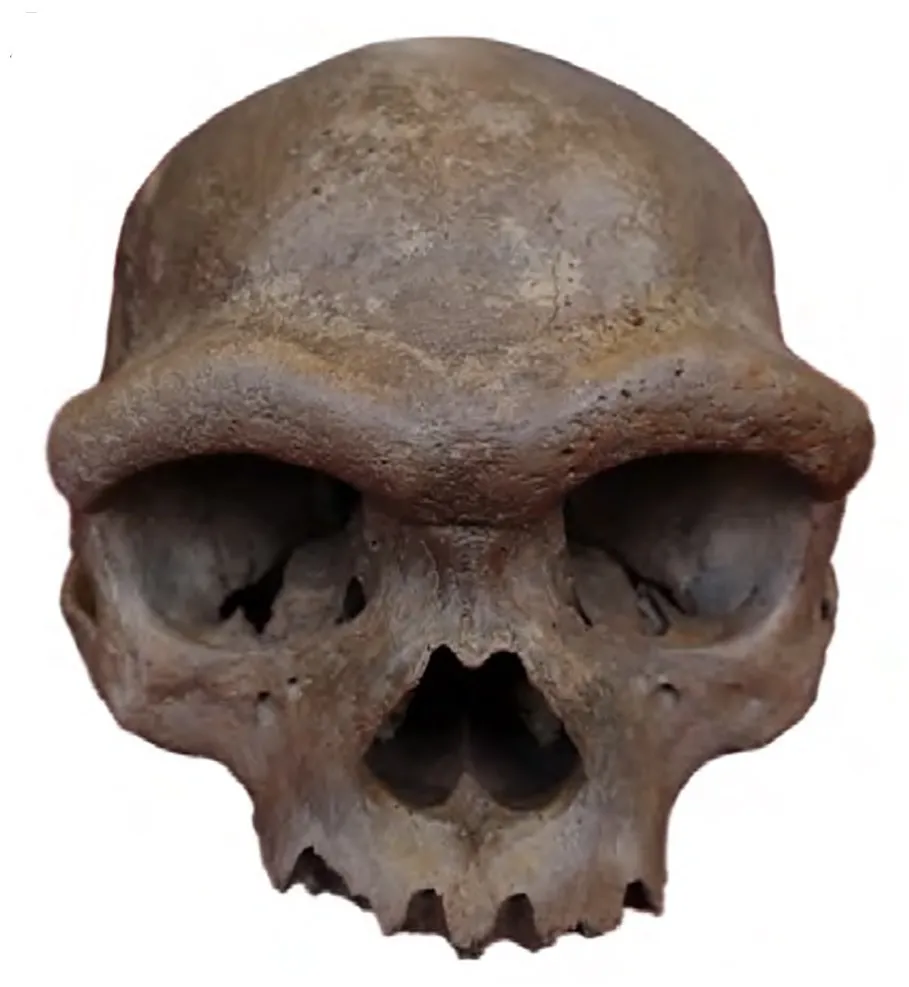
Some of it proved useful. Most Tibetans carry a version of EPAS1 inherited from Denisovans or their close relatives, a gene that shapes how the body responds to thin air. In 2025 a heavy skull found near Harbin, China, was shown to be Denisovan: the first time we could see one of their faces.

Reich and colleagues, 2010; Larena and colleagues, 2021; Jacobs and colleagues, Cell, 2019; Huerta-Sánchez and colleagues, 2014; Tsutaya and colleagues, 2025; Fu and colleagues, Science and Cell, 2025; Rao and colleagues, Nature, 2026

Statistical model · competing explanation

A ghost with no bones at all

Some populations are known only from the patterns they left in DNA. People in West Africa today carry stretches of DNA that match neither Neanderthals nor Denisovans nor any modern human. They look like the legacy of an archaic population that branched off before the Neanderthals did, somewhere between 360,000 and a million years ago, and mixed in much later.

The estimated share is wide: 2 to 19% of the genome. No fossil has been linked to it. Some geneticists think the same pattern could come from old, deep divisions among Africa’s own populations, with no separate ghost at all.

Durvasula and Sankararaman, Science Advances, 2020; Ragsdale and colleagues, Nature, 2023

New method, 2026

2026: more ghosts, found a new way

In August 2026 a Californian team published a method that rebuilds the family tree of each stretch of DNA and looks for branches too old to be modern human, with no archaic genome to compare against. It found the known Neanderthal and Denisovan signals, and also traces of unidentified hominins, in Africans and non-Africans alike, some of them where Neanderthal and Denisovan DNA is missing altogether.

Whether these ghosts are the West African one, population B or others again, nobody can yet say: the methods see different signals at different depths in time. But the idea that our genomes hold ancestors we have no fossil genome for no longer rests on a single study.

Zhang and colleagues, Science, 2026

Ancient DNA

Genes flowed the other way too

The mixing was not one-sided. The two best-sequenced Neanderthal genomes carry 2.5 to 3.7% DNA from early modern humans, mostly from a wave about 250,000 years ago and another about 100,000 to 120,000 years ago.

Modern humans who came out of Africa long before the ancestors of today’s non-Africans left descendants: inside the Neanderthals. Their own lines died out.

Li and colleagues, Science, 2024; Posth and colleagues, 2017

One model, 2025 · not yet confirmed independently

We are made of two populations that split for a million years

In 2025 geneticists at Cambridge looked for the traces of an old separation in modern genomes, and found one. By their model, our ancestors split into two populations about 1.5 million years ago. Right after the split, one of them shrank to a small group. The two came back together about 300,000 years ago.

Everyone alive today is roughly 80% from the first and 20% from the second. The majority population also seems to be the one the Neanderthals and Denisovans came from. No known fossil can be confidently assigned to the minority one. If the model is right, about a fifth of everyone’s genome comes from a population nobody has found.

Cousins, Scally and Durbin, Nature Genetics, 2025

Disputed

1,280 people, for 117,000 years?

The most dramatic claim is further down the river. In 2023 a team in China concluded that between about 930,000 and 813,000 years ago our ancestors fell to about 1,280 breeding adults and stayed there for 117,000 years. By their estimate that meant losing 98.7% of the population.

The dashed outline shows that claim. Other geneticists have not found it. When they tested the method on some simulated histories with no crash in them, it still found a sharp crash. Other methods applied to the same genomes see nothing like it. The authors replied in 2026 and stand by it. For now it is a disputed result.

Hu and colleagues, Science, 2023; Deng, Nielsen and Song, Genetics, 2024; Cousins and Durvasula, 2025; Zhou and colleagues, Molecular Biology and Evolution, 2026

Model

The oldest mixing we can detect

The deepest ghost is older still. The ancestors of Neanderthals and Denisovans mixed, perhaps around 700,000 years ago, with a “superarchaic” population whose line had split off about two million years ago, perhaps among the first humans to leave Africa.

Genomes show no sign that they mixed directly with our own ancestors, so you carry at most a trace of them, passed on through Neanderthals and Denisovans. They are the oldest people we know of only through their genes.

This is as far as genomes currently reach. Before this, the only evidence is bones.

Rogers, Harris and Achenbach, Science Advances, 2020; Prüfer and colleagues, Nature, 2014
What is in your genome?

Where does most of your family’s ancestry trace back to? The shares below are typical ranges for populations with that ancestry, not a reading of your own DNA. They come from different studies that look at different eras, so they do not add up to one pie. Read them as layers, the deepest first.

Your family’s ancestry traces mainly to

Layer 1 · 1.5 million to 300,000 years ago

One model, 2025 · not yet confirmed independently

The same for everyone alive: about 80% of your ancestry from population A and 20% from population B, the two populations that split and later merged again.

Layer 2 · mixing in the last 250,000 years

On top of that, your genome as 2,000 pieces of about 1.5 million letters each. Coloured pieces came in through later mixing. Solid squares mark the low end of each estimate and faded ones how far the high end reaches. The ghost is drawn in outline because no genome of it exists.

  • Modern human lines
  • Neanderthal
  • Denisovan
  • Ghost

Layer 3 · how we know

  • Neanderthal. Measured against sequenced Neanderthal genomes.
  • Denisovan. Measured against one sequenced Denisovan genome; the groups that mixed with our ancestors were relatives of it, not the same people.
  • West African ghost. Inferred from a statistical model. No genome or fossil; deep divisions within Africa could explain the same pattern.
  • Population B. Inferred from one model published in 2025.
  • Apparent Neanderthal DNA in Africans (about 17 million letters, or 0.5%) comes partly from people returning to Africa from Eurasia, and partly from DNA that early modern humans had passed into Neanderthals.
  • Denisovan shares below 1% outside Oceania and Asia are small and vary between studies.

Stories that don’t hold up

Some of the best-known stories about near-extinction don’t hold up against the evidence.

  • Largely rejected

    A supervolcano nearly wiped us out

    About 74,000 years ago Toba, in Sumatra, erupted in the largest known eruption of the last two million years. In 1998 an anthropologist proposed that the volcanic winter that followed cut humanity to a few thousand. Sites in Africa tell another story. At Pinnacle Point in South Africa, microscopic shards of Toba glass lie in the layers of a rock shelter, and people carried on, even busier than before. In Ethiopia, people at Shinfa-Metema adapted by catching more fish. The out-of-Africa bottleneck is real, but nothing ties it to Toba.

  • The dates don’t fit

    A cold spell trapped us on a beach, and shellfish grew our brains

    Archaeologist Curtis Marean has suggested that during a long glacial period, from about 195,000 to 130,000 years ago, a small population survived on the South African coast by eating shellfish. People at Pinnacle Point were collecting mussels about 164,000 years ago, one of the earliest such meals known. But our brains were already close to their present size by about 300,000 years ago, at Jebel Irhoud in Morocco. The idea that fish oils built the human brain is a minority view, and the coastal refuge remains a hypothesis that the genetic record has not confirmed.

  • A real signal, a different cause

    Most men died out 6,000 years ago

    Y chromosomes, passed from father to son, show a collapse in diversity between about 8,000 and 4,000 years ago: at its extreme, the effective number of women was up to 17 times that of men. The signal does not mean most men died. Two explanations compete: warring clans that traced descent through fathers, or clans that simply split and grew along male lines.

  • About 700,000, and not with us

    Our oldest mixing happened 800,000 years ago

    The oldest mixing that genomes reveal may have happened around 700,000 years ago, between the superarchaic population and the ancestors of Neanderthals and Denisovans. The 800,000 figure more likely comes from the disputed bottleneck of 930,000 to 813,000 years ago, which was a crash, not a mixing.

The evidence you can hold

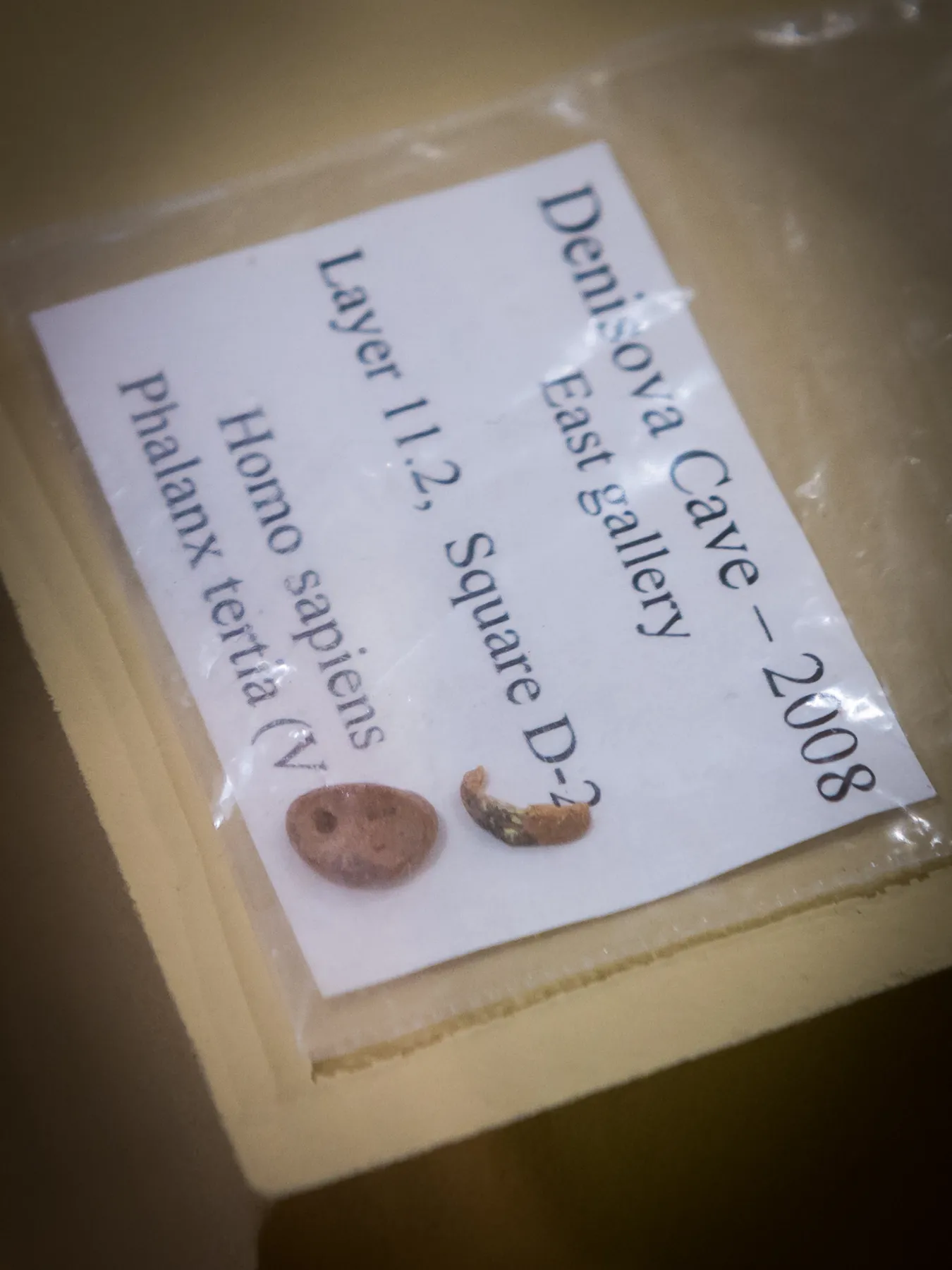
Two tiny bone fragments in a labelled plastic bag reading Denisova Cave 2008.
Denisova 3: a piece of a girl’s little finger, found in a Siberian cave in 2008. Its DNA was the first evidence that Denisovans existed.Thilo Parg, CC BY-SA 4.0, via Wikimedia Commons
A large, heavy-browed fossil skull seen from the front.
The Harbin skull from north-east China, at least 146,000 years old. In 2025 proteins from the bone and DNA from the tartar on its teeth showed it was Denisovan: the first face of the people you may carry.Fu et al. 2025, CC BY 4.0, via Wikimedia Commons
A cast of an ancient human skull on a museum shelf beside a map of Romania.
A cast of the Oase 2 skull, from the same Romanian cave as Oase 1, in the Smithsonian’s Hall of Human Origins.Ryan Somma, CC BY-SA 2.0, via Wikimedia Commons
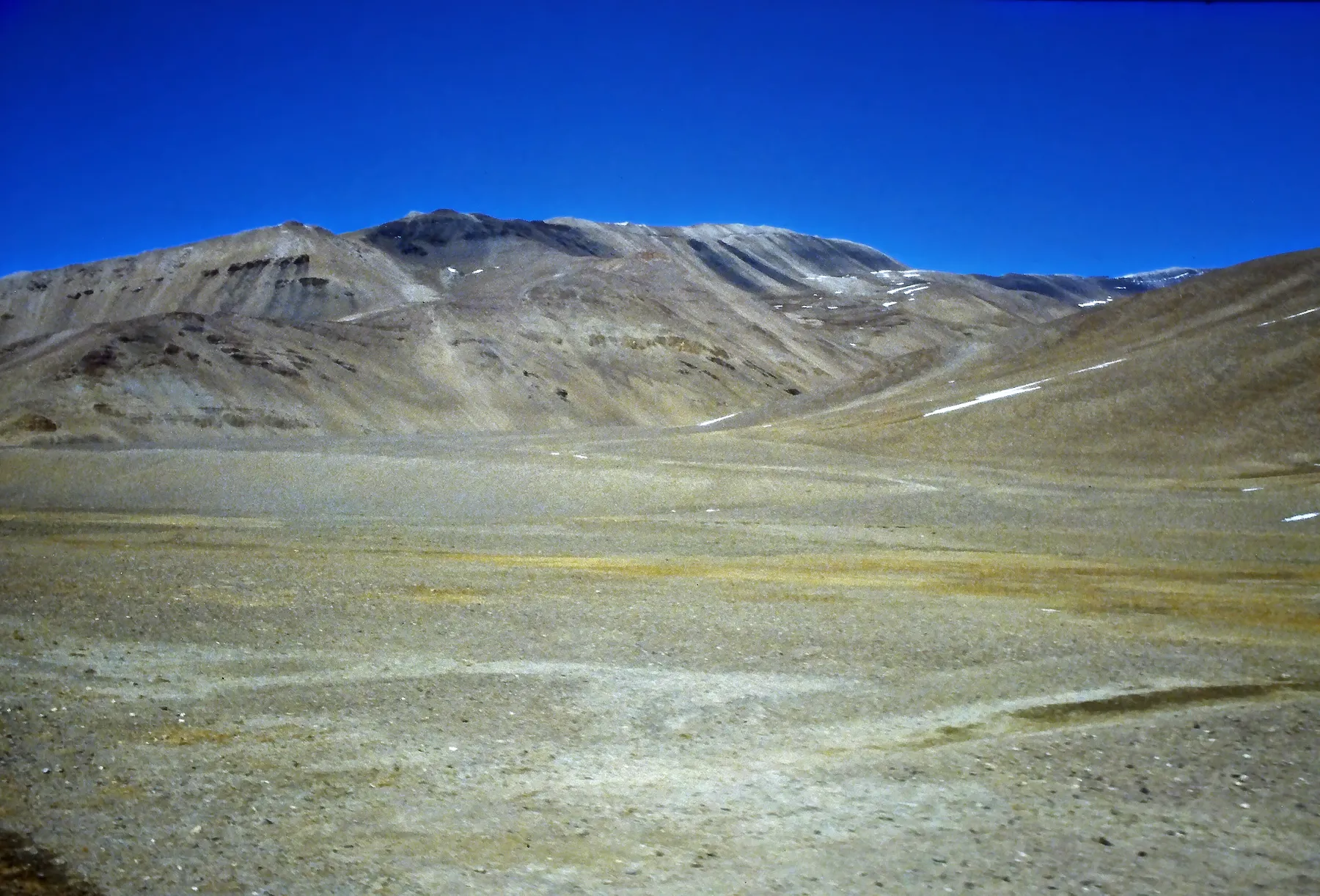
A bare high valley under bare mountains and blue sky.
The Tibetan Plateau, mostly above 4,000 metres. A version of the gene EPAS1 inherited from Denisovans helps Tibetans live here without the steep rise in red blood cells that altitude causes in most people.Jan Kranendonk, CC BY-SA 4.0, via Wikimedia Commons
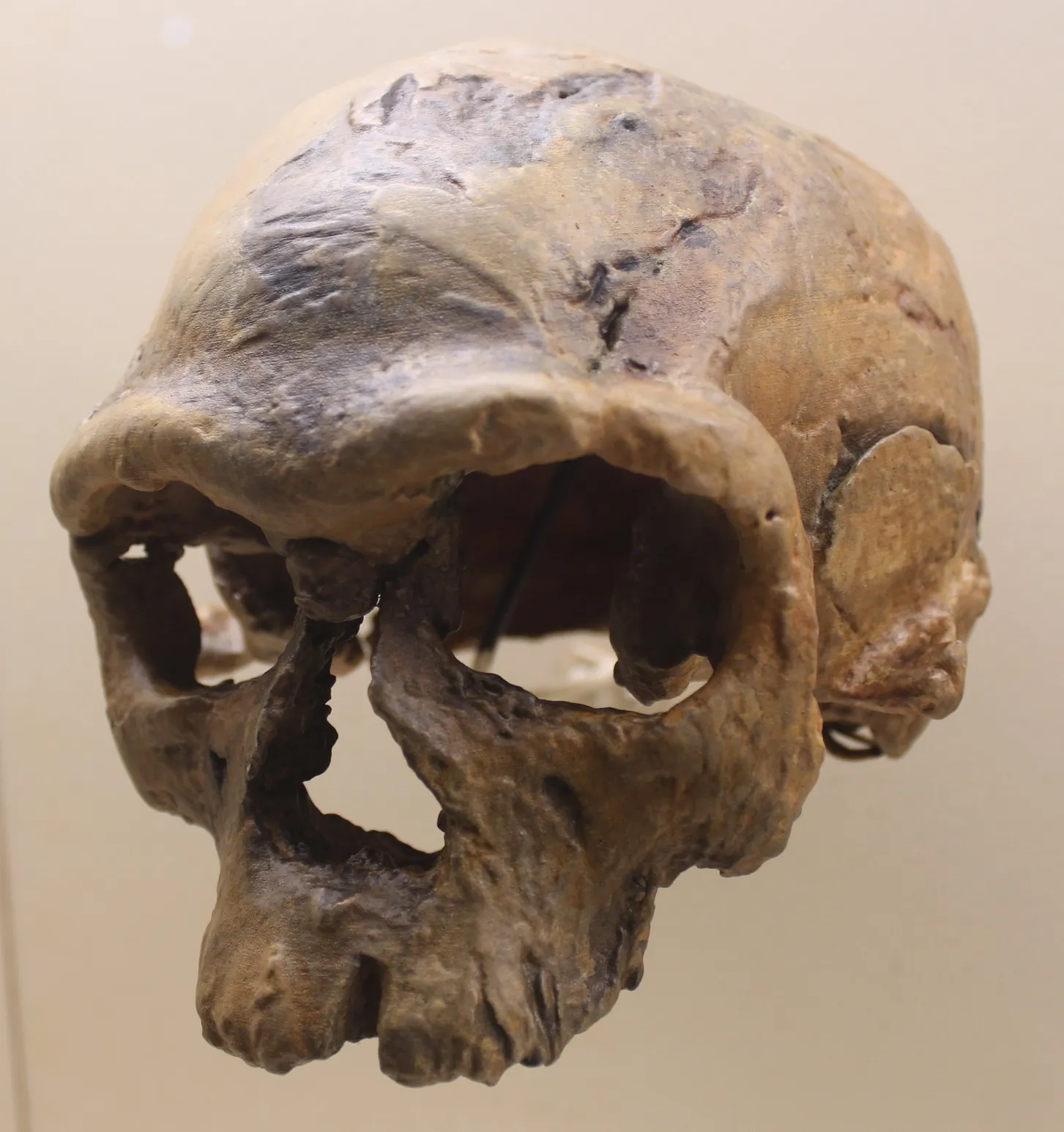
A cast of a fossil human skull with a long, low braincase.
Jebel Irhoud 1, Morocco, about 300,000 years old. A face much like ours and a brain already close to ours in size, though longer and lower in shape.Jonathan Chen, CC BY-SA 4.0, via Wikimedia Commons
A rocky green headland and a sandy bay on a sunny coast.
The coast at Pinnacle Point, near Mossel Bay, South Africa. In a cave in these cliffs people were eating shellfish about 164,000 years ago.Satdeep Gill, CC BY-SA 4.0, via Wikimedia Commons
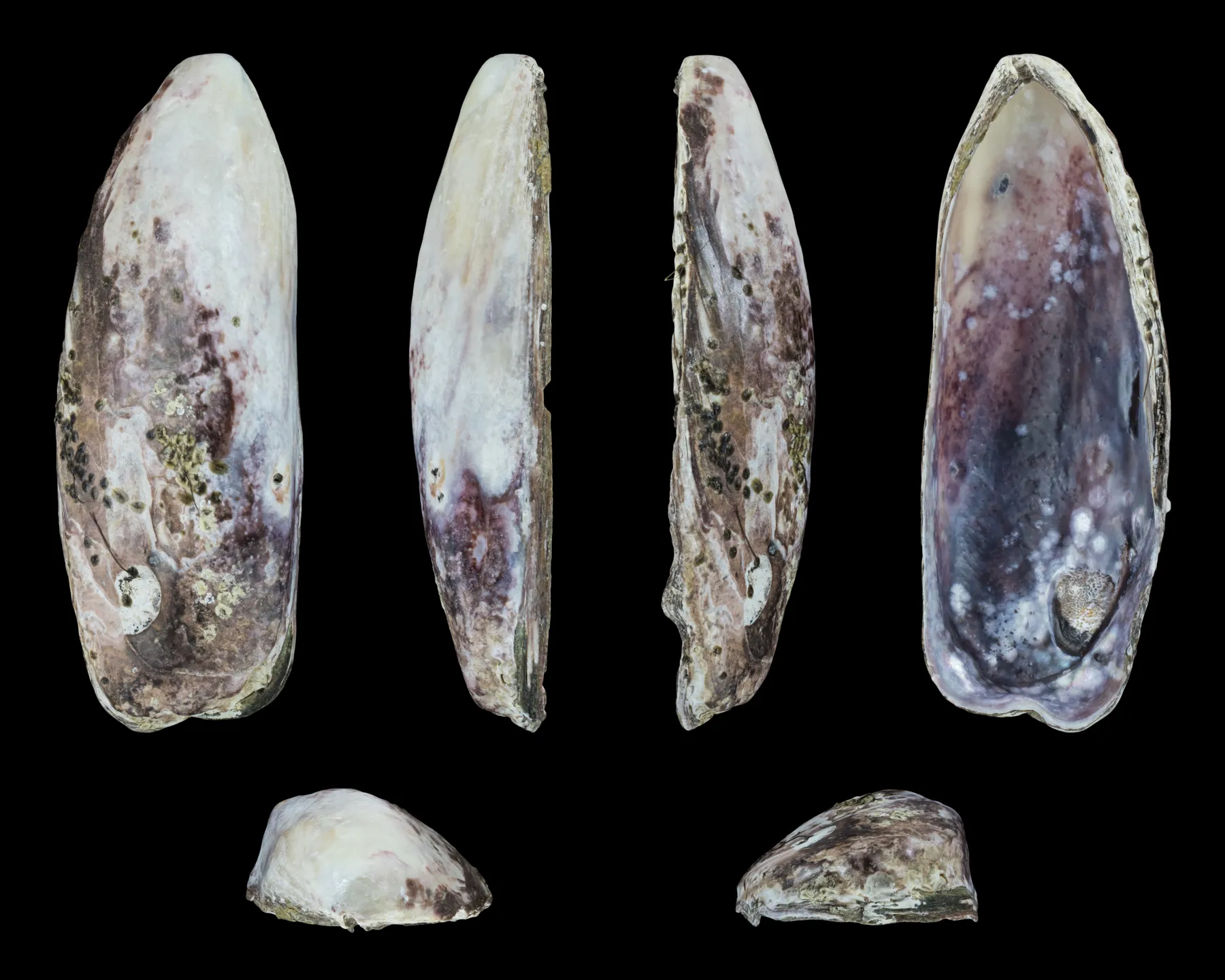
Four brown mussel shells, inside and outside, on black.
The brown mussel, Perna perna, one of the shellfish found at Pinnacle Point.H. Zell, CC BY-SA 3.0, via Wikimedia Commons
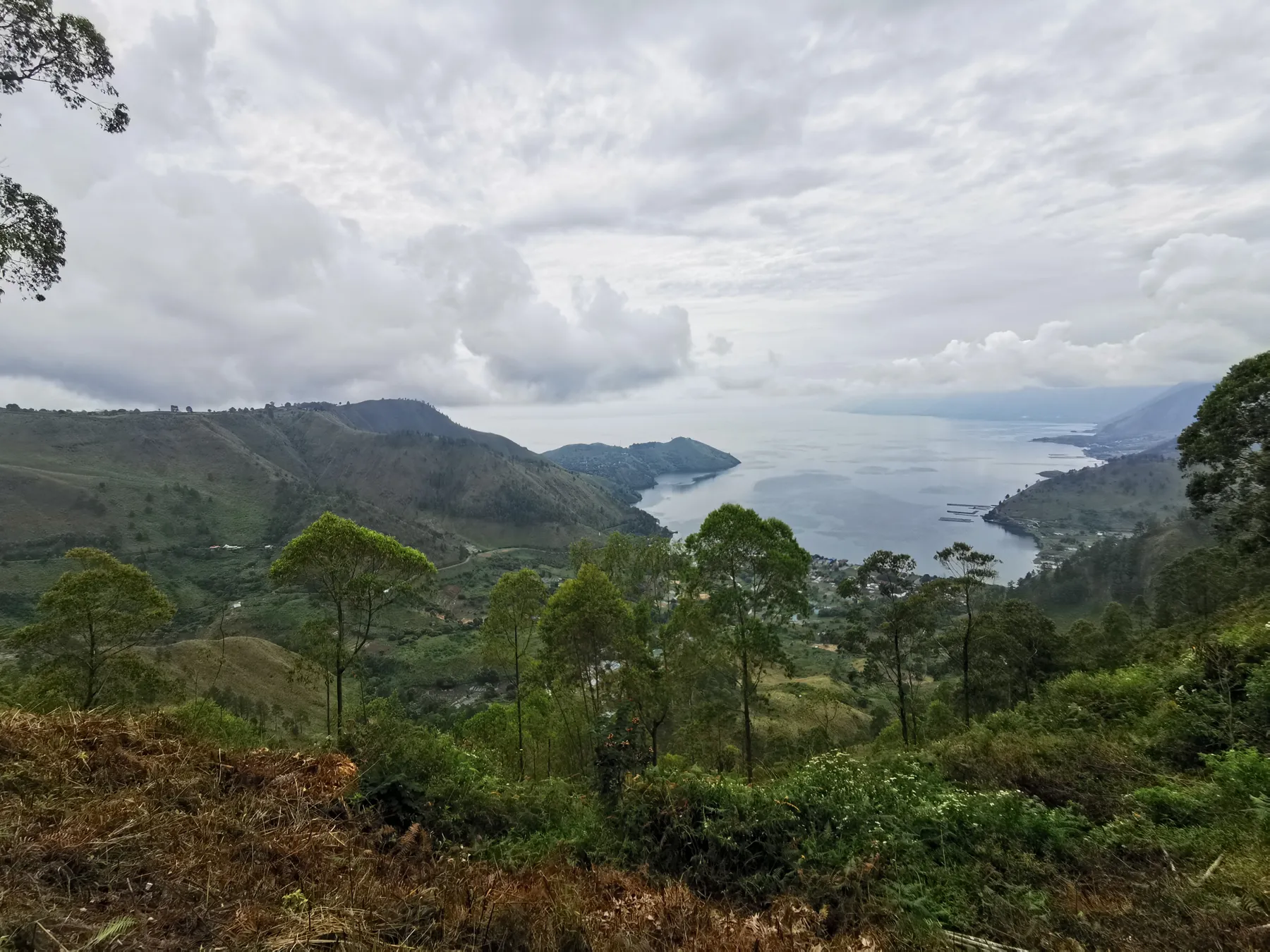
A wide lake between green mountains under cloud.
Lake Toba, Sumatra, fills the crater of the eruption of about 74,000 years ago.Herman Kurniawan, CC BY-SA 4.0, via Wikimedia Commons

How close did we come?

The one near-disaster that every genome outside Africa agrees on came after the exodus from Africa, when the ancestors of most people alive today had an effective size of a few thousand breeding adults. The crash to 1,280 is disputed. The squeeze after the split 1.5 million years ago rests on a single new model.

Our genomes keep the traces of many populations, including some to which no fossil can yet be assigned.

Sources and method

The river is drawn from published estimates of effective population size and of when populations split and mixed. Between those estimates the widths change smoothly; the sideways paths only keep streams apart. Each point of light stands for a line of ancestry, and the share of coloured points in a stream follows the published share of ancestry, so a 2% Neanderthal share appears as two points in a hundred.

The genome grid divides 3.1 billion letters into 2,000 pieces and colours them by the ranges in the sources, with the low end solid and the rest of the range faded. Pieces are placed at random: in a real genome, archaic stretches are scattered across every chromosome in short segments.

Photographs are from Wikimedia Commons under the licences credited beside them.

  • The 1000 Genomes Project Consortium (2015). A global reference for human genetic variation. Nature 526:68. doi.org/10.1038/nature15393
  • Hu W. and colleagues (2023). Genomic inference of a severe human bottleneck during the Early to Middle Pleistocene transition. Science 381:979. doi.org/10.1126/science.abq7487
  • Deng Y., Nielsen R., Song Y.S. (2024). A previously reported bottleneck in human ancestry 900 kya is likely a statistical artifact. Genetics 229:iyae192. doi.org/10.1093/genetics/iyae192
  • Cousins T., Durvasula A. (2025). Insufficient evidence for a severe bottleneck in humans during the Early to Middle Pleistocene transition. Molecular Biology and Evolution 42:msaf041. doi.org/10.1093/molbev/msaf041
  • Zhou S. and colleagues (2026). Severe bottleneck of ancient Homo populations: insights from computational modeling and relevant fossil evidence. Molecular Biology and Evolution 43:msag157. doi.org/10.1093/molbev/msag157
  • Cousins T., Scally A., Durbin R. (2025). A structured coalescent model reveals deep ancestral structure shared by all modern humans. Nature Genetics 57:856. doi.org/10.1038/s41588-025-02117-1
  • Li H., Durbin R. (2011). Inference of human population history from individual whole-genome sequences. Nature 475:493. doi.org/10.1038/nature10231
  • Gravel S. and colleagues (2011). Demographic history and rare allele sharing among human populations. PNAS 108:11983. doi.org/10.1073/pnas.1019276108
  • Hallett E.Y. and colleagues (2025). Major expansion in the human niche preceded out of Africa dispersal. Nature 644:115. doi.org/10.1038/s41586-025-09154-0
  • Iasi L.N.M. and colleagues (2024). Neanderthal ancestry through time. Science 386:eadq3010. doi.org/10.1126/science.adq3010
  • Prüfer K. and colleagues (2017). A high-coverage Neandertal genome from Vindija Cave in Croatia. Science 358:655. doi.org/10.1126/science.aao1887
  • Vernot B. and colleagues (2016). Excavating Neandertal and Denisovan DNA from the genomes of Melanesian individuals. Science 352:235. doi.org/10.1126/science.aad9416
  • Chen L. and colleagues (2020). Identifying and interpreting apparent Neanderthal ancestry in African individuals. Cell 180:677. doi.org/10.1016/j.cell.2020.01.012
  • Fu Q. and colleagues (2015). An early modern human from Romania with a recent Neanderthal ancestor. Nature 524:216. doi.org/10.1038/nature14558
  • Reich D. and colleagues (2010). Genetic history of an archaic hominin group from Denisova Cave in Siberia. Nature 468:1053. doi.org/10.1038/nature09710
  • Meyer M. and colleagues (2012). A high-coverage genome sequence from an archaic Denisovan individual. Science 338:222. doi.org/10.1126/science.1224344
  • Larena M. and colleagues (2021). Philippine Ayta possess the highest level of Denisovan ancestry in the world. Current Biology 31:4219. doi.org/10.1016/j.cub.2021.07.022
  • Jacobs G.S. and colleagues (2019). Multiple deeply divergent Denisovan ancestries in Papuans. Cell 177:1010. doi.org/10.1016/j.cell.2019.02.035
  • Huerta-Sánchez E. and colleagues (2014). Altitude adaptation in Tibetans caused by introgression of Denisovan-like DNA. Nature 512:194. doi.org/10.1038/nature13408
  • Fu Q. and colleagues (2025). Denisovan mitochondrial DNA from dental calculus of the >146,000-year-old Harbin cranium. Cell 188:3919. doi.org/10.1016/j.cell.2025.05.040
  • Tsutaya T. and colleagues (2025). A male Denisovan mandible from Pleistocene Taiwan. Science 388:176. doi.org/10.1126/science.ads3888
  • Rao H. and colleagues (2026). Ancient proteins identify various Denisovan remains from Southwest China. Nature. doi.org/10.1038/s41586-026-10976-9
  • Zhang Y., Biddanda A., Johnson S.A., O’Dushlaine C., Moorjani P. (2026). Recovering signatures of archaic hominin introgression using ancestral recombination graphs. Science 393:eaef8874. doi.org/10.1126/science.aef8874
  • Fu Q. and colleagues (2025). The proteome of the late Middle Pleistocene Harbin individual. Science. doi.org/10.1126/science.adu9677
  • Durvasula A., Sankararaman S. (2020). Recovering signals of ghost archaic introgression in African populations. Science Advances 6:eaax5097. doi.org/10.1126/sciadv.aax5097
  • Ragsdale A.P. and colleagues (2023). A weakly structured stem for human origins in Africa. Nature 617:755. doi.org/10.1038/s41586-023-06055-y
  • Li L. and colleagues (2024). Recurrent gene flow between Neanderthals and modern humans over the past 200,000 years. Science 385:eadi1768. doi.org/10.1126/science.adi1768
  • Posth C. and colleagues (2017). Deeply divergent archaic mitochondrial genome provides lower time boundary for African gene flow into Neanderthals. Nature Communications 8:16046. doi.org/10.1038/ncomms16046
  • Rogers A.R., Harris N.S., Achenbach A.A. (2020). Neanderthal-Denisovan ancestors interbred with a distantly related hominin. Science Advances 6:eaay5483. doi.org/10.1126/sciadv.aay5483
  • Prüfer K. and colleagues (2014). The complete genome sequence of a Neanderthal from the Altai Mountains. Nature 505:43. doi.org/10.1038/nature12886
  • Smith E.I. and colleagues (2018). Humans thrived in South Africa through the Toba eruption about 74,000 years ago. Nature 555:511. doi.org/10.1038/nature25967
  • Kappelman J. and colleagues (2024). Adaptive foraging behaviours in the Horn of Africa during Toba supereruption. Nature 628:365. doi.org/10.1038/s41586-024-07208-3
  • Marean C.W. and colleagues (2007). Early human use of marine resources and pigment in South Africa during the Middle Pleistocene. Nature 449:905. doi.org/10.1038/nature06204
  • Neubauer S., Hublin J.-J., Gunz P. (2018). The evolution of modern human brain shape. Science Advances 4:eaao5961. doi.org/10.1126/sciadv.aao5961
  • Karmin M. and colleagues (2015). A recent bottleneck of Y chromosome diversity coincides with a global change in culture. Genome Research 25:459. doi.org/10.1101/gr.186684.114
  • Zeng T.C., Aw A.J., Feldman M.W. (2018). Cultural hitchhiking and competition between patrilineal kin groups explain the post-Neolithic Y-chromosome bottleneck. Nature Communications 9:2077. doi.org/10.1038/s41467-018-04375-6
  • Guyon L. and colleagues (2024). Patrilineal segmentary systems provide a peaceful explanation for the post-Neolithic Y-chromosome bottleneck. Nature Communications 15:3243. doi.org/10.1038/s41467-024-47618-5