HACKNEY COACHES · LONDON · 1654–1832
How much for a mile?
For nearly two centuries the hired coach was London’s taxi — and every fare was printed before it was charged. Price four dated rides from the tables that governed them, then judge who the meter served: the passenger, the coachman, or the city.
Ten fares, four tables: an Exchange run of 1655, a lawyer’s shilling of 1662, two admeasured miles of 1715, a GPO circle of 1832. Every line dated, every line sourced — and a verdict on who the paper meter served.
The 1655 run: the Aldermen’s table
Start where the meter starts: paper. The Aldermen’s by-laws name the runs and price them — Exchange to Westminster, party rates, waiting by the hour. Three fares, January 1655: price each by the book.
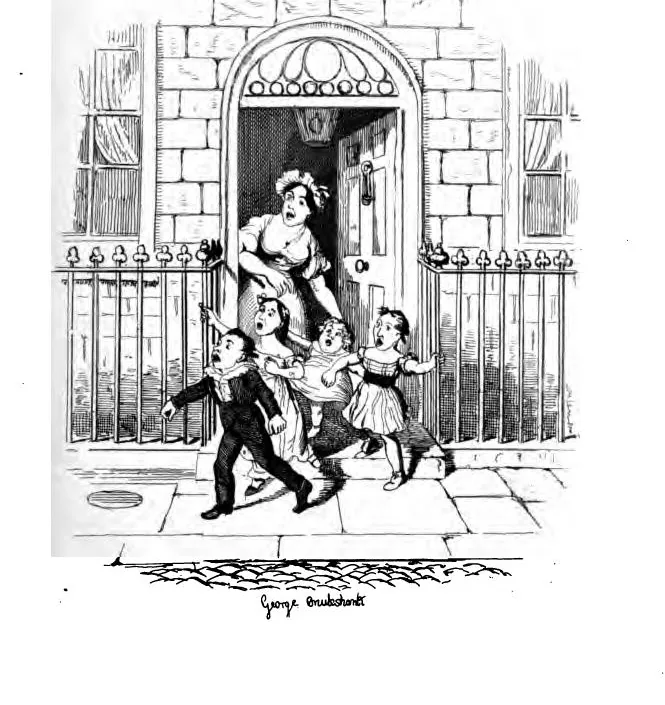
Figure receipt
Cruikshank · Sketches by Boz, 1894 reprint · public domain
Fare the 1655 run
Price each fare by the table — in order from the top. The tables judge every pricing, and a wrong fare sends you back with the line that decides it.
Prefer the plain list? All ten fares, with answers, are below, in Four runs, in brief.
The 1662 run: the lawyer’s shilling
Parliament’s turn — the hackney clauses ride inside a streets-and-paving Act, across London and the bills of mortality. Two fares, May 1662: a named run and three hours’ hire.
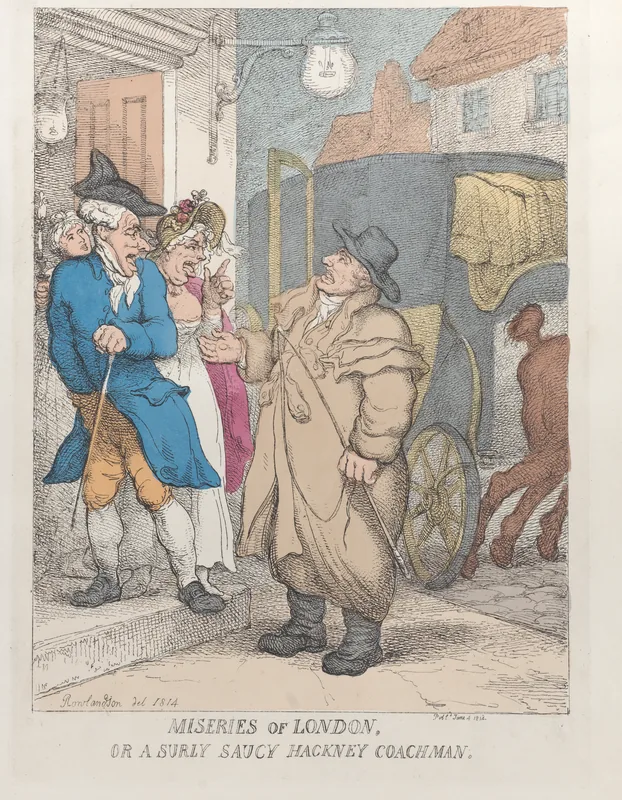
Figure receipt
Rowlandson · Met 59.533.1575 · public domain
Fare the 1662 run
Price each fare by the table — in order from the top. The tables judge every pricing, and a wrong fare sends you back with the line that decides it.
Prefer the plain list? All ten fares, with answers, are below, in Four runs, in brief.
The 1715 run: admeasured at the Exchange
The commissioners measure the ground: every unlisted run priced by distance from a board hung at the Exchange — lost long since — and the chairman pays the coach rate for two-thirds of the distance. Two fares, June 1715: two miles and a chair.
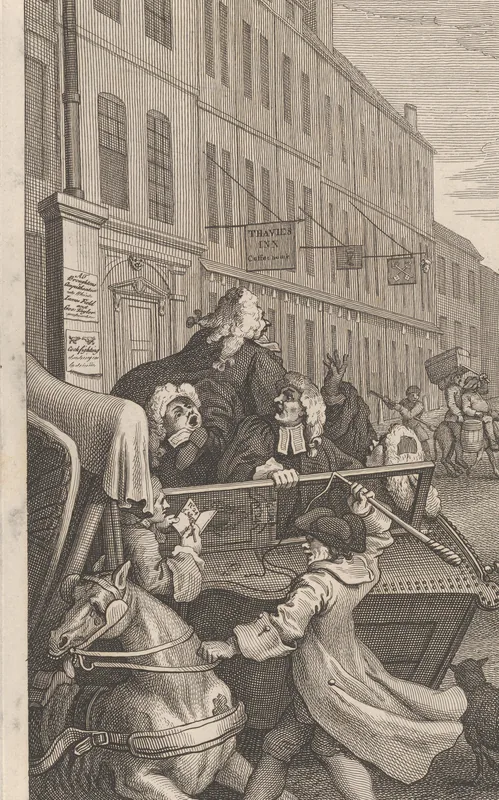
Figure receipt
Hogarth, 1751 · Met · public domain
Fare the 1715 run
Price each fare by the table — in order from the top. The tables judge every pricing, and a wrong fare sends you back with the line that decides it.
Prefer the plain list? All ten fares, with answers, are below, in Four runs, in brief.
The 1832 run: the GPO circle
The last paper meter: one three-mile circle round the General Post Office, a back-fare after dark — and stamped schedules. Three fares, 1832: two horses, one horse, and a lawful back-fare.
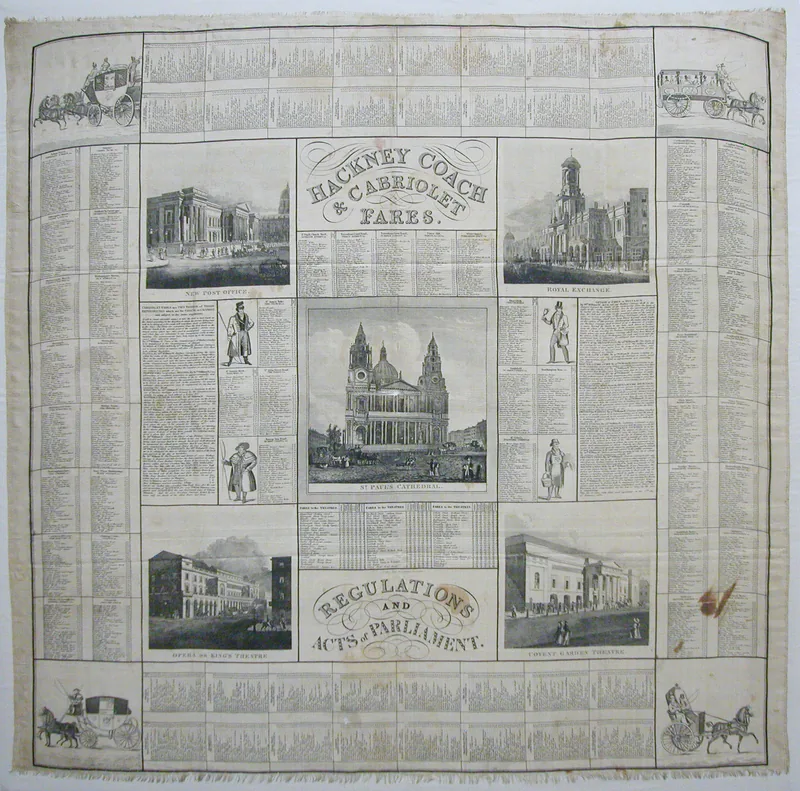
Figure receipt
J. Bishop sculp., London, 1832 · AIC 18432 · public domain
Fare the 1832 run
Price each fare by the table — in order from the top. The tables judge every pricing, and a wrong fare sends you back with the line that decides it.
Prefer the plain list? All ten fares, with answers, are below, in Four runs, in brief.
Two rails, one meter
The regulation spine runs from Baily’s rank to the Stamp Office; the fare lineage runs from the by-laws to the schedules. Eight dated stops each — read them against your pricings.
Fares priced
Every fare priced, in run order.
E1 — 2s → Old Exchange→Westminster, party above three — Aldermen’s by-laws, approved 19 Dec 1654
1655 · E1
E2 — 12d → First hour free, 12d the second — Aldermen’s by-laws
1655 · E2
E3 — Report him → 10s the first offence, 20s the second, dismissal the third — Aldermen’s by-laws
1655 · E3
L1 — 18d → Inns of Court→Tower 18d — 14 Cha. 2 c. 2, s. VII
1662 · L1
L2 — 3s6d → 18d + 12d + 12d — 14 Cha. 2 c. 2, s. VII
1662 · L2
M1 — 1s6d → Two miles, admeasured — “not exceeding two Miles”: 1s6d — 9 Anne c. 23, s. VII
1715 · M1
M2 — 1s → A shilling is twelve pence — the chair pays the coach rate for two-thirds of the distance: 9 Anne c. 23, s. VIII
1715 · M2
M2 — 12d → Twelve pence — the coach rate for two-thirds of two miles: 9 Anne c. 23, s. VIII
1715 · M2
G1 — 2s → Two miles, two horses: 2s — 1 & 2 Wm. 4 c. 22, Sched. B
1832 · G1
G2 — 1s4d → Two-thirds of 2s: 1s4d — 1 & 2 Wm. 4 c. 22
1832 · G2
G3 — Pay the back-fare → Night back-fare beyond three miles of the GPO — 1 & 2 Wm. 4 c. 22
1832 · G3
The regulation spine
Eight dated stops from Baily’s rank to the Stamp Office.
1634: Baily’s four coaches stand at the Maypole
1 April 1634 · Garrard to Wentworth, Strafforde Letters source
1635: the King restrains the multitude of coaches
1635 · Garrard's letter, Jan 1635 (Strafforde Letters) source
1654: the Protector caps the trade — 200 men, 300 coaches, 600 horses
1654 · ordinance (BHO interregnum) source
1662: a streets Act carries the hackney clauses — 400 coaches, a mark of distinction
1662 · 14 Cha. 2 c. 2 · legislation.gov.uk source
1683: the City re-freezes 1662 — 400 coaches, same rates
1683 · Common Council Act · EarlyPrint (City only) source
1694: 700 coaches, marks now on both sides, 175 on Sundays
1694 · 5&6 Will & Mar · Ruffhead abstract source
1710: 800 coaches, and distances hung at the Exchange — the board is lost
1710 · 9 Anne c. 23 · Ruffhead vol. 4 source
1831: no cap, stamped schedules, the GPO circle
1831 · 1 & 2 Wm. 4 c. 22 · legislation.gov.uk source
The fare lineage
Eight dated stops from the by-laws to the schedules.
1655: the by-laws name the runs — Exchange to Westminster 2s
1654 · EarlyPrint A88463 source
1662: the shilling schedule — Tower 18d, hours 18d then 12d
1662 · 14 Cha. 2 c. 2, s. VII source
1683: the City freezes 1662
1683 · Common Council Act · EarlyPrint (City only) source
1694: rates set down, pages missing
1694 · 5&6 Will & Mar · appendix gap (honest unknown) source
1710: distance bands and the chair rule
1710 · 9 Anne c. 23, ss. VII–VIII source
1767: the day rate rises — 12s6d the day
1767 · 7 Geo. 3 c. 44 · via Burn’s Justice source
1786: fifty thousand fares in print
1786 · Bowles’s directory · IA source
1831: the stamped schedules
1831 · 1 & 2 Wm. 4 c. 22, Sched. B/C source
Your rides, your verdict
Ten fares priced. One question left: who did the paper meter serve — the passenger, the coachman, or the city?
Who did the paper meter serve?
Ten fares priced across four tables. Give the verdict the tables support.
Refused. The passenger got capped runs and printed tables — but in 1832 the driver chooses time or distance, and the extras pile on: waiting, back-fares, party rates. The meter measured the passenger more than it served them.
Refused. The coachman got his hire secured — but every table polices him: report him in 1655 and he faces dismissal at the third offence; his mark rides the coach from 1662, on both sides from 1694. The meter watched the coachman more than it paid him.
Correct. The £5 rents paved the streets in 1662; the Stamp Office ran the schedules in 1831; Sunday lists and lost property kept the order. The meter served the city’s order first — passengers and coachmen rode inside it.
Four runs, in brief
The Exchange run of 1655, the lawyer’s shilling of 1662, the two admeasured miles of 1715, the GPO circle of 1832 — every fare worked and answered.
| Fare | Pricing | What the table says |
|---|---|---|
| E1 | 18d (had you picked this) | 18d is the run for three or fewer — the fourth man raises it to 2s, by the by-laws. |
| E1 | 2s | Old Exchange→Westminster, party above three — Aldermen’s by-laws, approved 19 Dec 1654 |
| E1 | 2s6d (had you picked this) | 2s6d is the Westminster→Whitechapel rate — the wrong destination. Westminster from the Exchange is 2s for your party. |
| E2 | 2s (had you picked this) | 2s charges both hours — the by-laws give the first hour free. |
| E2 | 6d (had you picked this) | 6d halves the rated hour — waiting after the first hour is 12d. |
| E2 | 12d | First hour free, 12d the second — Aldermen’s by-laws |
| E3 | Report him | 10s the first offence, 20s the second, dismissal the third — Aldermen’s by-laws |
| E3 | Pay the 3s (had you picked this) | Paying feeds the overcharge — the by-laws fine him 10s for the first offence. |
| E3 | Haggle to 2s6d (had you picked this) | 2s6d is still over the 2s table — the lawful move is to report him. |
| Fare | Pricing | What the table says |
|---|---|---|
| L1 | 12d (had you picked this) | 12d ends at the Exchange — the Tower costs 18d. |
| L1 | 2s (had you picked this) | 2s overpays the table — the Tower from the Inns is 18d. |
| L1 | 18d | Inns of Court→Tower 18d — 14 Cha. 2 c. 2, s. VII |
| L2 | 4s6d (had you picked this) | 4s6d prices every hour at the first-hour rate — only the first costs 18d. |
| L2 | 3s6d | 18d + 12d + 12d — 14 Cha. 2 c. 2, s. VII |
| L2 | 3s (had you picked this) | 3s prices every hour at 12d — the first hour costs 18d. |
| Fare | Pricing | What the table says |
|---|---|---|
| M1 | 1s6d | Two miles, admeasured — “not exceeding two Miles”: 1s6d — 9 Anne c. 23, s. VII |
| M1 | 1s (had you picked this) | 1s is no band in the Act — to a mile and four furlongs the most is 12d; above it, to two miles, 1s6d. |
| M1 | 2s (had you picked this) | 2s is no band either — two miles, admeasured, price 1s6d. |
| M2 | 1s6d (had you picked this) | 1s6d is the coach rate — the chair pays the coach rate for two-thirds of the distance. |
| M2 | 1s | A shilling is twelve pence — the chair pays the coach rate for two-thirds of the distance: 9 Anne c. 23, s. VIII |
| M2 | 12d | Twelve pence — the coach rate for two-thirds of two miles: 9 Anne c. 23, s. VIII |
| Fare | Pricing | What the table says |
|---|---|---|
| G1 | 1s6d (had you picked this) | 1s6d is 1715’s price for two miles — the 1832 schedule makes it 2s. |
| G1 | 2s | Two miles, two horses: 2s — 1 & 2 Wm. 4 c. 22, Sched. B |
| G1 | 2s6d (had you picked this) | 2s6d overpays the schedule — two miles by two horses is 2s. |
| G2 | 1s4d | Two-thirds of 2s: 1s4d — 1 & 2 Wm. 4 c. 22 |
| G2 | 2s (had you picked this) | 2s is the two-horse fare — one horse pays two-thirds: 1s4d. |
| G2 | 1s (had you picked this) | 1s halves the fare — the Act allows two-thirds: 1s4d. |
| G3 | Refuse — no back-fares, ever (had you picked this) | By day you’d want four miles beyond the Limits — but after eight, past the three-mile circle, the back-fare is lawful. |
| G3 | Refuse — four miles or nothing (had you picked this) | There is no four-mile circle — one three-mile circle, day and night; four miles is the DAY back-fare threshold beyond the Limits. |
| G3 | Pay the back-fare | Night back-fare beyond three miles of the GPO — 1 & 2 Wm. 4 c. 22 |
The coaches
Ranks, rows, and regulations
Five beats from the first rank to the last paper meter — the people the tables priced, policed, and occasionally failed.
The Maypole rank, 1634
On 1 April 1634 Captain Baily parks four hackney coaches with liveried men at the Maypole in the Strand — and no table prices them yet. A year later the King restrains the multitude of coaches; twenty years on, the by-laws price them.
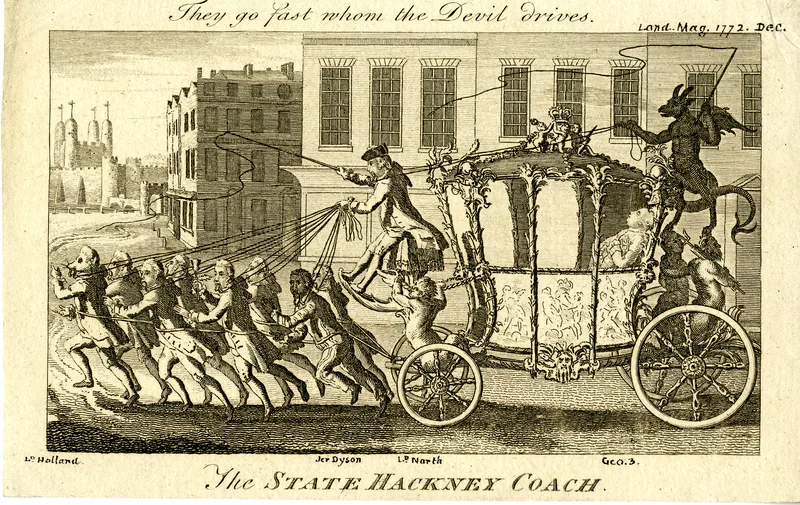
Before the meter: a state coach in allegory — the hireling’s grander cousin, priced by no table. Figure receipt
London Magazine, December 1772 · satirical print · public domain
The chairmen’s pole
The sedan chair patents in 1634 and crowds the flagstones; eighty years on, Gay still warns the walker against the chairman’s assuming stride — and laughs when the drunken chairman lands his passenger in the kennel.
Eighteen-pence and his number
In Ward’s London Spy a coachman demands eighteen-pence and seizes a scarf in pledge — and the passenger takes his number: coaches carry a mark of distinction from 1662, placed on both sides from 1694. Burn’s Justice caps the 1771 licences at a thousand; by 1836 Boz jokes that a cabman takes eightpence where a coachman took a shilling.
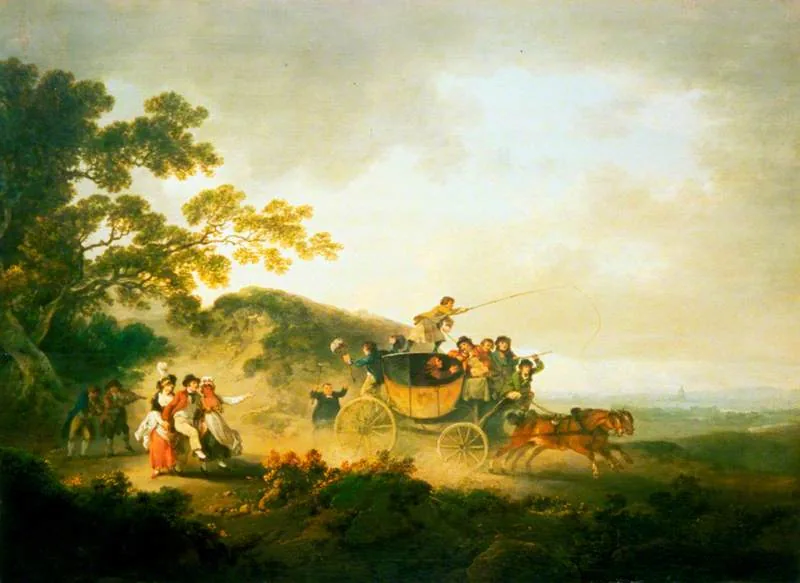
Passengers behaving badly: Ibbetson’s sailors in a coach — take the driver’s number. Figure receipt
Ibbetson · via Wikimedia Commons · public domain
The town by coach
Pepys rides through the sixties — a coach after the Fire, a regular coachman by 1667, expense forcing a coach of his own; Evelyn sits regulating the coaches in 1662; and Steele takes three lads rambling in a hackney-coach to show them the town.
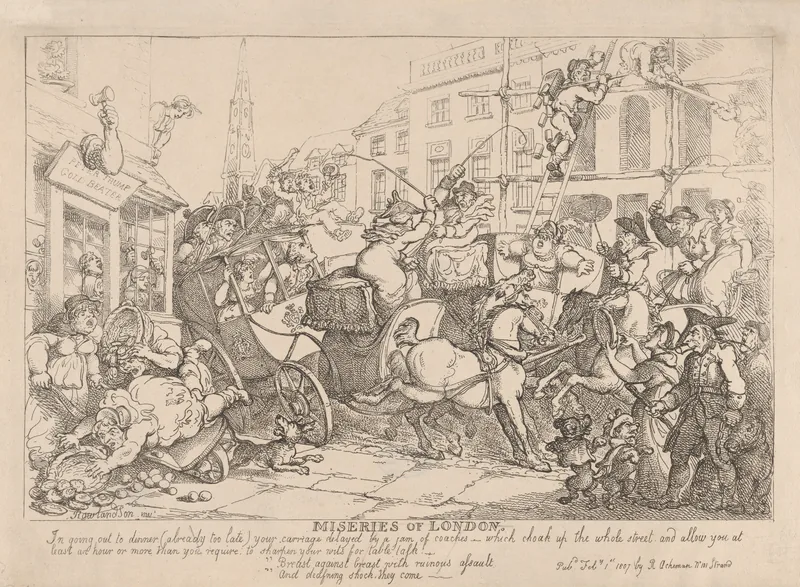
The town by coach: a jam of carriages — the traffic the diarists rode in. Figure receipt
Rowlandson · Met 56.567.14 · public domain
The omnibus ending
On 4 July 1829 Shillibeer’s two omnibuses run Yorkshire Stingo to Bank — twenty-two inside, a shilling through, sixpence halfway. In 1865 the Knowledge asks cabmen to carry London in their heads. The paper meter runs on into the cab age; the tables’ habit stays: every ride priced before it runs.
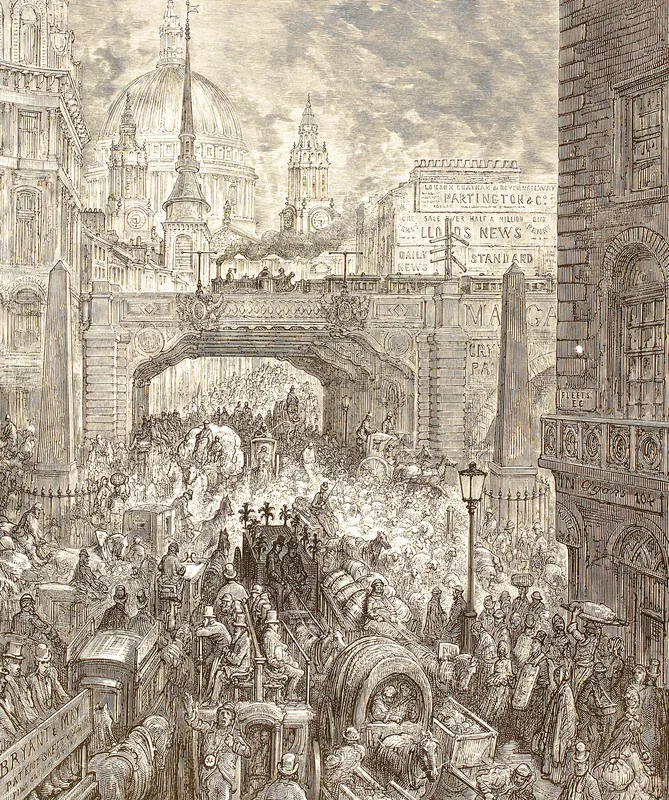
The omnibus ending: Doré’s Ludgate Hill, 1872 — the vehicles that swamped the single fare. Figure receipt
Doré · BnF/Gallica via Wikimedia Commons · public domain
The papers
Two passages, one meter
Two passages carry the whole trade: the poet who laughed at the chairman, and the reporter who priced the joke — eightpence against a shilling.
Gay’s chairman first, in 1716 — then Boz on the stands, in 1836.
- “The drunken Chairman in the Kennel spurns, / The Glasses shatters, and his Charge overturns.”
- “Or why should people be allowed to ride quickly for eightpence a mile, after Parliament had come to the solemn decision that they should pay a shilling a mile for riding slowly?”
1716: Gay, Trivia, Book II. 1836: Dickens, Sketches by Boz, “Hackney-Coach Stands”.
The tables behind both passages are linked below.
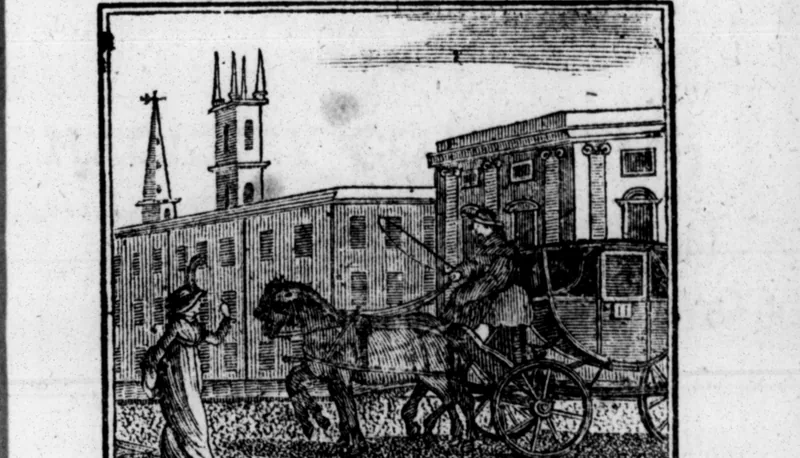
Figure receipt
Cheap Repository, 1796 · Internet Archive scan · public domain
Sources
Sources and receipts
Every table read directly; every quote from the edition cited. Open any of them.
Statutes and tables
Diaries and print
- Strafforde Letters, 1739 (IA)
- Pepys, 10 Sept 1666 — coaches after the Fire
- Pepys, 21 Apr 1667 — his regular coachman
- Pepys, 11 May 1667 — cost and dishonour
- Pepys, 1 June 1667 — expense forces ownership
- Evelyn’s Diary, Vol. 1 (Gutenberg #41218)
- Ward, London Spy, 1703 (IA)
- Gay, Trivia, 1716 (IA)
- Tatler, Vol. 1 — No. 30 (Gutenberg #13645)
- Sketches by Boz (Gutenberg #882)
Streets and trade
Set in open-licensed fonts, served locally.
Keep riding
Celia Fiennes rode England through the age of the hireling coach — read her journeys.
Answers, dated
Why price the rides before judging?
Because the tables are the evidence: every verdict choice below is tested against a fare you priced yourself. The page shows its working — check any fare against its linked table.
Did Parliament pass a hackney-carriage law in 1662?
No standalone Act of that kind. The hackney clauses rode inside a streets-and-paving Act — 14 Charles II — which also raised the £5 rents that paved the streets. The page calls it the 1662 clauses, never the Act.
Was the hackney coach named for Hackney?
No dated source says so. The village story circulates without one, so rides are dated instead of words: the first fact here is Baily’s rank, 1634.
What happened to the coaches?
Shillibeer’s omnibus — 4 July 1829, Yorkshire Stingo to Bank — began the end of the single fare; in 1865 the Knowledge asked cabmen to carry London in their heads. What happened next is another meter’s story.