Harald Sigurdson, called Hardrada, 1015 - 1066
Nineteen days before Hastings, a Viking king invaded England. He died in a Yorkshire field.
He was fifteen when he fled wounded from the battlefield at Stiklestad. Nearly two decades followed as a mercenary in Kyiv and in the Byzantine emperor's guard, with battles in Sicily and Bulgaria, an empress's prison and an escape over the chain slung across the strait at Constantinople. He became king of Norway. In 1066 he sailed for England. Follow the whole route on the map, chapter by chapter, and see what a Byzantine writer confirms of the saga's boldest claims.
independently confirmedsaga only, or route assumed
From Stiklestad to Kyiv, Constantinople and England
Harald Sigurdson's saga, written by Snorri Sturluson around 1230, is a prose narrative built around court verses composed by Harald's own poets, in his lifetime, rather than a travel diary. The map follows the saga's own order of events, chapter by chapter.
A solid line runs through a stage that the saga or another source from his own time confirms independently. A dashed line marks a stretch only the saga tells, or that no source describes step by step, so the route there is a guess. Distances are measured through those places, so the real journeys were at least that long.
.jpg)
Stage I
Stiklestad, and the flight east
1015 – 1031 · from the battlefield to exile
- In the saga
- “Harald Escapes from the Battle of Stiklestad”
- On the map
- 770 kmat least, through the places named
- One detail
- wounded, he was hidden by a peasant in the forest until he healed
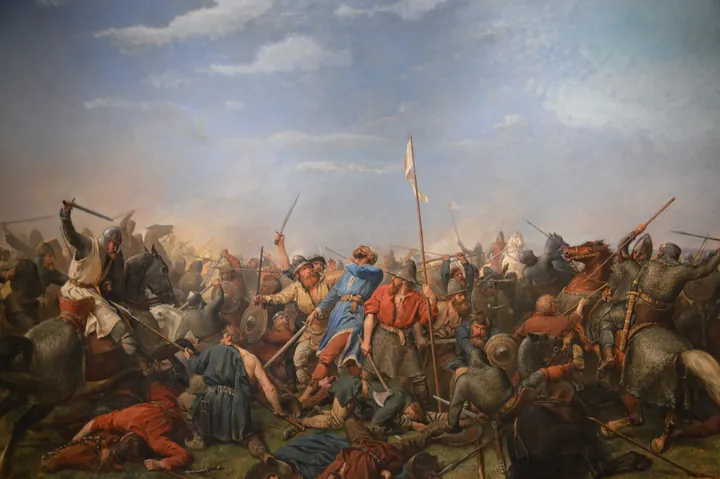
Harald was fifteen in the summer of 1030, when his half-brother, King Olaf II, fell at Stiklestad, in a battle against his own rebellious subjects. Harald fought at his side and was wounded. Ragnvald Brusason carried him from the field, and the night after the battle took him to a peasant who lived far off, in the forest.
The peasant took him in and kept him hidden until his wounds healed. The peasant's son then went with him east, over the mountain ridge, keeping off the main road, without knowing who his companion was. On the way his wounds bled in the saddle, while below, on the plain, peasants were killing the wounded stragglers, men of their rightful king. He would later tell the story himself, in verse.
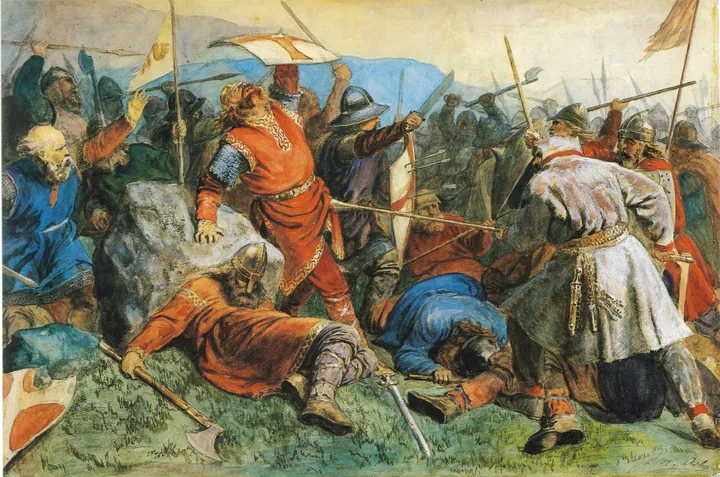

He crossed Jamtaland and Helsingjaland and reached Svithjod, Sweden, where he found Ragnvald Brusason and many other of King Olaf's men, fugitives from Stiklestad like himself. They stayed there until winter was over. The poem that tells of the flight already calls him, at fifteen, “Bulgaria's conqueror”: the poet Thiodolf wrote it years later, once Harald's Byzantine fame was known, and folded it back into the scene of the flight. The story of Bulgaria belongs to someone else, not to this saga.
What the saga says
“At Haug the fire-sparks from his shield / Flew round the king's head on the field, / As blow for blow, for Olaf's sake, / His sword and shield would give and take. / Bulgaria's conqueror, I ween, / Had scarcely fifteen winters seen, / When from his murdered brother's side / His unhelmed head he had to hide.”
Stage II
Kyiv and Novgorod, in Yaroslav's pay
1031 – 1034 · commander of the defence at a prince's court
- In the saga
- “Harald's Journey to Constantinople”
- On the map
- 1,860 kmat least, through the places named
- One detail
- every ounce of gold he later sent from Byzantium was kept safe here, at Novgorod
In the spring of 1031, Harald and Ragnvald took ships and sailed east to Prince Yaroslav, named Jarisleif in the saga, at Novgorod. The prince received them warmly and made Harald and Ellif, the son of Earl Ragnvald, commanders of the country's defence troops.
Under their command, the verses of the time say, the troops drove back “the eastern Vindland men” and subdued neighbouring peoples who resisted. The saga does not make clear exactly who these peoples were: the names come from a court poem, not a chronicle.
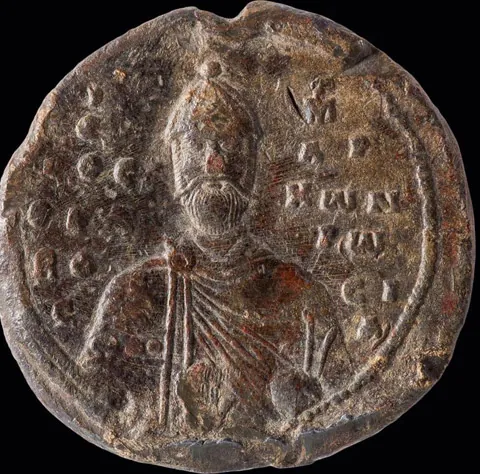

The saga says only this of the following years: “Harald remained several years in Russia, and travelled far and wide in the Eastern land.” It gives no year for his departure to Constantinople. Historians usually place that around 1034, but the figure comes from later calculation, not from the text.
What the saga says
“The king's sharp sword lies clean and bright, / Prepared in foreign lands to fight: / Our ravens croak to have their fill, / The wolf howls from the distant hill. / Our brave king is to Russia gone, -- / Braver than he on earth there's none; / His sharp sword will carve many feast / To wolf and raven in the East.”
Stage III
South to Constantinople
1034 · toward a city seen glowing from the sea
- In the saga
- “Of Harald”
- On the map
- 1,450 kmat least, through the places named
- One detail
- he saw the city from shipboard before he ever set foot in it
The saga does not describe the road from Novgorod to Constantinople: it says only that Harald “began his expedition out to Greece, and had a great suite of men with him.” The likeliest route followed the well-documented trade road of that century, down the Dnieper, over its rapids, then along the west coast of the Black Sea to the strait. The dashed line on the map follows that known road, not the saga, which says nothing about it.
The ship approached the city from the sea. The poet Bolverk, who was there, wrote of the metal glow of its roofs and towers, seen from the bow, among the painted sails in the harbour.
At Constantinople, Harald presented himself to the Empress Zoe and went into her pay. The empire was then ruled by Zoe and Michael, called “Catalactus” in the saga, Michael IV the Paphlagonian. That same autumn Harald sailed out on the galleys manned with troops for the Aegean. Before long every Varangian in the city had gathered around him, and that is how he became their commander.
What the saga says
“Before the cold sea-curling blast / The cutter from the land flew past, / Her black yards swinging to and fro, / Her shield-hung gunwale dipping low. / The king saw glancing o'er the bow / Constantinople's metal glow / From tower and roof, and painted sails / Gliding past towns and wooded vales.”
Stage IV
The emperor's guard: Sicily and Bulgaria
1034 – 1041 · commander of the Varangian Guard
- In the saga
- “Harald's Expedition in the Land of the Saracens (Serkland)”; “Battle in Sicily”
- On the map
- 6,590 kmat least, through the places named
- One detail
- eighteen regular battles, a court poem says
The Varangian Guard at Constantinople answered to a Greek commander the saga calls “Gyrger,” a relation of the empress: historians usually identify him with the general George Maniakes. Before their first campaign together, Harald and Gyrger quarrelled over the best camping ground; the dispute was settled by drawing lots, and Harald cheated, snatching the winning lot and throwing it into the sea, then pointing out that the one left in the box carried Gyrger's own mark. It is how the saga opens its portrait of a man who got his way by cunning as readily as by the sword.
Through the summer campaign, the troops noticed that whenever Harald commanded they won, while Gyrger “could do nothing.” Harald then took his men west into Africa, which the Varangians called Serkland, where the saga says he took eighty castles. He moved on to Sicily, where he besieged a castle he could not break by direct assault: he had small birds trapped, birds that nested under the castle's thatched roofs, tied burning wood-shavings to their backs, and let them fly home. The roofs caught fire, house by house, until the garrison begged for mercy.

At another castle he dug a tunnel from a streambed hidden from view, coming up through the floor of a hall where the defenders sat eating. At a third, his men played at unarmed games on the plain outside, day after day, until the garrison's guard slackened, then drew swords hidden under their cloaks and stormed the gate. In all these campaigns, the saga says, Harald fought eighteen regular battles.
He returned to Constantinople but stayed only briefly before setting out for Jerusalem. There, the saga says, every town and stronghold surrendered to him without a fight; he bathed in the Jordan, as pilgrims did, and gave rich gifts at the Holy Sepulchre. No Byzantine or Arab source confirms this journey, and Jerusalem in those years lay under Fatimid, not Byzantine, rule, reason enough to treat the episode as a story told at a northern court rather than a real conquest.
What the saga says
“He went, the warrior bold and brave, / Jerusalem, the holy grave, / And the interior of the land, / To bring under the Greeks' command; / And by the terror of his name / Under his power the country came, / Nor needed wasting fire and sword / To yield obediance to his word.”
Stage V
Prisoner of an empress
1041 – 1042 · accused, imprisoned, escaped
- In the saga
- “Harald Put in Prison”; “King Olaf's Miracle and Blinding the Greek Emperor”
- On the map
- 1,450 kmat least, through the places named
- One detail
- one galley split apart right on the chain; Harald's crossed it by shifting the crew's weight fore and aft
When Harald heard that his brother's son Magnus had become king of both Norway and Denmark, he wished to go home and gave up his Greek command. The Empress Zoe grew angry and accused him of misappropriating the wealth gathered on campaign. The saga adds a love story too: Harald had asked for Maria, Zoe's niece, and been refused; among the Varangians it was even rumoured that Zoe wanted Harald for herself, and that this was the real reason for her anger at his leaving. Constantine Monomachus now ruled beside her as emperor. On his order Harald was arrested and taken to prison.
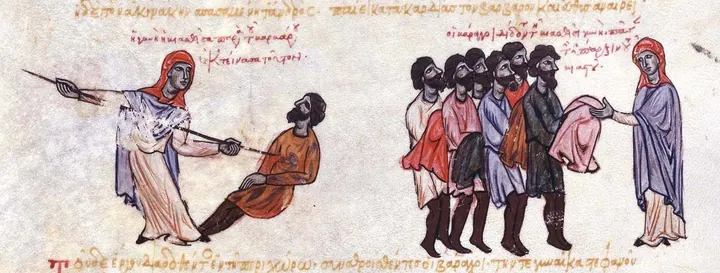
The saga tells that on the way to the prison Saint Olaf appeared to Harald and promised his help. The following night a noblewoman, once cured of a sickness by that same Saint Olaf, let down a rope and drew Harald and his two companions, Haldor and Ulf, up out of the cell. Once free, Harald and his men armed themselves, went to where the emperor slept, took him prisoner, and put out both his eyes. The poets who wrote of it credit the act to Harald himself, not to some unnamed general or count.
That same night, Harald and his men went to the house where Maria slept and carried her off by force, then made for the Varangian galleys. They reached the place where an iron chain was drawn across the strait to stop ships. Harald ordered the rowers to pull hard and everyone else to run to the stern of each galley. The ships rode up onto the chain; when they could go no farther, Harald ordered everyone forward to the bow. His galley rolled over the chain and through; the other, left stuck fast on it, split in two. Before he left the coast, Harald sent Maria back to Constantinople, with a message for her aunt the empress: to see how little power she had ever had over him.
What the saga says
“Of glowing gold that decks the hand / The king got plenty in this land; / But it's great emperor in the strife / Was made stone-blind for all his life.”
Stage VI
A bride, and half a throne
1042 – 1046 · north to Novgorod, then home to Norway
- In the saga
- “King Harald's Marriage”; “Treaty Between Harald and Svein Broken”
- On the map
- 2,290 kmat least, through the places named
- One detail
- an axe was found buried in the log where Harald should have been sleeping
He sailed out of Constantinople into the Black Sea, then north along the coast, composing sixteen songs on the way, each ending the same: that however much gold he wore, he was still not dear to the Russian queen's heart. He meant Elisabeth, Yaroslav's daughter, whom he had not yet asked to marry. At Novgorod, Yaroslav welcomed him again and kept for him all the wealth Harald had sent from Constantinople, a fortune, the saga says, “as no man in the Northern lands ever saw the like of it.”
That same winter, Yaroslav gave Harald his daughter Elisabeth, called Ellisif by the Norse, in marriage. In spring Harald left Novgorod for Aldeigjuborg, took ship, and sailed on to Sweden, reaching Sigtuna. There he found Svein Ulfson, who had fled King Magnus of Norway the year before; the two bound themselves to each other by oath.
Together, Harald and Svein laid waste to Zealand and Funen with their fleets, burned Roskilde, and carried women off to the ships in chains. King Magnus gathered an army against them, but Harald's own men secretly proposed a settlement: half of Norway, and half of each man's movable wealth, in exchange for peace with Magnus.
One evening at table, Svein asked Harald what he valued above all his property. His banner, Land-waster, Harald answered: it was said that whoever carried it before him always won. Svein replied sharply that he would believe that only after three battles won against Magnus, then let it be understood that Harald kept only the agreements that suited him. That night Harald moved where he slept on instinct, leaving a log of wood in his place. At midnight a boat drew up to the ship, a man came aboard and struck with an axe exactly where the king should have been sleeping. Harald and his men struck camp in silence and rowed through the night to Magnus, with whom he made peace.
What the saga says
“The fairest cargo ship e'er bore, / From Russia's distant eastern shore / The gallant Harald homeward brings -- / Gold, and a fame that skald still sings.”
Stage VII
King of Norway
1046 – 1066 · sole king, after twenty years of unfinished war with Denmark
- In the saga
- “Of King Harald Sigurdson”; “King Magnus the Good's Death”
- On the map
- 400 kmat least, through the places named
- One detail
- close to twenty years at war with Denmark, and he never conquered it
Harald and Magnus ruled together for a single winter. Magnus dreamed that his father, Saint Olaf, appeared and asked whether he would follow him in death or become a powerful king and commit a deed he could never make right. Magnus answered that he left the choice to his father, who chose death for him. He died soon after, in 1047, mourned by the whole people. One of his men, Einar Tambaskelfer, refused to follow Harald into a fight for Denmark, judging it his greater duty to carry the dead king's body home to Nidaros, beside Saint Olaf's grave. Harald returned to Norway, where he was proclaimed king over the whole country.
For nearly twenty years he fought King Svein Ulfson of Denmark, his own ally from a few years before: raids on both sides, a great battle on the river Nissan, truces broken and remade. He never conquered Denmark. That failure would weigh in his decision of 1066: a visitor from England reminded him he had fought fifteen years for a neighbouring country and would not take a crown that, the visitor said, “lies open” before him.
In Norway, Harald forced his authority on the great chieftains, including that same Einar Tambaskelfer, later killed on his order. His own people called him harsh, “Hardrada,” hard in counsel, a name that has outlasted his baptismal one by nine hundred years. The saga does its own arithmetic on his age: fifty years old when he fell, it says, thirty-five of them lived since Stiklestad, “never free from care and war.”
What the saga says
“King Harald never fled from battle, but often tried cunning ways to escape when he had to do with great superiority of forces.”
Stage VIII
England
1066 · claiming a foreign crown
- In the saga
- “Battle at Scarborough”; “The Battle at the Humber”
- On the map
- 1,560 kmat least, through the places named
- One detail
- he fell from his horse at the review of his own army, right in front of the rival who did not recognise him
King Edward the Confessor died in January 1066, and his brother-in-law Harold Godwinson was crowned king of England. Harold's brother, Earl Tostig, exiled from office, reached Harald Sigurdson's court at Viken and talked him into an attempt on England: “thou hast been fighting for fifteen years for Denmark, and wilt not take England that lies open to thee?” Harald called out half the fighting men of Norway.
The fleet gathered at the Solunds, nearly two hundred ships, by the reckoning of the people of the time. Before they sailed, several of his men had dark dreams: a witch riding the fleet westward, another feeding a wolf with human bodies, and to Harald himself his brother Saint Olaf appeared, singing that his death was near.
The fleet passed through Shetland and Orkney, where Harald left Queen Ellisif and their two daughters behind. He landed at Cleveland, then at Scarborough, which refused to submit: his men lit a bonfire on a hill above the town and pitched the burning wood down onto its thatched roofs, house after house, until the whole town was ablaze.
The fleet moved up the Humber and the Ouse, and south of York, Earl Morcar and his brother Earl Waltheof came out to meet them with a large force. Harald deliberately thinned his line near a ditch, and when the English pressed forward thinking the Norwegians were giving way, the banner Land-waster signalled the charge. The ditch filled so full of dead that the Norwegians crossed it dry-shod. Earl Morcar fell there.
What the saga says
“He has also spoken of this; and will give him seven feet of English ground, or as much more as he may be taller than other men.”
Stage IX
Stamford Bridge
25 September 1066 · the end of the road
- In the saga
- “Fall of King Harald”; “Fall of King Harald Godwinson”
- On the map
- 10 kmat least, through the places named
- One detail
- one lone Norseman held the bridge by himself, until he was killed by a spear thrust up from a boat below
After the victory, York surrendered, and the Norwegians were promised hostages on Sunday. That same evening, without their knowledge, Harold Godwinson slipped into the city with his whole army, come from the south by forced march.
On Monday, an unusually hot, clear day, the Norwegians went ashore leaving their armour on the ships, armed only with shields, helmets and spears. A cloud of dust appeared on the road from York. Harald asked Tostig who it might be; the earl answered it might be kinsmen come to sue for peace. A rider approached and offered Tostig a third of the kingdom, beside his brother; for Harald Sigurdson, only seven feet of English ground. Tostig refused. Only after the rider had gone did Tostig tell Harald that the man had been Harold Godwinson himself.
The Norwegians formed a long ring, shields locked, and the English cavalry broke against it wave after wave without breaking it. When part of the line pursued what looked like a retreat, the ring opened, and the English horsemen surrounded the exposed men. Harald threw himself into the thick of the fighting bareheaded, striking with both hands, until an arrow took him in the throat. He died on the spot. The fighting paused; Harold Godwinson offered peace to his brother Tostig and quarter to the surviving Norwegians, who refused to surrender. Towards evening Eystein Orre arrived at a run from the ships with reinforcements worn out by the march, who fought until they threw off their coats of mail, too exhausted to defend themselves, and died without a wound, from weariness alone.
Harald's son Olaf was allowed to sail home with the surviving ships. Nineteen days later, at Hastings, Harold Godwinson himself fell, fighting Duke William of Normandy. The saga ties the two deaths together in a single sentence.
What the saga says
“This was the nineteenth day after the fall of King Harald Sigurdson.”
What only the saga says
Harald's saga was written by Snorri Sturluson around 1230, nearly a century and a half after his death, built from court verses composed by Harald's own poets, in his lifetime. The verses, bound by metre and alliteration, survived oral transmission better than the prose that connects them. Six episodes in the Byzantine chapters have no confirmation outside the saga.
Exactly one Byzantine writer of the period names Harald directly: Kekaumenos, a Byzantine general who wrote his nephew a book of advice around 1078, in which he mentions “Araltes,” son of the king of the Varangians. What Kekaumenos says about Harald's actual ranks is far more modest than what the saga says.
Supreme command of the Greek army
The saga says the troops wanted Harald alone in command, while Gyrger, the Greek general, “could do nothing.” Kekaumenos gives him a far more modest rank: manglabites, an officer of the imperial guard, and later spatharokandidatos, after the Bulgarian campaign.
Eighty castles taken in Serkland
No Arab or Byzantine source confirms a Varangian campaign of this scale in North Africa. The figure comes from a court poem, written for a patron who paid the poets.
Blinding the emperor with his own hand
The Byzantine writer Michael Psellos, an eyewitness to the events of 1042, says Emperor Michael V was blinded by a man from the mob, not by a named Varangian.
The iron chain across the strait
The escape by breaking the chain at the Golden Horn is a spectacular episode, but no Byzantine chronicle mentions it.
The pilgrimage to Jerusalem
No Byzantine or Arab source confirms the journey. Jerusalem in those years lay under Fatimid, not Byzantine, rule, which makes bringing the city “under the Greeks' command,” as the saga tells it, impossible as stated.
“The last Viking”
The modern epithet casts him as the king who closed the Viking age. Norway in fact remained an independent kingdom, under his direct descendants, for more than three centuries after 1066: the epithet is a later romantic invention, not something said of him in his own time.

Attested, or just the story?
Ten claims about Harald, most from the saga, one about his later reputation. Guess which are confirmed by a source independent of his own family and which remain only story. The answers rest on the full text of the saga and on the notes on Kekaumenos, in research/raw.
-
1
He fought in Sicily, under a Greek general
The answer
Attested. The saga names the Greek general “Gyrger,” usually identified with George Maniakes; Kekaumenos and the chronicler John Skylitzes independently confirm the Sicilian campaign, 1038-1041.
-
2
He fought in Bulgaria
The answer
Attested, but not by the saga: the word “Bulgaria” appears exactly once in the whole text, in a poetic title given to him retrospectively at fifteen. The campaign itself is told by Kekaumenos, not Snorri.
-
3
He became supreme commander of the Greek army
The answer
Just the story. Kekaumenos gives him far more modest ranks: manglabites, then spatharokandidatos, an officer of the guard, not commander of the whole army.
-
4
He took eighty castles in Serkland
The answer
Just the story. The figure comes from a court poem; no Arab or Byzantine source confirms a campaign of this scale.
-
5
He blinded a Byzantine emperor with his own hand
The answer
Just the story. Michael Psellos, a Byzantine eyewitness to the events of 1042, says the blinding of Michael V was carried out by a man from the mob, not a named Varangian.
-
6
He escaped by breaking an iron chain across the Golden Horn
The answer
Just the story. No Byzantine chronicler mentions this episode.
-
7
He made a pilgrimage to Jerusalem
The answer
Just the story. No Byzantine or Arab source confirms the journey, and the city was under Fatimid, not Byzantine, rule in those years.
-
8
He married a daughter of Yaroslav the Wise
The answer
Attested, through the contemporary court verses quoted in the saga itself, not only through prose written two centuries later.
-
9
A Byzantine writer of his own time names him directly
The answer
Attested. Kekaumenos names him “Araltes” in his book of advice, written around 1078.
-
10
He was the last Viking king, before Norway lost its independence
The answer
Just the story. Norway remained an independent kingdom under his direct descendants for more than three centuries after 1066.
Your score appears here after your first answer.
Did he really serve the empire?
The saga's most spectacular Byzantine chapters are also its least confirmed. Here are the main doubts raised about them, what historians working with the Byzantine sources answer, and the evidence they regard as decisive.
-
The doubtThe court poems show Harald as the only man capable of victory, while his Greek general “could do nothing.”
The answerA poem written for a patron who paid for it naturally inflates that patron's role. Kekaumenos, a Byzantine writer with no interest in flattering a foreign mercenary, shows a far more modest position: an officer of the guard, not a supreme strategist.
-
The doubtThe saga says Harald blinded the Greek emperor himself, with his own hand.
The answerMichael Psellos, who was in Constantinople in 1042, says the mob, not a named Varangian, blinded Michael V. Harald's name appears only in verses composed at his own court, in the north, years later.
-
The doubtThe saga says Jerusalem came “under the Greeks' command” because of him.
The answerJerusalem in those years lay under Fatimid, not Byzantine, rule. No Byzantine, Arab or Syriac chronicle mentions any campaign of Harald's toward the Levant.
-
The doubtEvery source that praises him was in his own pay.
The answerThat is exactly why Kekaumenos matters: he is the one Byzantine writer of the period who names him, and he had no reason to flatter him. What he says, even briefly, carries more weight than dozens of court stanzas.
What held up
“Araltes” in Kekaumenos
Around 1078, the Byzantine general Kekaumenos wrote his nephew a book of advice in which he names “Araltes,” son of the king of the Varangians and brother of an earlier king, confirms his service in Sicily, and gives his actual ranks: manglabites, then spatharokandidatos.
Skylitzes, independent of the saga
The Byzantine chronicler John Skylitzes narrates, without naming Harald, the same events the saga describes from another angle: the Sicilian campaign under Maniakes and the Bulgarian revolt of Peter Delyan, 1040-1041, exactly the years Kekaumenos says Harald was fighting there.
The court verses, not only the prose
The stanzas quoted in the saga were composed by poets who knew Harald and were preserved by metre and rhyme, harder to alter than a prose story. They confirm his marriage to Yaroslav's daughter, the wealth sent north, and the Sicily and Serkland campaigns in outline, even where Snorri's prose, written two centuries later, inflates the details.
Harald served in the Varangian Guard, fought in Sicily and against the Bulgarian rebels, campaigns confirmed independently of his own family, by a Byzantine writer who had no reason to flatter him. The emperor blinded by his own hand, the iron chain and the road to the Jordan belong to the saga alone.
A saga written a century and a half later
Snorri Sturluson wrote Harald's saga in Iceland, around 1230, as part of Heimskringla, his history of the kings of Norway. Between Harald's death in 1066 and the writing of the saga lay a hundred and sixty-four years, longer than three generations' lifetimes.
Snorri's source was not documents but court verses, composed by poets who had travelled with Harald: Thiodolf, Bolverk, Stuf the Blind, Valgard o' Val, Arnor, the earls' poet. The saga cites them at every turn, “so says Thiodolf,” “so says Bolverk,” much as Marco Polo's translator pointed to his manuscripts. The verses, bound by metre and Norse alliteration, resisted casual change far better than a prose story could.
Even so, the saga's own chronology has a hole in it: Samuel Laing's translation dates Harald's return to Novgorod and his marriage to the winter of 1045, but the Byzantine sources place the fall of Emperor Michael V, which should coincide with Harald's escape, in April 1042. The three years between these dates remain unexplained, and this page follows the year each translated passage itself gives, without trying to close the gap.
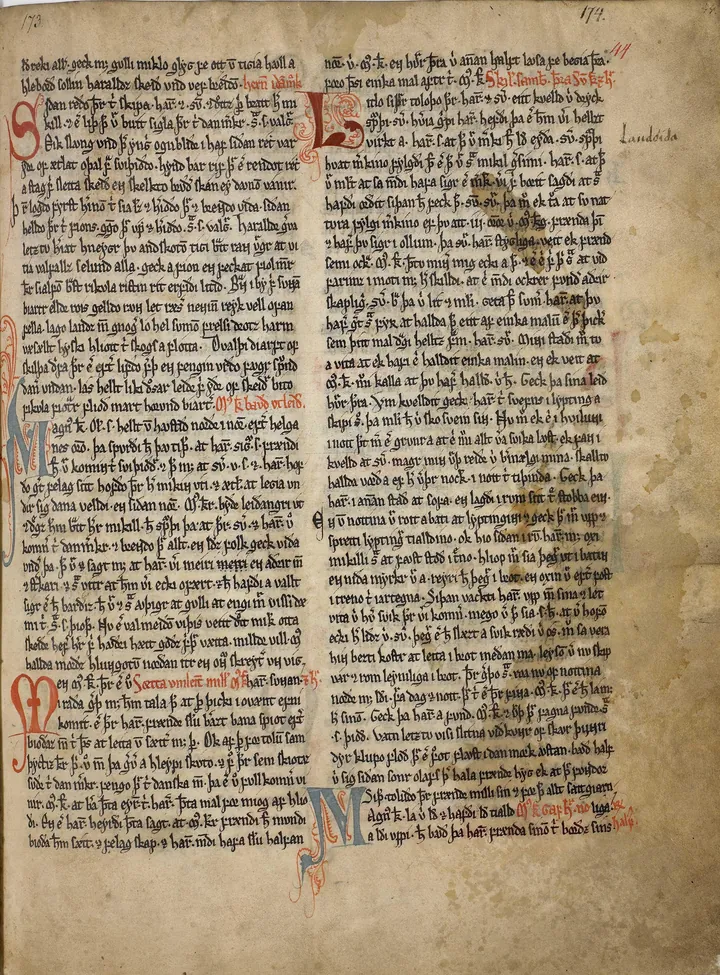
The manuscript pictured here, Fríssbók, is a 14th-century copy, itself another century removed from Snorri. The oldest text of Harald's saga has not survived: what we read today has passed through at least two layers of copying beyond the original verses.

How far he went
Kilometres are measured on the map through the places the saga names or that other sources reconstruct, so each is a minimum. The Sicily, Serkland and Jerusalem campaigns are measured there and back.
| Stage | Kilometres on the map, at least | When |
|---|---|---|
| Stiklestad, and the flight east | 770 | 1015 – 1031 |
| Kyiv and Novgorod, in Yaroslav's pay | 1,860 | 1031 – 1034 |
| South to Constantinople | 1,450 | 1034 |
| The emperor's guard: Sicily and Bulgaria | 6,590 | 1034 – 1041 |
| Prisoner of an empress | 1,450 | 1041 – 1042 |
| A bride, and half a throne | 2,290 | 1042 – 1046 |
| King of Norway | 400 | 1046 – 1066 |
| England | 1,560 | 1066 |
| Stamford Bridge | 10 | 25 September 1066 |
From Stiklestad to Stamford Bridge, the measured route runs past 16,000 kilometres, a quarter of the way round the Earth, for one man, in one life.
Sources and method
The chapters rest on Samuel Laing's 1844 English translation of Harald Sigurdson's saga, from Heimskringla, which is in the public domain. The English quotations are Laing's own words. The English-side dates, for Fulford, Stamford Bridge and Hastings, come from the Anglo-Saxon Chronicle, translated by James Ingram and J. A. Giles, also public domain.
Kekaumenos and John Skylitzes are cited through discussion and short quoted fragments at second hand, flagged as such, because their full English translations are under copyright. The route is drawn through the places the saga names; the Kyiv-to-Constantinople stretch, through the Dnieper rapids, follows the “Varangians to the Greeks” trade route, documented independently of the saga, not described by it. Distances are measured over the Earth's surface and rounded down to the nearest ten kilometres.
The saga
The Anglo-Saxon Chronicle
The Byzantine sources
- “Harald Hardrada,” with quotations from Kekaumenos via Charlotte Roueché's translation (2013), Wikipedia
- “Byzantine Source: Harald Hardrada,” Medievalists.net, quoting Charlotte Roueché's translation
- “Strategikon of Kekaumenos,” Wikipedia
- “Michael V Kalaphates,” Wikipedia, for Michael Psellos's account of the 1042 blinding
- “George Maniakes” and “Uprising of Petar Delyan,” Wikipedia, context for the Sicilian and Bulgarian campaigns
Images
- Peter Nicolai Arbo, 1870; public domain · Wikimedia Commons
- Peter Nicolai Arbo; public domain · Wikimedia Commons
- Photo of the coin, unknown author, CC BY-SA 4.0 · Wikimedia Commons
- Miniature from the Chronicle of John Skylitzes; public domain · Wikimedia Commons
- Drawing: C. I. Schive, lithographed by Bucher, Bergen; public domain · Wikimedia Commons
- Photo: Suzanne Reitz (probably); public domain · Wikimedia Commons