Sadu, near Sibiu, Romania · since December 1896
Sadu I: how many homes can water falling 30 metres light?
In December 1896 the Sadu river began turning two turbines 18 km from Sibiu, a Transylvanian town then in Austria-Hungary, and an overhead line carried the current into town. The plant still runs. The height of the drop and the flow through each turbine give the plant’s power; enter the monthly kWh on your electricity bill below to see how many homes using as much as yours it lit.
1,910 homes
at the average Romanian household’s monthly use, if the plant ran like this for a whole month
The water carries 883 kW. The two 1896 turbines use at most 2 m³/s between them, giving 400 kW at the switchboard. The other 1.00 m³/s goes over the weir.
Today: the 2012 water inventory lists 5.7 GWh a year, the use of 3,100 average Romanian homes.
How much electricity does water falling 30 metres make?
To get the power of falling water, multiply the density of water (1,000 kg/m³), the acceleration due to gravity (9.81 m/s²), the flow and the height of the drop. Oskar von Miller, the engineer who designed the plant, described it in 1898 in the Vienna journal Zeitschrift für Elektrotechnik: a 2.5 km concrete canal brought the water above the turbine hall for a useful drop of “about 30 m”, and each turbine used 1 m³ of water a second.
1,000 × 9.81 × 1 × 30 ≈ 294 kW per turbine
The generator coupled to each turbine could deliver, according to Miller, 200 kW at the plant’s switchboard. The ratio of those 200 kW of electricity to the water’s 294 kW gives an efficiency of 0.68. That is the efficiency from water to switchboard and the page’s one calibration number; the drawing applies it at every flow. The turbine ratings agree with each other: Miller’s drawing marks each set 275 PS, and the engineer Constantin Morțun, who wrote on the plant’s history in the Romanian journal Energetica in 1978, pairs a flow of 2.7 m³/s with “a power of about 750 CP”. CP is the Romanian abbreviation for metric horsepower (cai putere), about 735.5 W. Both give efficiencies from water to turbine shaft of 0.687 and 0.694. They are rounded nameplate ratings, so the gap down to 0.68 does not show what the generator lost. At low flows real efficiency falls, so the number of homes shown is an upper bound.
The number of homes is the energy made in a month divided by one home’s monthly use; the energy is the plant’s power times 730 hours, an average month. In 2024 the average Romanian household used 153 kWh a month (13,907 GWh across 7.57 million households, per Eurostat); at that rate the two turbines’ 400 kW, running flat out for a whole month, would cover the use of 1,910 homes. It does not say how many homes could switch everything on in the same minute.
What was in the turbine hall in December 1896?
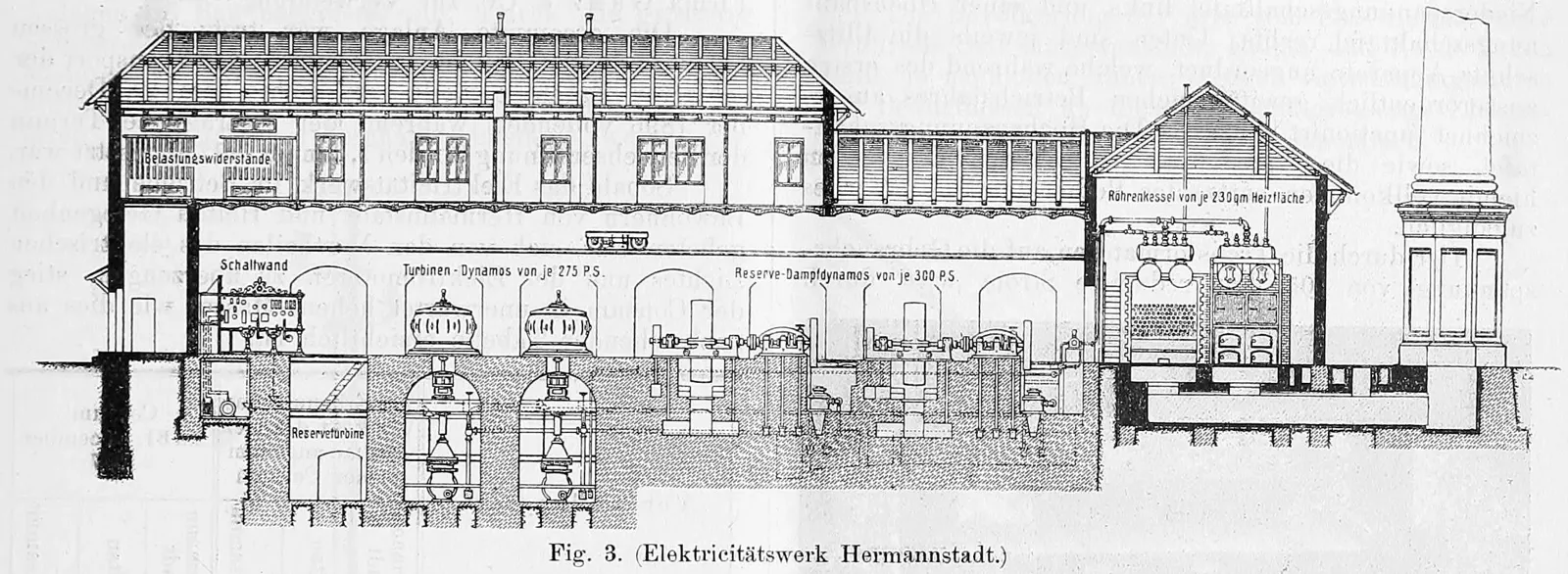
The hall was built for three turbines, but only two were fitted at first: vertical-shaft Girard turbines made by Ganz & Co in Budapest. Of the two reserve steam engines in the design, one was fitted, from the First Brno Engineering Company. Hidroelectrica, Romania’s state hydropower company, which runs the plant today, gives the full design, “3 turbines and two steam engines”, as the initial equipment; Miller, the designer, records two turbines and one steam engine in the first phase.
The turbines and the steam engine drove single-phase alternators directly, at 250 and 167 revolutions a minute. Miller gives “5000 reversals a minute”, which is 41.7 Hz, the frequency historians round to 42 Hz. The switchboard ran at 4,500 V. Overhead lines on oak poles 12–15 m tall carried the current to Sibiu and to Cisnădie, a wool-weaving town nearby (Transelectrica, the national grid operator, speaks of two lines). There, transformers, almost all of them in the street, reduced the voltage to 105 V for homes.
The company that built the plant was founded on 18 May 1895. More than 500 labourers worked on the site, and the contract set a deadline of 1 January 1897. Hidroelectrica gives 16 December 1896 as the day the plant went into service. Miller writes that the whole installation was finished on 19 December, a Saturday, and Morțun gives the same day. On 22 December 1896 the Romanian paper Tribuna reported that Sibiu’s paraffin street lamps had done their last duty on Saturday evening.
- Started
- 16 December 1896; finished on the 19th
- Drop
- about 30 m
- Water
- 1 m³/s per turbine
- Turbines in 1896
- 2 of the 3 planned
- Generators
- 2 × 200 kW, 41.7 Hz, 4,500 V
- Reserve
- 1 steam set, 230 kW
- Today
- 1.68 MW (ANRE, 2023)
What did the current from Sadu light in 1897?
On 31 December 1897, after the first year, Miller counted in Sibiu and Cisnădie, two towns with 29,000 inhabitants: 5,749 filament lamps of 16 candlepower each, 30 arc lamps, 39 motors totalling 93 metric horsepower and 75 heaters. In his table, all the equipment connected to the network came to the equivalent of 429 kW, against 360 kW forecast before construction.
Had it all run at once, it would have exceeded the 400 kW the two turbines could give. Miller credited the growth mainly to the tariff: cheap water power allowed a low flat rate rather than a meter, so customers had less reason to economise. He also wrote that an extension of about 400 metric horsepower was already under way, and that the first year’s results allowed a 5% dividend.
Why did a hydro plant need a steam engine?
The Sadu’s flow varies with the seasons. In the page’s model, up to the turbines’ maximum flow, the power is proportional to the water: half the flow, half the homes. Miller put a float in the sand trap at the end of the canal, connected to a bell that warned the sluice keeper when the water dropped, so he could raise the gate or telephone to have the steam engine made ready.
The steam set gave 230 kW at the switchboard, more than either turbine: the use of about 1,100 of today’s Romanian households. Press the button beside the drawing and drag the flow to zero to see what stays lit.
Why were the turbines replaced in 1902 and 1905?
The two turbines could use at most 2 m³/s between them. The water meant for the third turbine, which existed only in the design, would have gone over the weir. Drag the flow past that mark and the number of homes stops rising.
According to Hidroelectrica, the Girard turbines “proved too small” and were replaced in turn, in 1902 and 1905, by 350 CP Francis turbines, again with single-phase generators from Ganz & Co. In 1925–1926 the generators of units 1 and 2 were rewound for three-phase current, and Sibiu moved gradually from 42 Hz to 50 Hz. Meanwhile, in 1907, a second plant, Sadu II, had started 5 km upstream.
Who made it happen: Carl Wolff pushed for it, Oskar von Miller designed it
Carl Wolff, an economist and politician who ran Sibiu’s savings bank, drove the project. In 1891 three men from Sibiu were sent to the International Electrotechnical Exhibition in Frankfurt am Main. There they met Miller, who then came to study the site. In his 1898 article he writes that Sibiu (Hermannstadt in German), a garrison town of some 24,000 people, far from the capital and poorly linked by rail, needed power above all for its small workshops, and so did Cisnădie, whose wool weaving was in decline.
Miller (1855–1934) had sent electricity, with Marcel Deprez, down a line of about 60 km from Miesbach to Munich in 1882. He writes that four years passed before a company took up his Sadu design. In 1903 Miller founded the Deutsches Museum in Munich. His name is also linked to Sibiu’s first trolleybus (1904), its electric tram (1905) and the Sadu II plant (1907).
Is Sadu I still working?
Yes. Hidroelectrica calls it “the oldest power plant in operation in Romania”, and its museum page, archived in 2023, says the three old units are still in service. The 2023 register of ANRE, Romania’s energy regulator, lists it at 1.68 MW. The 2012 inventory of the Sibiu water management office lists four Francis turbines of 0.26, 0.26, 0.36 and 0.80 MW, a drop of 35 m and an output of 5.70 GWh a year: the use of about 3,100 average Romanian households today. A 2023 Hungarian study dates the Swedish ASEA unit to 1925–1926 and the unit from the Reșița turbine works, in Romania, to 1987.
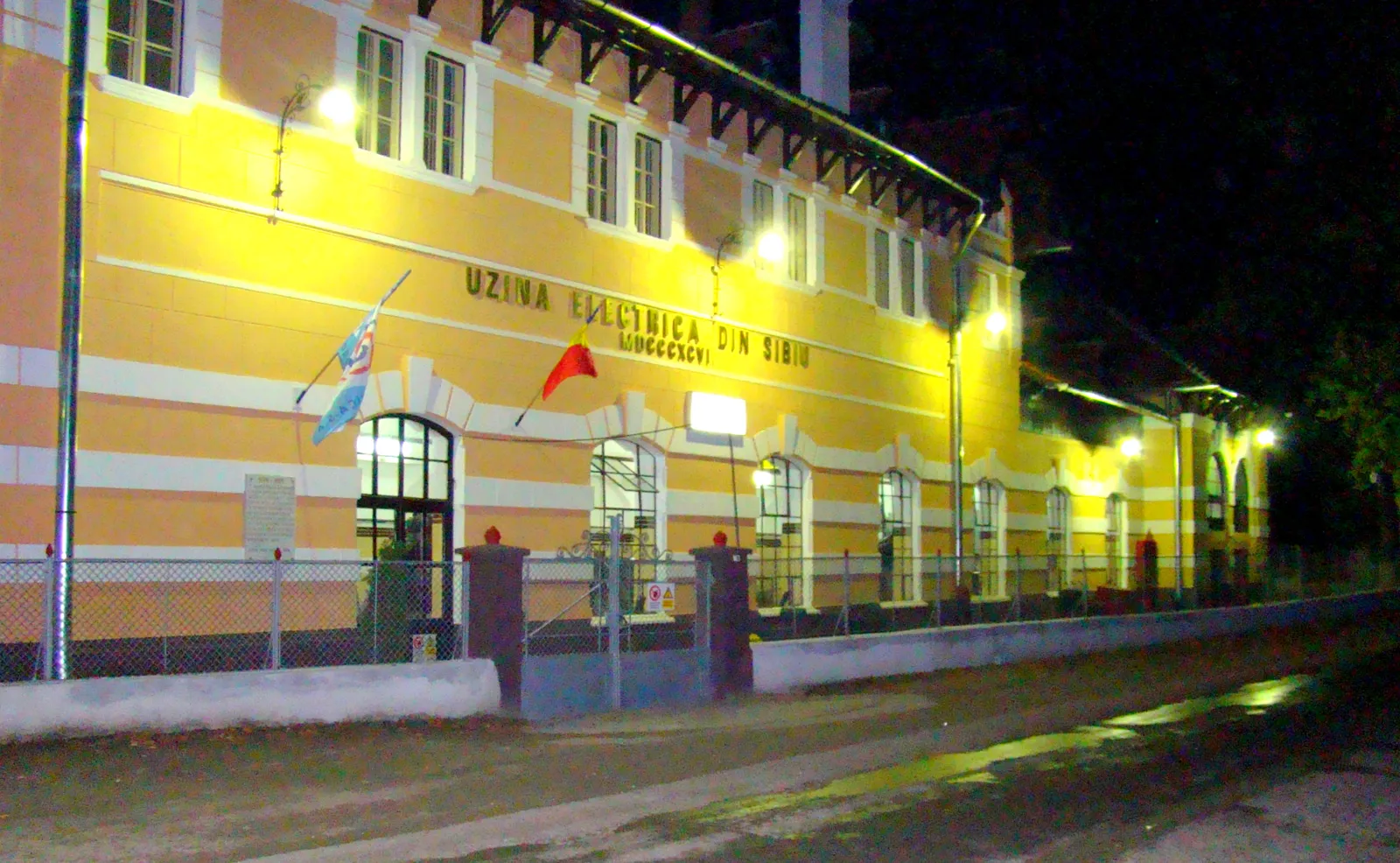
Besides the 1896 weir and canal, the Sadu II dam and later works up the valley now regulate the water. In 1996, at its centenary, the building also became the Sadu I Energy Museum. The plant also appears on the map of Romania’s small hydropower plants, drawn from the 2023 ANRE register.

What is not certain
The turbines’ horsepower. Marcel Stancu gives 260 CP for each turbine, while Miller’s drawing above labels each turbine-generator set 275 PS. The page uses only the 200 kW Miller gives at the switchboard.
The steam engine. Miller gives 350 metric horsepower for the planned steam engines and 300 on his drawing for the steam sets, while other sources give 260 or 270 for the engine fitted in 1896. The page uses the 230 kW at the switchboard from Miller’s text.
The total flow. Miller gives 1 m³/s per turbine; Morțun gives 2.7 m³/s. A 2023 Hungarian study gives “about 1 m³/s” without saying for what; for the whole plant it would mean at most 294 kW, too little for two 200 kW generators.
Today’s output. The 2012 water inventory gives 5.70 GWh a year; a 2024 study for Sibiu County Council gives “Sadu I” 2.9 MW and 4.8 GWh with units from 1986–1987, figures that match no other source on the 1896 plant.
The record. “The oldest power plant in operation in Romania” is the wording of Hidroelectrica, the plant’s operator.
Sources
The numbers come from the publications below, above all Oskar von Miller’s 1898 article. Where sources disagree, “What is not certain” says which version the page follows and why.
- Oskar von Miller, “Elektricitätswerk Hermannstadt in Siebenbürgen”, Zeitschrift für Elektrotechnik (Vienna), XVI, no. 16, 1898, pp. 185–189.
- Hidroelectrica, “Muzeul Energetic Sadu I” (Romanian; page archived June 2023).
- Constantin Morțun in Energetica (1978), quoted by Daniel Guță in “Savantul care a creat cea mai veche hidrocentrală din România, încă funcțională”, Adevărul (Romanian daily), 23 February 2026.
- Tribuna (Sibiu), 22 December 1896, quoted by Alin Bratu in “129 de ani de când s-a făcut lumină pe străzile Sibiului”, Turnul Sfatului, 18 December 2025.
- Sibiu Water Management System, “Situația folosințelor de tip CHE, CHEmp și MHC din Bazinul Hidrografic Olt” (Romanian, 2012), entry for Sadu I, listed as a small hydro plant (CHEmp).
- Adrian Istrate-Paul et al., “Transportul public sibian”, Transilvania 8/2022, pp. 74–81, after Marcel Stancu, Sibiul și electrificarea României (Honterus, 2014).
- Transelectrica, “1895: the Sibiu Electricity Works and the Sadu I plant” and “1907: Sadu 2 commissioned” (Romanian).
- Marcel Stancu, Stelian Gal, “Oameni cărora sibienii le sunt datori: Oskar von Miller”, Tribuna (Sibiu), 10 April 2009.
- Péter Kádár, “Városi vízerőművek Erdélyben” (Municipal hydro plants in Transylvania), EMT, Enelko–SzámOkt 2023, pp. 14–20.
- ANRE (Romania’s energy regulator), Installed generating capacity as at 24 April 2023, entry for Sadu 1.
- Eurostat, household energy consumption (nrg_d_hhq), electricity, Romania, 2024; number of households (lfst_hhnhtych), 2024.