The sky disc and its findspot
Evidence, computation, inference
- Evidencethe surviving bronze and gold of the disc
- Computedsun, moon and stars around 1600 BC and the angles on the horizon, as lines of light
- Inferredlost parts of the disc known only from grooves and X-rays, drawn in chalk
The horizon from the Mittelberg
The Mittelberg, in central Germany, is 252 metres high and wooded today. On 4 July 1999 two looters dug up the sky disc here; the findspot has been kept clear. Nearby stands a 30-metre observation tower, tilted by 10°, whose vertical slit marks the intended sightline to the Brocken.
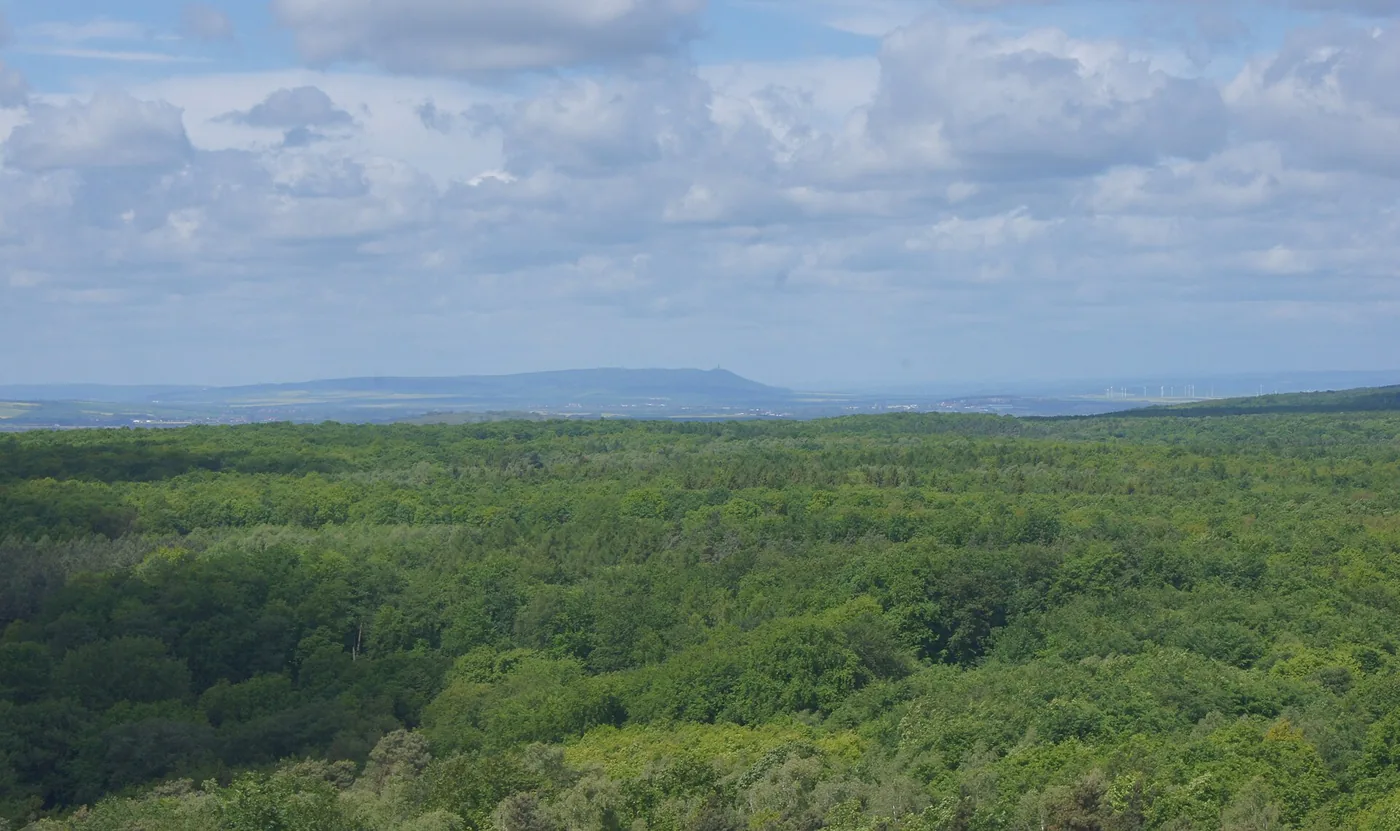
The view rests on elevation data: near the hill, the terrain model of the state of Saxony-Anhalt (a 5-metre grid without vegetation); further out, the Copernicus model to 118 kilometres. Earth curvature and refraction are included, so the mountains stand on the horizon at the height where the eye would see them.
On the summer solstice around 1600 BC, the last rim of the sun disappears behind the Harz in the model at 311.5°. The Brocken lies at 312.8°. So the sun set 1.3° to its left, not behind it. In 2003 Wolfhard Schlosser named the Harz massif with the Brocken as the direction of sunset; in the same issue Harald Meller wrote that the sun sets behind the Brocken on 21 June, and the State Museum still holds to this. The science journalist Dirk Lorenzen put the gap at about 2° on Deutschlandfunk in 2021; his 2022 report showed an offset for the Bronze Age as well.
In the model the Brocken summit stands 0.27° above the level, and the ridge in front of it, about 49 kilometres away, reaches 0.19°. The summit clears it by only about 0.08°. Whether forest stood in between, nobody knows. Around 1 May the sun sets in the model at 295.7°, 0.1° from the Kulpenberg in the Kyffhäuser hills (295.8°), which the State Museum names for that day.
Sources
- Landesmuseum für Vorgeschichte Halle: Der Fundort
- Deutschlandfunk, D. Lorenzen: Offenbar kein Bezug zum Brocken (2021)
- Deutschlandfunk, D. Lorenzen: Kein Brocken-Blick mit der Himmelsscheibe (2022)
- Arche Nebra: Fundort der Himmelsscheibe, Aussichtsturm und Wallanlagen
- LVermGeo Sachsen-Anhalt: Digitales Geländemodell DGM5 (© GeoBasis-DE / LVermGeo ST, dl-de/by-2-0)
- Copernicus DEM GLO-30 (© DLR e.V. 2010–2014 und © Airbus Defence and Space GmbH 2014–2018, bereitgestellt im Rahmen von COPERNICUS durch die EU und die ESA)
Do the arcs fit the horizon?
Harald Meller gives 82.7° for the horizon arcs of the disc. Theodor Schmidt-Kaler found mean values of 82.63° for one arc and 81.88° for the other. The usual reading: the ends of the arcs mark the directions in which the sun rises and sets at the two solstices.
From the Mittelberg, with the modelled terrain horizon and the tilt of the earth’s axis computed for 1600 BC (23.88°), the bearings of the sunsets at the winter solstice (230.1°) and the summer solstice (311.5°) lie 81.4° apart. That is about 1.3° less than the angle Meller gives. With today’s smaller tilt, the same model would give 79.6°.
That does not prove the disc was made or used on the Mittelberg. The similar angles only show that the arcs fit a place at this latitude.
Five phases, one disc
The disc is 31 to 32 centimetres across and weighs about 2.05 kilograms. According to the museum it is about 4.5 millimetres thick at the centre and about 1.5 at the rim. The bronze is about 97 per cent copper and 2.6 per cent tin. By its trace elements and lead isotopes, the copper comes from the Mitterberg mining district near Bischofshofen, in the Austrian state of Salzburg.
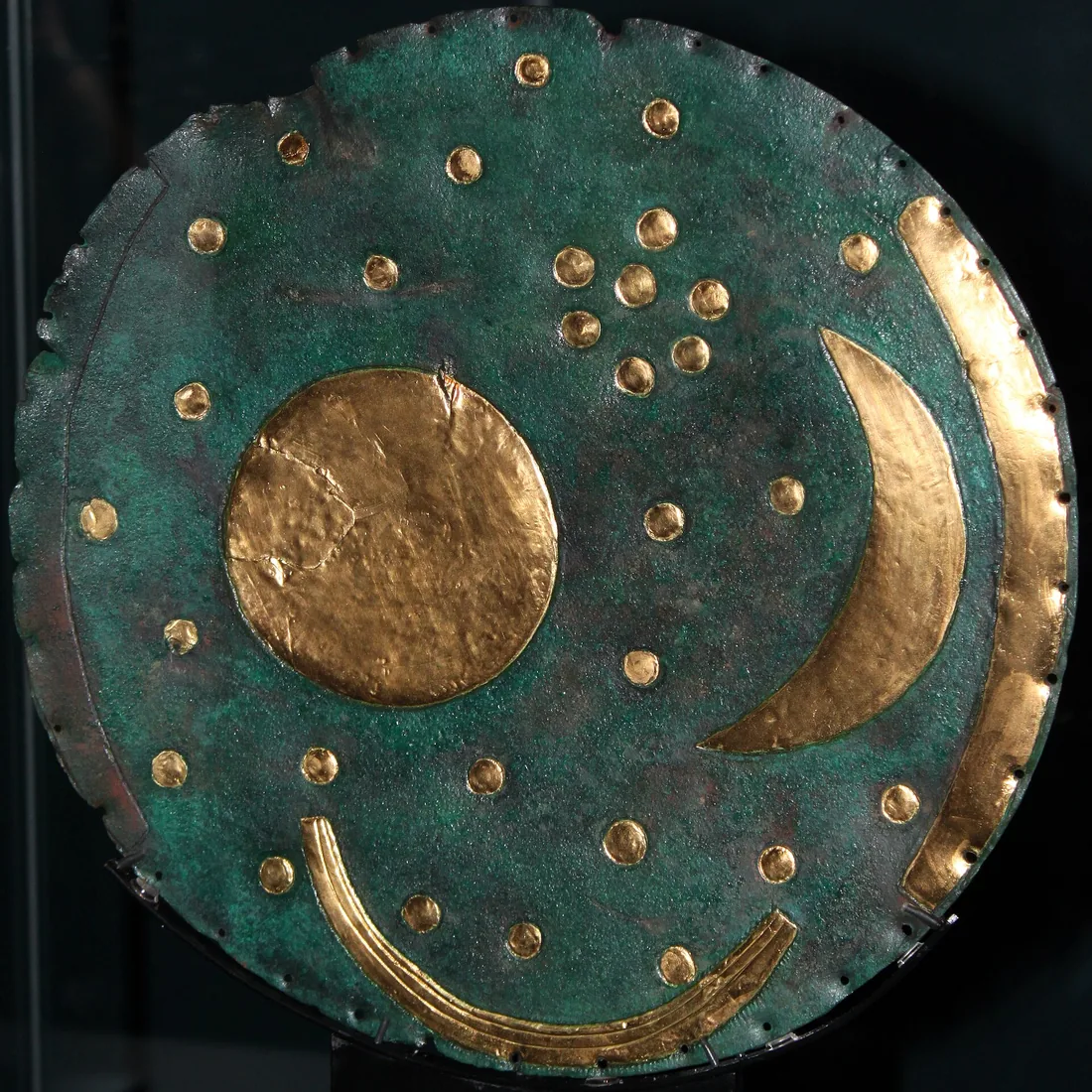
The State Museum distinguishes five phases. At first the disc carries a round gold sheet, a crescent moon and 32 stars. Then the two horizon arcs are added: the right one lies over the places of two earlier stars; on the left a piece of a star stayed in the groove, and a new one sits further in. Next comes the gold arc read as a boat, of different gold; Meller also allows the reverse order of boat and arcs. Then the rim is punched; the reconstruction shows 39 holes, some even through the boat. Last, the left arc is missing.
The gold of the early motifs is about 79 per cent gold and 21 per cent silver; the boat about 86 per cent gold. By its trace elements, the round sheet matches river gold from the Carnon in Cornwall best.
In the view, everything that sits on the disc today is drawn in metal. What only grooves and X-rays reveal, the two covered stars, the remnant of the moved star and the lost left arc, is chalk. Exactly where the covered stars sat is estimated.
Sources
- Landesmuseum für Vorgeschichte Halle: Nominierung der Himmelsscheibe für das UNESCO-Weltdokumentenerbe, S. 2–3
- Landesmuseum für Vorgeschichte Halle: Die Phasen der Himmelsscheibe
- Landesmuseum Halle, eMuseum Himmelswege: 3D-Modell der Himmelsscheibe (Lochung, Horizontbögen)
- H. Meller: Nebra: Vom Logos zum Mythos – Biographie eines Himmelsbildes (2010), S. 40–48, 62–69
- S. Dieck u. a.: Archaeometallurgical investigation of the Nebra Sky Disc, Scientific Reports 14 (2024), Artikel 28868
- E. Pernicka, J. Lutz, Th. Stöllner: Bronze Age Copper Produced at Mitterberg, Austria, and its Distribution (Archaeologia Austriaca 100), S. 20–36
- A. Ehser, G. Borg, E. Pernicka: Provenance of the gold of the Early Bronze Age Nebra Sky Disk, central Germany: geochemical characterization of natural gold from Cornwall (2011), S. 900–908
The Pleiades and the leap-month rule
Twelve lunar months together are about eleven days shorter than a solar year. To keep the months in step with the seasons, a leap month has to be inserted roughly every three years. Rahlf Hansen and Christine Rink read the broad crescent beside the seven stars as a reminder of this. They point to the Babylonian compendium MUL.APIN: in the reading they use of a damaged passage, the year needs no leap month if the first visible crescent stands by the Pleiades; if the moon reaches them only on the third day of the month, a month is inserted.
The view shows two computed evenings in February and March 1600 BC, in the proleptic Gregorian calendar. On 20 February a 3.9-day-old crescent stands 3.6° from the Pleiades, both high in the sky. On 19 March the crescent is 1.2 days old; the moon stands 4.3° and Alcyone, the brightest star of the Pleiades, 3.4° above the mathematical horizon.
The reading is disputed. Susanne M. Hoffmann thinks singling out this one rule from MUL.APIN goes too far. Manfred Feller and Johannes Koch doubt the Pleiades were visible reliably enough in spring at Nebra. Paul Gleirscher reads the picture as an image of the seasons, of sowing and harvest. That the rule travelled from Mesopotamia to central Europe is not shown.
Sources
- R. Hansen, Chr. Rink: Himmelsscheibe, Sonnenwagen und Kalenderhüte – ein Versuch zur bronzezeitlichen Astronomie (Acta Praehistorica et Archaeologica), S. 95–98
- S. M. Hoffmann: Zeigt die Himmelsscheibe von Nebra ein Instrument der Zeitrechnung?, PDF-S. 12–16
- M. Feller, J. Koch: Geheimnis der Himmelsscheibe doch nicht gelöst?, PDF-S. 6–7
- P. Gleirscher: Die Himmelsscheibe von Nebra: Zum Stand der Deutung und Datierung eines schillernden Ritualgeräts (Archäologische Informationen 44, 2021), S. 187–204
- Yale Bright Star Catalogue, 5. Ausgabe (D. Hoffleit, W. H. Warren Jr.)
- Astronomy Engine (D. Cross): Sonne, Mond, Präzession
Looting, seizure and the dispute over the date
On 4 July 1999 Henry Westphal and Mario Renner dug up the disc and the finds attributed to it: two gold-decorated bronze swords, two flanged axes, a chisel and two arm spirals. On 23 February 2002 the state archaeologist Harald Meller posed as a buyer at the Hilton hotel in Basel; the Basel police seized the disc, a sword and an axe.
The State Museum dates the burial of the hoard to about 1600 BC, on the types of the swords and axes and on radiocarbon dating of birch bark from a sword hilt. Dating the disc this way assumes it was buried with the other pieces. How old it already was by then, nobody knows.
In 2020 Rupert Gebhard and Rüdiger Krause doubted that the disc belonged with the other finds and came from the looters’ pit on the Mittelberg; on the basis of pictorial comparisons they dated it to the first millennium BC. Ernst Pernicka, Harald Meller and colleagues replied the same year with evidence from the pit, soil on the disc and a sword, and the metal analyses. The museum and the 2024 metallurgical study keep the Early Bronze Age date; dissent continues.
Sources
- Landesamt für Denkmalpflege und Archäologie Sachsen-Anhalt: 20. Jahrestag der Sicherstellung (2022)
- Kanton Basel-Stadt: Medienmitteilung zur Himmelsscheibe von Nebra (2003)
- Landesmuseum für Vorgeschichte Halle: Datierung
- E. Pernicka u. a.: Why the Nebra Sky Disc Dates to the Early Bronze Age (Archaeologia Austriaca 104, 2020), S. 89–116
- R. Gebhard, R. Krause: Kritische Anmerkungen zum Fundkomplex der sog. Himmelsscheibe von Nebra (Archäologische Informationen 43, 2020)
- P. Gleirscher: Die Himmelsscheibe von Nebra: Zum Stand der Deutung und Datierung eines schillernden Ritualgeräts (Archäologische Informationen 44, 2021), S. 187–204
How exact this is
Terrain: near the hill, the DGM5 terrain model of the state of Saxony-Anhalt (5-metre grid, bare ground); where it has no data and further out, Copernicus GLO-30 to 118 kilometres, a surface model that measures the crowns where there is forest. The terrain includes earth curvature and the usual coefficient of 0.13 for refraction near the ground.
Sun: tilt of the earth’s axis for 1600 BC 23.88° (Laskar’s series). The sunset bearing is the angle at which the upper rim of the sun, with refraction, touches the computed horizon. Observer: the summit, 252.2 metres, eye height 1.66 metres. Other refraction assumptions move the values by a few tenths of a degree.
Stars and moon: Yale Bright Star Catalogue to magnitude 5.8, with proper motion over 3,600 years and precession; moon and sun with Astronomy Engine. For such early dates the earth’s rotation (ΔT) is uncertain by hours, which can move the moon against the Pleiades by a few degrees; the picture of the two evenings stays.
Disc: the positions and outlines of the sun, crescent, stars, arcs and boat follow a public-domain photograph by Anagoria on Wikimedia Commons; the model is scaled to 31.6 centimetres, the thickness follows the museum. The positions of the two covered stars and of the star remnant in the left groove are estimated. The colour of the bronze before it lay in the ground is unknown.
Vegetation: for the Bronze Age the view assumes a treeless summit with meadow; the oaks at the edge of the clearing are assumed too. The bank visible today traces part of the Iron Age rampart and is therefore left out.
Sources
- Landesmuseum für Vorgeschichte Halle: Der Fundort
- Deutschlandfunk, D. Lorenzen: Offenbar kein Bezug zum Brocken (2021)
- Deutschlandfunk, D. Lorenzen: Kein Brocken-Blick mit der Himmelsscheibe (2022)
- Arche Nebra: Fundort der Himmelsscheibe, Aussichtsturm und Wallanlagen
- LVermGeo Sachsen-Anhalt: Digitales Geländemodell DGM5 (© GeoBasis-DE / LVermGeo ST, dl-de/by-2-0)
- Copernicus DEM GLO-30 (© DLR e.V. 2010–2014 und © Airbus Defence and Space GmbH 2014–2018, bereitgestellt im Rahmen von COPERNICUS durch die EU und die ESA)
- H. Meller: Nebra: Vom Logos zum Mythos – Biographie eines Himmelsbildes (2010), S. 40–48, 62–69
- Th. Schmidt-Kaler: Zur astronomischen Deutung der Himmelsscheibe von Nebra, S. 249–250
- Landesmuseum Halle, eMuseum Himmelswege: 3D-Modell der Himmelsscheibe (Lochung, Horizontbögen)
- Landesmuseum für Vorgeschichte Halle: Nominierung der Himmelsscheibe für das UNESCO-Weltdokumentenerbe, S. 2–3
- Landesmuseum für Vorgeschichte Halle: Die Phasen der Himmelsscheibe
- S. Dieck u. a.: Archaeometallurgical investigation of the Nebra Sky Disc, Scientific Reports 14 (2024), Artikel 28868
- E. Pernicka, J. Lutz, Th. Stöllner: Bronze Age Copper Produced at Mitterberg, Austria, and its Distribution (Archaeologia Austriaca 100), S. 20–36
- A. Ehser, G. Borg, E. Pernicka: Provenance of the gold of the Early Bronze Age Nebra Sky Disk, central Germany: geochemical characterization of natural gold from Cornwall (2011), S. 900–908
- R. Hansen, Chr. Rink: Himmelsscheibe, Sonnenwagen und Kalenderhüte – ein Versuch zur bronzezeitlichen Astronomie (Acta Praehistorica et Archaeologica), S. 95–98
- S. M. Hoffmann: Zeigt die Himmelsscheibe von Nebra ein Instrument der Zeitrechnung?, PDF-S. 12–16
- M. Feller, J. Koch: Geheimnis der Himmelsscheibe doch nicht gelöst?, PDF-S. 6–7
- P. Gleirscher: Die Himmelsscheibe von Nebra: Zum Stand der Deutung und Datierung eines schillernden Ritualgeräts (Archäologische Informationen 44, 2021), S. 187–204
- Yale Bright Star Catalogue, 5. Ausgabe (D. Hoffleit, W. H. Warren Jr.)
- Astronomy Engine (D. Cross): Sonne, Mond, Präzession
- Landesamt für Denkmalpflege und Archäologie Sachsen-Anhalt: 20. Jahrestag der Sicherstellung (2022)
- Kanton Basel-Stadt: Medienmitteilung zur Himmelsscheibe von Nebra (2003)
- Landesmuseum für Vorgeschichte Halle: Datierung
- E. Pernicka u. a.: Why the Nebra Sky Disc Dates to the Early Bronze Age (Archaeologia Austriaca 104, 2020), S. 89–116
- R. Gebhard, R. Krause: Kritische Anmerkungen zum Fundkomplex der sog. Himmelsscheibe von Nebra (Archäologische Informationen 43, 2020)