A mechanical history of cinema in eleven machines
For a century, half of every film was darkness
Until digital projection, a cinema projector showed you each still photograph twice, and blocked the light while the next one was pulled into place. On the two-blade 35 mm projector of the sound era, the shutter cut off the light for half of every frame; earlier and later shutters varied. This is the history of the machines that kept you from noticing, and of what cinema added once they worked.
Since you opened this page, a two-blade 35 mm projector would have blocked the light for (minutes:seconds).
Reel 1 · The trick
Nothing on the screen ever moved
A film is a row of still photographs. In a cinema each one was held motionless in front of the lamp, then the light was cut off while the next was pulled into place, and the audience saw a gallop, a kiss or a train. The movement was never on the screen. It happened in the viewer.
Two separate things in the eye and the brain make this work. The first is apparent motion: show a light in one place, then a light nearby, and at the right interval you see a single light moving. The psychologist Max Wertheimer published the classic experiments in 1912. Try it: the lights below only ever switch on and off.
The second is flicker fusion. A light that goes on and off fast enough looks steady. How fast depends on brightness: the brighter the light, the higher the rate needed (the Ferry–Porter law). At ordinary cinema brightness, flashing each of the 24 frames twice, 48 pulses of light a second, was generally enough to suppress visible flicker. Showing each frame only once was not.
For most of the 20th century textbooks explained both with “persistence of vision”. Afterimages on the retina are real, but they are not what turns a row of frames into movement: an afterimage would blur successive frames together, not animate them. Joseph and Barbara Anderson set out the case against the textbook explanation in 1993. It survives in many histories of film.
The first machines in this story all solve the same problem: how to show one picture, hide the change, and show the next.
Reel 2 · 1833
The first shutter was a row of slits
In a letter dated 21 January 1833 the Belgian physicist Joseph Plateau described a disc of drawings that came to life when you spun it in front of a mirror and looked through slits cut in its rim. The Austrian mathematician Simon Stampfer built the same device independently the same year. The disc below is one of Stampfer's, printed in Vienna in 1833.
Spun in the open, the disc is a blur. Seen through a slit, each face appears for an instant in the same place, then the dark card between slits hides the turn, then the next face appears. The dark is not a flaw of the toy. It is what makes it work.
Simon Stampfer, 1833. Wikimedia Commons, Public domain
.jpg)
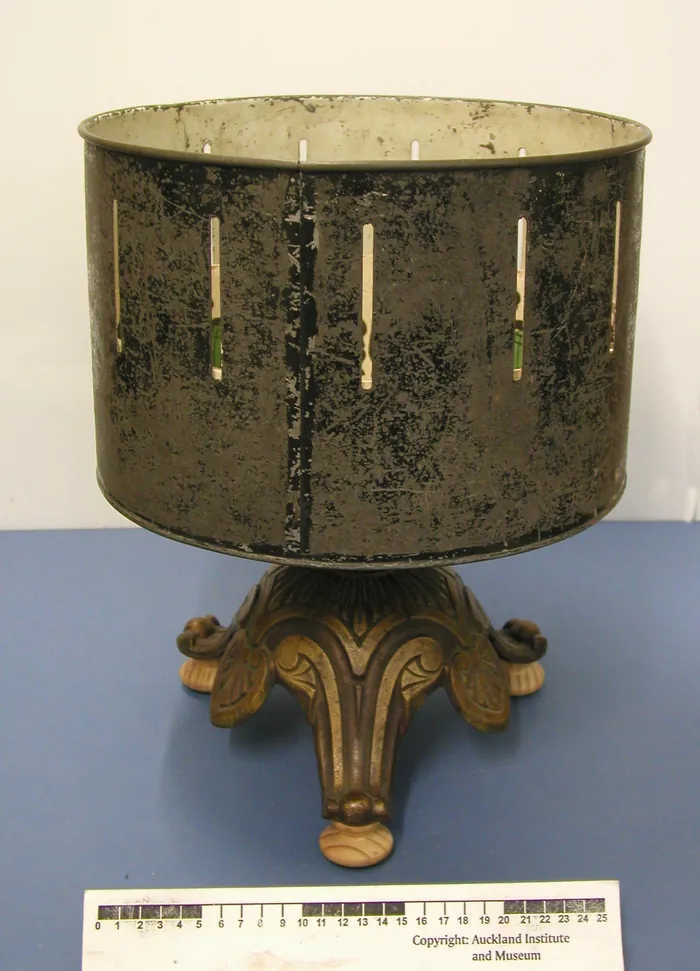
In January 1834 William Horner described a slotted drum he called the daedaleum, which several people could watch at once. It became a product 30 years later, when William E. Lincoln patented it as the zoetrope in 1867 and Milton Bradley sold it.
.jpg)
Reel 3 · 1878
A horse settled what painters had drawn wrong
Painters had long shown galloping horses with all four legs stretched out, front legs forward and hind legs back. On 19 June 1878, at Leland Stanford's stock farm in Palo Alto, Eadweard Muybridge set up 12 cameras beside a track, each fired by a thread as the mare Sallie Gardner ran past.
The pictures showed that a galloping horse does leave the ground with all four hooves, but only with its legs gathered under its belly, never outstretched. Play the frames at any rate you like; the frames marked in red are the ones with the horse in the air.
A popular story says Stanford commissioned the work to win a $25,000 bet. No contemporary evidence of a bet has been found; Stanford bred and trained trotting horses and wanted to understand their gait.
Eadweard Muybridge, 1878. Wikimedia Commons, Public domain
.gif)
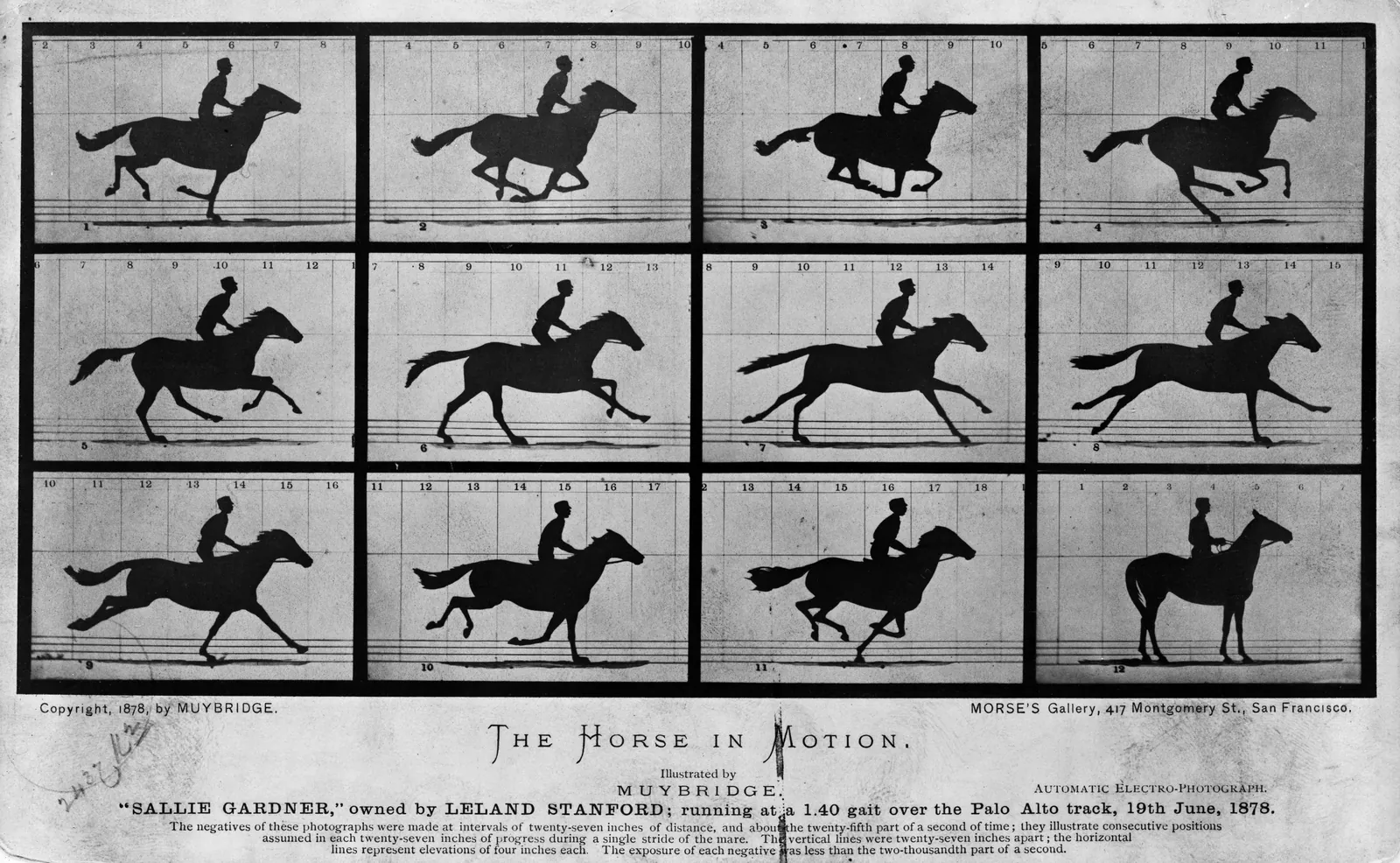

Muybridge's cameras took a series, not a film: 12 plates from 12 lenses. In 1882 the French physiologist Étienne-Jules Marey built a photographic gun that took 12 pictures a second through one lens. In October 1888 Louis Le Prince filmed a few seconds in a garden in Leeds at about 12 frames a second on a single-lens camera; in 1890 he boarded a train to Paris and was never seen again.
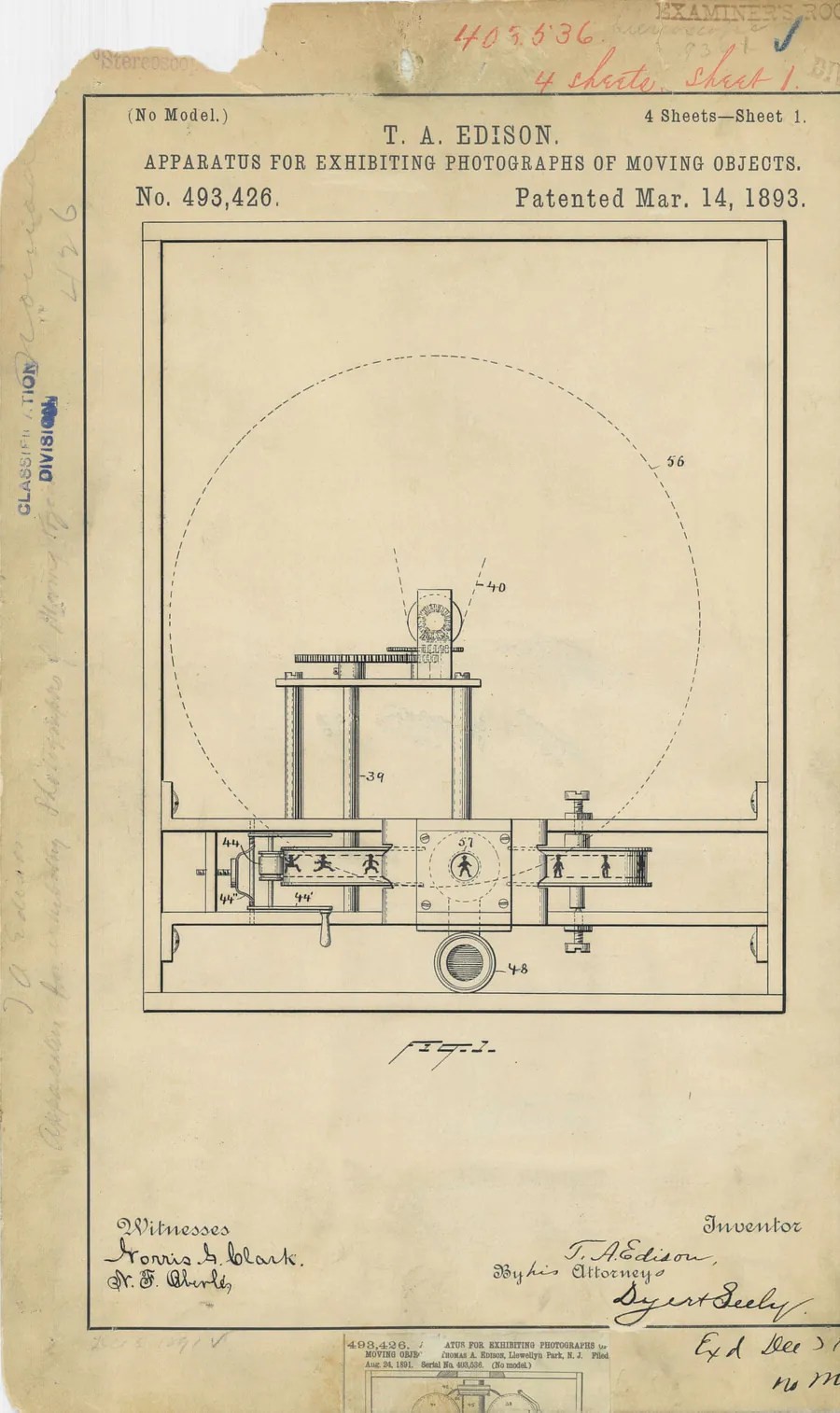
In Thomas Edison's laboratory, most of the design work fell to William Kennedy Laurie Dickson. Their Kinetoscope was a cabinet with an eyepiece: one person at a time watched a loop of film. The first Kinetoscope parlour opened at 1155 Broadway, New York, on 14 April 1894. Edison claimed a speed of 46 frames a second in 1891; in practice the machines ran at 30 to 40.

Reel 4 · 1895
The Lumières' first ticketed show began with workers leaving a factory
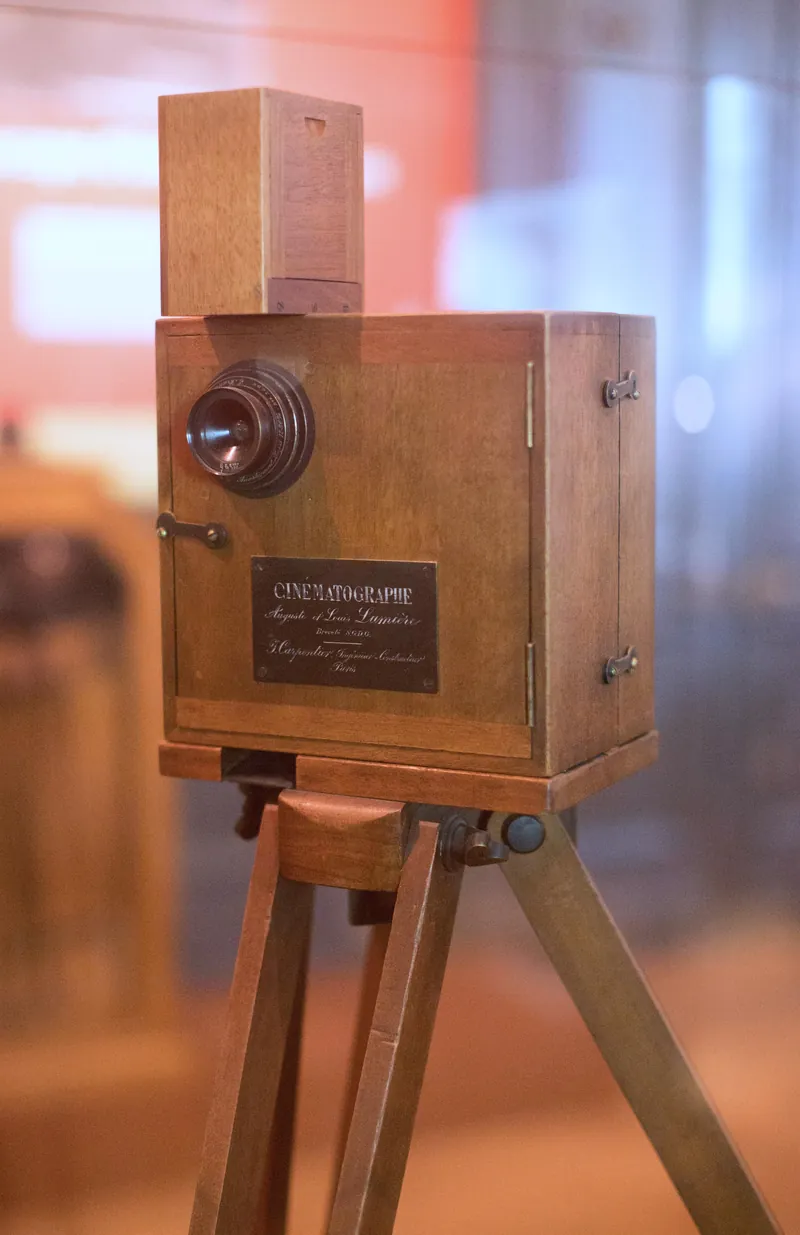
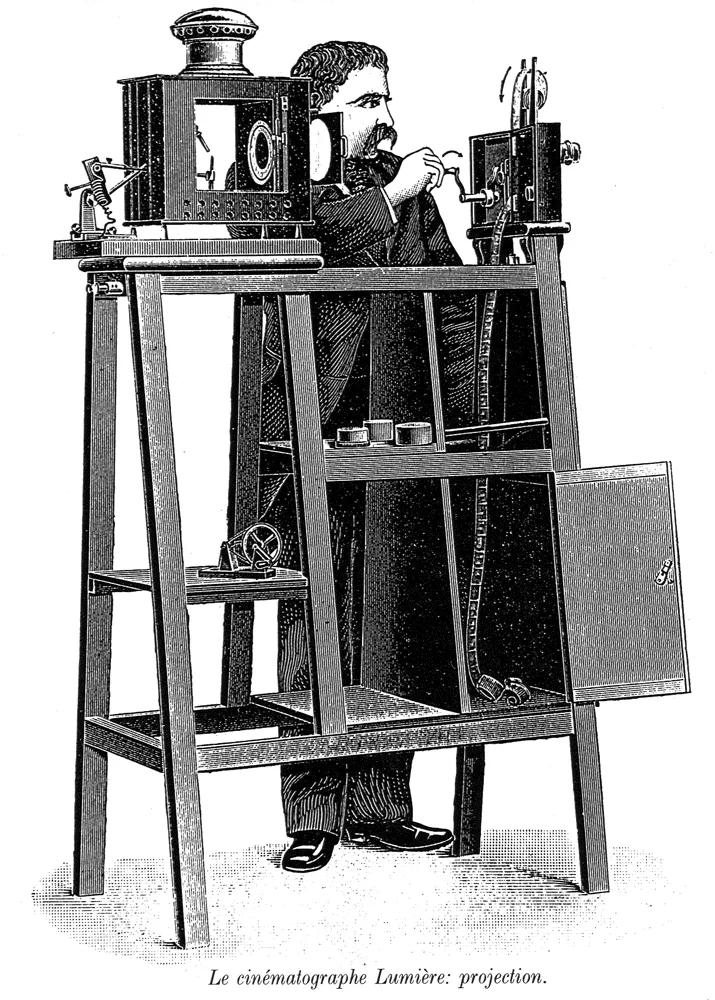
The Lumière brothers of Lyon, who ran a large photographic-plate factory, built a machine that did three jobs. The Cinématographe was a camera, a printer and, with a lantern behind it, a projector. It was light enough to carry, hand-cranked, and ran at 16 frames a second: two turns of the handle each second.
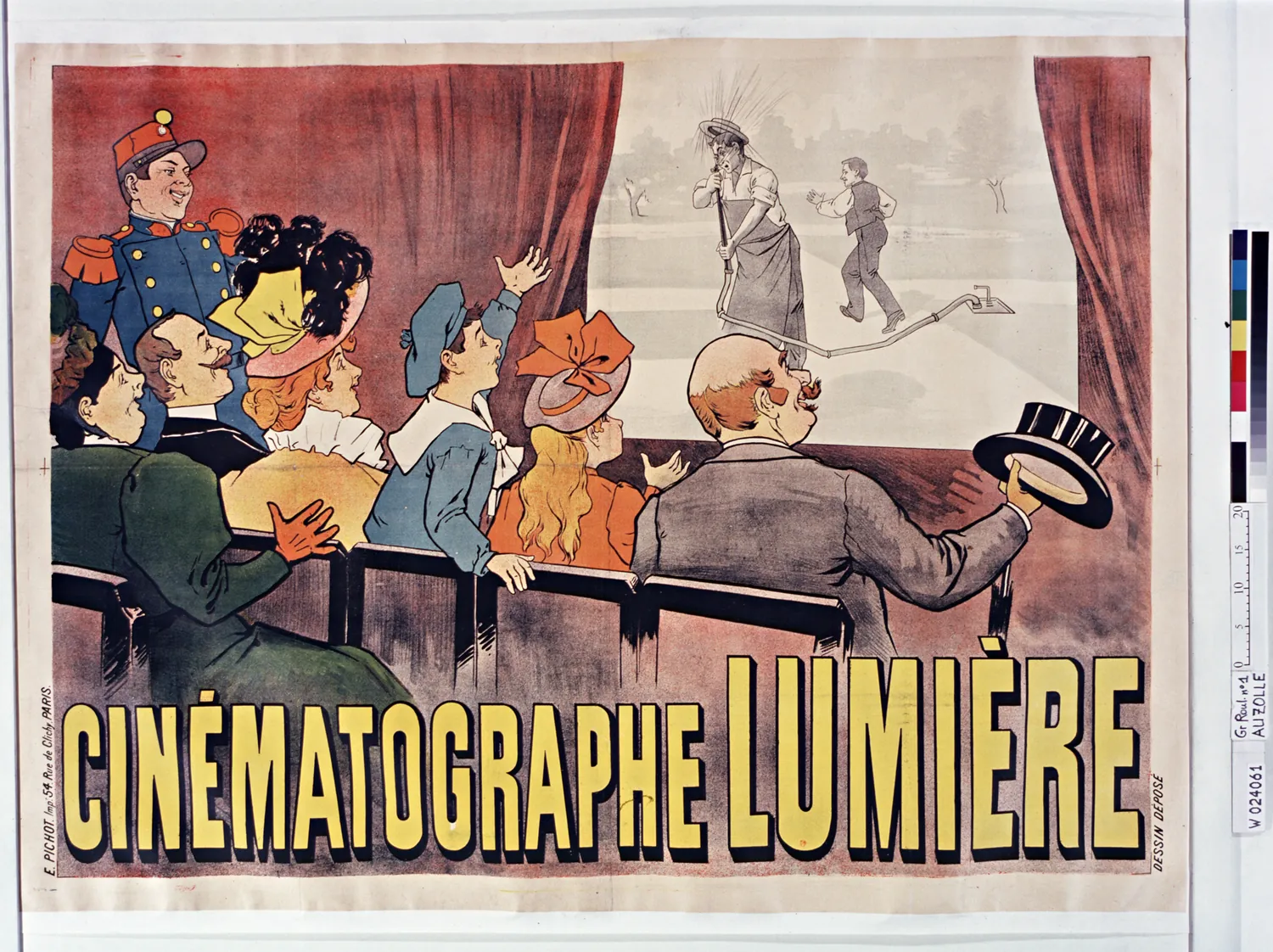
On 28 December 1895, in the basement Salon Indien of the Grand Café on the boulevard des Capucines in Paris, the Lumières charged one franc to watch ten films of under a minute each. The count usually given is 33 paying spectators. It was not the birth of cinema in one evening. In 1895 alone, the Lumières had shown their machine to an industry society in Paris on 22 March; from 20 May the Latham brothers screened boxing films to paying audiences in New York with their Eidoloscope; on 1 November Max and Emil Skladanowsky projected films in Berlin, with their Bioskop, as one act in a variety programme. The December show is the one that counts because of what followed: within a year the Cinématographe was in cities around the world.
Salon Indien du Grand Café, 28 December 1895
Programme of the first paid Lumière show, in the order usually given. One franc; the usual count is 33 paying spectators.
- La Sortie de l'usine Lumière à Lyon: Workers leaving the Lumière factory
- La Voltige: Trick riding
- La Pêche aux poissons rouges: Fishing for goldfish
- Le Débarquement du Congrès de photographie à Lyon: Delegates of a photography congress come ashore
- Les Forgerons: Blacksmiths
- Le Jardinier (L'Arroseur arrosé): The gardener gets sprayed
- Le Repas de bébé: Baby's meal
- Le Saut à la couverture: Tossed in a blanket
- La Place des Cordeliers à Lyon: A square in Lyon
- La Mer (Baignade en mer): Bathing in the sea



The panic that did not happen
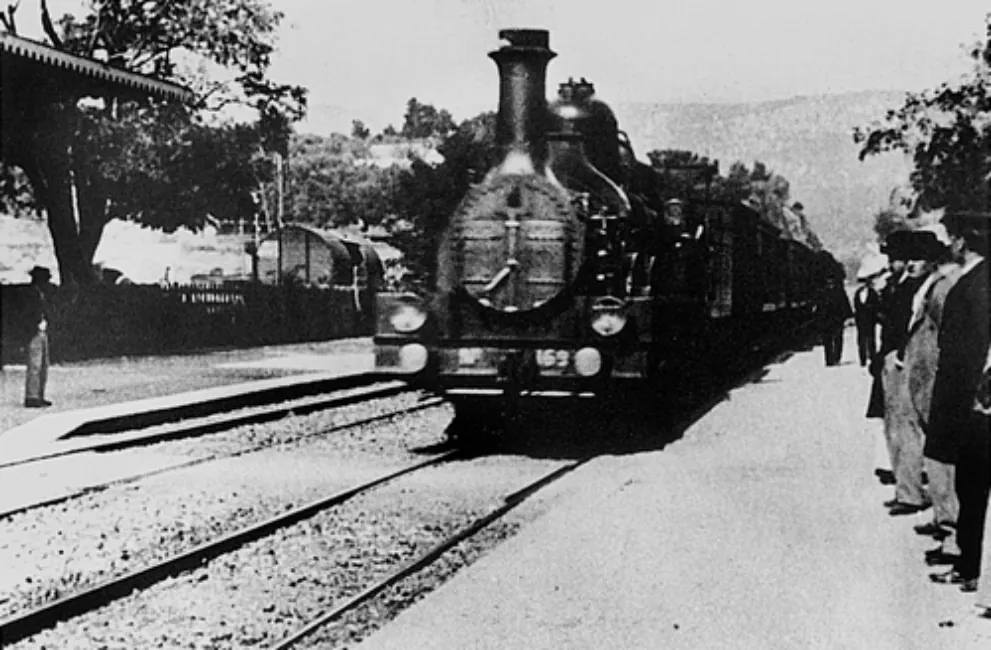
Arrival of a Train at La Ciotat was not on the first programme; it was shown from January 1896. The story that spectators screamed and ran from the approaching train appears in many histories. When the historian Martin Loiperdinger looked for evidence in 2004, he found no contemporary report of a panic. The story is a later retelling that became cinema's founding myth.

Bucharest, spring 1896
The Cinématographe reached Bucharest five months later. The first show was held in the building of the newspaper L'Indépendance Roumaine on Calea Victoriei, organised by the impresario Edwin Schürmann, with ten films including the train at La Ciotat. It is dated 27 May 1896 in the calendar Romania then used (8 June in today's). A review dated 27 May describes the show as “the evening before”, so it may have taken place a day earlier. Who turned the crank is not known: a 2024 study by Marian Țuțui weighs five candidates.
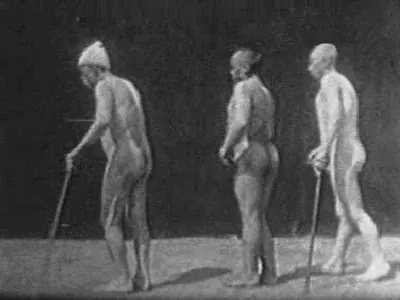
Two years later the neurologist Gheorghe Marinescu began filming his patients at the Pantelimon hospital with the cameraman Constantin M. Popescu, from 1898 to 1901, to study how illness changed the way they walked. He published frames from the films in La Semaine médicale in Paris from 1899. They are among the first medical films anywhere.

Reel 5 · The projector
Where the dark came from
How a 35 mm film projector works
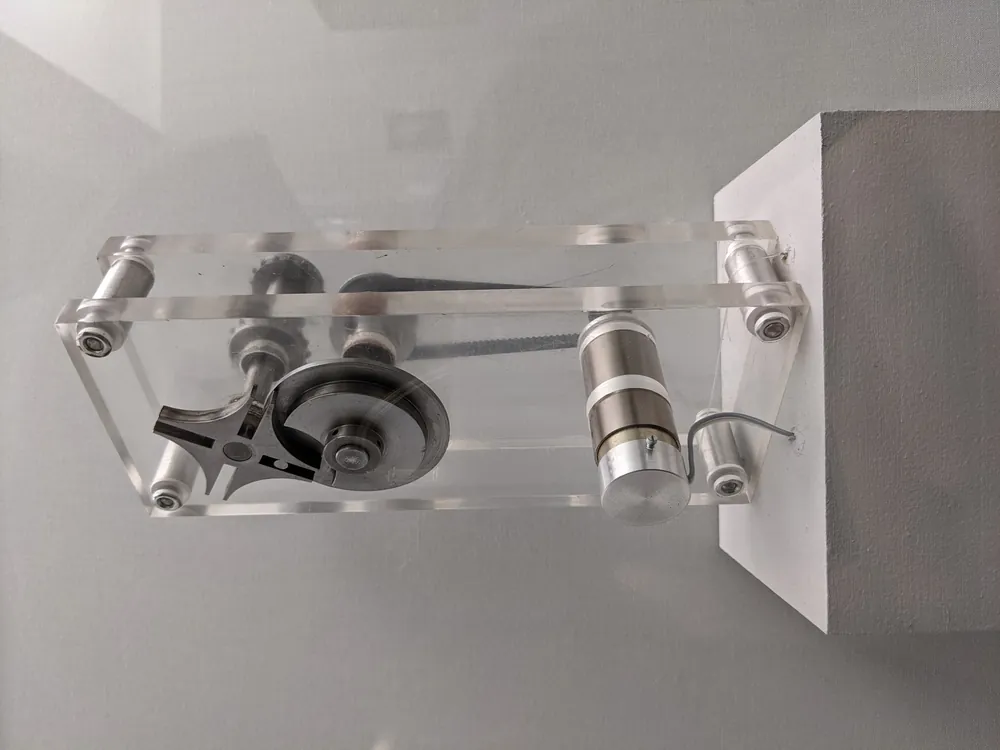
A film cannot be projected while it moves, or the picture smears down the screen. So a projector moves it in jerks. Behind the gate, a pin on a turning wheel enters a slot of a four-armed wheel, the Maltese cross, and turns it a quarter turn; the cross turns a sprocket that drags the film down exactly one frame, four perforations. Then the pin leaves the slot and the film stands still until the next turn.
While the film moves, a rotating blade must cover the lens. On a common design the pull-down takes a quarter of each frame's time: about 10 thousandths of a second out of 42 at 24 frames a second. A single blade would leave the screen lit three quarters of the time but flashing 24 times a second, which flickers. So projectors carried a second blade that interrupts the light again halfway through each frame, doubling the flash rate to 48 and bringing the dark to half.
With two blades the shutter blocks the light 50% of the time, and each picture is flashed twice: 48 flashes a second at 24 frames a second.
Slowed down roughly thirty times; the model never changes the screen's light more than two and a half times a second. In every mode the Maltese cross moves the film during the first quarter of each frame; only the shutter changes. A real blade sweeps across the beam, so the screen dims and brightens over a few thousandths of a second rather than switching.
A 2001 Kodak patent for a projector mechanism puts it plainly: with the typical two-bladed shutter, “approximately 50% of the available light is then lost per frame time”. Silent films, projected at about 16 frames a second, needed three blades to reach 48 flashes, and a three-blade shutter lost at least 54 per cent of the light. When sound fixed the speed at 24, two blades gave the same 48 flashes with less loss. Some later shutters trimmed the blades to about 40 per cent. None of them could do without the dark, because it hid the pull-down and stopped the flicker.
A two-hour feature is 172,800 frames on about 3.3 kilometres of film, and each frame stood in the gate for a 24th of a second. On a two-blade projector the shutter blocked the light for roughly an hour of those two hours, and the audience did not see it.

By the mid-1920s the first problem was solved: the pictures moved and nobody saw the joins. The next machines went after what was still missing: a steady speed, sound, colour, width. Underneath all of them the film still stopped and started behind a shutter, until the projector itself went digital.
Reel 6 · Speed
Silent films had no fixed speed
Early cameras and projectors were turned by hand, so the speed was whatever the operator made it. Silent films were shot and shown at roughly 14 to 24 frames a second, and got faster through the 1920s. D. W. Griffith sent projectionists instructions that work out at 16 to 19 frames a second for his 1914 films. The “16 frames a second of the silent era” is a later simplification.
Take the handle. The film on the right plays at the speed you crank.
Drag the handle round. The Lumière machine advanced 8 frames for each turn, so two turns a second gave 16 frames a second.
Sound ended the freedom. A voice played a little fast rises in pitch, and a soundtrack printed on the film needs the film to move at a constant speed. By the end of the 1920s the industry settled on 24 frames a second, probably as the slowest speed at which the early optical soundtracks gave acceptable sound. Every later figure in this story follows from that choice.
Reel 7 · Sound
The Jazz Singer is mostly a silent film
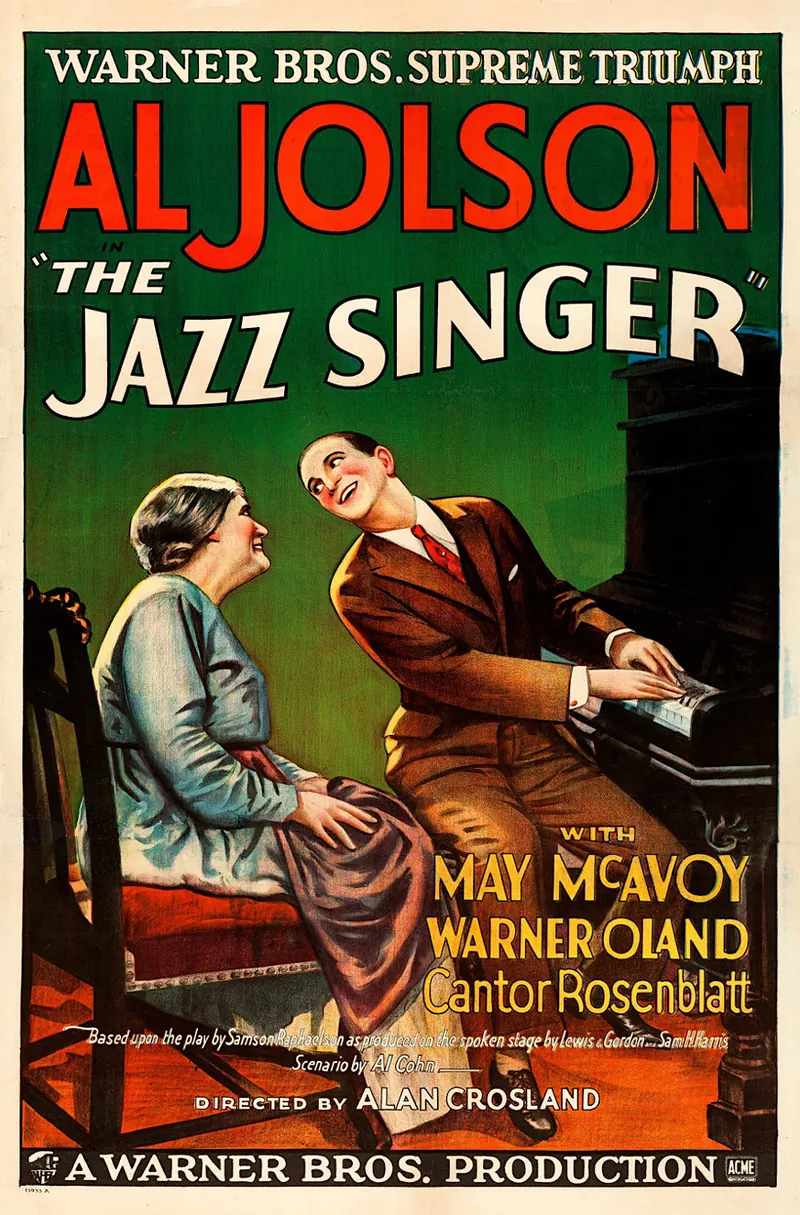
Warner Bros. showed Don Juan on 6 August 1926 with a recorded orchestral score and sound effects, played from discs synchronised with the projector. The Jazz Singer, which opened on 6 October 1927, is remembered as the first talking picture, but most of it is silent with intertitles. It has synchronised songs and about two minutes of spoken lines, reportedly ad-libbed by Al Jolson, including “Wait a minute, wait a minute, you ain't heard nothin' yet!”. The first all-talking feature, Lights of New York, followed in 1928.
Discs gave way to sound printed on the film itself, beside the pictures. In a variable-area track the sound wave is a clear band of changing width. A steady beam shines through it onto a photocell, and the light that gets through becomes the current that drives the loudspeakers.
The white band is the soundtrack. Press the button and the band is drawn from the sound you hear, as it would be printed on the film.
The sound reader cannot sit in the gate, where the film stops and starts 24 times a second; it needs film moving smoothly. So the sound is printed ahead of its picture, 21 frames ahead on standard 35 mm, and read further along the film path.

Reel 8 · Colour
Technicolor made colour from three black-and-white negatives
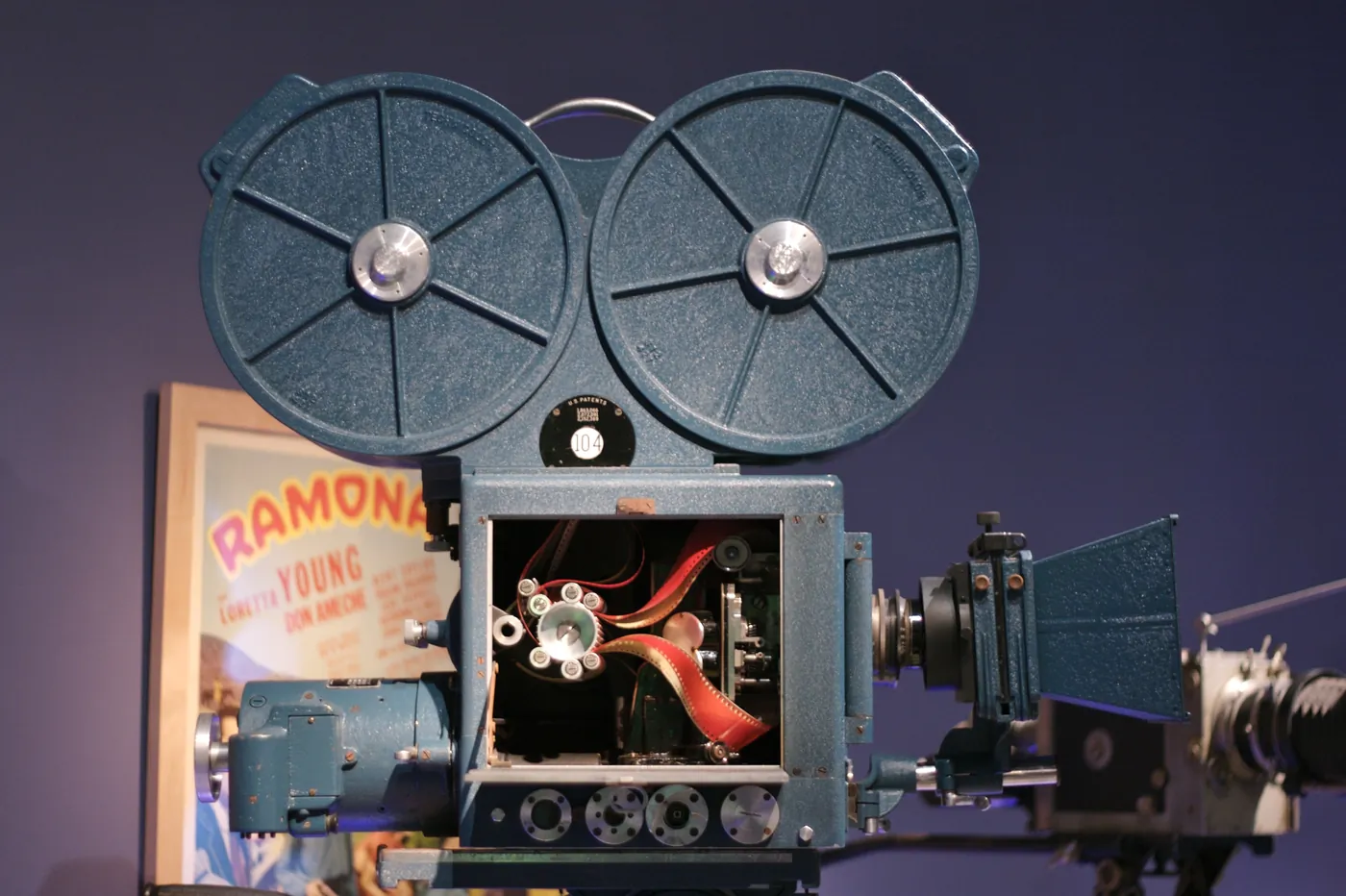
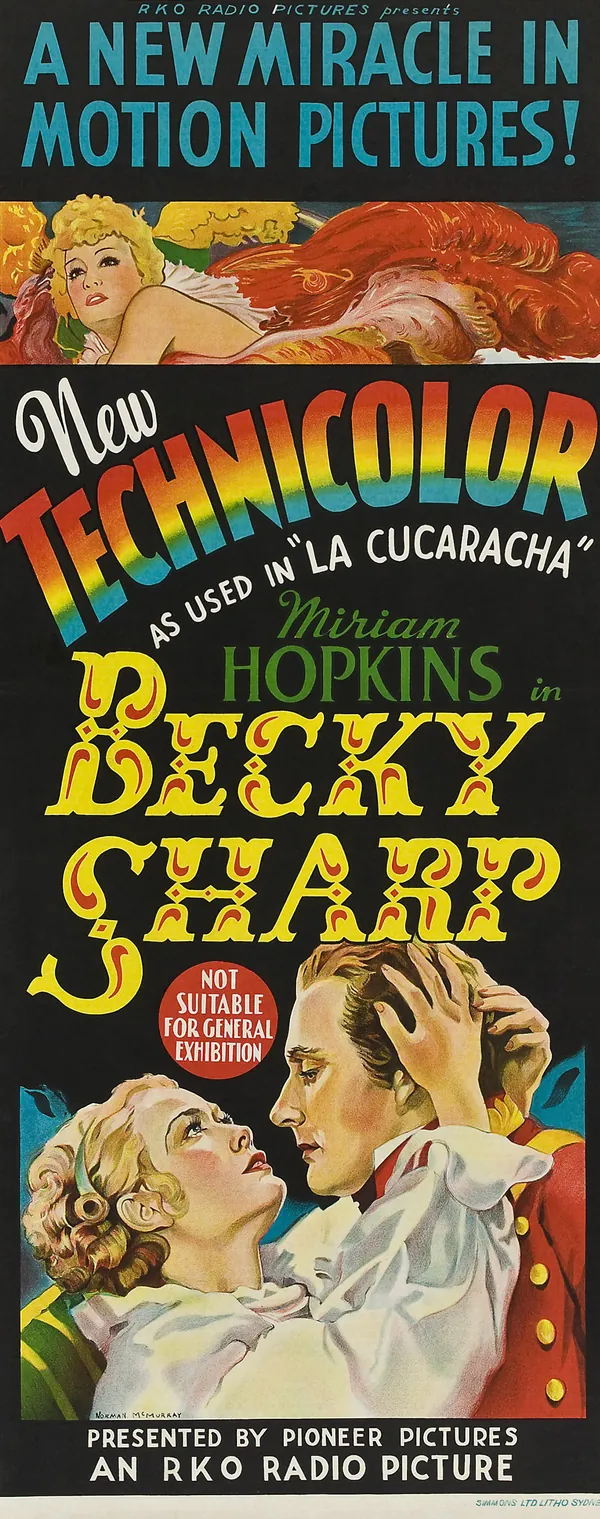
Early colour was added by hand, frame by frame, or with stencils. Technicolor's three-strip process, first used in Walt Disney's cartoon Flowers and Trees (30 July 1932), put colour in the camera. A prism behind the lens split the light two ways: one beam exposed a negative for green, the other a pair of films run face to face, one recording blue and one red. Three black-and-white negatives, one for each colour. The first feature shot entirely this way was Becky Sharp, which opened on 13 June 1935; the short La Cucaracha came a year earlier.
To make a print, each record was turned into a relief that printed one dye: the red record printed cyan, the green printed magenta, the blue printed yellow. Where a dye is missing its colour is missing. Turn the layers off, or push the magenta out of register, as a badly aligned print would be.

Colour demonstration built from a hand-coloured Méliès frame. Georges Méliès, 1902. Wikimedia Commons, Public domain



Reel 9 · Widescreen
Television pushed the screen wider
In 1932 the Academy of Motion Picture Arts and Sciences fixed the frame at 1.37 times as wide as it was tall, a shape close to the silent frame after the soundtrack took a strip of it. Television used almost the same shape. Then television spread: 9 per cent of American households had a set in 1950 and 64.5 per cent in 1955.
Cinema answered with width. This Is Cinerama opened on 30 September 1952, projected by three machines onto a curved screen. In 1953 The Robe introduced CinemaScope: a lens squeezed a wide picture onto ordinary 35 mm film and a second lens unsqueezed it on the screen, 2.55 times as wide as tall, with four magnetic sound tracks. The frame was later trimmed to 2.35 to make room for an optical track. Choose a shape.
The Academy ratio, 1.37 to 1, fixed in 1932.
Reel 10 · Digital
Then the screen stopped going dark
Toy Story (22 November 1995) was the first feature made entirely by computer, but it reached cinemas on film. Features began to be shot on digital cameras at the start of the 2000s; Star Wars: Episode II (2002) was the first major Hollywood studio feature shot entirely on one. The studios' technical specification for digital cinema was published on 20 July 2005.
A digital projector has no film to pull down and no shutter. In the common DLP design each pixel is a microscopic mirror that tilts toward or away from the lens thousands of times a second, and the light never stops for a change of frame. The arrangement that had made cinema possible since 1895, movement paid for with darkness, was no longer needed.
The change was fast. By the end of 2013 more than 80 per cent of the world's screens were digital, and 89.8 per cent by the end of 2014. At the end of 2013 Paramount made Anchorman 2 its last routine 35 mm release in the United States, as it moved its major releases to digital. Film did not vanish completely: studios later made prints for filmmakers who asked, and for special releases.
Press the button to slow the shutter down and take it away.
Some darkness survives. A single-projector 3D system alternates the pictures for the left and right eye, 144 flashes a second, so each eye sees its own picture only about half the time. A few directors still shoot and show on film, and some cinemas keep a 35 mm projector for them.
Reel 11 · Your total
How long you sat in the dark
Count the films you saw in a cinema on 35 mm film, before most screens went digital around 2013. On a two-blade projector the shutter blocked the light for half of each one.
You watched all of it. Your brain supplied the rest.
The endHow this was calculated
The half is the share of the projector's light that the usual two-blade shutter of a 35 mm sound-era projector blocks, as Kodak's patent states it; three-blade silent shutters blocked more, some later shutters about 40 per cent. Because a blade sweeps across the beam, the screen dims and brightens over a few thousandths of a second rather than switching. The counter at the top and the calculator at the end use one half. Frame and length figures use 24 frames a second, 16 frames per foot and 90 feet of film a minute.
The projector model follows a four-slot Maltese cross whose pull-down takes a quarter of each frame in every mode; the three-blade mode draws its two extra blades 60 degrees wide, an illustrative choice. It runs about thirty times slower than a real projector and never changes the screen's light more than two and a half times a second.
Sources
- Eastman Kodak, patent US6183087, Geneva mechanism and motion picture projector, 2001 patents.google.com/patent/US6183087B1/en
- Raytheon Anschütz, patent US6014198, shutter efficiency patents.google.com/patent/US6014198
- Silent-era projection and three-blade shutters (FIAF archive text) brianpritchard.com/FAOL/contents/2604200faol/Foncd/TEXTS/delamo/
- National Science and Media Museum, the Lumière brothers and the Lathams, 1895 blog.scienceandmediamuseum.org.uk/the-lumiere-brothers-pioneers-
- George Eastman Museum, the Technicolor three-strip camera eastman.org/technicolor/technology/three-strip-camera
- Los Angeles Times, Paramount ends 35 mm distribution, 2014 latimes.com/entertainment/envelope/cotown/la-et-ct-paramount-end
- Nachleben Experimental Film Lab, projector shutters nachleben.org.uk/skomer/category/shutters/
- Projector intermittent and sprocket, patent US5946076 patents.google.com/patent/US5946076
- Critical flicker frequency and luminance (PMC10057432) pmc.ncbi.nlm.nih.gov/articles/PMC10057432/
- Anderson & Anderson, The myth of persistence of vision revisited, 1993 eric.ed.gov/?id=EJ477391
- Phenakistiscope: Plateau 1833 and Stampfer en.wikipedia.org/wiki/Phenakistoscope
- Zoetrope: Horner 1834, Lincoln patent 1867 en.wikipedia.org/wiki/Zoetrope
- Not a Betting Man: Stanford and Muybridge muse.jhu.edu/article/685505
- The Bioscope, silent film speeds thebioscope.net/2011/04/13/pure-motion/
- Holland Brothers' Kinetoscope parlour, 1894 victorian-cinema.net/holland.php
- Institut Lumière, the Cinématographe institut-lumiere.org/le-cinematographe-lumiere
- Catalogue Lumière, Salon Indien du Grand Café catalogue-lumiere.com/series/salon-indien-du-grand-cafe/
- Salon Indien du Grand Café en.wikipedia.org/wiki/Salon_Indien_du_Grand_Caf%C3%A9
- Loiperdinger & Elzer, Lumière's Arrival of the Train: Cinema's Founding Myth, 2004 muse.jhu.edu/article/171125
- Marian Țuțui, Cinci ipoteze despre autorul primei proiecții cinematografice la București, SCIA 2024 scia.ap.istoria-artei.ro/resources/2024/Art.%2012%20-%20MARIAN%2
- Gheorghe Marinescu, Who's Who of Victorian Cinema victorian-cinema.net/marinescu
- Library of Congress, The Jazz Singer loc.gov/static/programs/national-film-preservation-board/documen
- The Jazz Singer en.wikipedia.org/wiki/The_Jazz_Singer
- GB/T 4638-1997 (equivalent to ISO 2939:1986): sound record 21 ± ½ frames from the picture on 35 mm prints bzxz.net/en/fb6b66aacc1d48f43.html
- Simplex 5 Star soundhead manual: 21 frames from picture aperture to sound take-off film-tech.com/warehouse/wareview.php?category=2&id=344
- Walt Disney Family Museum, Flowers and Trees waltdisney.org/blog/flowers-and-trees-first-color-movie
- Becky Sharp (1935) en.wikipedia.org/wiki/Becky_Sharp_(film)
- TVB, national TV household penetration tvb.org/wp-content/uploads/2022/10/National-TV-Household-Penetra
- This Is Cinerama en.wikipedia.org/wiki/This_Is_Cinerama
- CinemaScope en.wikipedia.org/wiki/CinemaScope
- Academy of Motion Picture Arts and Sciences, Toy Story oscars.org/collection-highlights/toy-story
- Digital Cinema Initiatives en.wikipedia.org/wiki/Digital_Cinema_Initiatives
- Variety, almost 90 per cent of screens digital, 2015 variety.com/2015/film/global/report-almost-90-percent-of-the-pla
- Chicago Film Society, The Wolf of Wall Street and 35 mm chicagofilmsociety.org/2014/01/24/the-wolf-of-wall-street/
- RealD 3D triple flash en.wikipedia.org/wiki/RealD_3D
Images
- Stroboscopic disc with a distorted man: Simon Stampfer, 1833. Wikimedia Commons, Public domain
- Zoetrope: Unknown maker, 19th century. Wikimedia Commons, CC BY 4.0
- The Horse in Motion: Eadweard Muybridge, 1878. Wikimedia Commons, Public domain
- Sallie Gardner at a gallop, frames 1–11: Eadweard Muybridge, 1878. Wikimedia Commons, Public domain
- Kinetoscope patent drawing: US Patent Office records, 1893. Wikimedia Commons, Public domain
- A Lumière Cinématographe: Victorgrigas, 2014. Wikimedia Commons, CC BY-SA 4.0
- The Cinématographe set up as a projector: Louis Poyet, c. 1897. Wikimedia Commons, Public domain
- Cinématographe Lumière poster: Marcellin Auzolle, 1896. Wikimedia Commons, Public domain
- Arrival of a Train at La Ciotat: Louis Lumière. Wikimedia Commons, Public domain
- Frames from Gheorghe Marinescu's films of patients: Gheorghe Marinescu, 1899. Wikimedia Commons, Public domain
- A Trip to the Moon, hand-coloured frame: Georges Méliès, 1902. Wikimedia Commons, Public domain
- Maltese cross mechanism: SunOfErat, Filmmuseum Berlin (Oskar Messter collection). Wikimedia Commons, CC BY-SA 4.0
- The Jazz Singer poster: Warner Bros., 1927. Wikimedia Commons, Public domain
- Three-strip Technicolor camera: Marcin Wichary. Wikimedia Commons, CC BY 2.0
- Becky Sharp poster: RKO Radio Pictures, 1935. Wikimedia Commons, Public domain