mariuscomper.uk RO
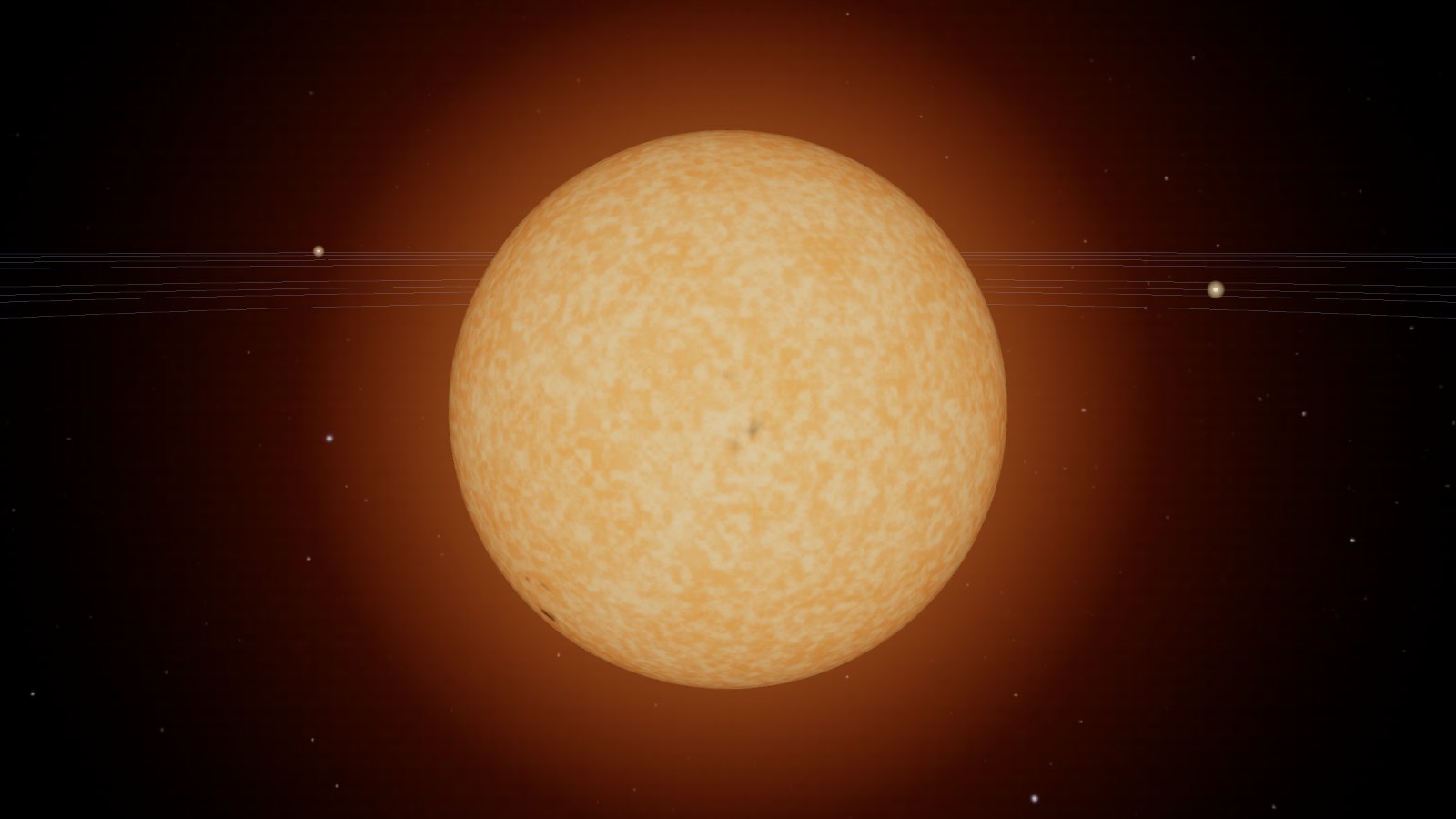
The Sun, the instant before it goes dark.

A thought experiment

If the Sun went out

Suppose the Sun stopped shining at this moment but stayed where it is, its gravity still holding the planets on their orbits. For 8 minutes and 19 seconds nobody on Earth would notice. Then the cold would begin, and it would deepen for millions of years.

The last light leaves

The Sun cannot really switch off. Even if the nuclear reactions in its core stopped, the heat stored inside would keep it shining for millions of years. This is a thought experiment.

So imagine it anyway: the light stops at the surface, all at once, and the solar wind with it. The last light to leave is a thin shell spreading outward at 299,792 kilometres a second. Inside the shell, space is already dark. Outside it, everything still looks normal.

Mercury, then Venus

At their average distances, the shell passes Mercury after 3 minutes and 13 seconds and Venus after 6 minutes and 1 second. Each goes dark as it is crossed.

On Earth, nobody has noticed. The sky is still blue and shadows are still sharp, because the light arriving now left the Sun before it went out.

8 minutes and 19 seconds

At its average distance of 149.6 million kilometres, the Earth receives the last sunlight 8 minutes and 19 seconds after it left. At that moment half the planet is in daylight.

There, the Sun vanishes from the sky between one second and the next. There is no dusk and no sunset, only the instant.

Stars at noon

Wherever it was day, the blue sky turns black at once. The blue is sunlight scattered by the air; with no sunlight there is nothing to scatter. The stars were there all along, and now they shine at noon.

The planets stay a little longer. Their light set out from the Sun before it went dark and must still travel to them and then back to the Earth. Venus can go dark within seconds or after up to 12 minutes, Jupiter after 70 to 87 minutes, Saturn after more than two hours, depending on where each is in its orbit. One by one, they go out.

The scene shows an ordinary evening sky, not a particular date. Your own sky, with today’s planets, is at the end of the page.

Night everywhere

Seen from space, the day side is gone. What remains are the lights of cities, still running on their power stations.

The Moon goes dark at almost the same moment. It shines only by reflected sunlight and is about 384,400 kilometres away, so the last sunlight reaches it up to about 1.3 seconds before or after it reaches the Earth, depending on where it is in its orbit. Seen from the Earth, it goes dark up to 2.6 seconds later than the Earth does. A full Moon, on the far side of the Earth from the Sun, stays lit longest: the time light takes to go out to it and back.

The last light crosses the planets

Mars goes dark 12 minutes and 41 seconds after the light leaves the Sun, Jupiter after about 43 minutes, Saturn after about 1 hour 20 minutes, Uranus after 2 hours 39 minutes and Neptune after 4 hours 11 minutes.

From the Earth, each planet stays visible a little longer than that, because its last reflected light still has to make its way back. The table gives both.

A day later, Voyager 1

Voyager 1, launched in 1977, is the most distant object humans have made. On 26 November 2026 it was 172.5 times as far from the Sun as the Earth is, about 25.8 billion kilometres. The last sunlight would reach it 23 hours and 54 minutes after leaving the Sun.

On 18 November 2026 Voyager 1 became the first spacecraft one light-day from the Earth: a radio message now takes a whole day to reach it. The shell of last light keeps going, fainter and fainter. Proxima Centauri, the nearest star, about 4.2 light-years away, would still see the Sun shining for more than four years.

How the light-day was reached, and what the probe still sends home: Voyager 1 at one light-day.

The first week

Without sunlight, the Earth keeps radiating heat into space and receives almost none back. Land cools first; the oceans, which hold far more heat, cool much more slowly. Beyond the first few days, Caltech planetary scientist David Stevenson pointed out, the atmosphere holds almost no heat of its own.

Stevenson estimated in 1999 that within days to a week the surface would fall below the freezing point of seawater, and that in about a year it would be near 200 kelvin, around −73 °C.

The planet on the screen is lit more brightly than starlight could manage, so the surface stays visible.

The plants stop

Almost all food on Earth starts with photosynthesis. Every year, plants on land and algae in the sea use sunlight to lock about 105 billion tonnes of carbon into new growth, roughly half on land and half in the ocean. In the dark, that stops on the first day.

In the sea, the microscopic algae at the base of the food web stop growing at once. On land, frost would kill most crops and leaves long before the plants used up their stored sugars.

People would live on what is already in store. At the end of the 2026–27 season the world’s cereal stocks equal about a third of a year’s consumption, roughly four months, spread very unevenly between countries.

What keeps the lights on

The Sun delivers about 173,500 terawatts to the Earth. All the heat rising from the planet’s interior is about 47 terawatts, 3,700 times less. Everything humanity uses, more than 600 exajoules in 2025, averages about 19 terawatts.

Put another way, sunlight brings in as much energy in under an hour as humans use in a year. Once it is gone, the surface is left with the trickle from below: about 0.09 watts per square metre, the light of a small torch spread over a whole room’s floor.

The UK’s power is mostly sunlight

In 2025, almost 88% of the electricity generated in the UK came from sunlight in one form or another. Solar panels use today’s light. Wind and rain are weather, and weather is driven by the Sun heating the air and lifting water. Biomass power stations burn plants that grew in recent years; coal, gas and oil are plants and plankton buried millions of years ago.

In the dark, solar output stops at once. Wind turbines and hydro plants lose their energy source as the winds weaken and the rivers freeze. Gas and nuclear plants can carry on while there is fuel, people to run them and liquid water to cool them. Nuclear, about 12% of generation, is the only large source that never depended on the Sun.

The oceans freeze over

The seas freeze from the top. Ice floats and insulates the water beneath it, so it thickens more and more slowly: the thicker the ice, the more slowly the water’s heat escapes through it.

How long until the deepest water freezes? Estimates differ widely. Stevenson suggested about a thousand years. Dorian Abbot and Eric Switzer, calculating in 2011 for an Earth-like planet warmed only from inside, found that it would settle after about a million years; by their formula, the ice would then be about 15 kilometres thick. The oceans average 3.7 kilometres deep, so on a planet the size of the Earth they would eventually freeze to the bottom.

Who survives

In 1977, scientists exploring the Galápagos Rift found the first hydrothermal vents: hot springs on the sea floor with whole communities living on chemical energy instead of light. But most of the animals there breathe oxygen dissolved in seawater, and that oxygen comes from photosynthesis. With nothing to replenish it, they too would run out of it.

The safest life is inside the rock. In 2018 the Deep Carbon Observatory estimated that 15 to 23 billion tonnes of carbon live underground as microbes, 245 to 385 times the carbon in all humans, about 70% of the planet’s bacteria and archaea. In 2006, Li-Hung Lin and colleagues described microbes 2.8 kilometres down in a South African gold mine that live on hydrogen and sulphate made by radioactivity in the rock, with no link to photosynthesis. They would not notice that the Sun had gone out.

Life without sunlight exists in Europe too, in a cave sealed from the surface: Movile Cave, near Mangalia in Romania.

The air falls as snow

Water vapour freezes out first. Then, as the cold deepens, the air itself. Carbon dioxide, at today’s 0.04% of the air, turns to frost at about −142 °C. Oxygen condenses at about −196 °C and nitrogen at about −198 °C, first as a rain of liquid air, then as ice. These temperatures are calculated from laboratory vapour-pressure measurements, for the pressure each gas has in today’s air.

The atmosphere weighs about 5.1 million billion tonnes, roughly 10 tonnes over every square metre of the planet. Frozen, it would cover the Earth in a layer about 10 metres deep, about as tall as a three-storey house.

Thirty-five degrees above absolute zero

In the end the only heat left is the planet’s own: about 47 terawatts rising from the interior: heat left over from the Earth’s formation and heat released by radioactive elements in the rock. A surface that radiates exactly that much into space settles at about 35 kelvin, around −238 °C. Stevenson put it at about 30 kelvin, reached only after millions of years. A blanket of frozen air would make it only about 4 degrees warmer.

The Earth would keep circling the dark Sun once a year, as it does now. It would shine only in infrared, faintly, with its own heat.

And if the Sun vanished altogether?

Then its gravity would go too, but not at once. Changes in gravity travel at the speed of light. In 2017 a collision of two neutron stars was recorded in gravitational waves and in gamma rays; after a journey of about 130 million years, the two signals arrived 1.7 seconds apart.

So the Earth would keep orbiting the empty spot for 8 minutes and 19 seconds, then leave in a straight line at its orbital speed, 29.8 kilometres a second, like a stone released from a sling.

What will really happen

The real Sun is getting brighter, by about 1% every 110 million years. In about a billion years it will be some 10% brighter, enough for the oceans to start evaporating. The Earth’s end will come from too much sunlight, not too little.

About 7.6 billion years from now, at its largest as a red giant, the Sun will swallow Mercury and Venus and, by the calculation of Klaus-Peter Schröder and Robert Connon Smith, the Earth.

A white dwarf

Then it will shed its outer layers into a glowing shell of gas and shrink to a white dwarf with about 54% of its present mass: a star about the size of the Earth, very hot at first, that will slowly cool and fade.

Only then will the Sun really go out. It will take billions of years, not one second.

Your sky, right now

Choose your town to see where the Sun, the Moon and the planets are in your sky at this moment, and what you would see if the last sunlight reached the Earth now.

Send your sky

Sources

Light times use the fact-sheet average distances and 299,792.458 km/s. The 173,500 TW of sunlight is the measured solar irradiance, 1,360.8 W/m², over the Earth’s disc; 19 TW is 600 EJ spread over a year; 35 K is the temperature at which a surface radiates the 91.6 mW/m² of Earth’s mean heat flow. The condensation temperatures use the NIST vapour-pressure fits at today’s partial pressures; the carbon dioxide value extends the fit slightly beyond its measured range. The frozen-air layer assumes a density near 1 g/cm³. The scenes are reconstructions: distances in the solar system are drawn on a square-root scale, planets are enlarged, and after the Sun goes dark the Earth is lit by a brightened starlight so its surface can be seen. Images of the Earth, the night lights, the Moon and the stars are NASA’s.

  1. NOAA National Centers for Environmental Information. Annual 2024 Global Climate Report (20th-century average 13.9 °C, 2024 1.29 °C above it). www.ncei.noaa.gov
  2. NASA Space Science Data Coordinated Archive. Planetary Fact Sheet (distances from the Sun, Earth’s orbital speed). nssdc.gsfc.nasa.gov
  3. JPL Horizons System (DE441): positions of the planets, the Moon and Voyager 1. ssd.jpl.nasa.gov
  4. NASA Science. Where are Voyager 1 and Voyager 2 now? (one light-day from Earth, 18 November 2026). science.nasa.gov
  5. NASA Imagine the Universe. The nearest star (Proxima Centauri, 4.25 light-years). imagine.gsfc.nasa.gov
  6. Stevenson D. J. (1999). If the sun ceased to exist right now, how long would mankind survive? Caltech Question of the Month. experts.caltech.edu
  7. Abbot D. S., Switzer E. R. (2011). The Steppenwolf: a proposal for a habitable planet in interstellar space. The Astrophysical Journal Letters 735: L27. arxiv.org
  8. Davies J. H., Davies D. R. (2010). Earth’s surface heat flux. Solid Earth 1: 5–24. doi.org
  9. Kopp G., Lean J. L. (2011). A new, lower value of total solar irradiance. Geophysical Research Letters 38: L01706. doi.org
  10. Energy Institute (2026). Statistical Review of World Energy 2026, as reported by DieselNet. dieselnet.com
  11. Egbert G. D., Ray R. D. (2000). Significant dissipation of tidal energy in the deep ocean inferred from satellite altimeter data. Nature 405: 775–778. doi.org
  12. Ray R. D., Egbert G. D., Smith D. E. (2000). Tidal energy dissipation in the oceans (AGU abstract). ntrs.nasa.gov
  13. Field C. B. et al. (1998). Primary production of the biosphere: integrating terrestrial and oceanic components. Science 281: 237–240. doi.org
  14. FAO. Cereal Supply and Demand Brief, 6 November 2026. www.fao.org
  15. Ember, via Our World in Data. Share of electricity production by source (2025). ourworldindata.org
  16. UK Department for Energy Security and Net Zero. Digest of UK Energy Statistics, chapter 5 (electricity). www.gov.uk
  17. World Nuclear Association. Nuclear power in Romania (Cernavodă). world-nuclear.org
  18. NOAA. How deep is the ocean? (average depth). oceanservice.noaa.gov
  19. NOAA. How far does light travel in the ocean? (sunlight zone, top 200 m). oceanservice.noaa.gov
  20. Corliss J. B. et al. (1979). Submarine thermal springs on the Galápagos Rift. Science 203: 1073–1083. doi.org
  21. Smith C. (2012). Chemosynthesis in the deep-sea: life without the sun. Biogeosciences Discussions 9: 17037–17052. doi.org
  22. Deep Carbon Observatory (2018). Life in deep Earth totals 15 to 23 billion tons of carbon. EurekAlert. www.eurekalert.org
  23. Lin L.-H. et al. (2006). Long-term sustainability of a high-energy, low-diversity crustal biome. Science 314: 479–482. doi.org
  24. NIST Chemistry WebBook. Vapour-pressure (Antoine) data for carbon dioxide, nitrogen and oxygen. webbook.nist.gov
  25. Trenberth K. E., Smith L. (2005). The mass of the atmosphere: a constraint on global analyses. Journal of Climate 18: 864–875. doi.org
  26. Abbott B. P. et al. (2017). Gravitational waves and gamma-rays from a binary neutron star merger: GW170817 and GRB 170817A. The Astrophysical Journal Letters 848: L13. arxiv.org
  27. Schröder K.-P., Connon Smith R. (2008). Distant future of the Sun and Earth revisited. Monthly Notices of the Royal Astronomical Society 386: 155–163. arxiv.org
  28. NOAA Space Weather Prediction Center. Solar wind. www.swpc.noaa.gov
  29. NASA Earth Observatory. Blue Marble: Next Generation, and Earth at Night (Black Marble). earthobservatory.nasa.gov
  30. NASA Scientific Visualization Studio. Deep Star Maps 2020; CGI Moon Kit. svs.gsfc.nasa.gov
  31. GeoNames. cities15000 (town list for the last chapter), CC BY 4.0. www.geonames.org