The farthest thing people have ever made is a day away, even for light
On 18 November 2026, at 10:16, Voyager 1 reaches one light-day from Earth. Its signal already needs close to a day to reach us. It left in 1977, and it carries greetings in 55 languages.
A command sent from Earth now arrives tomorrow. Word that it arrived comes back the day after.
Pasadena, 1965
The tour that was never made
In the mid-1960s someone at the Jet Propulsion Laboratory noticed that Jupiter, Saturn, Uranus and Neptune would each come round to the right place in turn towards the end of the following decade. A craft sent to Jupiter could be thrown by the planet's gravity on to Saturn, from there to Uranus and onward to Neptune, burning almost no fuel along the way. The first written description of the opportunity is a report by Gary Flandro, printed at the laboratory on 31 October 1965.
The arrangement comes round rarely, and not on a fixed beat: the planets’ periods do not divide into one another, and a workable trajectory allows some margin. Two NASA pages say “about every 175 years”; the figure repeated everywhere else is 176. Neither is derived anywhere in the open.
The full route was cut all the same, for want of money. A craft that would last twelve years and carry the instruments needed was judged too expensive. The two Voyagers were funded for Jupiter and Saturn, and no further. More than ten thousand trajectories had been studied first.
How many planets can a single craft visit along that line of planets?
The physics allowed four. The budget paid for two. And Voyager 2 reached all four in the end, for a reason that arrives fifteen years later in this story.
Cape Canaveral, August and September 1977
The second craft left first
Voyager 2 lifted off on 20 August 1977 at 14:29:44. Voyager 1 followed sixteen days later, on 5 September at 12:56:01. The numbers were not mixed up: the order was chosen.
Voyager 2 left on the long trajectory, the one that kept Uranus within reach. Voyager 1 left on a shorter and faster path, with Jupiter and Saturn on it. On 15 December 1977 it drew farther from the Sun than its twin. It became the most distant human-made object only on 17 February 1998, at 69.4 astronomical units, when it overtook the Pioneer 10 probe.
Which of the two is farther from the Sun today?
Voyager 1, by almost 28 astronomical units, which is some four billion kilometres.
Pasadena, 9 March 1979
Something rises from behind the edge of Io
On 5 March 1979 Voyager 1 had passed 280,000 kilometres above Jupiter’s clouds. Four days later Linda Morabito, the engineer responsible for optical navigation, was working through the pictures taken after the encounter. She was not looking for volcanoes. She was looking for stars: the pictures were used to fix exactly where the craft was, and the faint stars in the corners were the reference points.
To bring out a star of magnitude 8.3 in the lower left quadrant she stretched the contrast of the image. Io fell in the same corner. She wrote later: “It was at the moment that I displayed the lower left hand quadrant in which the 8.3 visual magnitude star was predicted to be in… that I noticed the peculiar marks to the left of Io.”
Her first explanation was the simplest one: “It looks like a satellite behind a satellite.” Her colleague Steve came to the monitor and said “Jesus, what’s that?” The thing was about twenty pixels across, and the tables gave no known moon anywhere near Io at that moment.
Three days before the encounter, Peale, Cassen and Reynolds had printed in Science that tidal friction might have melted much of Io’s interior, and that the consequences might show in the very pictures Voyager 1 would return. They did. It was the first volcanic eruption seen anywhere beyond Earth.
What did Morabito first think she was seeing beside Io?
Another moon. In her own words, written later: “It looks like a satellite behind a satellite.”
Saturn, 12 November 1980
The trade at Titan
At 23:46 on 12 November 1980, Voyager 1 passed about 126,000 kilometres above Saturn’s clouds. Its real target, though, was Titan, the moon wrapped in an atmosphere nothing could see through. The craft found that atmosphere to be ninety per cent nitrogen, with methane and more complicated hydrocarbons in it.
The Titan flyby came at a plain cost, known in advance: the trajectory bent the craft upward, out of the plane the planets move in. After Saturn, Voyager 1 could reach nowhere else. Not Uranus, not Neptune, not Pluto, though it could have been aimed there.
Voyager 2 waited behind as the fallback. Had Voyager 1 missed Titan, its twin would have been sent there instead, at the same cost. NASA puts the decision plainly: “Once Voyager 1 had successfully gathered data at Titan, Voyager 2 was allowed to go on to Uranus and Neptune.” The four-planet tour exists because the first craft did its job.
Would you have sent Voyager 1 to Titan, knowing what it gives up?
NASA sent it. The cost was real: after Saturn, Voyager 1 met no further planet. So was the gain: Titan examined, and a Voyager 2 free to go on to Uranus and Neptune.
40 astronomical units, 14 February 1990
The last photograph, and a dot on it
Twelve years after departure the cameras were turned back towards the place the craft had come from. Sixty-four frames were taken, from forty astronomical units: a family portrait of the solar system with six planets in it. Mercury and Mars did not show. These were the last of the 67,000 photographs the two craft took.
In one of the frames Earth appears as a bright speck caught in a band of light scattered by the camera’s own optics, six billion kilometres from the Sun. Nothing on it can be seen: at that distance, the laboratory writes, Earth was a crescent 0.12 of a pixel across. What the photograph holds is its position.
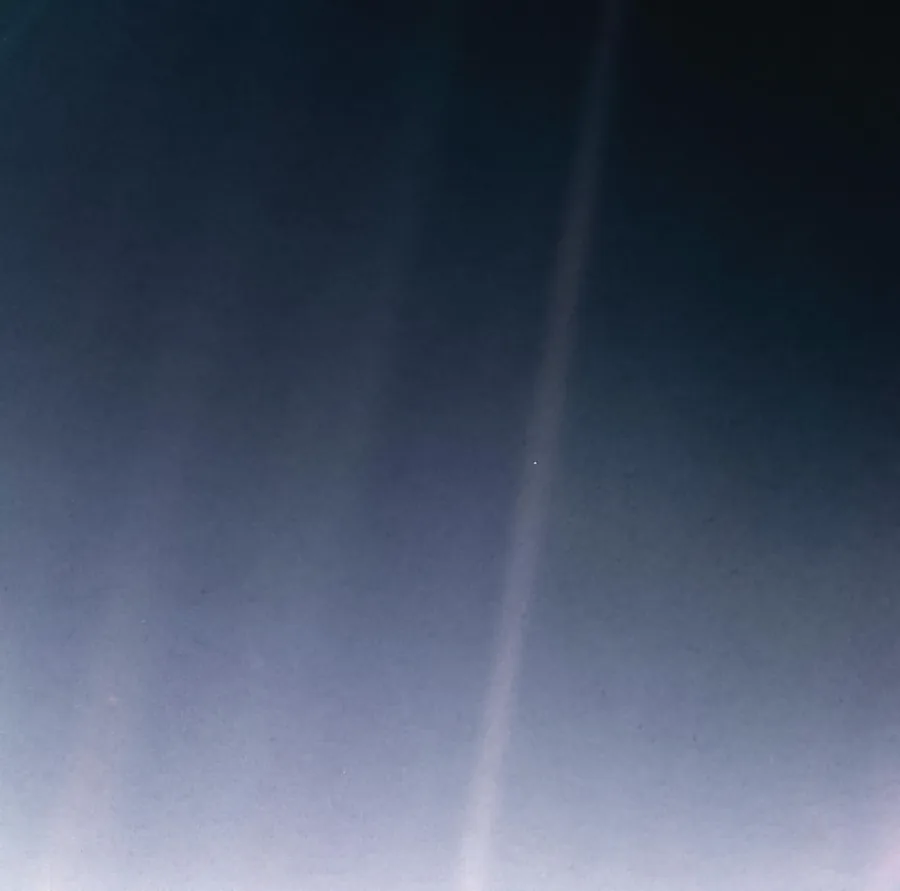
How large does Earth appear in that frame?
Less than one pixel. What shows is a patch of light wider than the planet, spread by the camera’s optics.
On board, since 1977
One of the greetings on the record is in Romanian
Each of the two craft carries a thirty-centimetre gold-plated copper disc. On it are 115 images, 35 sounds of Earth, ninety minutes of music, messages from President Jimmy Carter and from the Secretary-General of the United Nations, Kurt Waldheim, and greetings in 55 languages.
The list opens with Akkadian, a language of ancient Mesopotamia, and closes with the Chinese dialect Wu. Between them, in its alphabetical place, is Romanian.
NASA publishes only the English translation of what is said: “Greetings to everybody.” The sentence as spoken, in Romanian, is not in the list NASA publishes. The recording itself is on NASA’s own greetings page.
Swahili is missing from the record. The reason, given by Linda Salzman Sagan, who gathered the greetings, is that no speaker could be found in time.
How many languages are on the record, and is Romanian among them?
Fifty-five languages, and Romanian is one of them.
At the edge of the heliosphere, 25 August 2012
It left the Sun’s bubble. It did not leave the solar system
The Sun blows a wind of particles around itself which holds the matter between the stars at bay. The edge of that bubble is the heliopause. On 25 August 2012 Voyager 1 passed through it, the first craft to do so. Nearly eight years earlier, on 16 December 2004, it had crossed the termination shock, where the solar wind slows abruptly.
There is nothing to see there, and the craft no longer had a working plasma sensor. The answer came from the Sun: an eruption of March 2012 reached the spacecraft thirteen months later, and the plasma around it, NASA writes, “began to vibrate like a violin string”. On 9 April 2013 the instrument that listens to plasma waves caught it. The pitch gave the density: more than forty times what they had met at the edge of the heliosphere. Don Gurnett’s team at the University of Iowa published the result in Science on 12 September 2013; counting back, the crossing falls in August 2012.
From here the confusion starts. “Voyager 1 has left the solar system” is false by NASA’s own reckoning. Beyond the heliopause lies the Oort cloud, a shell of bodies still bound to the Sun, whose near edge is thought to sit somewhere between 2,000 and 5,000 astronomical units out. NASA writes that Voyager 1 will enter it in about 300 years and leave its far side in perhaps 30,000.
How long until Voyager 1 enters the Oort cloud?
About 300 years, according to NASA. And perhaps another 30,000 to pass its outer edge.
17 April 2026
The instruments go out, one at a time
The power on board comes from the heat of decaying plutonium. At launch the three generators together gave about 470 watts. By the beginning of 1997, after nineteen and a half years, some 335 were left. Today each craft loses about four watts a year.
Of the ten sets of instruments each Voyager carries, seven were off before this one. The order is not decided in a hurry: the science and engineering teams sat down years ago and settled what would be switched off and in what sequence.
On 27 February 2026, during a routine roll, Voyager 1’s power fell unexpectedly. On 17 April the command to shut down the low-energy charged particles experiment left for the spacecraft. The command would take some 23 hours to arrive, and the shutdown itself three hours and a quarter. A half-watt motor, the one that turns the sensor, was left running so the instrument could be switched back on if power is ever found.
Two instruments are still working on Voyager 1: the one that listens to plasma waves and the one that measures the magnetic field. In August 2026 the team completed on Voyager 2 a power-saving change it calls “the Big Bang”, swapping a group of devices all at once for less hungry ones, and plans the same operation on Voyager 1.
You have four watts to save. What do you switch off?
The team switched off an instrument. The heating has to stay or the fuel lines freeze; without the transmitter the craft goes silent for good.
18 November 2026, 10:16
One light-day, on three different days
A light-day is how far light travels in twenty-four hours: 25,902,068,371 kilometres. On 18 November 2026, at 10:16:07 by universal time, that is the straight-line distance between Earth and Voyager 1. NASA announces the very same second on California’s clock: 2:16:07 in the morning. No object made by people has ever been this far away.
At that instant nobody on Earth can know it has happened. The signal arriving at 10:16 left the craft a day earlier, from a closer position. Only on 19 November, at 02:17, has the signal reaching us genuinely spent twenty-four hours in flight.
Why sixteen hours later, when a day has twenty-four? In a day the craft alone puts another million and a half kilometres between itself and us. Were Earth to stand still, the distance would grow by exactly that much in a day, and the threshold would arrive a day later. In November, though, Earth is drawing away from the craft as well, so the distance grows by some twenty-five kilometres a second, faster than the seventeen the craft manages alone. It adds up sooner, and the threshold arrives after sixteen hours.
And there is a third date. Measured from the Sun rather than from Earth, the same line is crossed on 3 February 2027, at about 21:39. Earth travels round the Sun and moves the reckoning by up to one astronomical unit either way.
All three dates come out of the same published NASA laboratory ephemeris, asked for three different quantities. Which one is “the moment” depends entirely on the question.
Measured from where, to give 18 November 2026?
From Earth, in a straight line, at that instant. Measured by the signal’s journey the moment comes on 19 November; measured from the Sun, on 3 February 2027.
Three things to try
Where Voyager 1 was when you were born
Pick a year. The marker on the axis moves to where the craft stood that year, and the numbers below say how far it had already come.
How long the signal takes today
The distance grows by about three and a half units a year, so the signal's journey grows with it. Pick a date and see how long a message is on its way.
You have four watts a year to save
Of the ten sets of instruments, seven are already off. Choose what you would switch off now, and see what the mission team chose.
The story's numbers, in brief
| One light-day | 25,902,068,371 kilometres |
|---|---|
| Voyager 1 from the Sun, 21 September 2026 | 171.82 astronomical units, or 25,703,845,212 kilometres |
| Voyager 2 from the Sun, the same day | 144.00 astronomical units |
| How much farther Voyager 1 goes in a year | 3.56 astronomical units |
| The straight-line distance reaches one light-day | 18 November 2026, 10:16:07 universal time |
| The signal received has genuinely been twenty-four hours in flight | 19 November 2026, 02:17 |
| Measured from the Sun rather than from Earth | 3 February 2027, about 21:40 |
| From launch to one light-day | 17,970 days |
| Power at launch, from three generators | about 470 watts |
| Power at the beginning of 1997 | some 335 watts |
| Instruments switched off, of the ten sets | seven |
| Languages greeting on the golden record | 55, Romanian among them |
Quiz: what happened and what did not
Eight statements. Choose, then see what the sources say.
The two Voyagers were funded from the start to visit four planets.
False. The four-planet tour was judged too expensive. NASA writes that “the Voyagers were funded to conduct intensive flyby studies of Jupiter and Saturn only”. Voyager 2 reached Uranus and Neptune by a decision taken later.
Voyager 1 launched after Voyager 2 and overtook it in the same year.
True. Voyager 2 left on 20 August 1977, Voyager 1 on 5 September, and on 15 December 1977 it passed its twin.
The volcano on Io was found by a team looking for volcanoes.
False. Linda Morabito was working on optical navigation and looking for a reference star. She stretched the contrast to see it, and the mark beside Io appeared then.
Linda Morabito, 'Discovery of Volcanic Activity on Io. A Historical Review', 2012
Voyager 1 could reach no planet after Saturn, because of the Titan flyby.
True. The trajectory to Titan lifted the craft out of the plane of the planets. It could have been aimed at Pluto, but Titan and the rings took priority.
There is a greeting in Romanian on the craft’s golden record.
True. Romanian is one of the 55 languages on the record. NASA publishes only the English translation of what is said: “Greetings to everybody.”
Voyager 1 left the solar system in 2012.
False. In 2012 it left the heliosphere, the bubble blown by the Sun. The Oort cloud, also bound to the Sun, begins far further out: NASA writes that the craft enters it in about 300 years.
In 2026 a command sent to Voyager 1 takes nearly a day to arrive.
True. NASA writes that the shutdown sequence of 17 April 2026 needed some 23 hours to reach the spacecraft.
On 18 November 2026 the signal arriving on Earth has been in flight exactly one day.
False. At that instant the straight-line distance is one light-day, but the signal arriving then had left from closer in. The signal that has genuinely spent twenty-four hours in flight arrives on 19 November, at 02:17.
What the sources cannot say
- The sentence spoken in Romanian on the golden record. NASA publishes only the English translation, “Greetings to everybody.”, and gives no original text of the greetings.
- Why “176 years” is repeated for the planets’ arrangement. Two NASA pages say 175, and neither figure comes with a published calculation.
- What damaged the onboard computer’s memory in 2023. NASA suspects that a single chip has stopped working, and says plainly that whether it was struck by a particle or simply wore out cannot be told.
- How much power Voyager 1 has today. The sources give 470 watts at launch, some 335 at the beginning of 1997 and a loss of about four watts a year. No present-day figure is published anywhere.
- What density exactly the plasma-wave instrument measured in 2013. The laboratory’s statement gives the ratio, more than forty times, and the Science paper that gives the figures requires a subscription.
Sources
The distances, the dates and the signal’s travel times are computed from the Jet Propulsion Laboratory’s published ephemeris for Voyager 1, requested once and kept with the project: the craft’s position every thirty days from launch to 2027, its daily distance from Earth, and the signal’s travel time around 18 November 2026. The instant NASA announces for one light-day comes out of that ephemeris to the same second. Distances are measured from the centre of the Earth. The figures on the page are those of 21 September 2026.
- NASA Science — Voyager 1: What Is a Light-Day
- JPL Horizons, the Voyager 1 ephemeris
- JPL, the release of 12 September 2013 on the crossing into interstellar space
- NASA Science — Voyager 1
- NASA Science — Voyager 2
- NASA Science — Planetary Voyage
- NASA Science — Voyager frequently asked questions
- NASA SP-4219, 'Voyager: The Grand Tour of Big Science'
- Linda Morabito, 'Discovery of Volcanic Activity on Io. A Historical Review', 2012
- NASA Science — Pale Blue Dot (PIA23645)
- NASA Science — Golden Record Greetings
- NASA Science — Oort Cloud facts
- NASA Voyager mission blog, 17 April 2026
- NASA Voyager mission blog, 4 August 2026
- NASA Voyager mission blog, 4 April 2024
- NASA NSSDCA — Voyager 1 record
- The photograph is NASA/JPL-Caltech, public domain, used with the credit the laboratory asks for.