The night sky · Saturn
Saturn's rings: 274,000 kilometres across, about ten metres thick
Tonight Saturn is the bright, yellowish point in the evening sky, and a small telescope shows how far its rings are tilted: a narrow ellipse in 2026, wide open by 2032. Follow the rings from Galileo's letters down into the ice they are made of, through the years of your own life and along the route of the Cassini spacecraft.
Saturn tonight from London.
Another town · Watch the journey as a film, without the text
To the naked eye it is just a point. Through a small telescope the point becomes a little ball with a narrow ellipse across its middle: the rings, open less than 10° this year, a year after they stood edge-on to Earth.
What did Galileo see when he looked at Saturn?
In July 1610 Galileo turned his telescope on Saturn and saw something nobody had described. On 30 July he wrote to Belisario Vinta that “the star of Saturn is not a single one, but a composite of three, which almost touch”, and drew it.

Two years later the two companions were gone. “Has Saturn perhaps devoured his own children?” Galileo asked in a letter to Mark Welser dated 1 December 1612. The geometry explains it: that day the rings were tilted only 3.2° toward Earth, and sunlight was striking them almost edge-on, at 0.4°.
By 1616 the companions were back, changed. For almost half a century astronomers drew Saturn with ears, arms or crescents, until Christiaan Huygens printed the answer in Systema Saturnium (1659): Saturn “is surrounded by a thin, flat ring, touching it nowhere, inclined to the ecliptic”.

In 1675 Giovanni Domenico Cassini noticed that “the breadth of the ring was divided by a dark line into two equal parts”. The gap still carries his name: the Cassini Division.
How many times have Saturn's rings vanished in your lifetime?
Saturn takes 29.4 years to go round the Sun, and its rings stay tilted the same way in space. Twice in every Saturn year the Earth passes through the plane of the rings (once, or three times in a row, in a single season), and for weeks or months they shrink to a line too thin for small telescopes. In between they open to about 27°, showing Earth first one face, then the other.
Drag the picture left or right to change the year.
Every season since 1900 in which the rings stood edge-on to Earth, and the next
| Season | Earth crosses the ring plane |
|---|---|
| 1907–08 | 13 April 1907, 3 October 1907, 7 January 1908 |
| 1920–21 | 8 November 1920, 22 February 1921, 4 August 1921 |
| 1937 | 21 February 1937 |
| 1950 | 14 September 1950 |
| 1966 | 2 April 1966, 28 October 1966, 18 December 1966 |
| 1979–80 | 27 October 1979, 12 March 1980, 23 July 1980 |
| 1995–96 | 22 May 1995, 10 August 1995, 12 February 1996 |
| 2009 | 4 September 2009 |
| 2025 | 23 March 2025 |
| 2038–39 | 15 October 2038, 1 April 2039, 9 July 2039 |
The rings were most widely open to Earth in 1915, 1929, 1944, 1958, 1973, 1988, 2003 and 2017; next in 2032.
How thin are Saturn's rings?
On 23 March 2025 the Earth crossed the ring plane again. Nobody could see it: Saturn was about 10° from the Sun, lost in its glare. By 24 November 2025, in the evening sky, the rings had closed again to within 0.4° of edge-on.
Seen exactly edge-on they almost disappear, because they are so thin. The main rings measure about 274,000 km from edge to edge, 71% of the distance from the Earth to the Moon, but NASA gives their typical thickness as about ten metres.
Shrunk to the thickness of a sheet of paper, the rings would be a sheet about 2.7 km wide. NASA's ring fact sheet gives 5 to 30 metres depending on the ring, which makes the sheet between about 1 and 5.5 km wide.
What are Saturn's rings made of?
Ice. The main rings are “strongly dominated by water ice”, in the words of a 2023 review, with small amounts of silicate rock and other darker material. They are not a solid disc: in 1859 James Clerk Maxwell showed that a rigid ring could not be stable, so the rings must be countless separate pieces, each on its own orbit. In 1895 James Keeler confirmed it with a spectroscope: the inner parts of the rings go round faster than the outer parts.
The pieces “mostly range from tiny, dust-sized icy grains to chunks as big as a house”, in NASA's words. This drawing follows that range: from a centimetre to five metres, many more small pieces than large ones, spaced so that the layer blocks about as much light as the A ring does.
It is a drawing: no camera has been inside the rings.
How were Saturn's rings measured?
On 3 May 2005, as seen from Earth, Cassini passed behind the rings and beamed a radio signal of 3.6 cm wavelength through them to a NASA antenna. How much of the signal got through, every 250 metres from the inner edge outwards, shows how much material is in the way. The rings in the picture are drawn after that measurement: where the signal passed easily they are translucent; through the core of the B ring almost nothing got through.
Each piece follows Kepler's laws: the closer to Saturn, the faster it goes. At the inner edge of the C ring a lap takes 5 h 43 min; at the outer edge of the A ring, 14 h 18 min. Saturn's interior turns in about 10 h 34 min (a 2019 estimate from ring seismology), so the inner rings outrun the planet beneath them and the outer rings lag behind. The two periods are equal about 111,800 km from the centre, inside the B ring.
The Cassini Division begins where the B ring stops, about 117,600 km from the centre, according to this measurement. A piece there goes round in 11 h 24 min, about half the time the moon Mimas takes to orbit Saturn (22 h 37 min), so Mimas pulls on it at the same point of its orbit once every two laps. That repeated pull, a 2:1 resonance, holds the B ring's edge in place. The resonance lies at about 117,560 km (Spitale and Porco, 2010); the edge swings tens of kilometres in and out around it, partly from Mimas's pull and partly from its own oscillations, and on 3 May 2005 it lay about 90 km further out.
Further out, two small moons keep their paths clear: Pan, in the Encke Gap, about 320 km wide, and Daphnis, in the Keeler Gap, about 40 km wide. Their pull raises waves on the gap edges, which Cassini photographed. The waves in the picture are drawn after those photographs, but taller than life.
What did Cassini find between the rings and the planet?
Cassini reached Saturn on 1 July 2004 and orbited it for 13 years. In 2017 it was sent on 22 dives through the gap between the innermost ring and the cloud tops, the first on 26 April. On 15 September 2017 it entered Saturn's atmosphere; its last signal reached Earth at 11:55 UTC.
The dives weighed the rings directly, by their pull on the spacecraft: about 1.5 × 10¹⁹ kilograms (±0.5), 0.41 times the mass of the moon Mimas (Iess and colleagues, 2019). Rings this light would long since have been darkened by dust from space if they were old, so the team concluded they may have formed 10 to 100 million years ago; a 2023 study of the dust falling onto them set the limit at no more than a few hundred million years. A study published in December 2024 argues that most of that dust vaporizes when it strikes the ice and is swept out of the rings instead of sticking, so the rings may only look young and could be much older.
The rings are also losing material. Ice from them falls into Saturn, 432 to 2,870 kilograms every second by one estimate (O'Donoghue and colleagues, 2019); if that rate held in every Saturn season, this rain alone would drain the rings in about 300 million years.
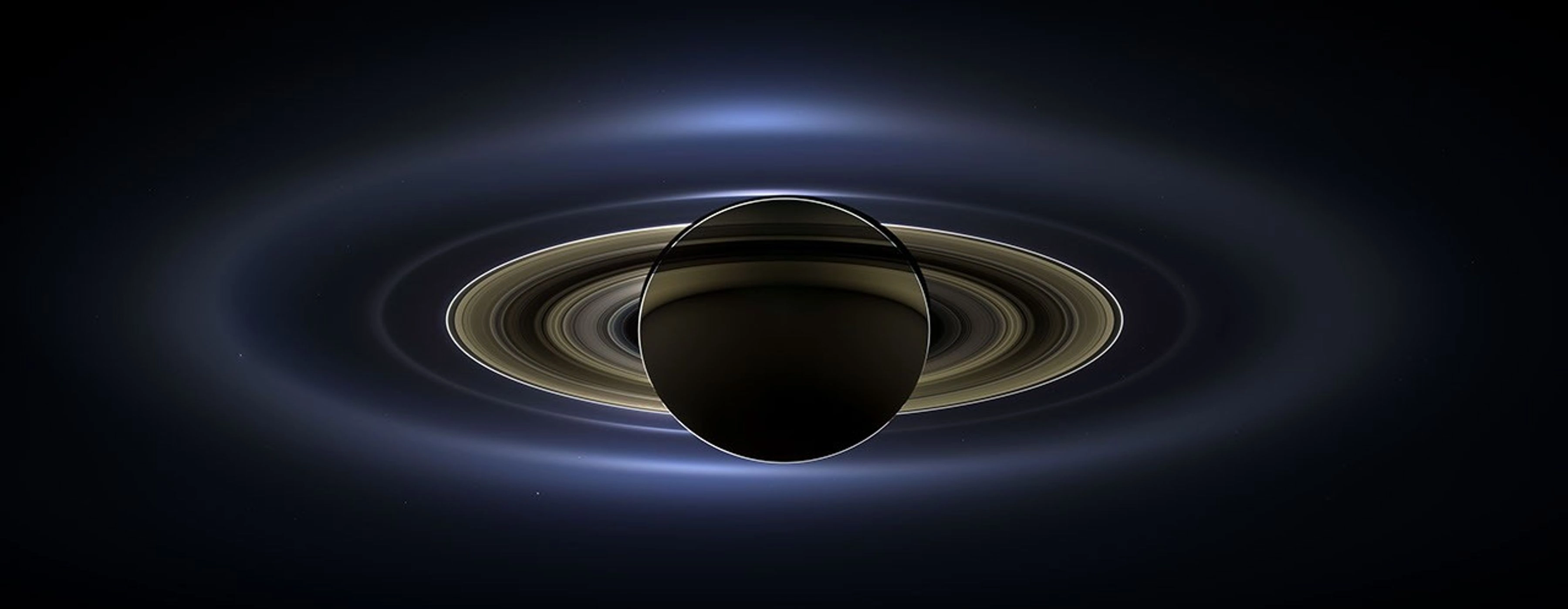
On 19 July 2013 Cassini slipped into Saturn's shadow, turned back towards the Sun and photographed Earth from nearly 1.5 billion km away, between 21:27 and 21:42 UTC. Earth is the pale dot below the bright main rings. If you were alive that day, you are in that dot.
 Earth
Where is Saturn in the sky tonight?
Back on Earth, Saturn is only a point in the sky again.
The rings will open widest to Earth on 12 May 2032, at 27°, showing their southern face. They stand edge-on to Earth again on 15 October 2038.