Transylvania, measured by the ploughing day
How big is an iugăr? As much as two oxen plough in a day
A Transylvanian iugăr covers 5,755 square metres: a square 76 metres on a side. The name comes from the ox yoke — the word Rome used to measure its fields, carried into Transylvania's land books and the allotments of 1921.
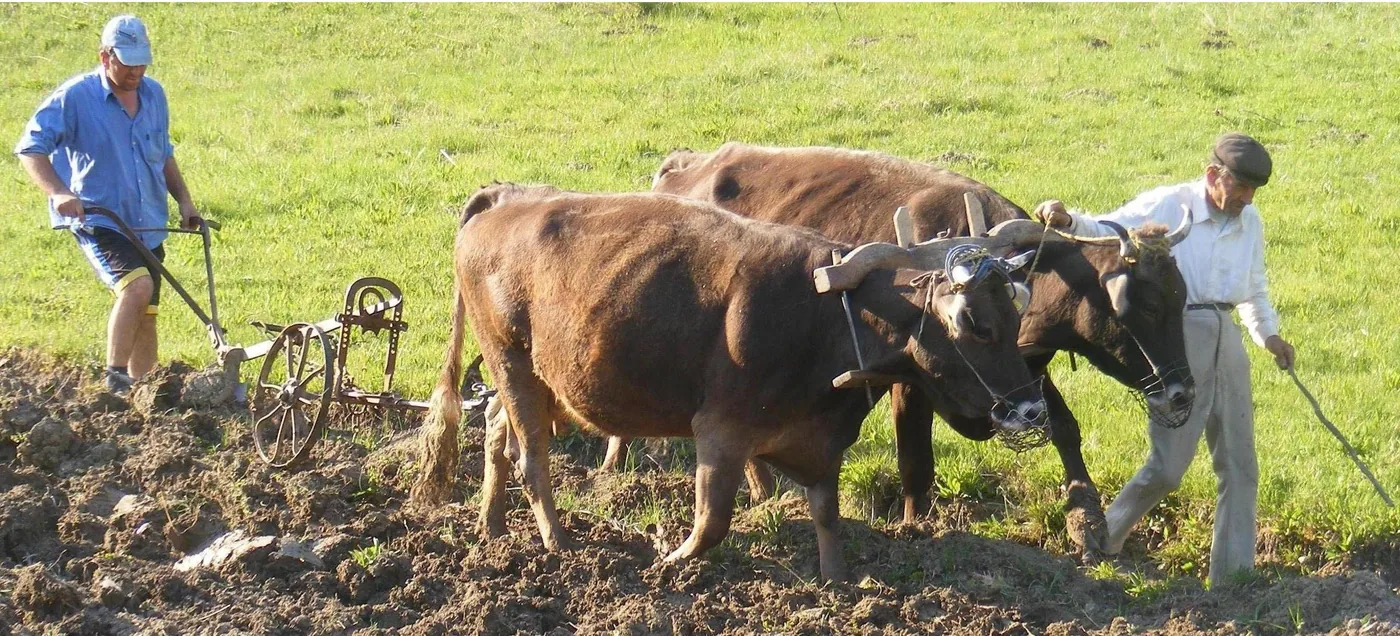

The yoke: a tool that became an area
The yoke is the wooden beam that sits on the necks of oxen harnessed to a cart or a plough. The Romanian word jug comes straight from Latin iugum, with no detours.
- iugumjugthe wooden beam on the oxen's necks; originally also the pair of oxen (DEX, MDA2).
- iugerumiugărthe old Transylvanian unit of 1,600 square fathoms; variant jugăr (DEX, DLRLC).
The academic dictionary goes further: in an old regional sense, the jug itself is "the area of land that can be ploughed in a day with a pair of oxen". Tool, team, and working day each took their turn inside the same word.
Everything else follows from that: an iugăr is, at its origin, what two oxen plough in a day.
In Rome: 2,520 square metres
The Romans wrote the definition down. Varro says a iugum is the area a pair of oxen ploughs in a day. Pliny the Elder adds the technical detail: an actus — 120 feet — is what the oxen plough in one spell, without stopping; two actus lengths make one iugerum.
"They call a iugum the area which a pair of oxen can plough in a day."
The Roman reckoning gives 28,800 square feet, about 2,520 square metres: a rectangle twice as long as it is wide, 240 by 120 feet. A quarter hectare worked in a day.
- Shape
- A rectangle 240 by 120 Roman feet
- Area
- About 2,520 m²
- The day
- One pair of oxen, morning to evening
In Transylvania: 5,755 square metres
The Transylvanian iugăr is over twice the Roman one. It measures 1,600 square fathoms, and the cadastral square fathom covers 3.5966 square metres. The multiplication gives 5,754.64 square metres — 5,755, rounded. The DEX dictionary rounds differently, to 5,775; the cadastral reckoning stays 5,755.
And 1,600 is a handsome number: 40 times 40. The cadastral iugăr is a square 40 fathoms on a side, which is 76 metres. The village boundary, divided into 76-metre squares — that is what the land books measured.


Not every iugăr was the same. The small Hungarian hold covered 1,200 square fathoms — 4,316 square metres, exactly three quarters of the cadastral iugăr. Local reckonings here and there ran between 1,100 and 1,300 square fathoms; the imperial cadastre fixed 1,600.
South of the Carpathians the measure was called the pogon: about half a hectare, 5,012 square metres — 743 square metres smaller than the Transylvanian iugăr. Another word, another reckoning.
How big was your iugăr?
Pick a region. The drawing shows each measure at its true scale, next to the cadastral iugăr.
5,755 m²
- 0.58 ha
- side of the equal-area square: 76 m
- division: 40 × 40 fathoms
| Region | Measure | Area | Side |
|---|---|---|---|
| Ancient Rome | iugerum | 2,520 m² | 50 m |
| Transylvania | cadastral iugăr | 5,755 m² | 76 m |
| The small hold | magyar hold | 4,316 m² | 66 m |
| Wallachia | pogon | 5,012 m² | 71 m |
The 1921 reform counted in iugăre
The metric system became law in Romania on 15 September 1864, under Cuza. In Hungary — Transylvania included — the change to metric was decided in 1874 and became compulsory in 1876. Even so, Transylvanian land was divided in 1921 counted in iugăre.
The law of 30 July 1921 for Transylvania, Banat, Crișana, and Maramureș worked from the land books inherited from the Empire — and the land books kept their accounts in iugăre. The allotments were written in the same unit the estates had been measured in.


The dictionaries still list it: the DEX calls it an "old unit of measure", and the literary dictionary quotes prose in which people sell "the four jugăre of land". Two thousand years from the Roman plough to the village auction — measured by the same yoke.
- 37 BC – AD 77Varro and Pliny the Elder define the iugerum: what a pair of oxen ploughs in a day.
- 1864Cuza's metric law: the metre becomes law in Romania.
- 1876The metre becomes compulsory in Hungary, Transylvania included.
- 1921The land reform divides Transylvania counted in iugăre.
Sources
The etymologies are from the dexonline dictionaries (DEX, MDA2, DLRLC). The Varro and Pliny passages are in the rendering by Marius Comper.
- dexonline: DEX, MDA2, DLRLC for iugăr, jugăr, jug, and pogon. dexonline.ro/definitie/iugar
- Varro, On Agriculture 1.10 (the iugum: a ploughing day). en.wikisource.org
- Pliny the Elder, Natural History 18.3 (the iugerum: two actus lengths). perseus.tufts.edu
- Wikipedia: "Jugerum" (28,800 square feet). en.wikipedia.org/wiki/Jugerum
- Hungarian Historical Review 9/2 (2020): the cadastral hold of 1,600 square fathoms is 5,755 m². epa.hu
- Hungarian Studies 4/1 (1988): the Hungarian yoke ran between 1,100 and 1,300 square fathoms; the cadastral one was fixed at 1,600. epa.niif.hu
- Rowlett, Dictionary of Units: the small hold of 1,200 square fathoms. ibiblio.org/units/dictH.html
- Wikipedia: "Romanian units of measurement" (the square fathom, the pogon, the survival of old measures). en.wikipedia.org/wiki/Romanian_units_of_measurement
- The law of 30 July 1921 for the land reform in Transylvania, Banat, Crișana, and Maramureș, M. Of. 93/1921; the reform worked from the land books (RRID 2022/2). rrid.ro
- Analele UAIC, Istorie LXXI/2025: the Transylvanian reform areas counted in iugăre. biblioteca-digitala.ro
- The metric law of 15 September 1864 (NOEMA/CRIFST; INM). noema.crifst.ro
- Wikipedia: "Hungarian units of measurement" (metric adopted 1874, compulsory from 1876). en.wikipedia.org/wiki/Hungarian_units_of_measurement