Joia Verde, Bucharest's Catholic Corpus Christi · 7 June 2026
Corpus Christi on the streets of Bucharest: the route from the Italian Church to St Joseph's
On 7 June 2026 a procession crossed central Bucharest: children scattering petals and a brass band at the front, priests and a canopy further back. Under the canopy, past the Crețulescu Church, the Roman Catholic archbishop carried the Eucharist in a monstrance. The map follows the procession along the roughly 1.2 km between the two churches, with the document that describes each stop.
- ≈ 1.2 kmalong the streets announced for 2026, church to church
- 15:00–16:00walking time in the schedule the police announced
- 3 namesin three documents, for the same street beside the Crețulescu Church
#What does the archbishop carry under the canopy?
In the Roman Catholic Archdiocese of Bucharest's photographs of 7 June 2026, the canopy passes the Crețulescu Church, the Orthodox brick landmark next to the former Royal Palace, over tarmac strewn with petals. Children with petals and the band lead the column; further back comes the canopy, surrounded by priests. Under the canopy, Archbishop Aurel Percă holds a gilded vessel with rays.
The vessel is a monstrance, and through its centre you can see a host consecrated at Mass. Catholics believe that Christ is truly present in the Eucharist. That is why the host is carried under a canopy, with singing, and flowers are strewn in its path. The Catechism of the Catholic Church lists carrying consecrated hosts in procession among the ways the Eucharist is adored outside Mass.
The Archdiocese's report also explains the petals: they are scattered by children who have made their First Communion, that year or in earlier years, as a sign of innocence.
In Romania the feast of the Body and Blood of Christ, Corpus Christi (Corpus Domini), is popularly called Joia Verde, "Green Thursday". The Archdiocese links the name to the altars decorated with "plenty of greenery" (2011) and with flowers (2026) for local processions. The feast falls on the Thursday 60 days after Catholic Easter, and is unrelated to Maundy Thursday. In 2026 the Italian Church kept its feast day on Thursday 4 June, and the city procession went out on Sunday 7 June. A 2011 Archdiocese notice explained the move to Sunday as a way to let more people take part.
#Where the procession goes, street by street
The 2026 procession set out from the Italian Church and ended at St Joseph's Cathedral. On today's map, the streets announced by the Archdiocese and the Traffic Police add up to about 1.2 km. The distances below are measured along the street centrelines and rounded: a participant walks on the pavement or in a lane, crosses at the crossings and is somewhere particular in the column.
1the start
The Italian Church, 28 Nicolae Bălcescu Boulevard
"between 14:30 and 15:00, participants gather at the Italian Church at 28 Nicolae Bălcescu Boulevard, on the pavement"
Participants gather on the pavement outside the church between 14:30 and 15:00. The Archdiocese's call asked for children with petals, altar servers, scouts, volunteers and priests. The church's official name is the Most Holy Redeemer, and its parish priest dates its consecration to 2 July 1916.
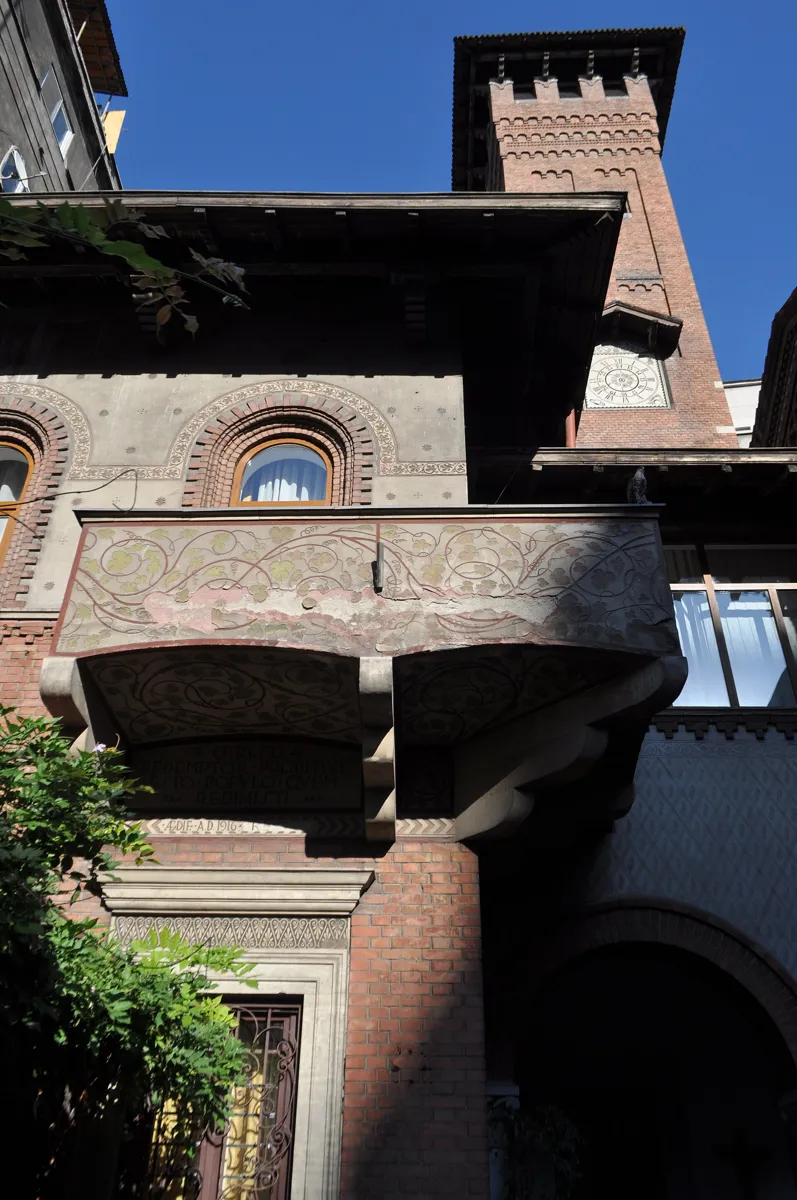

2≈ 60 m from the start
Towards University Square, then Dem. I. Dobrescu Street
"on the left-hand pavement, heading towards University Square, as far as the junction with Dem. I. Dobrescu Street"
The first steps are on the boulevard's pavement, towards University Square, as far as the corner of Dem. I. Dobrescu Street. There the procession turns west.
A 2018 notice called this stretch "Onești Street". That was the old name of the same street: a 2012 prefect's order lists "Demetru I. Dobrescu, (formerly Onești)". The notice does not describe a different route.
3≈ 350 m from the start
Revolution Square and Calea Victoriei
"Dem. I. Dobrescu St - Revolution Square - the street between the Crețulescu Church and the Royal Palace"
Dobrescu Street opens into Revolution Square, next to the Central University Library. In the Archdiocese's 2025 photographs, the procession appears here with the library behind it.
On 7 June 2026, Calea Victoriei had another programme too. ARCUB, the city's cultural centre, had announced "Open Streets": the avenue was for pedestrians from 10:00 to 22:00, with junctions open to cars, and from midday there was open-air painting on canvas on the pavement outside the National Museum of Art. The documents show that the promenade and the procession overlapped in time and place. They do not say whether the crowds mixed or whether the promenade changed anything about the procession's route.
4≈ 430 m from the start
The street between the Crețulescu Church and the Royal Palace
One 220-metre street, three names
- Archdiocese, 2026
the street between the Crețulescu Church and the Royal Palace
Roman Catholic Archdiocese of Bucharest, notice published by AGERPRES, 5 June 2026translated from Romanian - Police, 2026
Calea Victoriei - Walter Mărăcineanu St - Ion Câmpineanu St
Bucharest Traffic Police, notice published by AGERPRES, 4 June 2026translated from Romanian - Police, 2021
cross Calea Victoriei - Aleea Kretzulescu - Ion Câmpineanu St
Mihai Stoica, AGERPRES, reporting the Traffic Police notice, 4 June 2021translated from Romanian
Here the two 2026 documents describe the same place in different ways. The Archdiocese's notice, addressed to the faithful, names the buildings anyone recognises: the church and the palace. The police notice, which ends with advice for drivers, gives the street's official name, Walter Mărăcineanu. The 2021 police notice used a third name: "Aleea Kretzulescu", Kretzulescu Lane.
On today's map all three fit the same stretch of street, about 220 m long, which leaves Calea Victoriei just north of the church and runs to Ion Câmpineanu Street. The church stays to the south; the palace, now the National Museum of Art, to the north. In the Archdiocese's photographs from 2025 and 2026, the procession passes the brick walls and towers of the Crețulescu Church.
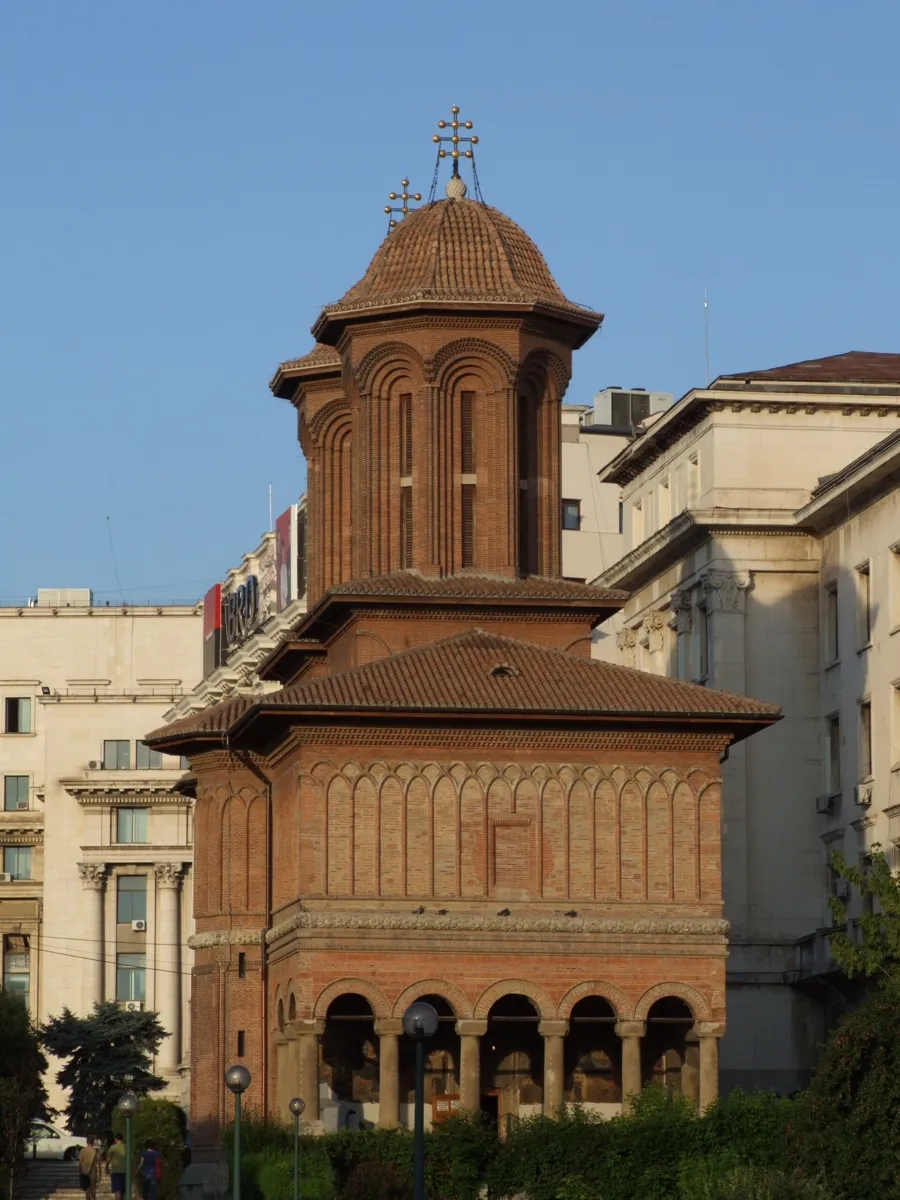

A name can also mislead. In Cișmigiu Gardens, more than 450 m to the west, next to the Crețulescu Palace, there is a path actually called Aleea Crețulescu. The procession does not go there: the 2021 notice places the lane straight after crossing Calea Victoriei and before Ion Câmpineanu Street.
5≈ 650 m from the start
Ion Câmpineanu Street
"The procession will move in lane I [...] and main roads will be crossed only at pedestrian crossings."
Behind the palace, the procession heads north along Ion Câmpineanu Street. For 2026 the police announced that traffic would be restricted in lane I along the route and on the streets leading into it for the duration of the procession, and on General Berthelot Street gradually, as participants reached the cathedral, until about 17:00. The first stretch, from the Italian Church to Dobrescu Street, stayed on the pavement.
6≈ 900 m from the start
Luterană Street
"Ion Câmpineanu St - Luterană St, ending at St Joseph's Cathedral"
Luterană Street runs past the Evangelical Lutheran church and takes the procession on northwards, about 270 m, to General Berthelot Street.
7≈ 1.2 km from the start
General Berthelot Street, St Joseph's Cathedral
"ending at St Joseph's Cathedral (19 General Berthelot St) at 15:45-16:00"
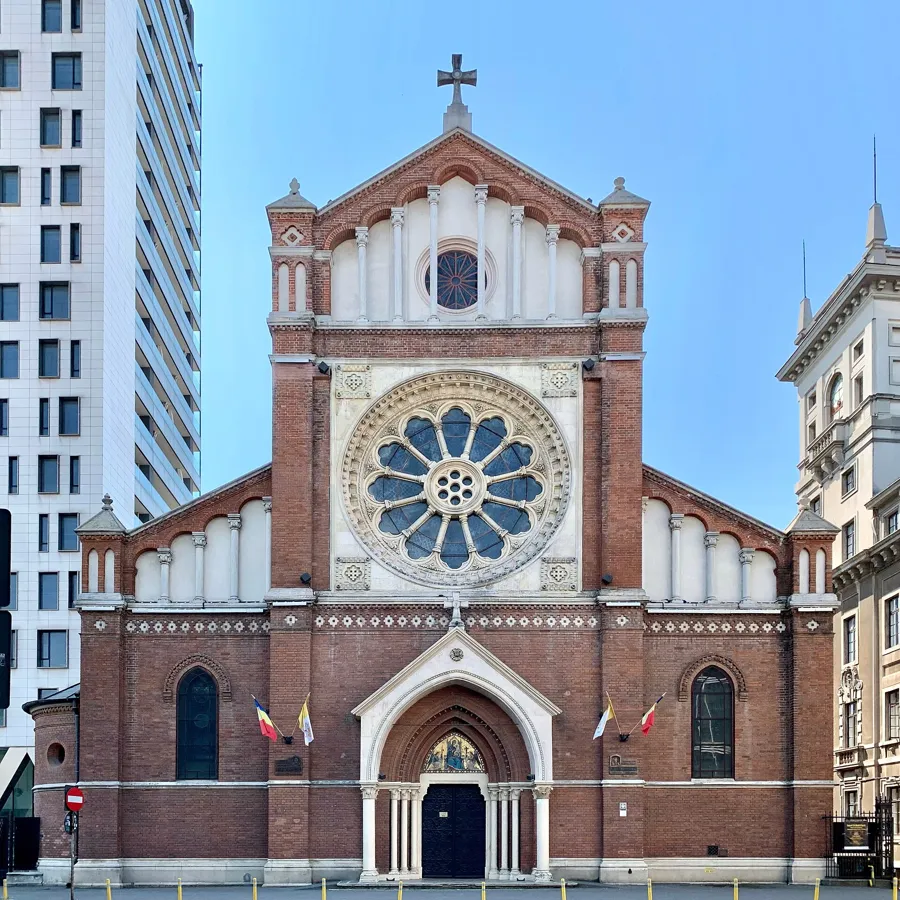
The last metres are along General Berthelot Street to the cathedral. There the archbishop celebrated Mass, broadcast live by Angelus TV, as was the procession. Work on the cathedral began in the summer of 1873, and its foundation stone was blessed on 19 September 1875.
The two churches are about 1.2 km apart by street and about 790 m apart in a straight line. The 2023 report spoke of roughly an hour on foot.

#Same route, different instructions: 2021 and 2026
"Participants will move in groups of six people, on the pavement, observing all traffic rules in force"
For 6 June 2021, the police described the same corridor with different rules: walking "exclusively on the pavement", crossing at crossings and "groups of six people". The notice does not say why. In 2026 only the start was on the pavement; the rest of the route was announced in lane I of the road.
- 2021: on the pavement, in groups of six
- 2026: pavement at the start, then lane I
The comparison is between two published plans. For 2026 there are also photographs showing the procession on the road beside the Crețulescu Church. For 2021 no report or footage has been found showing how people actually walked.
#1908: when the cathedral was the starting point
The oldest mention found of a Corpus Christi procession in Bucharest is a memory. In a letter from Bucharest published on 15 May 1909 in Unirea, the Greek Catholic newspaper of Blaj in Transylvania, a correspondent unsigned in that issue recalled the feast "of last year", so 1908. The procession had left the cathedral and gone "as far as the courtyard of the Seminary". The letter gives neither the day nor the streets.
Pag. 172.UNIREANr. 19.
Imi aduc aminte din anul trecut de sărbătoarea dela Joia verde a catolicilor din Bucureşti când au făcut o procesiune din catedrală până în curtea Seminarului, şi cu care ocaziune s’au făcut decoraţiuni cu inscripţiuni; ei bine, cine i-ar fi putut opri pe catolicii noştri ca acelea inscripţiuni să le facă în limba franceză, italiană, germană şi chiar maghiară, căci acestea naţiuni sunt poporenii catedralei? Nimenea! Şi cu toate acestea acelea inscripţiuni au fost făcute în limba românească şi latinească, adecă tot limba noastră.
St Joseph's Cathedral, today's destination, was then the starting point. The Italian Church did not yet exist. "The courtyard of the Seminary" can be read two ways. In 1893 the seminary had moved into its own building in the cathedral courtyard. In 1906 Archbishop Raymund Netzhammer moved the seminarians to the Archbishop's Palace on Esculap Street, today the Apostolic Nunciature, about 550 m to the south-west. The building in the cathedral courtyard remained a Catholic school. The map shows both places with no line between them: no document found says which way the procession went.
The correspondent was not writing about the procession for its own sake. The letter is a polemic about language and denomination, and the procession is his example: the inscriptions on the decorations had been made "in Romanian and Latin", even though, he writes, the cathedral's parishioners were French, Italian, German and Hungarian.