mariuscomper.uk Română

Maritime optics · 1822–1900

The Fresnel lens: how a cage of glass carried a flame to the horizon

A single lamp burning in a tower wastes almost all its light into the sky and onto the waves below. To fold that sphere into a horizontal blade, ailing French physicist Augustin Fresnel carved a giant lens into concentric steps and surrounded it with crystal prisms.

Chapter I · The horizon

A night that swallows fire

A flame burning freely atop a coastal tower radiates in every direction: upward into the clouds, downward onto the rocks, and landward behind the tower. The narrow ±5-degree band that actually reaches the sea horizon receives just 8.7% of the light; 91.3% is wasted.

For centuries, keepers burned wood, tallow candles, or oil lamps in front of polished metal reflectors. Yet metal absorbs nearly half the light at every bounce, and salt spray dulls its polish within months.

Chapter II · The focal point

Four concentric wicks

At the centre of the apparatus burns a rapeseed-oil lamp designed by Fresnel with François Arago: four concentric circular wicks fed under steady pressure by a clockwork pump.

Contained inside a tall glass chimney, the bright flame stays compact at exactly 920 millimetres from the future glass panels. The tighter the source sits at the focal point, the sharper the beam leaving the tower.

Chapter III · Impossible glass

Why you cannot cast a two-metre magnifier

To collimate light into a parallel beam at a 920-millimetre focal length, a conventional curved lens spanning just the central ±30-degree belt would have to be 288 millimetres thick at its centre.

A solid block of that size would weigh several tonnes, crack while cooling in the foundry, swallow a large share of the light passing through its own bulk, and overwhelm any clockwork drive trying to spin it.

Chapter IV · 29 July 1822

Only the surface bends the ray

Augustin-Jean Fresnel started from a clean optical truth: the interior bulk of a glass lens does nothing to steer light. Only the tilt of the surface where a ray enters and exits obeys Snell’s law of refraction.

By slicing out the dead interior glass and stepping the curved faces into concentric annular rings, Fresnel collapsed that 288-millimetre profile down to at most 119 millimetres. The central ±30-degree dioptric belt alone captures 50% of the entire sphere of light.

Chapter V · First light

25 July 1823: eight panels at Cordouan

The first full-scale first-order lens was lit on 25 July 1823 at the Phare de Cordouan, guarding the Gironde estuary in France. Its octagonal drum carried 8 stepped dioptric panels, 60 metres above the sea.

One detail is often misremembered: in 1823, curved glass prisms could not yet be ground at scale. Above and below the octagonal glass drum, Fresnel mounted angled silvered-metal mirrors to catch the steep rays escaping vertically.

Chapter VI · 1825–1842

A cage of total internal reflection

In late 1825, Fresnel designed triangular glass prisms to replace those metal mirrors. A steep ray enters the prism, strikes its back face beyond crown glass’s critical angle (41.14° for n = 1.52), and bounces horizontally by total internal reflection with zero metallic absorption.

He built a small working model for the Canal Saint-Martin in 1826, but died of tuberculosis in July 1827 at age 39. His brother Léonor Fresnel and Scottish engineer Alan Stevenson scaled catadioptric rings into full coastal towers between 1836 and 1842, lifting geometric capture to 87.5% of the sphere.

Chapter VII · Snell’s law live

Move the lamp off focus and watch the beam break

Every stepped ring and every prism is ground for a flame sitting at the exact focal point. Shift the lamp a few centimetres up or down and the collimation breaks: half the beam climbs into the clouds while the other half plunges into the sea.

Switch optical modes, turn chromatic dispersion on or off along the prism edges, or slide the lamp vertically to inspect real-time refraction and total internal reflection inside the cutaway.

Optical assembly
0 mm

Chapter VIII · 1890–1893

Two tonnes floating without friction

A complete first-order glass-and-brass cage weighs more than two tonnes. Resting on bronze rollers, it turned sluggishly, producing slow flashes separated by a minute or more.

Fresnel had sketched floating the lens in liquid mercury as early as 1825. French engineer Léon Bourdelles perfected the system in 1890 and put it into service at Cape La Hève in 1893: an annular cast-iron trough filled with mercury supported the entire lens so lightly that a finger could push it, ushering in rapid lightning-flash beacons.

Chapter IX · From Tuzla to Fastnet

How mariners tell one coast from another

Sailors identify a lighthouse at night not by its stonework, but by the rhythm of its flashes—set by panel count and rotation speed. Tuzla Lighthouse on Romania’s Black Sea coast, built in 1900 with French optics by Barbier, Bénard et Turenne, sends two white flashes every 9.7 seconds from a focal height of 62 metres.

Choose one of five historic lighthouses below, or adjust the panel count and tower height to see how the sweep across the water and the horizon range change.

Real lighthouse
Flash panels
62 m

Chapter X · Classification

From harbour breakwaters to ocean landfalls

Fresnel classified lighthouse optics into six standard orders by focal length, from 920 millimetres for primary ocean landfalls down to 150 millimetres for harbour piers. Later engineers added a giant 1,330-millimetre hyper-radial order.

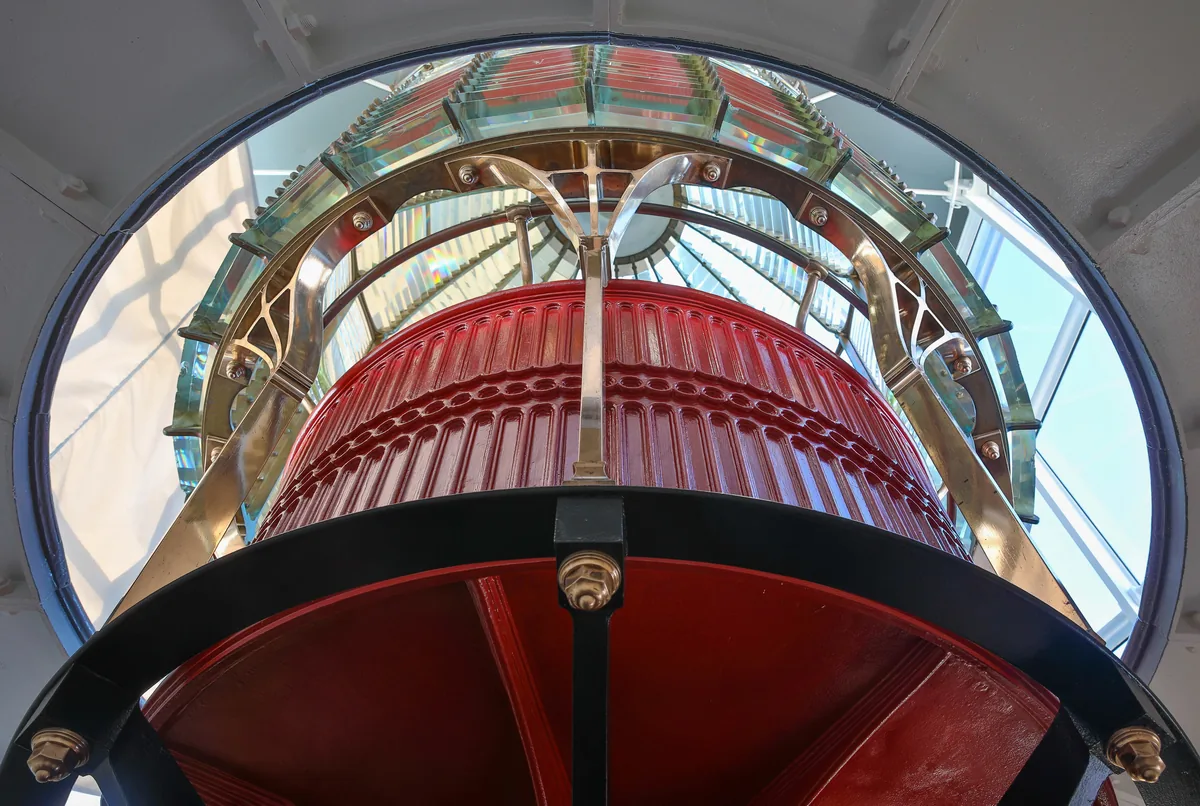
The photograph below shows an intact first-order apparatus still standing in its lantern room: the Point Reyes lens in California, cast in Paris in 1867 by Barbier & Fenestre out of 1,032 hand-ground prisms.

Upward view through the red cast-iron pedestal and green-tinted stepped glass prisms and brass frame of the first-order Fresnel lens at Point Reyes.
The first-order Fresnel lens at Point Reyes Lighthouse, California (built in Paris in 1867 by Barbier & Fenestre), following its 2019 restoration. Photo: Frank Schulenburg, Wikimedia Commons, CC BY-SA 4.0.

Chapter XI · Earth’s curvature

Where the brightest beam still stops

No matter how fierce the lamp, a beam cannot bend around the curve of the Earth. From a focal height of 62 metres and a sailor’s eye 5 metres above deck, the geometric horizon lies at 36.1 kilometres; standard atmospheric refraction stretches it to 38.7 kilometres (20.9 nautical miles).

That is why maritime nations raised tall masonry and iron towers onto storm-swept rocks: every metre gained in stone buys extra miles of warning for a crystal cage that already wastes almost nothing.

Share this story

Send the interactive 3D optical journey, Snell’s-law ray lab, and lighthouse horizon simulator.

Fresnel’s six orders and five reference lighthouses

Focal lengths follow the standard French Lighthouse Service classification. Refracted horizon range assumes an observer 5 metres above sea level with standard atmospheric refraction (k = 0.13).

Standard Fresnel lens orders
OrderFocal lengthApprox. heightTypical role
Hyper-radial1,330 mm3.7 mMajor oceanic landfalls
1st Order920 mm2.6 mPrimary coastal beacons
2nd Order700 mm2.1 mSecondary headlands
3rd Order500 mm1.6 mChannels and straits
4th Order250 mm0.9 mHarbour entrances
5th Order187.5 mm0.7 mRiver mouths and piers
6th Order150 mm0.5 mBreakwaters and shoals
Five historic Fresnel-equipped lighthouses
LighthouseCountryYearFocal heightCharacteristicRefracted horizon
Tuzla LighthouseRomania190062 mFl(2) W 9.7s38.7 km (20.9 NM)
Cordouan LighthouseFrance182360 mFl W 60s (1823)38.2 km (20.6 NM)
Île Vierge LighthouseFrance190277 mFl W 5s42.1 km (22.8 NM)
Fastnet RockIreland190449 mFl W 5s35.3 km (19.1 NM)
Cape HatterasUnited States187059 mFl W 7.5s38.0 km (20.5 NM)

Sources and method

Dioptric ring tilts and catadioptric prism vertices are solved directly from Snell’s law for crown glass (n = 1.52, critical angle 41.14°). Spherical capture fractions integrate solid angle across −52° to +74°.

  1. Augustin-Jean Fresnel, Mémoire sur un nouveau système d’éclairage des phares, read before the Académie des Sciences in Paris on 29 July 1822 (Gallica / BnF).
  2. Phare de Cordouan — heritage dossier and the 1823 lens apparatus, French Ministry of Culture (60 m focal height, eight-panel octagonal drum, 920 mm focal length).
  3. Point Reyes Lighthouse — first-order Fresnel lens (1867, Barbier & Fenestre), U.S. National Park Service.
  4. Cape Hatteras Lighthouse — 1870 tower and focal plane, U.S. National Park Service.
  5. Léon Bourdelles and the mercury float bath (1890–1893, La Teignouse and Cape La Hève), United States Lighthouse Society.
  6. Photograph: First order Fresnel lens at Point Reyes lighthouse, Frank Schulenburg, 2019, Wikimedia Commons (CC BY-SA 4.0).