The Line Across the PrutBessarabia in six border switches
How Bessarabia — the land between the Prut and the Dniester rivers, at the eastern edge of Romania — became the Russian Empire's, then Romania's, then the Soviet Union's: six times in 130 years, and what became of the people living on both banks.
45,630 km² ceded in 18123,776,309 people taken in 1940
Approximate outline of the territory ceded in 1812. The Prut, Dniester and Danube courses are drawn from data; the shores and the northern seam are indicative.
MAP · 1812 → 1991
Pick a year. See who ruled what.
Eight moments, one map. The dots show who ruled each locality in the chosen year — and the panel tells you what changed and what people lost.
Bessarabia · Bukovina · HertsaOutline indicative; rivers real
Moldavia / RomaniaRussian Empire / USSRAustria-HungaryRepublic of MoldovaUkraine
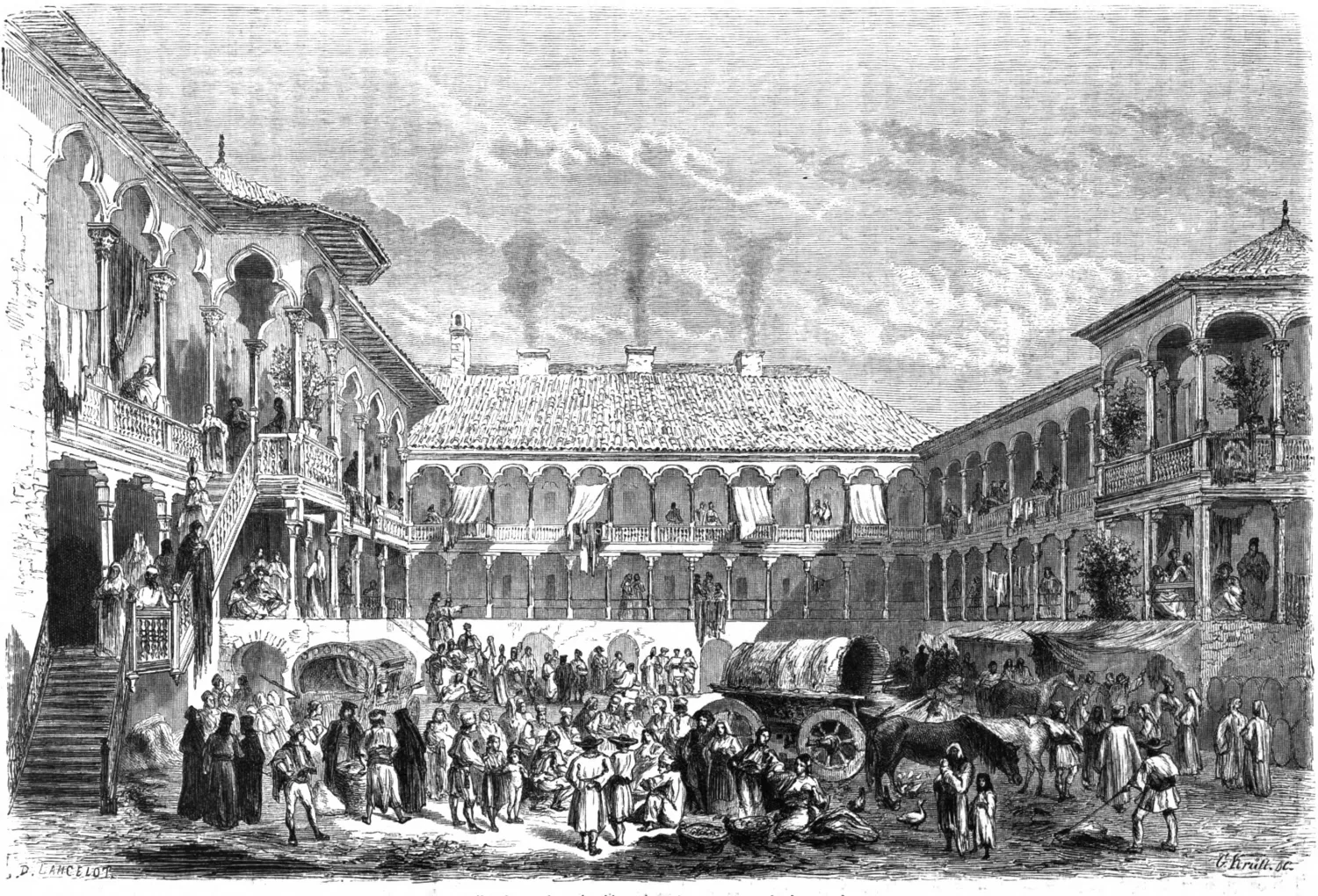
On 28 May 1812, at Manuc's Inn in Bucharest, Romania's capital, two empires divided Moldavia in two. The signatories were not from there and had nothing to lose. This is the story of six acts of division — 1812, 1856, 1878, 1918, 1940, 1944 — and of the people who lived under all six stamps.
Act I · 28 May 1812
Two empires carved up a country that was not theirs
The war Russia started against the Ottoman Empire in 1806 and the pressure of the great powers brought the peace to Bucharest: Russia obtained the land between the Prut and the Dniester, plus Budjak and the Khotyn district — about 45,630 km². Moldavia, whose land it was, was not at the table: it was an Ottoman vassal, and Russia and the Sublime Porte settled the matter directly. Kutuzov signed for Russia; the treaty was ratified on 5 July 1812, weeks before Napoleon crossed the Neman.
Russia gave the province a new name — Bessarabia — and began to colonise it: the Tatars were expelled from Budjak, and Russians, Ukrainians, Bulgarians, Gagauz, Germans and Lipovans were settled in their place. In 1817, a census shortly after the annexation, Romanians accounted for about 86% of the population. By 1897 they were 47.6% — and even that is uncertain: census-takers were instructed to count everyone who understood the state language as Russian.
Land ceded
45,630 km² — about half of Moldavia
Inhabitants at annexation
between 240,000 and 360,000 (estimates differ)
Ratified
5 July 1812, Saint Petersburg
Administration
oblast (1812–1828), then governorate with seat at Chișinău, 1828
Schools in Romanian
none until 1918
Manuc's Inn, 1860. The treaty that divided Moldavia was signed here on 28 May 1812. Engraving after a contemporary painting, public domain, Wikimedia Commons.
Act II · 30 March 1856
The south went back to Moldavia — for 22 years
Losing the Crimean War forced Russia to Paris. The 1856 treaty retroceded the southern part of Bessarabia to Moldavia: the counties of Cahul, Bolgrad and Ismail, plus the Danube mouths. The delta and the outlets were placed under a European Commission, and the war fleets of the great powers were excluded from them.
Moldavia in 1856 was not the Moldavia of 1812: Cuza united it with Wallachia in 1859, and southern Bessarabia joined the United Principalities and, from 1881, the Kingdom of Romania. On this side of the Prut, life moved on; on the far bank, Bessarabia remained the Russian governorate.
Retroceded to Moldavia
the counties of Cahul, Bolgrad and Ismail — 8,694 km²
Inhabitants (1859)
138,521
What stayed Russian
everything north of the line Reni–Bolgrad–Cahul
The lower Danube
neutralised; European Commission of the Danube, 1856
Act III · 13 July 1878
Berlin gave the south back to Russia; Dobruja came instead
Romania won the war of independence on Russia's side, but at the Congress of Berlin it learned what an ally with more power means: Russia took southern Bessarabia back, over the Romanian delegation's protests. In return, Romania received Dobruja — and independence, with a forced concession: Article 44 conditioned recognition on the emancipation of the Jews, which Romania accepted with delays and compromises.
The actual handover took place between 13 and 18 October 1878. Russia thereby obtained both banks of the Danube mouth and the gate to the Black Sea — what it had wanted since 1812.
What Romania lost
southern Bessarabia — 8,694 km², 163,000 people (1878)
What Romania received
Northern Dobruja and the Danube Delta
Recognition of independence
Treaty of Berlin, 13 July 1878 — with Article 44
Actual handover
13–18 October 1878
Act IV · 27 March 1918
The year Bessarabia voted
The 1917 revolution opened the window: Bessarabia elected its own parliament — Sfatul Țării, “the Council of the Land” — proclaimed the Moldavian Democratic Republic in December 1917, and declared independence on 24 January 1918. The Romanian army had already entered Bessarabia in January to stabilise the front, with the Allies' consent.
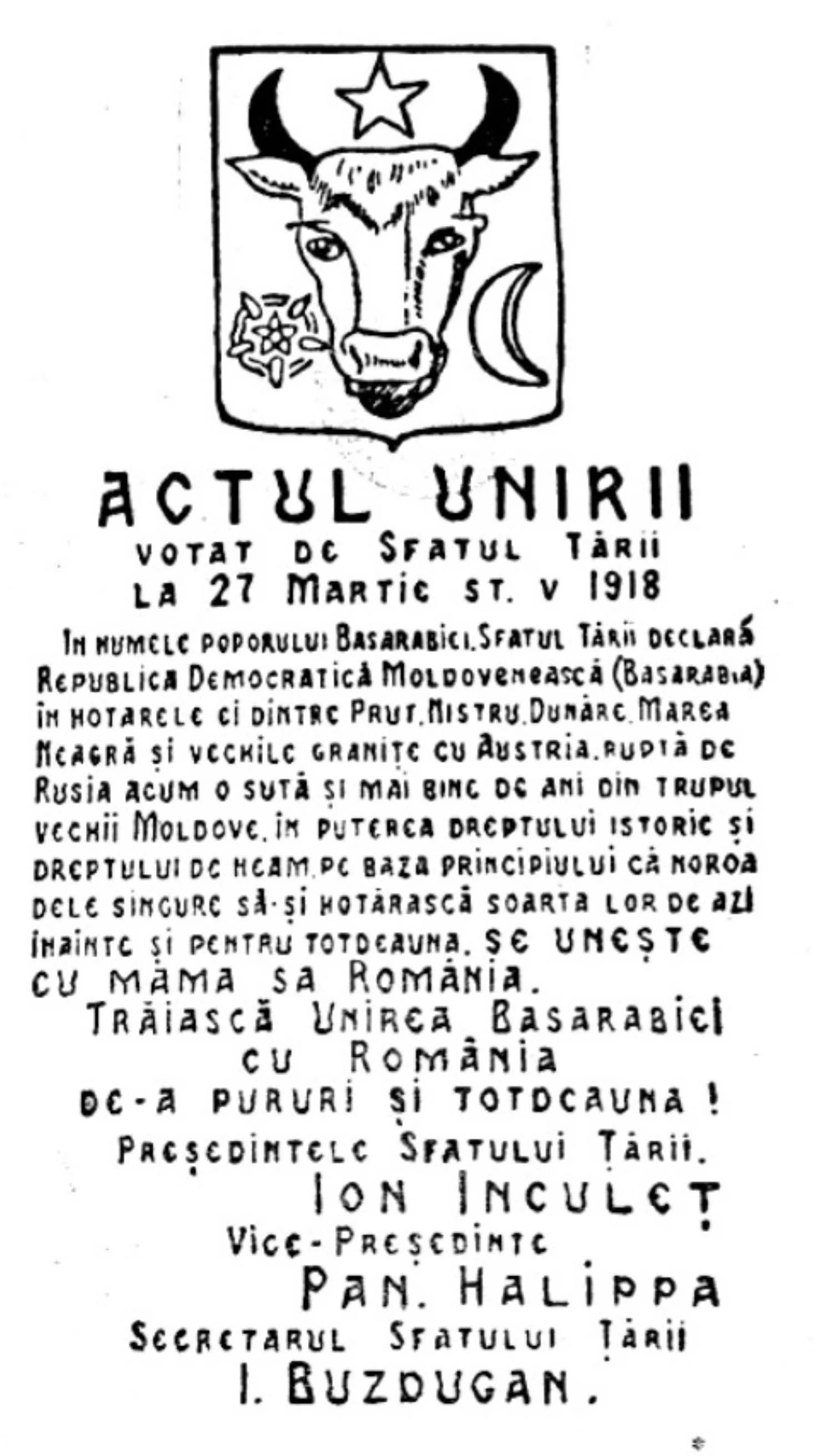
On 27 March 1918, Sfatul Țării voted for union with the Kingdom of Romania: 86 in favour, 3 against, 36 abstaining (and 13 absent). The union had conditions: agrarian reform (carried out) and local autonomy (revoked in November 1918 by just 44 of 125 members — a quorum still contested). Bukovina moved in parallel: a congress of Romanians, Germans and Poles voted for union on 28 November 1918; the Ukrainians boycotted it.
International legalisation failed elegantly: the 1920 Treaty of Paris, signed by Italy, Britain, France and Japan, never came into force — Japan never ratified it. The United States refused to sign without Russia, and the USSR never recognised the union.
38.1% of the population — double the 1917 rate, still the lowest in Romania
1920
Treaty of Paris recognising the union — never in force
The Act of Union, 27 March 1918. Facsimile of the document voted by Sfatul Țării. Public domain, Wikimedia Commons.
Act V · 26–28 June 1940
The note from Moscow
On 23 August 1939, Molotov and Ribbentrop had divided Europe in secret. Article III of the secret additional protocol said only this:
With regard to Southeastern Europe attention is called by the Soviet side to its interest in Bessarabia. The German side declares its complete political disinterestedness in these areas.Molotov–Ribbentrop Pact, secret additional protocol, Art. III
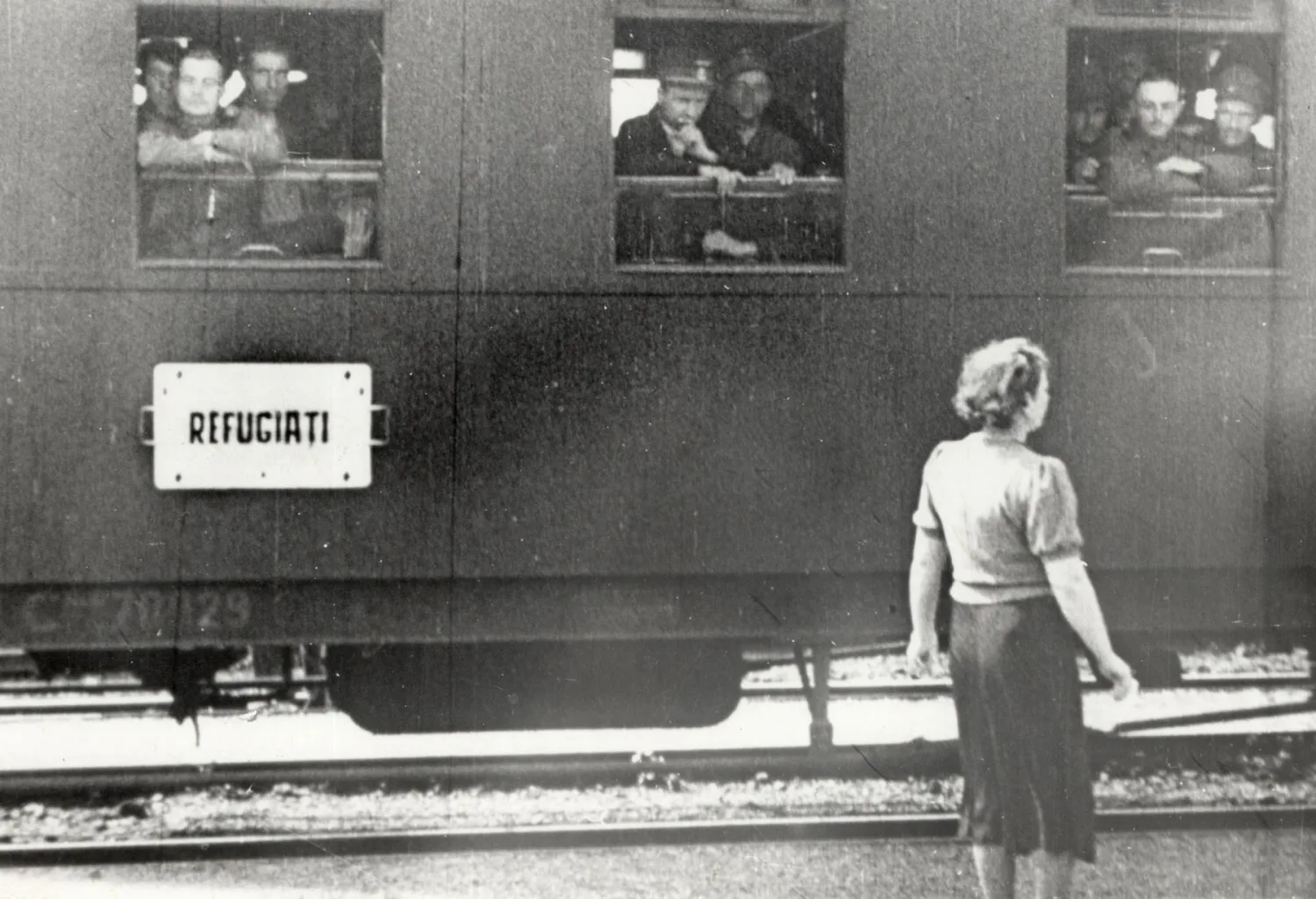
On 22 June 1940 France fell. Four days later, in Moscow, the USSR handed Romania an ultimatum to evacuate Bessarabia and Northern Bukovina — the latter not even in the pact signed with Germany. Romania complied, to avoid war; the withdrawal was completed between 28 June and 3 July. About 48,888 servicemen were reported missing during the retreat, and in some divisions more than half the personnel deserted, choosing to stay behind. The occupied territory had 50,762 km² and 3,776,309 inhabitants. Hertsa was taken without any pact providing for it; on 26 October the USSR also occupied six Romanian islands in the Chilia arm, 23.75 km².
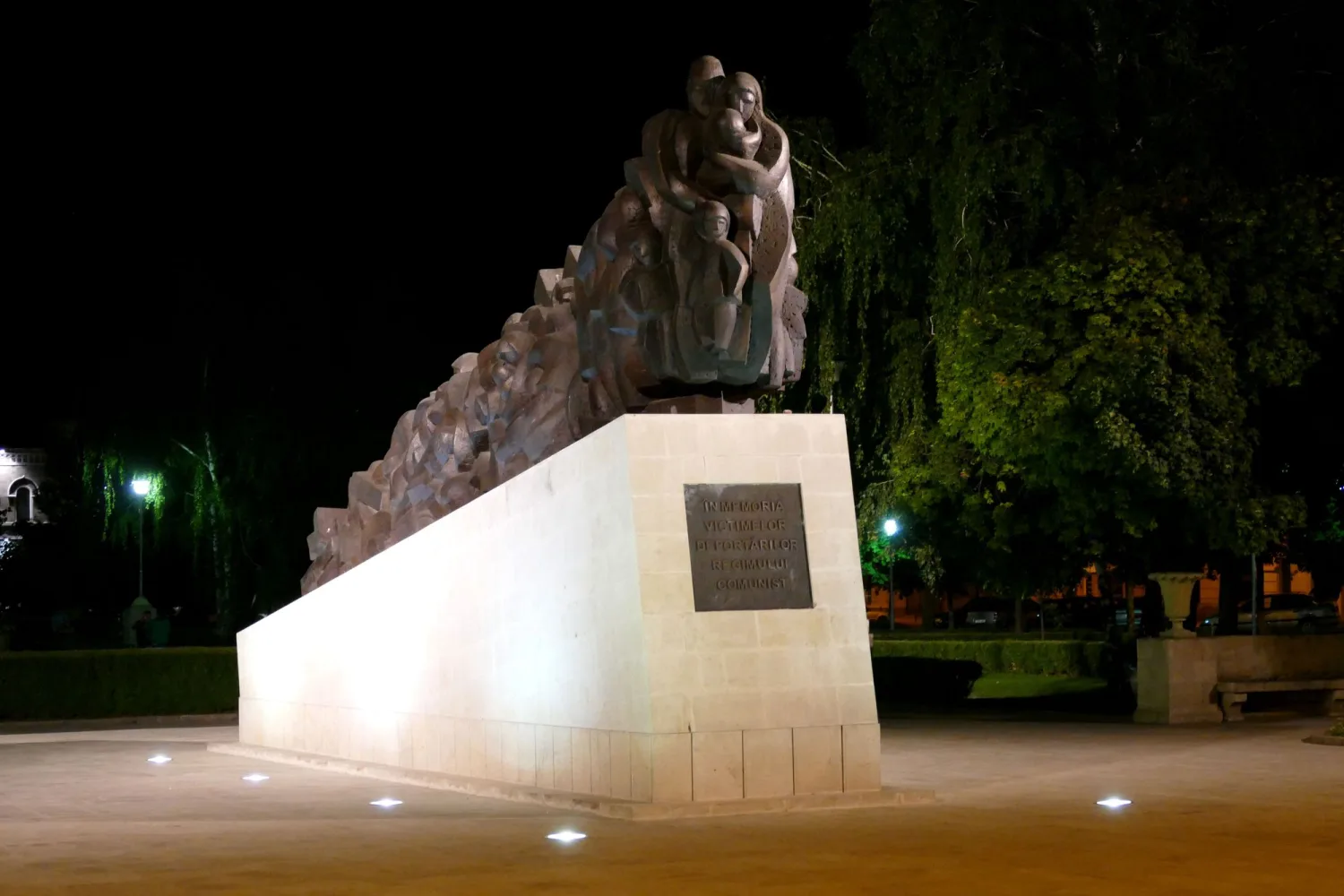
Where there was no treaty, there was persecution. The nights of 12–13 June 1941 took 29,839 people from Bessarabia, Northern Bukovina and Hertsa — whole families, no trial, to Kazakhstan and Siberia. In 1949 and 1951 two more waves followed: 35,050 deported in July 1949 and 2,617 in April 1951. A secret 1965 report of the Soviet Interior Ministry admits 46,000 deportees from the Moldavian SSR alone, 1940–1953. Historian Igor Cașu, on Soviet archives, puts the total repressed in 1940–1941 at 86,604 — over 53,000 through forced labour.
Ultimatum
26 June 1940
Occupation completed
28 June – 3 July 1940
Territory occupied
50,762 km² · 3,776,309 inhabitants
Moldavian SSR
proclaimed 2 August 1940
Deportations
29,839 (12–13 June 1941) · 35,050 (July 1949) · 2,617 (April 1951) · 46,000 total (1940–1953)
Refugees, 1940. Frame from the propaganda film Războiul nostru sfânt (“Our sacred war”, 1942), Arhivele Naționale ale României. Attribution required, Wikimedia Commons.
ACT VI · 1941–1944
Three Romanian summers, and what goes unsaid
On 22 June 1941, Romania entered the war alongside Germany, with the declared goal of reintegrating Bessarabia and Bukovina. By 16 July 1941, Chișinău was retaken; by August, the rest. The Romanian administration brought its own crimes, though: Jews from Bessarabia and Bukovina were executed on the spot or deported to Transnistria, where very many died. This is not a footnote to the glorious chapter; it is part of what happened under this administration, and it deserves the same line of type.
On 20–29 August 1944, the Soviet Iași–Chișinău offensive broke the front. On 23 August, King Michael arrested the government and Romania changed sides. On 12 September 1944, the Moscow armistice reconfirmed the frontier along the Prut as of 1 January 1941. The Paris peace treaty of 10 February 1947 set the border in stone:
The Soviet-Roumanian frontier is thus fixed in accordance with the Soviet-Roumanian Agreement of June 28, 1940, and the Soviet-Czechoslovak Agreement of June 29, 1945.Treaty of Peace with Romania, Paris, 10 February 1947
The recovery was thus lost three times: in 1940, in 1944 and at Paris.
Reoccupation
22 June – August 1941
Iași–Chișinău offensive
20–29 August 1944
Moscow armistice
12 September 1944
Paris peace treaty
10 February 1947
The Train of Pain. The monument to the Soviet deportees in front of Chișinău railway station. Photo: Maxence, CC BY 2.0, Wikimedia Commons.
Act VII · 27 August 1991
The border no one ever fully signed
On 6 May 1990, tens of thousands of people walked both ways across the Prut — at Ungheni, Sculeni, Leușeni and Costești — in a day called the Flower Bridge. A year later, on 27 August 1991, the Republic of Moldova declared independence; Romania was the first country to recognise it. At the USSR's dissolution, Bessarabia stayed split between the two successor states: its core — in Moldova; Budjak, Northern Bukovina and Hertsa — in Ukraine.
Today the Prut is the border between Romania and the Republic of Moldova. The treaty fixing it was signed in Bucharest on 8 November 2010, but never came into force: Moldova ratified it in 2013, Romania did not, and the lists of treaties in force do not record it. The border exists, runs through the river, and moves with it, centimetre by centimetre — the exact survey is in The Prut that keeps moving.
The Flower Bridge
6 May 1990 — Ungheni, Sculeni, Leușeni, Costești
Independence
27 August 1991 — Romania, first recognition
Today's split
Moldova (core + left bank) · Ukraine (Budjak, Northern Bukovina, Hertsa)
The border treaty
signed 8 November 2010 · never ratified by Romania · not recorded as in force
The towns on the bank — Leova, Khotyn, Novoselytsia — sit tangent to the border line. This map counts them historically, not geometrically.
YOURS, ON THE MAP
Who ruled your town?
Pick one of the 41 localities in Bessarabia, Bukovina and on the Prut — or tap a point on the map. See, year by year, who held it: Moldavia, Russia, the USSR, Austria or Romania.
Pick a locality — or tap it on the map. 41 localities on both sides of the line.
Share
THE DOSSIER
What the paper says, not what the stories say
The secret protocol, 23 August 1939
The pact with Germany never mentioned Bukovina — yet the USSR demanded it and took it, exceeding even the small agreement with Berlin.
Art. III, drafted in Russian and German; the text above is the published English translation.
The Act of Union, 27 March 1918
A vote with conditions: agrarian reform (carried out), autonomy (revoked in November 1918 by 44 of 125 members). No quorum, no unanimity, three votes against.
Bukovina voted for union on 28 November 1918; the Ukrainians boycotted the congress.
The Paris peace treaty, 10 February 1947
The border on the Prut was written into international law: “in accordance with the Soviet-Roumanian Agreement of June 28, 1940”. Romania had no choice: accepting was the condition of peace.
The Moscow armistice of 12 September 1944 had already reconfirmed the line as of 1 January 1941.
SOURCES
Where every number was verified
Treaty of Bucharest — signed 28 May 1812 at Manuc's Inn, ratified 5 July 1812; territory ceded: Budjak and eastern Moldavia (45,630 km²).
Russian census of 1897 (Bessarabia governorate): 1,935,412 inhabitants; demoscope.ru (archived).
Population retroceded 1856–1878: Southern Bessarabia (Cahul, Bolgrad, Ismail; 8,694 km²; 138,521 people in 1859; 163,000 in 1878).
The Sfatul Țării vote — 86/3/36; Union of Bessarabia with Romania, per Moldovan and Romanian archives.
Romanian census of 1930: 2,864,662 inhabitants in Bessarabia; Romanians 56.2%, Ukrainians 11.0%, Russians 12.3%.
The ultimatum of 26 June 1940 and the occupation of 28 June – 3 July 1940; 50,762 km² and 3,776,309 inhabitants (King 2000: 91, citing official reports).
Deportations: 29,839 (12–13 June 1941); 35,050 in July 1949 (Operation South); 2,617 in April 1951 (Operation North); 46,000 in 1940–1953 (1965 MVD report). Igor Cașu, Stalinist Terror in Soviet Moldavia, 2010.
Iași–Chișinău offensive 20–29 August 1944; the coup of 23 August 1944; the Moscow armistice of 12 September 1944.
Treaty of Peace with Romania, Paris, 10 February 1947 — full text, Yale Avalon Project (American Society of International Law).
Independence of the Republic of Moldova, 27 August 1991; Romania, first recognition.
Romania–Republic of Moldova border treaty, signed in Bucharest on 8 November 2010 — not in force (Moldovan MFA treaty list, 2026; Moldovan Border Police).
Photographs: Manuc's Inn (1860, public domain); refugees 1940 (Arhivele Naționale ale României, frame from Războiul nostru sfânt, 1942); The Act of Union (facsimile, public domain); The Train of Pain (Maxence, CC BY 2.0) — all via Wikimedia Commons.
Maps on this page: Natural Earth (public domain) for land, countries and rivers; the courses of the Prut, Dniester and Danube are simplified. The outline of the ceded Bessarabia is indicative: only the rivers are real.
No figure on this page is estimated by the author: every number has a source above. Demographic figures between 1812 and 1897 vary significantly between sources; ranges are used where they disagree.