2–6 September 1666
London burned for four days. Nobody knows how many died
It started in a bakery in Pudding Lane and consumed 13,200 houses. Follow it across today's map of the City, reconstructed from the diaries of Samuel Pepys and John Evelyn and the official newspaper. Then find out what they never wrote: the Lord Mayor's famous remark, and the number of the dead.
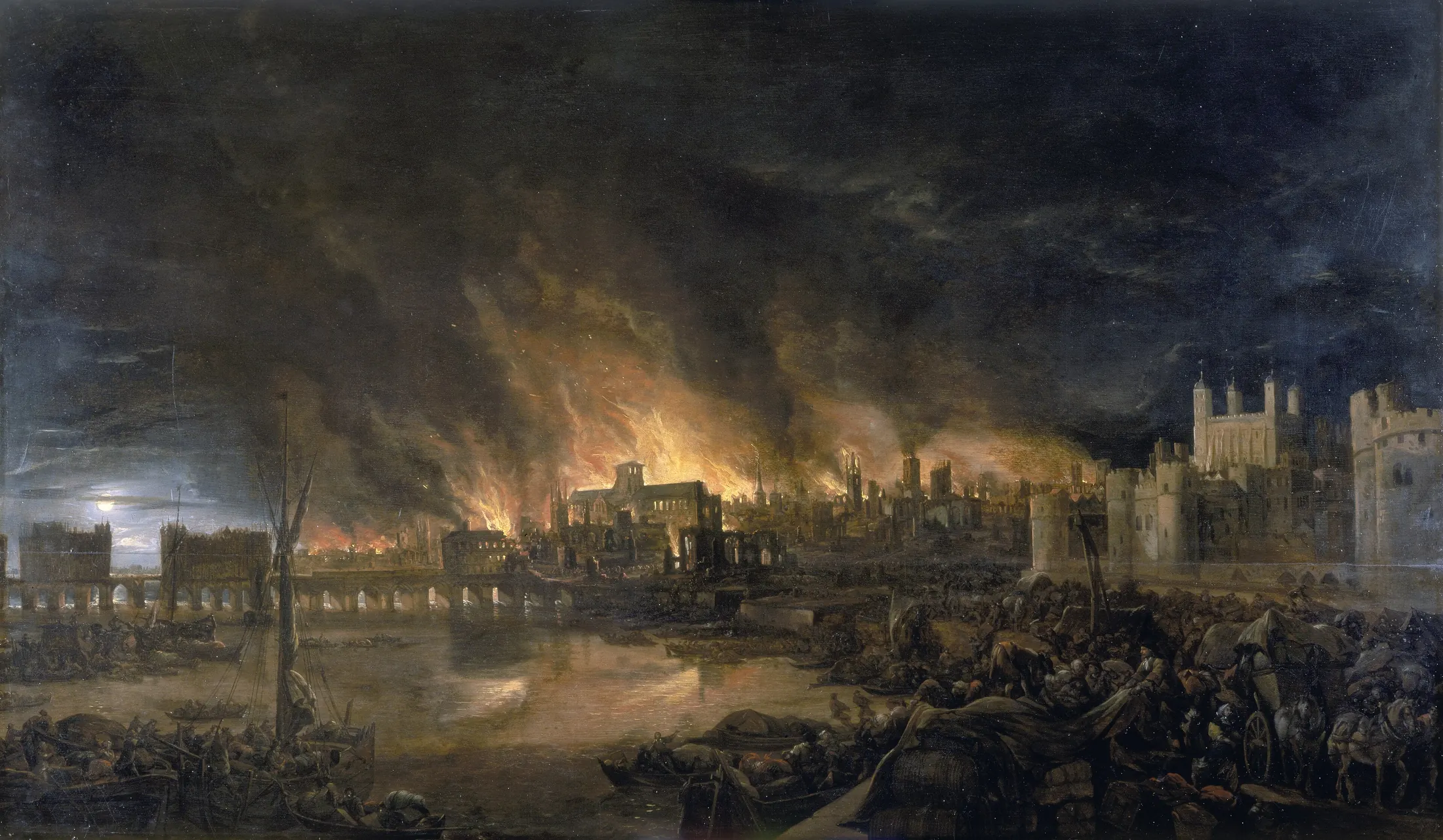
Start at one in the morningDutch School, c. 1675, Museum of London · public domain

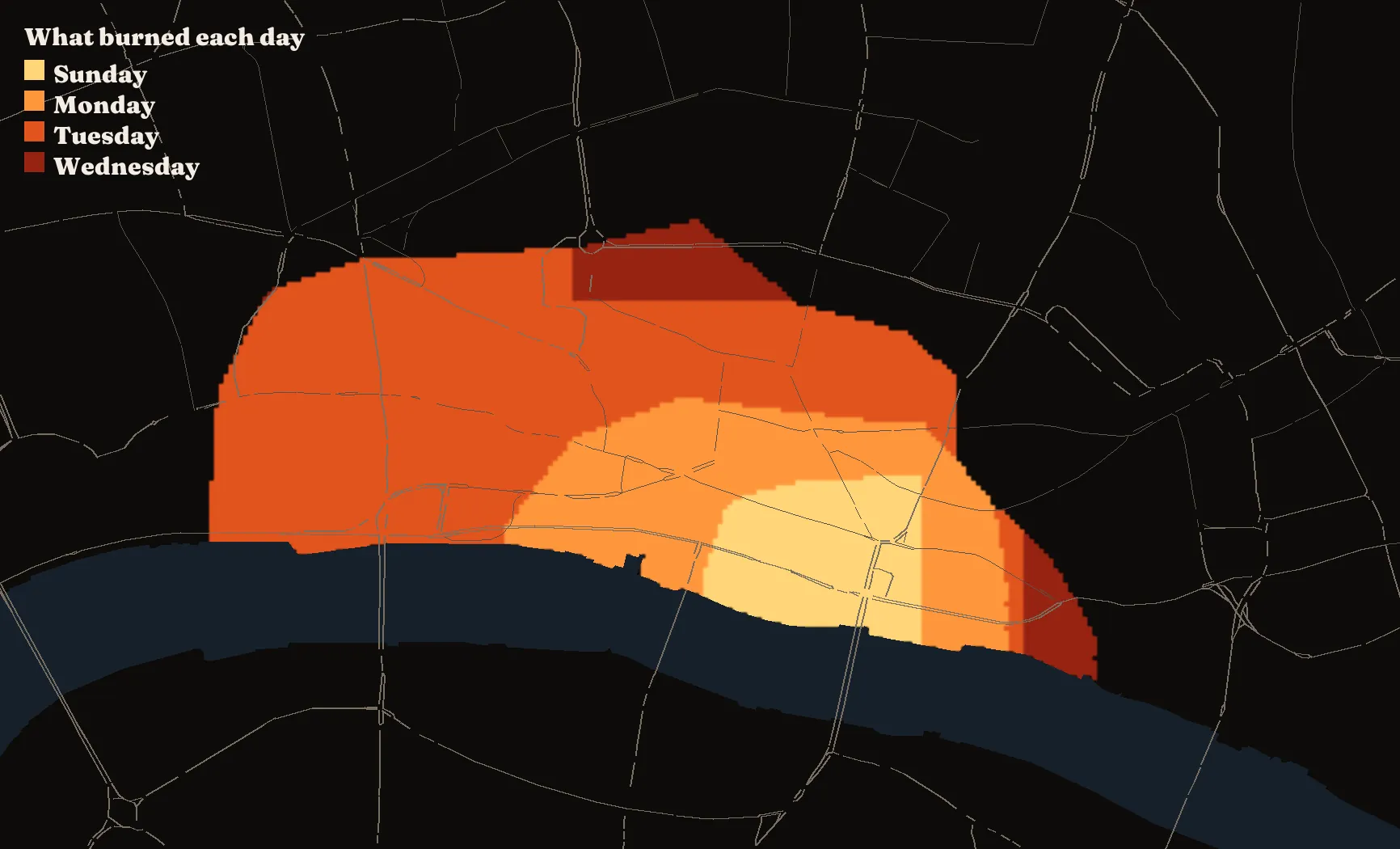
Approximate reconstruction. Only a few places are time-attested; the spread between them is interpolated from contemporary accounts, the end-of-day limits of the fire and the east wind. The streets are today's.
burning time attested in the sources
Sunday 2 September, 1 a.m.
A bakery on a street named after offal
The journeyman baker, Thomas Dagger, woke “after 1am” “with the choke of the smoke”, Sir Edward Harley wrote in a letter from which the historian Kate Loveman identified Dagger in 2023. The baker, Thomas Farriner, his daughter and his man escaped by an upper window; the maid died. The family later swore that the oven had been drawn at ten at night. London Museum, 2023
The hour depends on who tells it: the London Gazette, the official newspaper, says “one of the clock in the Morning”, the City's surveyors “between one and two”, the Monument's inscription “in the dead of night”.
The street was called Pudding Lane because the “puddings”, the offal of the Eastcheap butchers, were carried down it to the dung boats on the Thames, John Stow wrote in 1598.
Sunday, 3 a.m.
Pepys looks out of the window and goes back to bed
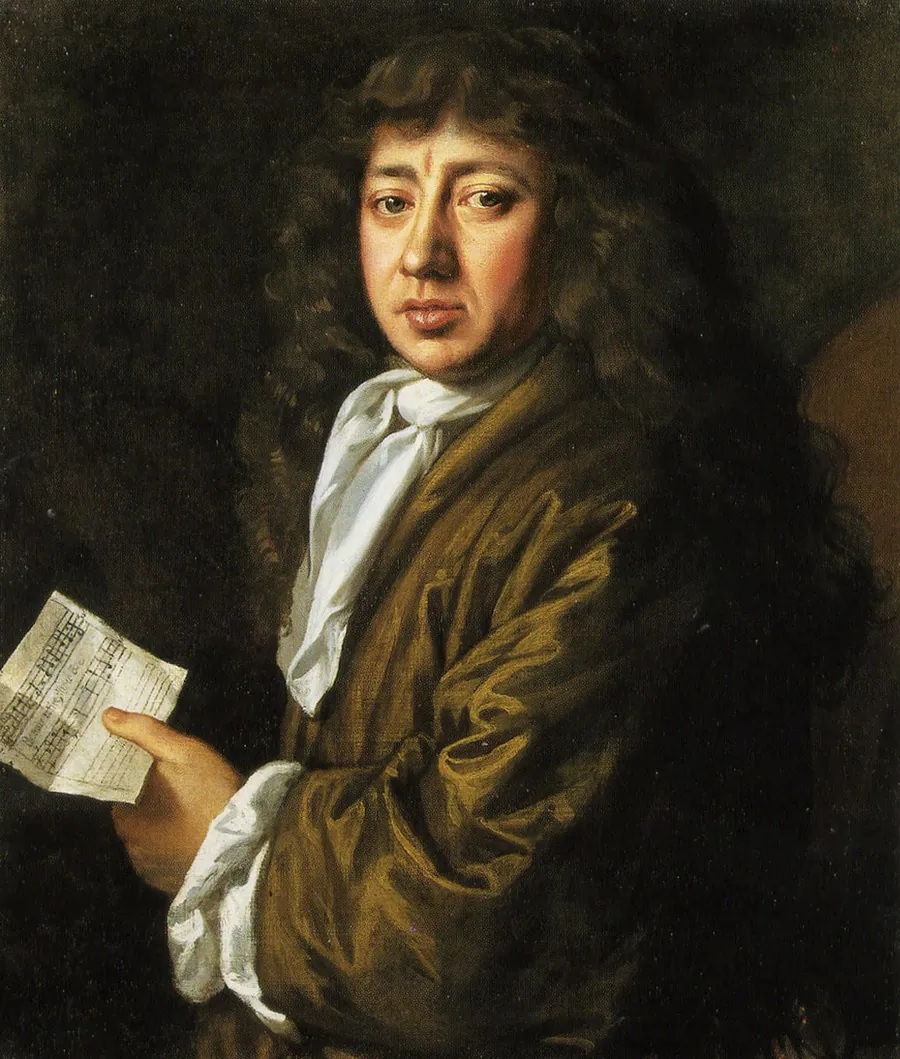
Samuel Pepys, an official of the Navy Office, lived a few hundred metres to the east. His maid Jane called him up at about three. He watched from the window, thought it far enough off, and went back to bed.
In the morning Jane told him that “above 300 houses have been burned down to-night” and that the fire was “now burning down all Fish-street, by London Bridge”.
Sunday morning
The Lord Mayor's famous line is not in Pepys's diary
From the Tower, Pepys saw the houses at the end of the bridge on fire. He took a boat: the fire “got as far as the Steeleyard, while I was there”. Along the river, Thames Street was lined with warehouses of pitch, tar, oil, wine and brandy.
He went to the King at Whitehall and said that nothing could stop the fire unless houses were pulled down. The King sent him to the Lord Mayor. Pepys found Thomas Bloodworth in Cannon Street, with a handkerchief about his neck:
“Lord! what can I do? I am spent: people will not obey me. I have been pulling down houses; but the fire overtakes us faster than we can do it.”
Pepys, 2 September
Bloodworth is remembered for saying that “a woman might piss it out”, a line sometimes credited to Pepys's diary, Wikipedia included. The diary does not contain it. The historian Stephen Porter says the mayor “was said to have remarked” it and leaves open whether he did. We found no contemporary source either, so the line stays unverified. Gresham College, 2016
Sunday evening
An arch of fire a mile long
A violent east wind was blowing after a long drought. The pigeons would not leave their houses and fell with their wings burned. On the Thames, Pepys noticed, hardly one boat in three carrying the goods of a house was without a pair of virginals in it.
In the evening he watched from the south bank, at Bankside:
“we saw the fire as only one entire arch of fire from this to the other side the bridge, and in a bow up the hill for an arch of above a mile long: it made me weep to see it.”
Pepys, 2 September
Showers of “firedrops” crossed the water and set houses alight three or four, even five or six houses away. By dawn the fire had spread up to Gracechurch Street and along the river to the Three Cranes.
Monday 3 September
On Monday the banks burn, and night is as light as day
At four in the morning Pepys sent his money and plate by cart to Bethnal Green. The fire entered Lombard Street, the bankers' street, on Monday; one banker told readers of the Gazette he had moved everything almost a day before. The Royal Exchange burned on Monday afternoon.
Evelyn wrote that the fire “kindled back against the wind”, towards Cornhill, and called the night one “which was light as day for ten miles round about”.
Tuesday 4 September
On Tuesday, the worst day, Pepys buries his parmesan
On Tuesday the fire crossed the west of the City: Fleet Street, the Old Bailey, Ludgate, Newgate, as far as the Inner Temple. The post house burned too, so Pepys's letter to his father could not go.
In the Navy Office garden a neighbour buried his wine, and Pepys the papers of his office. In the evening they dug another pit, and Pepys put in his wine and “my Parmazan cheese”.
Tuesday evening
The cathedral's stones fly like grenades
“the stones of Paul's flew like grenados, the melting lead running down the streets in a stream, and the very pavements glowing with fiery redness, so as no horse, nor man, was able to tread on them”
Evelyn, 4 September
St Paul's lead roof, “no less than six acres by measure”, Evelyn wrote, melted entirely. The vault fell into St Faith's chapel, where the Stationers had carried their books for safety. They burned for a week.
Wednesday 5 September, 2 a.m.
The fire stops at a church's clock dial
On Tuesday night they began blowing up houses with gunpowder in Tower Street, next to the Tower, where the powder magazine was kept. The wind slackened.
At two in the morning Pepys's wife called him up: the fire had reached All Hallows Barking, “which is the bottom of our lane”. He took her by boat to Woolwich, with his gold, about £2,350.
He came back to find it stopped there, “it having only burned the dyall of Barking Church, and part of the porch”.
Wednesday
Where it stopped
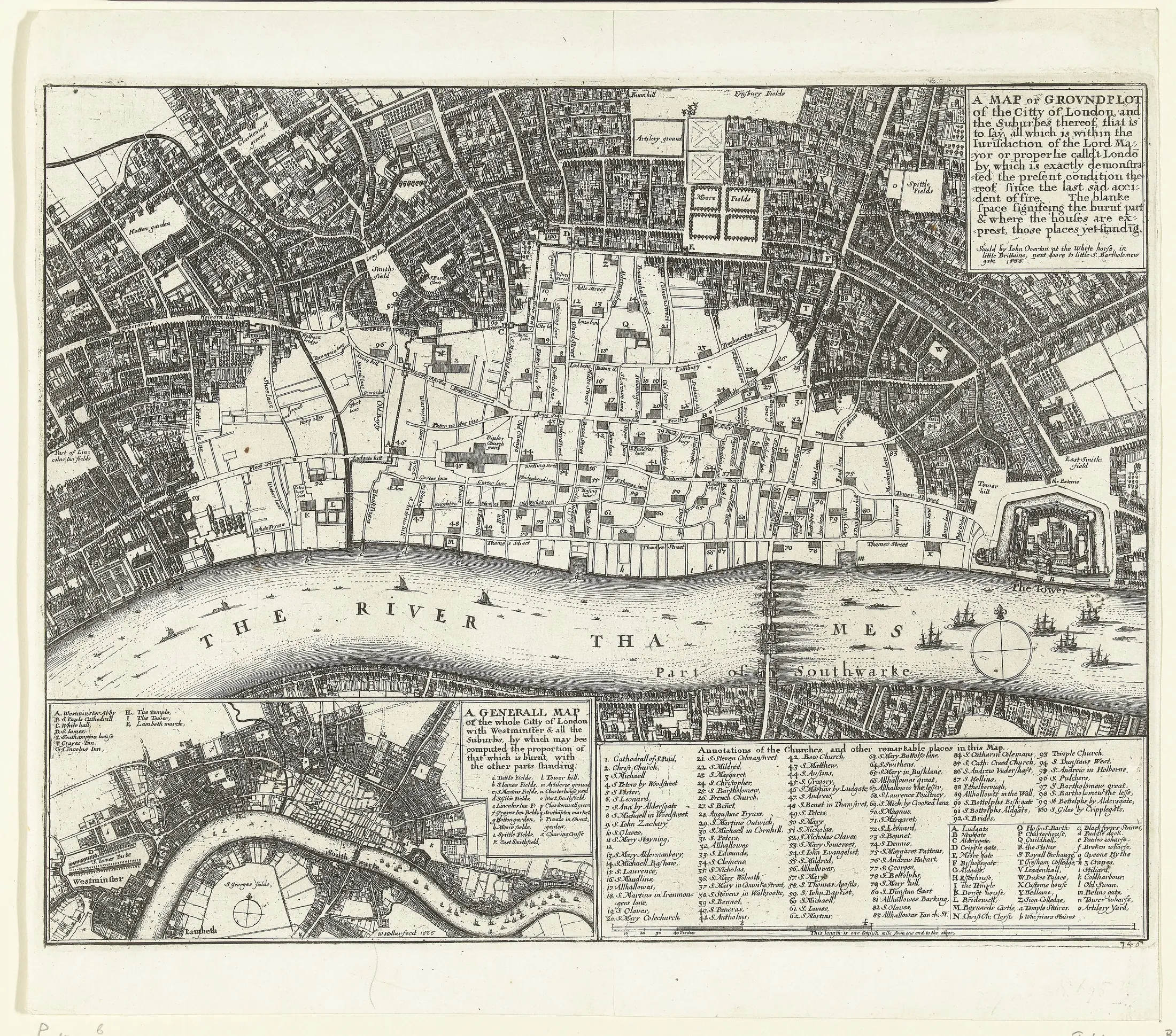
The Gazette lists where a stop was put to it: the Temple Church, near Holborn Bridge, Pie Corner, Aldersgate, Cripplegate, the lower end of Coleman Street, Bishopsgate Street, Cornhill, Fenchurch Street, Mincing Lane, the middle of Mark Lane and Tower Dock.
Evelyn wrote that seamen had proposed early on to blow houses up, making a wider gap than pulling them down, which would have saved nearly the whole City, but “some tenacious and avaricious men, aldermen, etc., would not permit”, because their own houses would have gone first.
Pepys climbed Barking steeple and saw “the saddest sight of desolation that I ever saw”.
Wednesday afternoon
Moorfields, a twopenny loaf and a cat with no fur
Pepys crossed the City, “our feet ready to burn, walking through the towne among the hot coles”. Fenchurch Street, Gracechurch Street and Lombard Street were “all in dust”; of the Exchange nothing stood “but Sir Thomas Gresham’s picture in the corner”.
Moorfields, the open ground beyond the wall, was full of people with what they had saved. He paid twopence for a penny loaf. By the Exchange he saw a cat pulled out of a chimney “with, the hair all burned off the body, and yet alive”.
Thursday 6 September, and after
Beaten down, with Clothworkers' Hall still burning
On Thursday it was “wholy beat down”, though that evening it broke out again at the Temple and was mastered with gunpowder before day. Clothworkers' Hall, its cellar full of oil, had been burning for three days and nights.
The King sent biscuit from the navy's stores to Moorfields. The people, “being unaccustomed to that kind of Bread, declined it”, the Gazette reported, and it went back to the stores. On 7 September Evelyn reckoned some 200,000 people lay by their goods towards Islington and Highgate: an eyewitness impression, not a count. The London Museum puts the number made homeless at around 100,000. London Museum
Before and after
The same view, from the same steeple
Wenceslaus Hollar drew London from the steeple of St Mary Overie in Southwark, on the south bank, before and after the fire, and printed the two views one above the other. Drag the line to move from one to the other.


What was counted
Houses, churches, acres: the losses were measured
The losses were counted carefully. That autumn two surveyors, Jonas Moore and Ralph Gatrix, measured the ruins for the City.
13,200 houses
One square for each house. Evelyn saw “above 10,000 houses all in one flame”; the surveyors' certificate and the Monument give 13,200.
87–89 churches
- burned
- parishes within the walls left standing
The sources do not count churches and chapels the same way. The surveyors and the Monument give 89 parish churches burned, with eleven parishes within the walls left standing. A table printed in 1769 gives 87 churches and 6 chapels, and the London Museum uses 87 today. The squares follow the surveyors.
436 acres
That is 176 hectares, according to the Monument's inscription; the surveyors measured 373 acres (151 ha) within the walls alone. Of the City's 26 wards, 15 were destroyed entirely and 8 left half burnt.
,_RP-P-OB-82.347.jpg)
The dead
How many died? Fewer than ten are recorded; the true toll is unknown
The houses were counted one by one. The dead were not. The London Gazette mentions no deaths, and an account printed in 1769 thought it “a very miraculous circumstance” that no one was known “either to be burnt, or trodden to death in the streets”. Today the London Museum says fewer than ten deaths are recorded. London Museum
What the documents record
Tradition and modern historians
Speculation
Hanson lists known deaths from hunger and cold among survivors in the winter that followed (the playwright James Shirley and his wife are believed to have died this way), and argues that most were never counted: the poor with no fixed address, bodies that heat able to melt lead would not have left, people who died in the camps in the fields. The surviving records can neither confirm nor refute such a number: they were not designed to count the poor.
The figures of Field, Porter, Tinniswood and Hanson are quoted through Wikipedia's article on the fire; their books are not freely available.
The culprit
A man confessed. He came ashore two days after the fire began
The Gazette concluded that the fire was “an unhappy chance, or to speak better, the heavy hand of God upon us for our sins”. The City still wanted someone to blame.
Robert Hubert, a Frenchman from Normandy, confessed that he had reached a fire-ball in through a window of the bakery with a stick. The baker, his son and his daughter all swore there was no such window. Hubert was hanged at Tyburn in October 1666, “upon no other evidence but that of his own confession”, as Bishop Gilbert Burnet later wrote.
According to the ship's master, Laurence Peterson, whose evidence was recorded only later by the historian Laurence Echard, Hubert reached England just before the fire but was “not landed till two days after” it began.

The Monument
Laid on its side, the Monument would reach the bakery
In 1667 Parliament ordered a column to be put up “on or as neere unto the place where the said Fire soe unhappily began as conveniently may be”. It was designed by Robert Hooke in consultation with Christopher Wren and built between 1671 and 1677. It is 202 feet high, 61.6 metres: exactly its distance from the baker's house, to the east. Scroll to watch it fall.
In 1681 the City added to the Monument that “Popish frenzy” had started the fire, and put a plaque on the house in Pudding Lane naming Hubert, who had confessed. James II, a Catholic king, had the words erased; after the revolution of 1688 they were cut again. Alexander Pope wrote of the column that it “Like a tall bully, lifts the head, and lies.” The words were removed under an order of the City's Common Council dated 6 December 1830.
Myths
Three things everybody knows
- “The fire ended the plague.” The Museum of London lists the idea among the myths about the fire. The plague had not gone away: that week Evelyn noted it still “continuing in our parish” at Deptford, outside the City, and the Gazette reported 147 plague deaths in one week at Norwich.
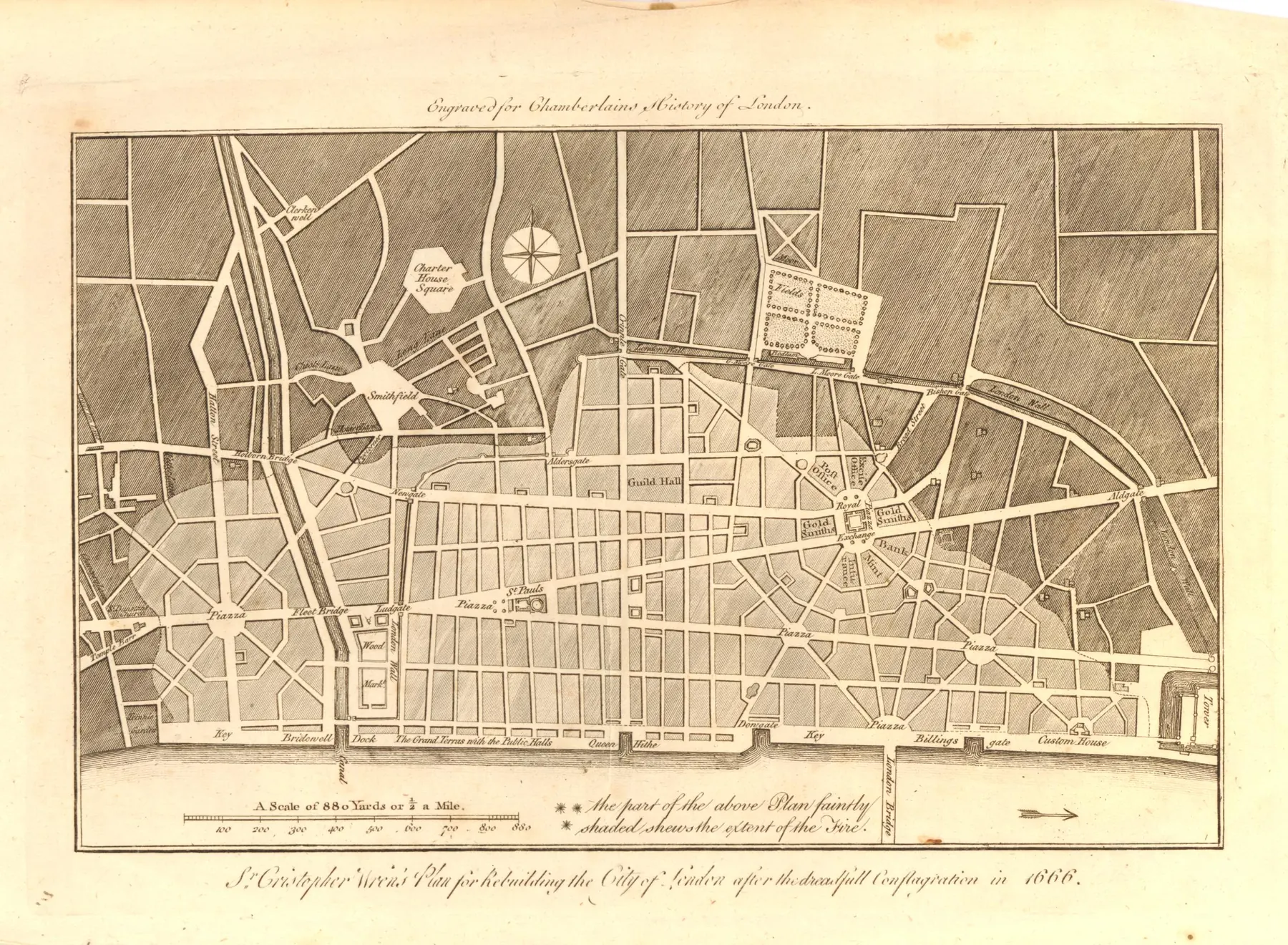
- “London was rebuilt to a new plan.” Evelyn presented the King with “a plot for a new city” on 13 September, a week after the fire, and Christopher Wren drew one too, with broad avenues and piazzas. Neither was built: the streets largely followed their old lines, rebuilt in brick and stone.
- “Six people died.” The figure is handed down by tradition. The records of the time name almost no dead.
.jpg)
What is not known
The limits of the map and the story
- The daily outlines of the fire are rebuilt from the places the sources name, not from a map of the time; Monday's and Tuesday's are the least certain. The final outline follows the Gazette's list, simplified: it encloses about 148 hectares, against 176 on the Monument.
- The times on the map are approximate. They are pinned only at a few places dated by the diarists and the Gazette: the bridge and the Steelyard on Sunday morning, the Three Cranes on Sunday night, the Exchange on Monday afternoon, St Paul's on Tuesday evening.
- Secondary sources give the date of Hubert's hanging as 27 or 29 October.
- The Lord Mayor's line (“a woman might piss it out”) is unverified, not proven false: it is not in Pepys's diary and we found no contemporary source for it.
- The true number of deaths cannot be established from the surviving records. Fewer than ten are recorded; hundreds or thousands remain speculation.
- Contemporary sources give different totals: 87 or 89 churches, 50 or 52 company halls.
- Evelyn's 200,000 people are an eyewitness impression, not a count.
- Evelyn has the fire beginning “about ten” at night; this looks like an error, perhaps because he wrote his entries up later.
Sources and method
Pepys is quoted from the Wheatley edition (1893) and Evelyn from the Bray edition, both on Project Gutenberg. The official account is the London Gazette no. 85 (3–10 September 1666). The streets and the Thames on the map come from OpenStreetMap (© OpenStreetMap contributors, ODbL).
- London Museum, “Great Fire of London” (recorded deaths, homeless, churches). www.londonmuseum.org.uk/collections/london-stories/great-fire-of-londo
- London Museum, “First witness to the Great Fire of London uncovered”, 2023 (Thomas Dagger; research by Kate Loveman). www.londonmuseum.org.uk/about/press/press-releases/first-witness-to-th
- The Monument, “About” (design by Robert Hooke with Christopher Wren). www.themonument.org.uk/about
- Stephen Porter, “London’s Great Fire and its Aftermath”, Gresham College, 2016 (the Bloodworth remark). www.gresham.ac.uk/watch-now/londons-great-fire-and-its-aftermath
- Samuel Pepys, Diary, ed. Henry B. Wheatley, 2–7 Sept 1666 and 24 Feb 1667. www.gutenberg.org/ebooks/4200
- John Evelyn, Diary, ed. William Bray, 2–16 Sept 1666. www.gutenberg.org/ebooks/42081
- The London Gazette no. 85, 3–10 Sept 1666 (Wikisource transcription). en.wikisource.org/wiki/London_Gazette/Issue_85
- An Historical Narrative of the Great and Terrible Fire of London (1769): the surveyors' certificate, the Monument inscription, the Hubert evidence. www.gutenberg.org/ebooks/37489
- Charles Welch, History of The Monument (Corporation of London, 1921). archive.org/details/historyofmonumen00welc
- John Stow, A Survey of London (1598). www.gutenberg.org/ebooks/42959
- Wikipedia, “Great Fire of London” (for the modern historians' death figures and dates). en.wikipedia.org/wiki/Great_Fire_of_London
- Wikipedia, “Thomas Bloodworth”. en.wikipedia.org/wiki/Thomas_Bloodworth
- Wikipedia, “Robert Hubert”. en.wikipedia.org/wiki/Robert_Hubert
- OpenStreetMap, streets and river (ODbL). www.openstreetmap.org/copyright
Images
- The Great Fire of London: Dutch School, c. 1675, Museum of London · public domain
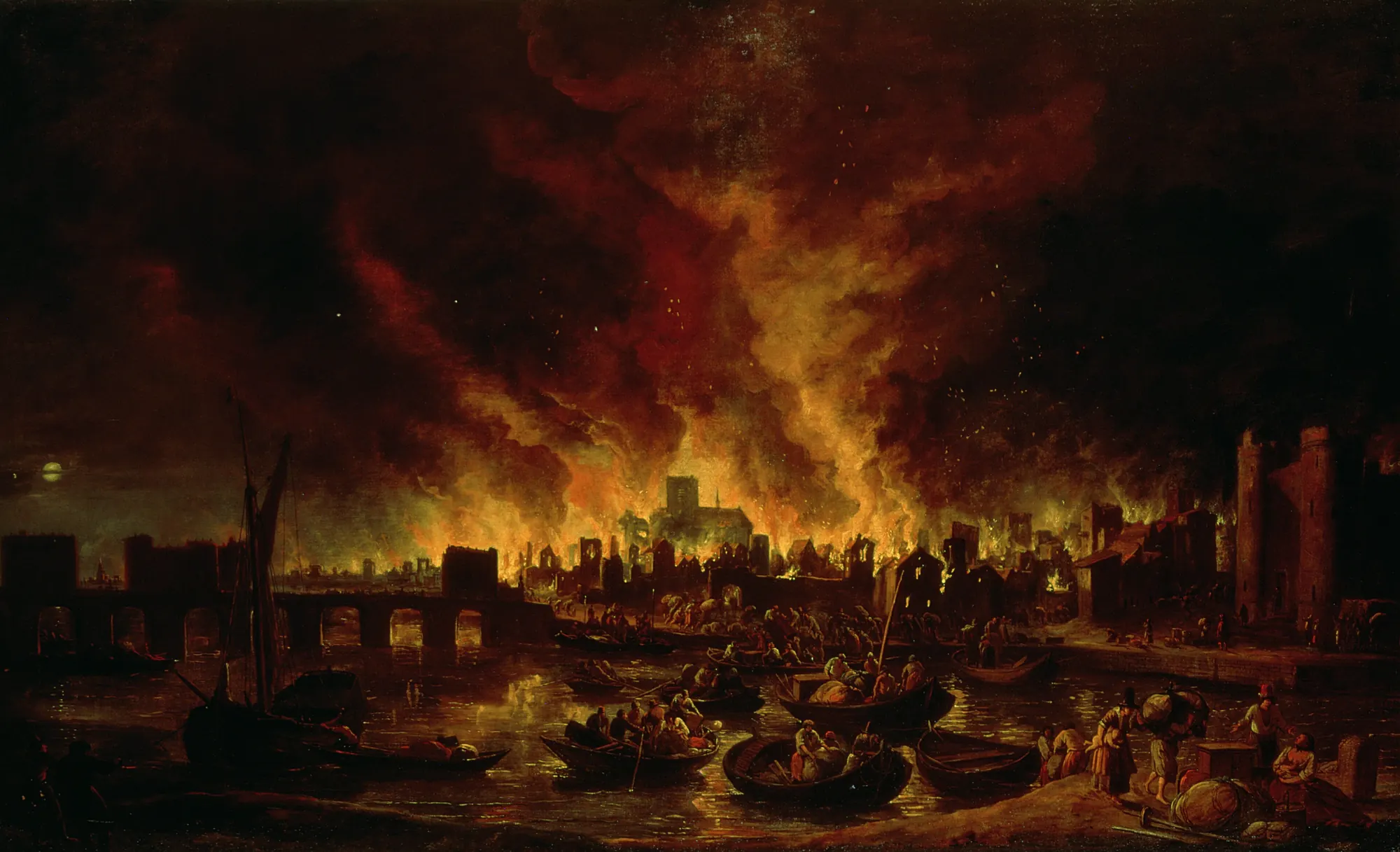
- The Great Fire of London: Lieve Verschuier, 1666 · public domain
- London before and after the fire, from St Mary Overie: Wenceslaus Hollar, 1666 · public domain
- A Map or Groundplott of the Citty of London: Wenceslaus Hollar, 1666, Rijksmuseum · CC0
- Samuel Pepys: John Hayls, 1666, National Portrait Gallery · public domain
- Wren's plan for the City: after Christopher Wren, 1666; engraving, British Museum · public domain

.jpg)