The story of light
How old is the light that woke you this morning?
The flight across space takes eight minutes. But the energy in the light wandered inside the Sun for some 170,000 years before setting off. Follow its path, step by step.
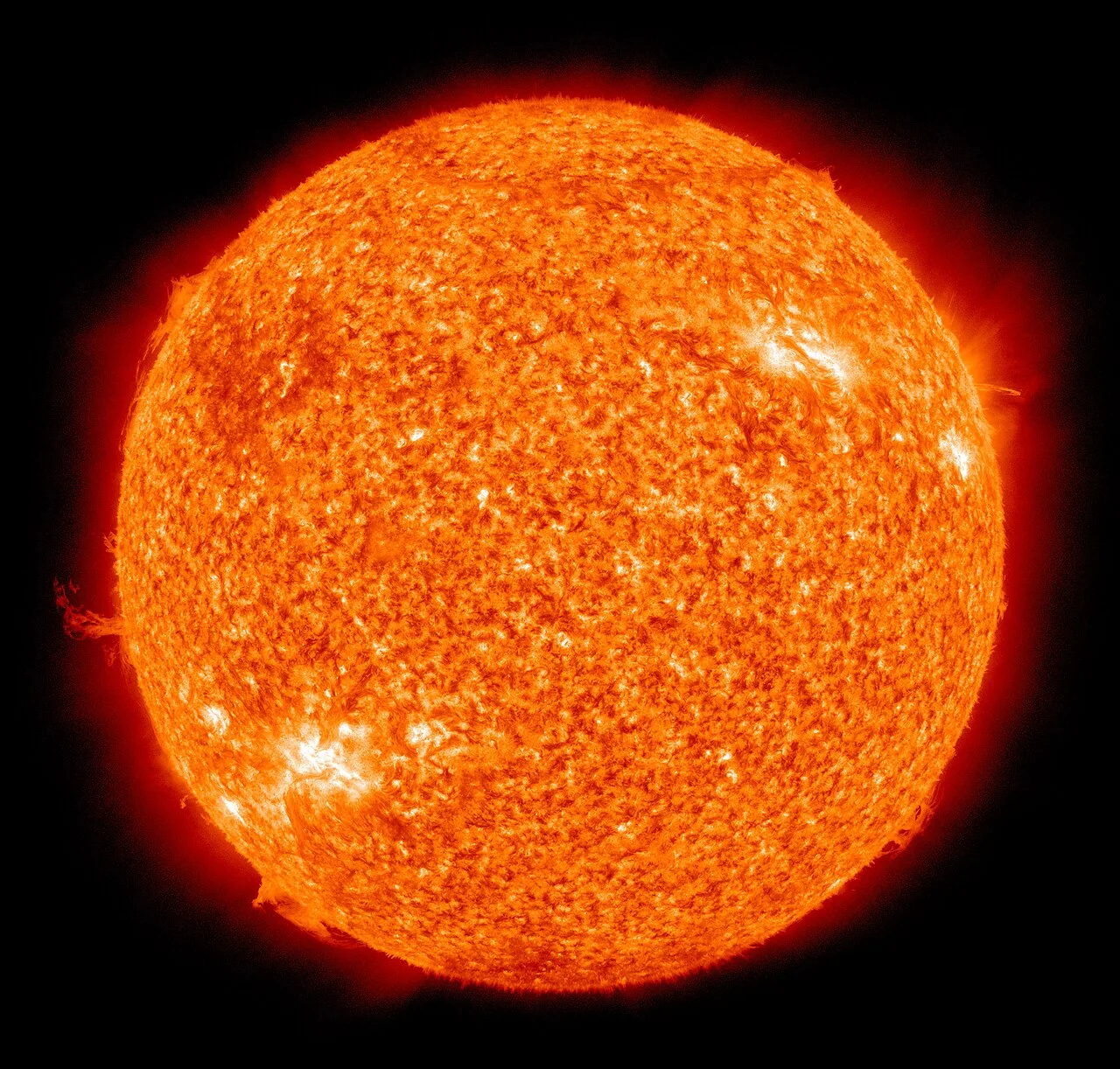
Start with a guessImage: NASA/SDO, public domain
Guess first
How long did the journey through the Sun take? #
The light that woke you flew eight minutes through space. Before that, its energy climbed from the Sun's core to the surface. Pick an answer. The verdict appears after you commit.
170,000 years.
The right answer is 170,000 years, over ten billion times the sprint across space. Careful calculations give between 10,000 and 170,000 years. The best calculation so far, worked out in 1992, is 170,000.
The answer: 170,000 years.
The right answer is 170,000 years, over ten billion times the sprint across space. Careful calculations give between 10,000 and 170,000 years. The best calculation so far, worked out in 1992, is 170,000.
The simulation
A random walk in millimetre steps #
In the Sun's core, light does not fly straight. It is absorbed and sent out again in a random direction, step after step. Choose the step length and see how long the escape takes.
t = R² / (λ · c) The time grows as the step shrinks: more steps, each equally fast.
- Step
- 0.09 cm
- Steps needed
- 6.0 × 10²³
- Escape time
- 56,843 years
The full layer-by-layer calculation: 170,000 years.
In the drawing, the steps are magnified billions of times. Otherwise you would see nothing.
With 0.09 cm steps, the simple model gives some 57,000 years.
The model here uses equal steps. In the real Sun, the shortest steps are right at the centre, where light spends most of its time. That is why the full calculation comes out larger than the simulation shows.
Each step is short: under a millimetre on average. But the Sun's centre is nearly 700,000 kilometres from the surface, and after every step the direction changes at random. The 1992 calculation counts that many steps, a 1 followed by 25 zeroes.
Spread over the whole time, the average outward drift is 0.97 centimetres per second: about 35 metres an hour. The energy climbs toward the surface very slowly.
The rule is merciless: a hundred times more steps take you only ten times further. After 100 random steps you are some 10 metres from the start, after 10,000, 100 metres. That is why leaving the Sun takes so many steps.
The two times
Eight minutes and 170,000 years on one strip #
On the strip below, each step forward multiplies the time by ten. Otherwise eight minutes could never fit beside 170,000 years.
- 2 seconds a neutrino crosses the Sun
- 8 minutes 19 seconds the sprint to you
- 170,000 years the walk through the Sun
At 8, 21,250 lifetimes like yours fit inside 170,000 years.
In January, when the Earth is nearest the Sun, the light arrives some 17 seconds earlier than in July.
For a sense of the proportion: if the whole walk lasted a year, the sprint across space would last three milliseconds.
The race
The neutrino wins by 170,000 years #
The same reaction also makes neutrinos: particles that pass through matter like air. Guess when one reaches you, then watch the race.
A neutrino born with the energy in today's light reaches you…
The middle answer.
The neutrino leaves the Sun in about two seconds, then crosses space beside the light. It reaches you 170,000 years ahead of the energy born with it.
The answer: The middle answer.
The neutrino leaves the Sun in about two seconds, then crosses space beside the light. It reaches you 170,000 years ahead of the energy born with it.
The finish: the neutrino is out in two seconds; the light's energy takes 170,000 years.
Since you opened this page, about this many neutrinos have passed through every square centimetre of you:
neutrinos from the Sun.
Every second, 65 billion neutrinos from the Sun pass through every square centimetre of you.
Neutrinos are born in the core's reactions and barely touch matter: they cross the Sun, the Earth and you without stopping. That is why they escape in two seconds while the light's energy wanders for 170,000 years.
There are so many that 65 billion pass through every square centimetre each second. You feel nothing: they go through you like air.
The core
A 15-million-degree furnace, denser than lead #
To grasp why light escapes so slowly, look at where it starts.
Over 15 million degrees
the temperature at the centre
162 grams per cubic centimetre
the density at the centre, greater than lead's
600 million tons
of hydrogen becoming helium every second
4 million tons
turned into energy every second
About 5,500 degrees
the surface temperature, in Celsius

Every second, the Sun turns 600 million tons of hydrogen into helium, and 4 million tons never reappear: they have become energy, the light and warmth we receive.
The core is over 15 million degrees, and one cubic centimetre of it holds 162 grams. Newborn light is a gamma ray, full of energy. Each collision takes a little away until it leaves the surface as ordinary light.
The calculations
Why the calculations span 10,000 to 170,000 years #
The answer depends on the step length you assume. The curve shows the escape time for each step. The dots show what the textbooks assumed and what the layer-by-layer sum gave.
- the old assumption: 5,116 years
- the 1992 mean step: 56,843 years
- the layer-by-layer sum: 170,000 years
The old textbooks assumed a one-centimetre step everywhere and a constant density, and got thousands or tens of thousands of years. The 1992 calculation used the real step in every layer of the model: under a millimetre across almost half the radius. Hence the 170,000 years.
And the millions of years in some textbooks are mistakes copied from book to book, with nobody redoing the sum. The only real time of that order, some 30 million years, measures something else: how long the Sun would take to shrink if its core reactions went out.
Honesty
What the sources cannot say #
Three limits, stated plainly.
- No single number is nailed down. Careful calculations give between 10,000 and 170,000 years. Of these, 170,000 comes from the most careful one.
- Nobody has tracked one ray's journey. Every number is calculated from models of the Sun's interior.
- There is no published number for the convection zone. All that is known is that the rising gas crosses it much faster than light would by random steps.
Game
True or false? #
Eight statements about the ancient light. Some sound like stories and are true.
The eight statements and their answers:
- False. The energy in sunlight is 8 minutes old too. Eight minutes 19 seconds is only the sprint across space. Before setting off, the energy wandered inside the Sun for some 170,000 years. Mitalas & Sills 1992; NASA
- False. A particle of light flies straight from the core to the surface. It zigzags, absorbed and passed on at every step: the 1992 calculation counts that many steps, a 1 followed by 25 zeroes. Mitalas & Sills 1992
- False. The same particle that left the core reaches your eye. No particle survives the journey: light is absorbed and passed on at every step. What reaches your eye left the surface eight minutes ago. Odenwald, NASA
- False. Neutrinos born in the same reaction need 170,000 years too. They cross the Sun in about 2 seconds, passing through matter untouched, then travel to you with the light. Borexino collaboration
- True. Inside the Sun, energy advances some 35 metres an hour. The average is 0.97 centimetres per second, about 35 metres an hour. The energy seeps slowly toward the surface. Mitalas & Sills 1992
- False. Textbooks that say millions of years measure the same journey. No: the millions are mistakes copied from book to book. The only real time of that order, some 30 million years, is how long the Sun would take to shrink if its reactions went out. Odenwald, NASA; Princeton notes
- True. Every second, the Sun turns 600 million tons of hydrogen into helium. Of those, some 4 million tons become energy: the light and warmth you receive. OpenStax Astronomy
- True. January light is younger than July light. In January the Earth is nearest the Sun, so the light arrives some 17 seconds earlier. NASA; USNO
Sources
Where the numbers come from #
The 170,000 years come from Mitalas and Sills (1992), who worked the random walk through the layers of a Sun model. The sprint across space comes from dividing NASA's mean distance by NIST's exact speed of light. The smallest and largest distances give January and July. The year in the sums has 365.25 days.
Wherever the sources give a range, the page shows all of it. Wherever they are silent, the page says so. Translation and adaptation: Marius Comper.
The escape time
- Mitalas, R. and Sills, K. R. (1992). On the photon diffusion time scale for the Sun. The Astrophysical Journal 401:759–760. ADS, 2-page PDF — the 0.090 cm mean step, the 170,000 years, the huge step count, the 0.97 cm/s speed
- Stellar timescales. Princeton A403 course notes. princeton.edu, PDF — the simple 1 cm model, the 30-million-year Kelvin–Helmholtz time
- Odenwald, S. (2007). Ancient Sunlight. NASA Sun–Earth Day, Technology Through Time #50. NASA, via web archive — the 10,000–170,000 range, the textbook errors, the gamma rays at birth
The Sun and its neutrinos
- Williams, D. R. Sun Fact Sheet. NASA Goddard Space Flight Center. nssdc.gsfc.nasa.gov — radius, temperatures, central density, distances from Earth
- Fraknoi, Morrison, Wolff. Astronomy 2e, 16.3. OpenStax, Rice University. OpenStax, via LibreTexts — the 600 million tons of hydrogen converted to helium every second
- The Equation of Time. U.S. Naval Observatory. aa.usno.navy.mil — closest approach in early January, farthest in early July
- CODATA 2022: speed of light in vacuum. NIST. physics.nist.gov — 299,792,458 m/s, exact
- Measuring elusive neutrinos flowing through the Earth. UMass Amherst / Borexino, October 2011. phys.org — the 65 billion neutrinos per square centimetre per second
Images
- The Sun, 19 August 2010. NASA/SDO (AIA), public domain. Wikimedia Commons — the opening image
- Kelvinsong (2014). Sun poster. CC BY-SA 3.0. Wikimedia Commons — the Sun layers diagram

