Six in every ten atoms in your body are hydrogen, and the core of every hydrogen atom was made in the first minutes of the universe. Almost all the rest were forged inside stars that lived and died before the Sun was born. Set your weight to see how much of you is that old. Then scroll, and each part of you will fly back to where it was made.
70 kg
7.0 kg of you is 13.8 billion years old
Scroll to take yourself apart
Marius Comper · 25 September 2026
The Big Bang · 13.8 billion years ago
7.0 kg
Your hydrogen is as old as the universe
Every hydrogen atom in you, in your water, your fat and your DNA, has a nucleus that formed in the first minutes after the Big Bang. Hydrogen is the lightest atom, so it is only a tenth of your weight. Counted atom by atom, it is most of you: 4.2 × 1027 of your 6.7 × 1027 atoms.
Exploding giant stars
49.0 kg
Most of your weight was thrown out by stars that exploded
Stars more than about eight times heavier than the Sun burn out within a few tens of millions of years and blow themselves apart. They made all the oxygen in you, and oxygen, mostly locked in water, is about 61% of your weight.
Dying stars like the Sun, and heavier
13.3 kg
Much of your carbon came from stars that swelled up and shed their outer layers
Stars like the Sun, and up to several times heavier, end as red giants that puff their outer layers into space. They made between half and three quarters of the carbon in you, depending on the study, and most of your nitrogen, woven through the amino acids of proteins and the bases that spell out DNA.
Exploding white dwarfs
634 g
Half the calcium in your bones came from exploding white dwarfs
A white dwarf is the burnt-out core of a star like the Sun. If it pulls in enough matter from a companion star, or merges with another white dwarf, it can explode. Explosions like these made half the calcium in your body, about 499 g, almost all of it in your bones and teeth, and two thirds of your iron, most of which sits in your red blood cells.
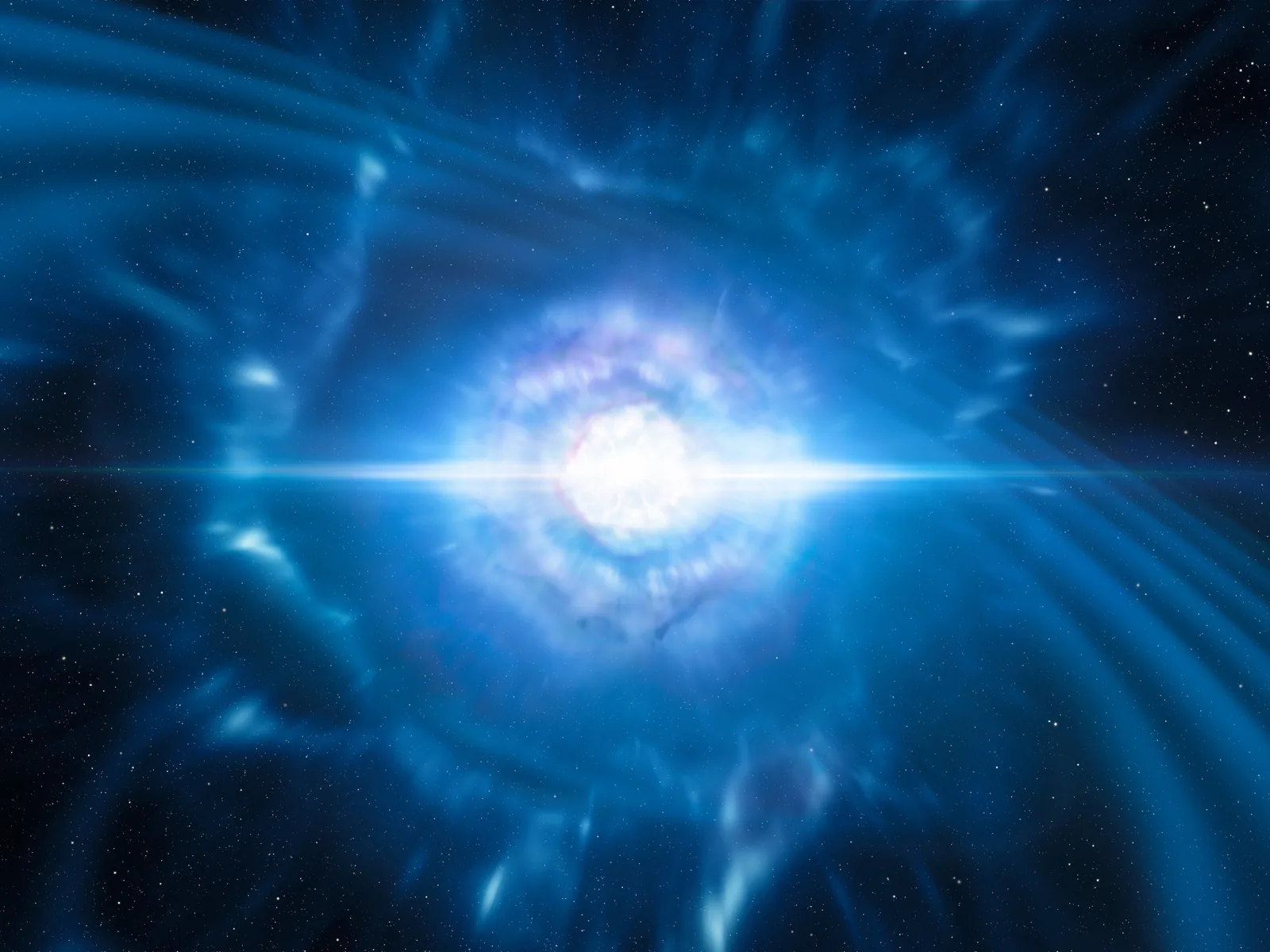
Colliding neutron stars
75 mg
A pinch of you came from the most violent collisions in the universe
Your body holds about 13 mg of iodine, almost all of it in your thyroid. Most of it was made when neutrons were packed onto atoms faster than they could decay, something that happens when two neutron stars collide. Astronomers watched one such collision in 2017. Whether collisions made most of these atoms, or rare exploding stars did, is still argued.
The gold points are drawn far larger than life. At true scale, there is too little to see.
You, put back together
Every colour is a different birthplace
Big Bang7.0 kg
Exploding giants49.0 kg
Dying stars13.3 kg
White dwarfs634 g
Neutron stars75 mg
Big Bang62%
Exploding giants28%
Dying stars9.8%
White dwarfs0.15%
Neutron starsa trace
Almost every atom in you is older than the Sun. They have been air, rock, ocean and other living things many times over, and they will be again.
The reference body lists 36 elements. Pick one to see how much of it you carry and which kind of star made it. The coloured bar under each symbol shows the shares.
Squeeze the universe's 13.8 billion years into a single calendar year, and the story of your atoms looks like this.
JanFebMarAprMayJunJulAugSepOctNovDec
1 January, 00:00The Big Bang. Your hydrogen forms within minutes.
2 SeptemberThe Sun forms, and Earth soon after, from gas already enriched by generations of dead stars.
31 December, eveningTwice, Earth passes through iron-rich dust from nearby stellar explosions: from 5 h 32 min to 4 h 8 min before midnight, and again from 2 h 2 min to 57 min before. That iron is in the sea floor, not in you.
0.18 s
An 80-year human life: the last fraction of a second before midnight on 31 December.
2 September
The Solar System forms. The stars that made your oxygen, carbon, calcium and iron had already lived and died.
33%
The share of cosmic history that has passed since the Sun formed.
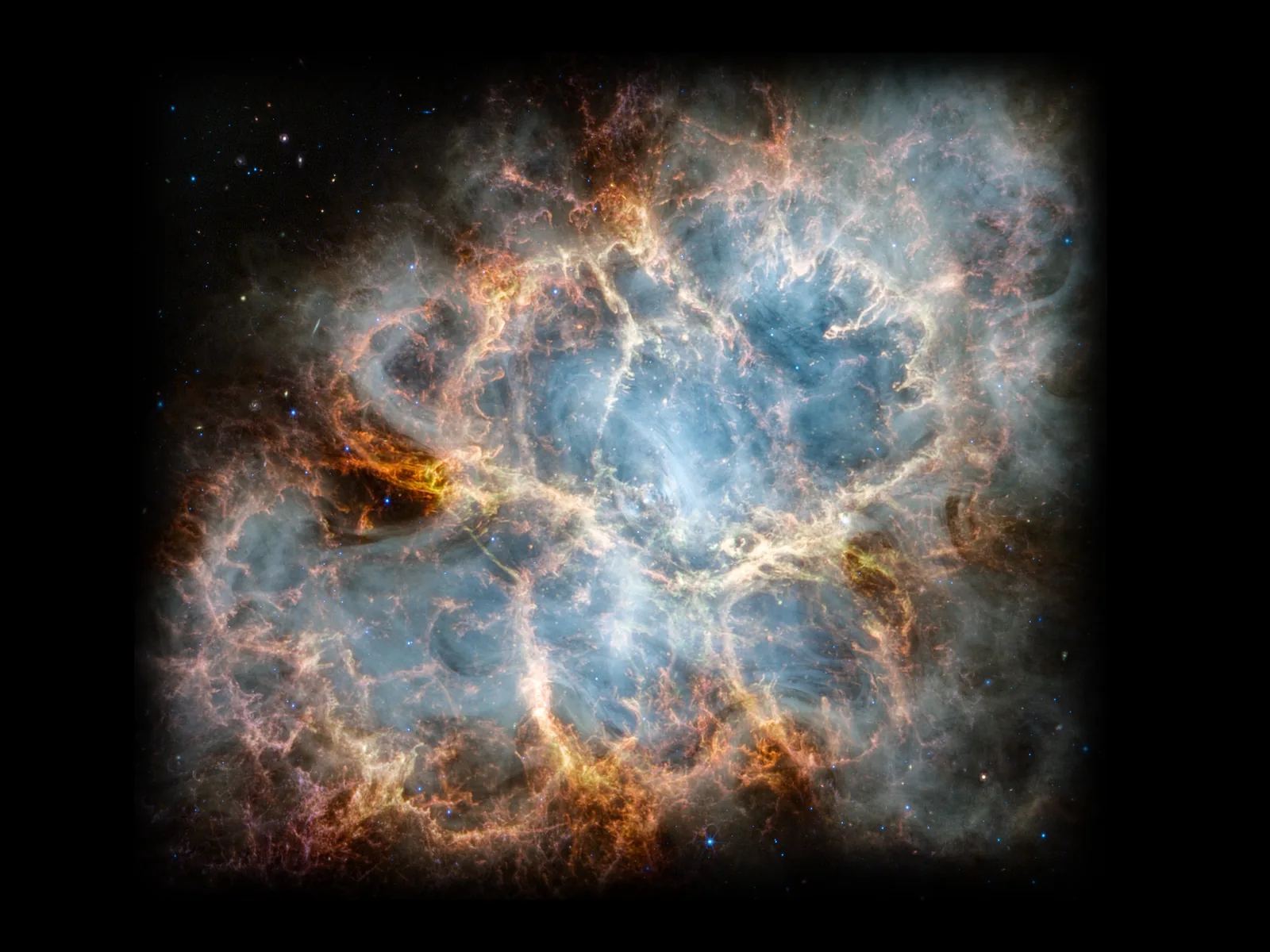
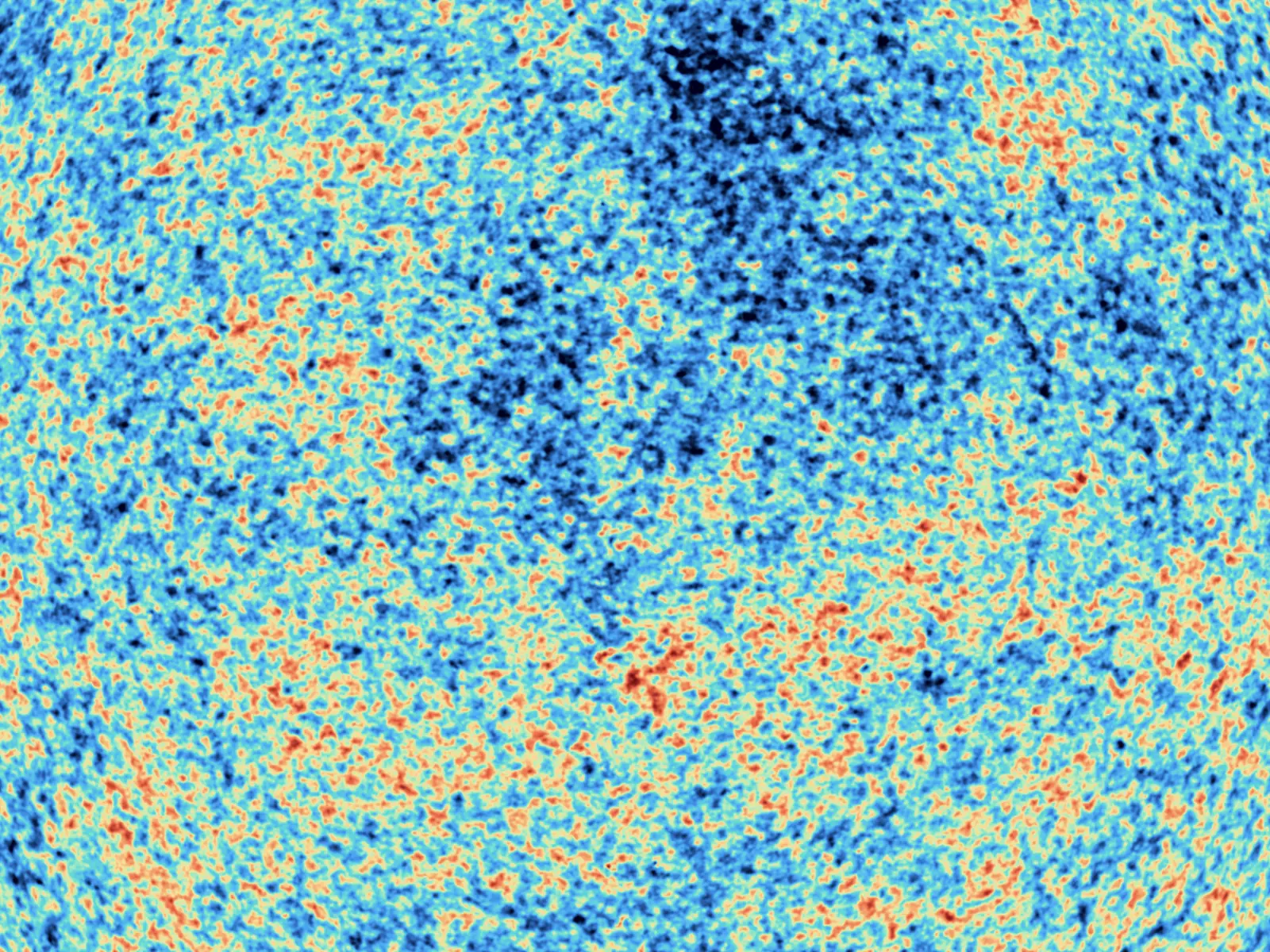
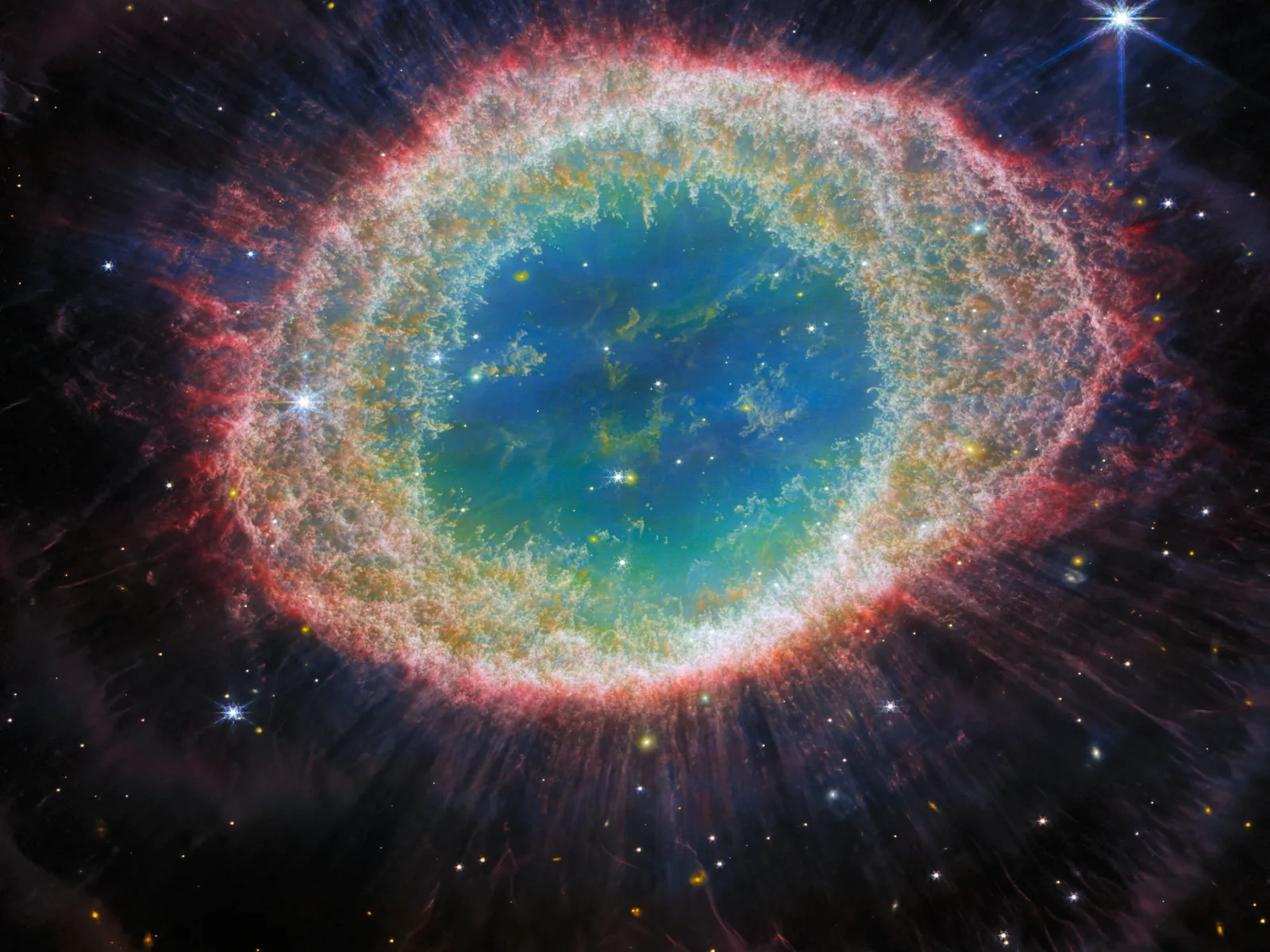
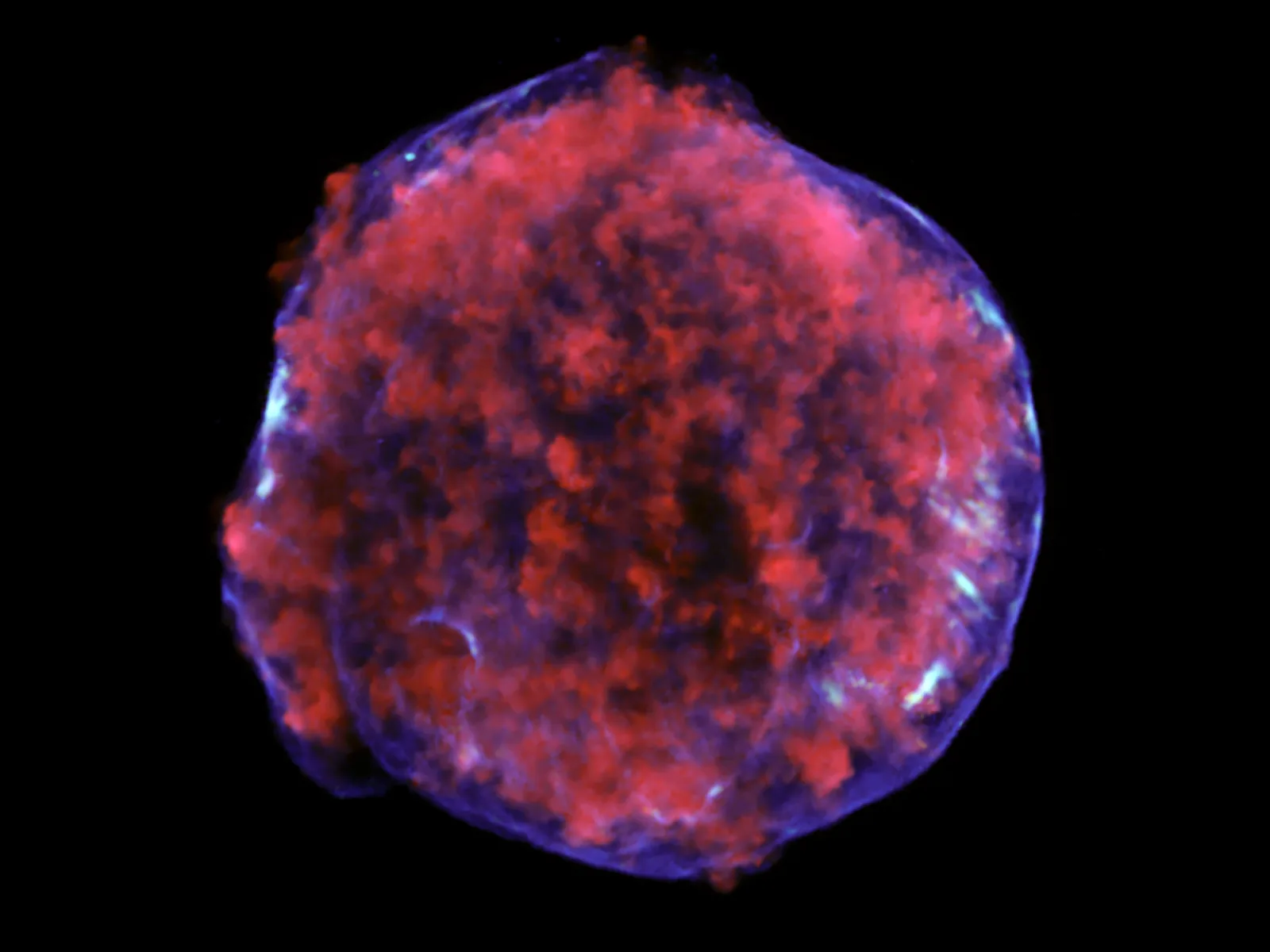
Real photographs, cropped, of the kinds of places that made you. None of these particular objects made your atoms: those stars died long before the Sun was born, and their remains spread through the galaxy.
The oldest light: the cosmic microwave backgroundPart of the Planck satellite's map of the cosmic microwave background, the oldest light in the Universe, imprinted on the sky when the Universe was about 380,000 years old. The colours show tiny differences in temperature. The hydrogen in your body dates from the Big Bang.Planck / ESA, Planck Collaboration / image processing Mark McCaughrean · CC BY-SA 4.0Crab NebulaThe Crab Nebula, the remains of a star whose explosion astronomers recorded in 1054. It is about 6,500 light-years away, and a rapidly rotating neutron star sits at its centre. Explosions of massive stars made all the oxygen in your body and half of its calcium.NASA, ESA, CSA, STScI, T. Temim (Princeton University) · CC BY 4.0Ring NebulaThe Ring Nebula, the outer layers thrown off by a star as it ran out of fuel. It is about 2,500 light-years away. Dying stars like this one made much of the carbon and most of the nitrogen in your body.ESA/Webb, NASA, CSA, M. Barlow, N. Cox, R. Wesson · CC BY 4.0Tycho's supernova remnantTycho's supernova remnant seen in X-rays, left by the explosion of a white dwarf star that Tycho Brahe reported in 1572. Estimates of its distance range from about 8,000 to 13,000 light-years. Exploding white dwarfs made half the calcium in your bones and about two thirds of your iron.NASA/CXC/Rutgers/K. Eriksen et al. · public domainMerging neutron stars (illustration)An illustration, not a photograph: two neutron stars colliding and the explosion that follows, called a kilonova. The one detected on 17 August 2017 was about 130 million light-years away. Collisions like this are a likely source of very heavy elements such as iodine and gold; how much of them they made is still debated.ESO/L. Calçada/M. Kornmesser · CC BY 4.0
Nine tenths of your weight was made in stars. Counted atom by atom, it is the other way round: six in ten of your atoms are hydrogen that no star ever made. The astronomer Harlow Shapley said “we are made of the same stuff as the stars” in 1929; Carl Sagan wrote “we are made of star-stuff” in 1973 and made it famous in the television series Cosmos in 1980.
Carbon is the least certain big number
The study behind this page gives dying low-mass stars three quarters of your carbon. A 2020 study gives them about half. That would move roughly 4 kg of a 70 kg person from the orange group to the pink one.
Neutron-star collisions made some of your heaviest atoms, perhaps not most
In 2017 telescopes watched two neutron stars collide and saw the light of freshly made heavy elements. But collisions may be too slow and too rare to explain everything: a 2019 study argued that a rare kind of collapsing star could make over 80% instead. The question is still open.
Almost every atom, not every atom, is older than the Sun
A few formed on Earth: carbon-14, made in the air by cosmic rays; radium; part of your lead, from uranium and thorium decaying in rock; and a little of your calcium, from potassium decay. Together they are roughly one atom in tens of millions.
Your atoms are not all replaced every seven years
Many are swapped out as you eat, drink and breathe, but not all. The carbon in the core of your eye lenses has been there since around the time you were born.
You are not the reference body
The amounts come from a standard 70 kg adult defined by radiation-protection scientists in 1975, scaled to the weight you set. A real body differs: children hold more water, and trace metals such as lead depend on where you live.
The amount of each element comes from the 70 kg Reference Man of the International Commission on Radiological Protection (Publication 23, 1975, table 110), which lists 36 elements. The listed amounts add up to 70.1 kg, so they are scaled to exactly 70 kg and then in proportion to the weight you set. For boron, tin, gold, molybdenum and chromium the table gives only upper limits; the page shows them with “<” and uses the limits in the totals.
Where each element was made comes from Jennifer Johnson's 2019 estimate of the origin of every element in the Solar System when the Sun formed (Science, supplementary table S1). Your body inherited that mixture. Johnson labels the rapid neutron-capture process “merging neutron stars”; the site of that process is still debated. Carbon and iron shares differ between studies; the notes above and the element table give the range.
Atoms are counted by dividing each element's mass by its atomic weight: 6.7 × 10²⁷ atoms for 70 kg, of which 62% are hydrogen. The cosmic year uses 13.8 billion years for the age of the universe (Planck 2018) and 4.567 billion years for the Solar System (Connelly and colleagues, 2012). The particle figure gives each group of points a share of the body in proportion to its mass; trace elements are magnified so they can be seen. When this page gives an atom an age, it means the age of its nucleus: when that nucleus was made.
J. A. Johnson (2019), Populating the periodic table: nucleosynthesis of the elements, Science 363:474, supplementary table S1 science.org/doi/10.1126/science.aau9540
C. Kobayashi, A. Karakas, M. Lugaro (2020), The origin of elements from carbon to uranium, ApJ 900:179 arxiv.org/abs/2008.04660
J. N. Connelly et al. (2012), The absolute chronology and thermal processing of solids in the solar protoplanetary disk, Science 338:651 doi.org/10.1126/science.1226919
B. P. Abbott et al. (2017), GW170817, Physical Review Letters 119:161101 arxiv.org/abs/1710.05832
D. Kasen et al. (2017), Origin of the heavy elements in binary neutron-star mergers, Nature 551:80 arxiv.org/abs/1710.05463
D. M. Siegel, J. Barnes, B. D. Metzger (2019), Collapsars as a major source of r-process elements, Nature 569:241 arxiv.org/abs/1810.00098
A. Wallner et al. (2016), Recent near-Earth supernovae probed by global deposition of interstellar radioactive 60Fe, Nature 532:69 doi.org/10.1038/nature17196