Chemistry · Mendeleev’s table · 1871–1886
Can you weigh an element no one has ever seen?
In 1871 Dmitri Mendeleev printed a table of the elements with empty places in it. In one of them, in silicon’s column, he wrote “?72” and a provisional name, eka-silicon. Fifteen years later a chemist in Freiberg, in Saxony, found what was there. Try before he does.
The numbers under the symbols are atomic weights, as Mendeleev knew them. The box framed in violet, “?72”, is the one you will guess.
What does the element in the “?72” box weigh?
Mendeleev had ordered the elements by atomic weight and stacked those that behave alike in reactions; where the two clashed, as with tellurium and iodine, he chose chemical likeness and suspected the measured weight was wrong. Where the order called for an element nobody had on the shelf, he left the place empty. Of the “?72” box, in silicon’s column, he wrote that the new element stands “in the middle, between Ea and As on one side, and between Si and Sn on the other”.
In that column, related elements sit every other row: two rows up is silicon, 28; two rows down, tin, 118. On the same row, to the right, is arsenic, 75. To the left is another gap: an element Mendeleev had named eka-aluminium and given the weight 68, although no one had seen it. To guess one unknown, you have to lean on another.
The answer, in brief: Mendeleev predicted 72; Winkler measured 72.32.
Mendeleev does not print the sum that gives 72. He does print the same method for other quantities: he places the new element’s atomic volume between silicon’s (11) and tin’s (16) and gives it 13 (the exact midpoint would be 13.5), and he checks selenium’s weight by averaging its four neighbours. Applied here, the average is (28 + 118 + 68 + 75) / 4 = 72.25.
The card written before, the card written after
In 1886 Clemens Winkler, a chemist at the Freiberg Mining Academy, found a new element in a silver mineral, argyrodite, and named it germanium. He quoted Mendeleev’s 1871 description at length, then gave his own measurements.
| Mendeleev, 1871 | Winkler, 1886 | |
|---|---|---|
| Atomic weight | 72 | 72.32 |
| Density of the metal | 5.5 | 5.469 |
| Density of the oxide (EsO₂ / GeO₂) | 4.7 | 4.703 |
| The chloride boils at (°C) | “100, probably somewhat lower” | 86 |
| The ethyl compound boils at (°C) | 160 | about 160 (1887) |
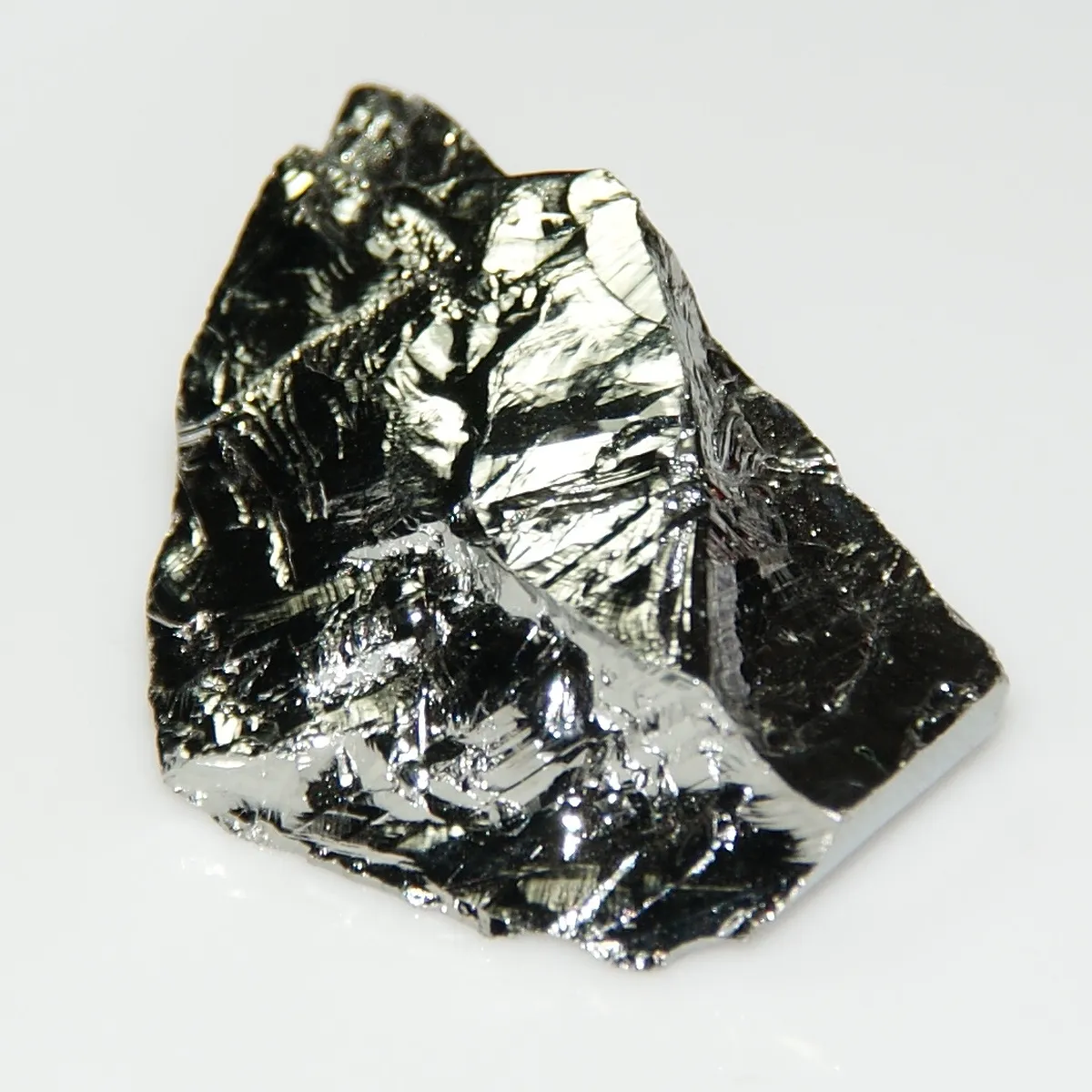
Who was right: the chemist holding the metal, or the man who had never seen it?
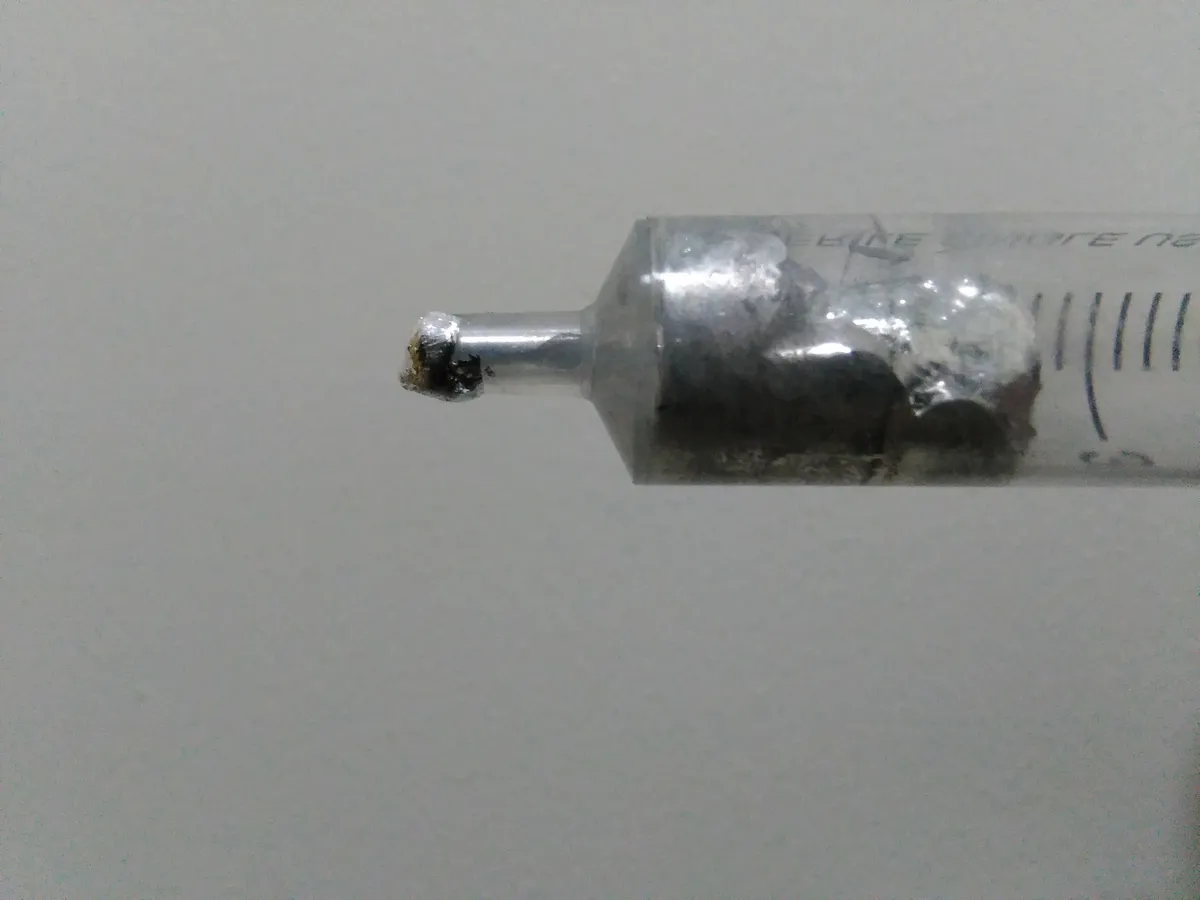
The first element on Mendeleev’s list turned up in France. On 27 August 1875, between three and four in the afternoon, Paul-Émile Lecoq de Boisbaudran saw in the spectrum of a zinc blende from the Pierrefitte mine, in the Pyrenees, a bright violet line, and a very faint one, that belonged to no known element. He called it gallium.
On 22 November 1875 Mendeleev wrote in the same journal, the Paris Academy of Sciences’ Comptes rendus, that gallium was his eka-aluminium and that “its density will be 5.9”.
On 1 May 1876 Lecoq published the first measured density, on a piece weighing 64 milligrams: 4.7. He added that the figure confirmed theory, since the average density of aluminium and indium is 4.8.
Who do you side with?
On 18 September 1876 Lecoq came back with metal purified by electrolysis, which melted at the same temperature from sample to sample. Its density was 5.935, measured on a 58-centigram sample. He sets his old result beside Mendeleev’s calculations, which “led to the number 5.9”. He suspected his first piece had held bubbles of air or water.
The man who had never seen the metal had been right. Back in December 1875, Lecoq had made another point: he had not known Mendeleev’s description when he searched for gallium, and he thought that, had he followed it, he would have looked in the wrong place.
Scandium, recognised by someone else
The second predicted element came from Sweden in 1879. Lars Fredrik Nilson, who found it, did not connect it to Mendeleev: he thought the new metal weighed between 160 and 180. The same year Per Teodor Cleve pointed out that it matched eka-boron: weight 45 against a predicted 44, and an oxide of density 3.8 against “about 3.5”.
How many of Mendeleev’s predicted elements were found?
Ten out of twenty-four, in the list compiled by the historian of chemistry Eric Scerri and reproduced by the chemist Gábor Lente in 2019. The other fourteen were never found.
- newtonium (x)0.17never found
- coronium0.4never found
- unnamed2never found
- unnamed8never found
- unnamed20never found
- unnamed22never found
- unnamed36never found
- eka-boron44scandium, 1879
- eka-cerium54never found
- eka-aluminium68gallium, 1875
- eka-silicon72germanium, 1886
- eka-manganese100technetium, 1937
- eka-molybdenum140never found
- eka-niobium146never found
- eka-cadmium155never found
- eka-iodine170never found
- eka-caesium175never found
- inert gas137–180never found
- tri-manganese190rhenium, 1925
- dvi-tellurium212polonium, 1898
- unnamedastatine, 1940
- dvi-caesium220francium, 1939
- unnamedactinium, 1899
- eka-tantalum235protactinium, 1913
found (year) never found
Most of the false gaps come from the rare earths, a group of metals Mendeleev never managed to place. The strangest date from 1902: two elements lighter than hydrogen, one of which, “x” or newtonium, was to be the ether through which light was thought to travel, weighing at most 0.17. The other, coronium, was meant to explain a green line in the Sun’s corona. The line turned out to come from iron that has lost thirteen electrons.
Did the predictions win people over?
Historians disagree. Some philosophers of science, among them Patrick Maher and Peter Lipton, cite the Royal Society’s 1882 Davy Medal as a sign that the predictions earned him recognition. Eric Scerri and John Worrall reply that the medal’s citation does not mention the predictions, and that it was shared with Lothar Meyer, who had made no such predictions. Samuel Schindler counted the papers, in the year of each discovery, that cited the table and mentioned the new element: 15 of 27 for gallium (1875), 13 of 21 for scandium (1879) and 7 of 26 for germanium (1886). Germanium, the third prediction to come true and the most detailed, is mentioned in the fewest.
How many elements were known in the year you were born?
Type your year, or a grandparent’s. The table lights up only with the elements identified by then.
An element enters the table in the year of the first publication that identified it as a new element and was later credited; those known since antiquity are lit from the start. For some elements the sources give different years; the rule and the exceptions are at the end.
| 1869 | 64 |
|---|---|
| 1900 | 83 |
| 1950 | 98 |
| 2000 | 114 |
| today | 118 |
Which element was discovered in Romania?
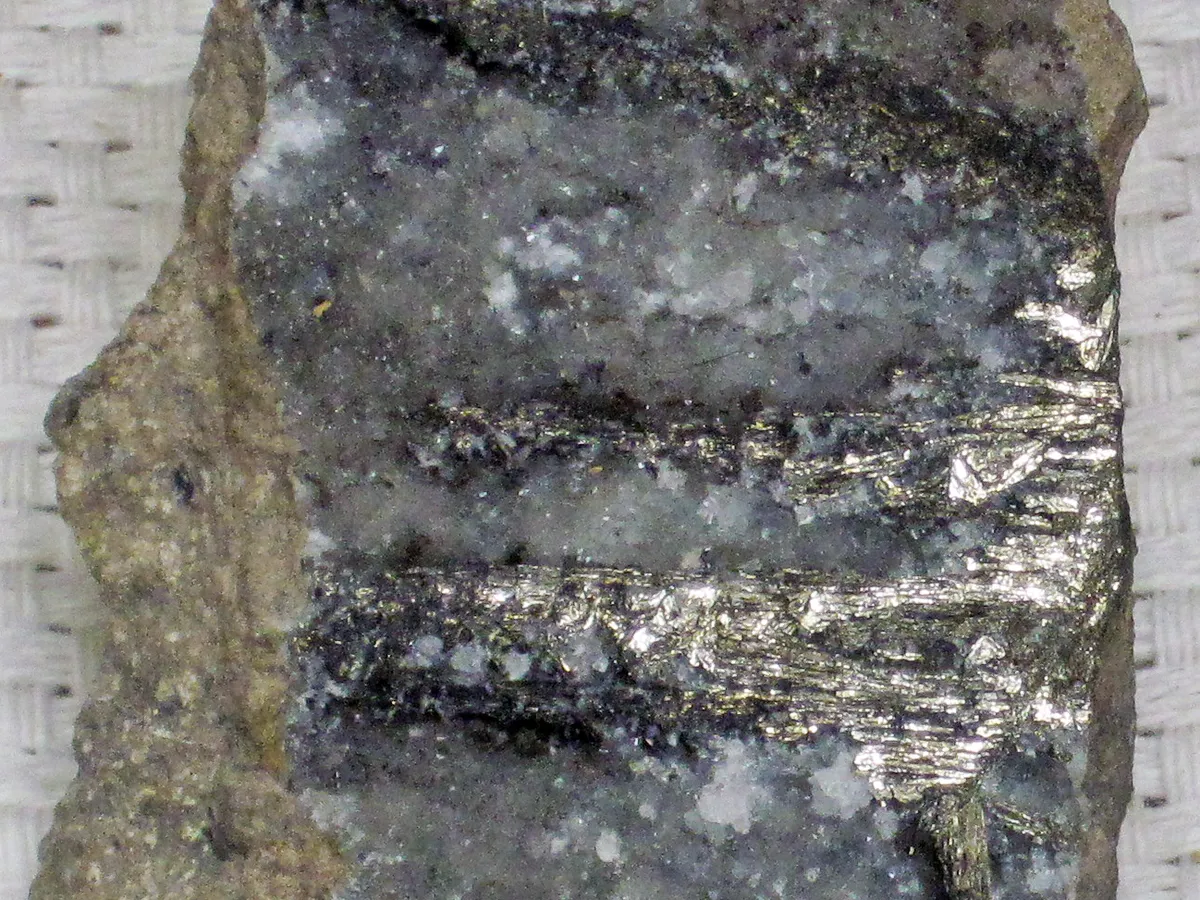
Tellurium, the only element first found in ore from what is now Romania. In 1782, in Habsburg Transylvania, Franz-Joseph Müller von Reichenstein, a senior official of the Transylvanian mining administration, examined a gold ore from the Mariahilf mine at Fața Băii, near Zlatna, in Alba county. The metal in it matched none known; Müller called it “metallum problematicum” and published his results in Vienna between 1783 and 1785.
He sent samples to the Swedish chemist Torbern Bergman, who died in 1784 without having analysed them. Only in January 1798, in Berlin, did Martin Heinrich Klaproth confirm the element, credit Müller with the discovery and name it tellurium, from the Latin tellus, earth. Meanwhile, in 1789, the Hungarian chemist Pál Kitaibel had found it independently, in an ore from Hungary. Müller also described the ore now called sylvanite, after Transylvania.
Moldavium, the element that didn’t stay
In 1936 the physicist Horia Hulubei, who worked in Paris with Yvette Cauchois, announced in the Comptes rendus that he had found in the X-ray spectrum of a mineral traces of element 87, the empty place under caesium. A year later he proposed the name moldavium. The American physicist Frederick Hirsh disputed the result in 1937. In 1939 Marguerite Perey, of the Curie Institute, showed that element 87 appears in the decay of actinium; the discovery was credited to her, and the element is called francium.
The decisive argument against moldavium is physical: Hulubei called his element “not fugitive”, apparently meaning stable, and abundant enough in the mineral to give X-ray lines. Element 87 has no stable isotope; its longest-lived one halves in about 22 minutes, and in uranium ores it occurs only in minute traces, constantly renewed by decay. Hulubei also announced element 85, which he named “dor” in 1944; the discovery was credited to the Berkeley team of 1940, who named it astatine. The historians Brett Thornton and Shawn Burdette argued in 2010 that astatine was present in Hulubei and Cauchois’s samples; the doubt is whether their instrument could detect it. The discovery is still credited to the Berkeley team.
Did Mendeleev dream the table? Did he invent 40% vodka?
The dream. The story comes from the memoirs of the geologist Alexander Inostrantsev, published after Mendeleev’s death. It appears nowhere in what Mendeleev wrote. According to the recollections of Olga Ozarovskaya, he answered such stories by saying he had thought about the table “perhaps twenty years”, not that he had sat down and “suddenly, done”. The table emerged while he was writing a textbook, The Principles of Chemistry.
The vodka. His 1865 doctoral thesis is about compounds of alcohol and water. The physicist Vladimir Shiltsev read it: nowhere does it argue that 40% is the ideal strength. The story appears even in William Pokhlebkin’s A History of Vodka, of 1991. And Russia had set 40% in 1843, when Mendeleev was nine.
How many elements are in the periodic table today, and which box is next?
The table has 118 elements. The last four, nihonium, moscovium, tennessine and oganesson, were named on 28 November 2016. Elements 119 and 120 have not been made yet.
In 2024 the Berkeley laboratory used a titanium-50 beam to make two atoms of livermorium in 22 days of running, as a rehearsal for element 120; the director of the laboratory’s nuclear science division estimated that 120 would take about ten times longer. In Japan, the RIKEN institute is firing vanadium at curium to make 119; in a report in May 2025 the search was under way and no discovery had been announced.
Like the “?72” box, box 119 already has its card written in advance. Calculations give element 119 a first ionisation energy of about 4.78 electronvolts, higher than francium’s (4.07) and caesium’s (3.89). In the textbook, the metals of the first group get more reactive going down. For 119 the calculations take relativity into account, because the inner electrons move very fast, and predict that the trend turns back. No one has been able to check: the element has not been made.
Sources and method
The 1871 table is redrawn from the sheet in «Основы химии», box by box; the weights are those printed then, not today’s. Predicted properties come from the 1871 German text, reprinted in 1895; measured ones from Winkler’s papers of 1886 and 1887. Winkler did not measure the density of the ethyl compound.
Each element’s year is that of the first publication that identified it as a new element and was later credited; helium enters in 1868, from its line in the Sun’s spectrum, fluorine in 1810, when Ampère proposed it as an element. Where the Royal Society of Chemistry and other lists give other years, we kept the rule.
The list of 24 predicted elements is Lente’s Table 3 (2019), compiled from Scerri.
- Mendeleev, Die periodische Gesetzmässigkeit der chemischen Elemente (1871), in Ostwald's Klassiker 68 (1895). archive.org/details/dasnatrlichesys00seubgoog
- Mendeleev, Основы химии (1871), Естественная система элементов (Science History Institute). commons.wikimedia.org/wiki/File:Dmitry_Mendeleyev_Osnovy_Khi
- Lecoq de Boisbaudran, gallium, Comptes rendus 81 (20 Sep 1875) 493. archive.org/details/comptes-rendus-hebdomadaires-academie-de
- Mendeleev, Remarques à propos de la découverte du gallium, Comptes rendus 81 (22 Nov 1875) 969–972. archive.org/details/comptes-rendus-hebdomadaires-academie-de
- Lecoq de Boisbaudran, Comptes rendus 81 (6 Dec 1875) 1104–1105. archive.org/details/comptes-rendus-hebdomadaires-academie-de
- Lecoq de Boisbaudran, Nouvelles recherches sur le gallium, Comptes rendus 82 (1 May 1876). archive.org/details/comptes-rendus-hebdomadaires-academie-de
- Lecoq de Boisbaudran, Comptes rendus 83 (18 Sep 1876) 611–613. archive.org/details/comptes-rendus-hebdomadaires-academie-de
- Nilson, Sur le scandium, Comptes rendus 88 (24 Mar 1879) 645–648. archive.org/details/comptes-rendus-hebdomadaires-academie-de
- Cleve, Sur le scandium, Comptes rendus 89 (18 Aug 1879) 419–422. archive.org/details/comptes-rendus-hebdomadaires-academie-de
- Winkler, Mittheilungen über das Germanium, J. prakt. Chem. 34 (1886) 177–229. archive.org/details/sim_journal-fuer-praktische-chemie-1834_
- Winkler, J. prakt. Chem. 36 (1887). archive.org/details/sim_journal-fuer-praktische-chemie-1834_
- Lente, Where Mendeleev was wrong, ChemTexts 5:17 (2019). doi.org/10.1007/s40828-019-0092-5
- Scerri & Worrall, Prediction and the periodic table, Studies in History and Philosophy of Science 32 (2001) 407–452. doi.org/10.1016/S0039-3681(01)00023-1
- Schindler, Novelty, coherence, and Mendeleev's periodic table (2014). philsci-archive.pitt.edu/9923/1/Novelty_and_Mendeleev.pdf
- Horovitz, telurul, Noesis (Academia Română) 2008. noesis.crifst.ro/wp-content/uploads/revista/2008/2008_2_03.p
- Adloff & Kauffman, Francium, the last discovered natural element, Chemical Educator 10 (2005) 387–394. perey.org/genealogy/MP%202.pdf
- Thornton & Burdette, Finding eka-iodine, Bulletin for the History of Chemistry 35(2) (2010). semanticscholar.org/paper/Finding-eka-iodine:-discovery-prio
- Shiltsev, Dmitri Mendeleev and the science of vodka, Physics Today (2019). lss.fnal.gov/archive/2019/pub/fermilab-pub-19-464-apc.pdf
- Gates et al., Physical Review Letters 133, 172502 (2024). journals.aps.org/prl/abstract/10.1103/PhysRevLett.133.172502
- Berkeley Lab, A new way to make element 116 (2024). newscenter.lbl.gov/2024/07/23/a-new-way-to-make-element-116-
- RIKEN, element 119 search, INPC 2025. indico.ibs.re.kr/event/701/contributions/7306/
- IUPAC, names of elements 113, 115, 117 and 118 (2016). iupac.org/iupac-announces-the-names-of-the-elements-113-115-
- Programa școlară Chimie, clasele a VII-a – a VIII-a (2017). ise.ro/wp-content/uploads/2017/01/Programa_Chimie_gimnaziu_f
- AQA GCSE Chemistry 8462, 4.1.2. aqa.org.uk/subjects/chemistry/gcse/chemistry-8462/specificat
Photographs
- germanium: Jurii, images-of-elements.com, CC BY 3.0, via Wikimedia Commons. commons.wikimedia.org/wiki/File:Polycrystalline-germanium.jp
- gallium: Leiem, CC BY-SA 4.0, via Wikimedia Commons. commons.wikimedia.org/wiki/File:Melting_gallium.jpg
- sylvanite: jsj1771, Museum of Geology, South Dakota School of Mines, CC BY 2.0, via Wikimedia Commons. commons.wikimedia.org/wiki/File:Sylvanite_(Transylvania,_Rom