Genetics in the mirror
Your earlobe doesn’t obey Mendel
For nearly a century, biology lessons have used the earlobe to teach dominant and recessive genes: free or attached. The rule is wrong. As early as 1937 Alexander Wiener, one of the doctors who would discover the Rh factor, wrote that every grade exists between the two. Look in a mirror.
What does your earlobe look like, seen from the side?
The textbook and the olympiad teach a wrong rule
In short: a Romanian eighth-grade biology textbook lists the earlobe among traits inherited by the dominant–recessive rule, like Mendel’s peas, and the 2025 olympiad answer key spells out how: free is dominant, attached is recessive. Research shows otherwise. Every grade exists between free and attached, and the shape of the lobe is linked to dozens of places in the genome, each with a small influence. For the earlobe, the school rule is wrong.
The textbook (Litera) states that “lip thickness, jaw shape, earlobe type and the length of the second toe” are inherited “by the dominant–recessive rule”. At Romania’s county biology olympiad in March 2025, ninth grade, the answer key required the free lobe to be written LL or Ll and the attached one ll. That is Mendel’s rule exactly: one gene, two versions, two forms. On that question, the right answer by the key is the wrong answer by genetics.
The doubt is old. In 1937 Wiener, a New York doctor, looked at the ears of 607 children and replied to researchers who had proposed exactly that rule: sorting ears into two sharply defined types “gives a false picture, since all gradations between the two extremes are encountered”. He even found people with one lobe free and the other attached. His conclusion: the lobe isn’t inherited by a simple rule; probably more than one gene with two versions is involved.
The answer came in 2017. Researchers compared the genomes of 74,660 people with the shape of their lobes and found 49 places in the genome associated with it, each with a small influence, none strong enough to decide it alone. (In the groups whose ears were rated by specialists rather than described by the people themselves, 6 emerged.) It isn’t just one textbook’s mistake: the authors write that the idea of a Mendelian trait had been “perpetuated through the primary literature and educational materials for nearly a century”.
In class: everyone grades both their ears from 0 to 3, with a phone camera or a mirror, on an unsigned slip. Then count how many land on 1 and 2: the textbook has two categories and doesn’t say where they go.
A Dacian ear or a Roman ear?
Besides the textbook rule, the earlobe has another one in Romania, which many remember from childhood. In 1996, in the magazine România literară, the narrator of a short prose piece by the philologist Paul Miron remembered one version of it, as a primary-school game: “When I was at primary school we played Dacians and Romans. If your earlobe was attached, you were a Dacian; on Romans that tip hangs free.” The Dacians were the ancient people of Dacia, whose kingdom Rome conquered in 106.
Today’s articles give the reverse version. Pro TV (published 2017, updated 2020) and several news sites in 2024 say a free lobe means Dacian and an attached one Roman; some do so to debunk it, and guess, without evidence, that it comes from Roman statues. Two opposite versions of the same “rule” can’t both be true.
Genetics supports neither. The lobe comes in grades, and of the 49 regions found in 2017, the one that differs most between continents, in the gene EDAR, has a variant whose frequency is under 1% in the European samples and over 90% in the Han Chinese one. No known variant can tell from an ear whether an ancestor was Dacian or Roman.
Tongue rolling and the geneticist it embarrassed
Turn up both edges of your tongue at once, so that from the front it looks like a trough.
In 1940 Alfred Sturtevant, who as a student had drawn the first genetic map of a chromosome, published observations, gathered by many observers, on 282 people. 183 could, 99 could not. He suggested, carefully, that the ability “may be due to a single dominant gene”, adding “though not proved”. He also wrote that many people had learned it by practice, and that in children “a few hours are sometimes enough”.
In his own table, couples in which neither parent could had 13 children between them; 4 of them could, all from two families. Sturtevant noted that the two fathers had slight speech defects and suggested this might have muddled their tests, though he added that other people with speech defects could do it.
In 1952 Philip Matlock went looking for identical twins at twins’ conventions: 33 pairs, confirmed as identical by blood groups and fingerprints where there was any doubt. In 7 pairs, one twin could and the other could not.
“I am still embarrassed to see it listed in some current works as an established Mendelian case.”
Clasp your hands. Now the other way.
Interlace your fingers without thinking. Which thumb ended up on top?
Now undo them and clasp again with the other thumb on top. For most people it feels like a coat buttoned wrong. Fold your arms across your chest, too: which one is on top?
A rule that left-thumb-on-top is dominant has circulated for a long time. The biologist John McDonald, who traced such myths back to their sources, couldn’t find where it came from. The first study of how people clasp their hands, published by Frank Lutz in 1908 on about 600 people whose data came from an Aberdeen professor, found that the habit runs in families but already concluded that it “does not seem to follow the Mendelian law, as neither position breeds true”.
In 1932 Wiener counted 709 people in 120 families: 53.1% right thumb on top, 46.9% left. For folded arms, of 595 people, 44.4% had the right on top and 55.6% the left. He re-examined 22 of them eighteen months later: each clasped exactly as before. The habit is stable, and Wiener concluded that it is not inherited.
In 1999 a review of family studies, with a new sample in which about 55% clasped left thumb on top, 44% right and 1% had no preference, concluded that the data “do not fit any straightforward recessive or dominant Mendelian model”, though they suggest some genetic influence. The proportions vary from study to study and population to population.
Put the rule to the test on your family
Choose a trait, then say what your mother, your father, you and your brothers and sisters have. The drawing is a family tree as textbooks draw it: a circle is a woman, a square a man, a diamond anyone, and the filled shape is the form the rule calls dominant.
The school rule: free is dominant, attached is recessive.
Choose for your mother, your father and you. “Don’t know” is fine anywhere.
The tree checks only the school rule; it says nothing about anyone’s genes or kinship. Nothing you choose leaves your device.
The textbook rule has one impossible case: two parents with the recessive form cannot have a child with the dominant form. For the tongue and for eyes, such families appear in the published data; for earlobes, in Wiener’s 1937 table (as John McDonald summarises it), every pairing of parents, from 0 × 0 to 3 × 3, had some children with in-between ears.
Identical twins share their genes. Not always their tongues.
If a single gene decided everything, identical twins would always match. This is the test an ordinary family can’t give.
can can’t pairs that disagree: 7 of 33, or 21.2%
That doesn’t mean genes play no part: in a 1971 study summarised by John McDonald, fraternal twins differed on tongue rolling about twice as often as identical twins. But identical twins didn’t always match, as a single dominant gene would require. In 1975 a twin study by N. G. Martin was titled, simply, “No evidence for a genetic basis of tongue rolling or hand clasping”. For earlobes, a few twins with different ears would prove nothing: the genome matters there, but through dozens of regions, each with a small effect.
Blue eyes and the two “hazel” children
In 1907 Gertrude and Charles Davenport (from 1910 he would run the Eugenics Record Office at Cold Spring Harbor, the centre of American eugenics) collected 132 pedigree cards, each tracing one person’s eye colour through three generations, from school principals and friends, and announced in Science: blue is recessive to brown. Two blue-eyed parents, then, would have only blue-eyed children.
Their count: 69 blue-eyed children, 6 blue-grey or grey, and two more with “so-called ‘hazel’ eyes”, which the authors “suspect to be of a blue type”. The authors recorded them as hazel but suspected them of being blue, and the rule stayed intact. By 1909 Holmes and Loomis were already reporting brown-eyed children of blue-eyed parents.
Today we know where most of the answer lies: on chromosome 15, next to the gene OCA2. In 2008 a single variant in the neighbouring gene, HERC2, explained about two-thirds of eye-colour differences in a sample of European ancestry; earlier estimates put the whole region at about three-quarters. Other genes contribute too: a 2011 review listed around 16 genes linked to eye colour.
That makes eye colour the best example of an “almost” simple trait: one large region and many small ones. And it is why a brown-eyed child of two blue-eyed parents has been reported for more than a century and is possible on the map of the genes.
The trait that really does obey Mendel: earwax
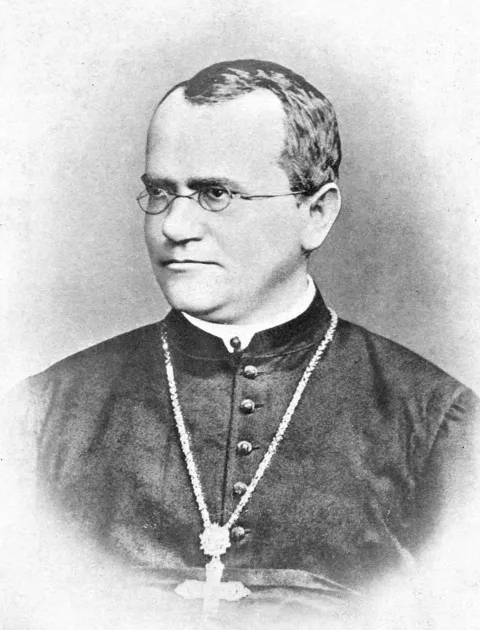
Mendel chose his peas with care: he followed seven characters, each with two forms that didn’t blend, like the smooth pea and the wrinkled one. People have very few visible traits like that. The clearest one isn’t among those in the school lesson.
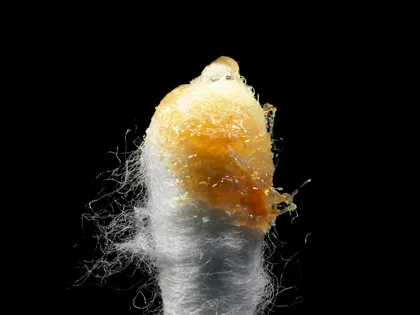
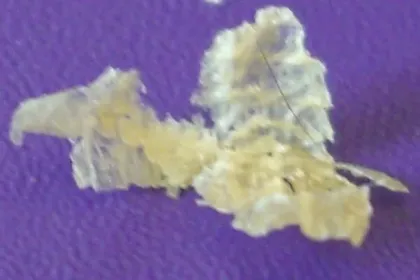
Earwax comes in two kinds: wet, sticky and yellow-brown, or dry, in pale flakes that crumble. In 2006 a Japanese team found the difference: a single letter in the gene ABCC11. Two copies of the A version give dry earwax; at least one G almost always gives wet. The exception the team found: in a few people of Asian ancestry, a rare version in which 27 letters are missing from the gene. The authors called it “the first example of DNA polymorphism determining a visible genetic trait”.
Bitter taste comes close. In a paper published in 1932 the chemist Arthur Fox told how, as he worked with a powder in the lab, a colleague complained of the bitter dust; Fox, who was much closer, “observed no taste”. The substance was phenylthiocarbamide. In 2003 the versions of a single receptor gene, TAS2R38, explained between 55% and 85% of the differences between people. Close, not complete: there are grades between tasters and non-tasters.
How you see what you expect to see
ABO blood groups are the textbook done right: one gene, with three common versions, O, A and B. In the model Felix Bernstein proposed in the mid-1920s, a parent with group O and one with group AB can only have children with group A or B. Here is what doctors had reported before and after the model spread.
Sturtevant, who printed the table in his history of genetics, wrote: “One has the uncomfortable feeling that observers see and report only what they expect to find.” And straight after: “The most probable interpretation is that the methods of typing were improved.” Both can be true. Here, by his judgement, the rule was right and much of the old data probably wrong; for earlobes, tongues and eyes it went the other way.
Blood groups country by country, on this site: Blood Doesn’t Choose.
Tonight, at home
Ask your family three things: clasp your hands, roll your tongue, look at your earlobe in the mirror. Then put them in the family tree above.
Whatever comes out is a good result. If your family fits the textbook, you have seen why the rule could look convincing for so long: in the old tables, too, most families fitted the tongue and eye rules. If it doesn’t, you are in the company of Sturtevant, Davenport and Wiener, who had children in their tables that didn’t fit the rule. The one you won’t check at the table, earwax, is also the only visible trait here inherited almost like Mendel’s peas.
For teachers: ten minutes in class
- Hands. The whole class clasps their hands. Count left and right thumbs on top. Then “the other way”, and let them feel how odd it is. Ask: gene, habit, or both?
- Earlobes. Everyone grades their own ear from 0 to 3 on an unsigned slip. How many are on 1 and 2? Read the textbook sentence and ask where it puts them.
- Twins. Project the chart of 33 pairs. What should we see if one gene decided?
- Blood. The O × AB table, before and after 1925: what changed, the people or the method? A discussion of how expectation shapes what we see.
- Earwax. The correct example of a Mendelian trait in humans: one gene and, almost always, one letter.
Project one section at a time. Students can open the same address on a phone and carry on at home, with their family.
Sources and method
The numbers come from the original papers, read in full where possible (Sturtevant 1940 and 1965, Matlock 1952, Komai 1951, Lutz 1908, Wiener 1932 and 1937, Davenport 1907, Holmes and Loomis 1909, Fox 1932, Shaffer 2017) and from abstracts for the rest (Reiss 1999, Sturm 2008, Sturm and Larsson 2009, White and Rabago-Smith 2011, Yoshiura 2006, Kim 2003). “Nearly a third” in Japan is our calculation from the proportion Komai published: 65.71% of the children of two non-rolling parents could not roll either. Komai’s data compare children of different ages, not the same children followed over time.
Frequencies of the dry-earwax version come from the 1000 Genomes Project (phase 3, via Ensembl, variant rs17822931, where the A version appears as T, on the opposite strand); the share of people with dry earwax is our calculation from those frequencies, assuming random mating. We found no published figure for Romania. The earlobe grades are our drawings, after the idea of Wiener’s scale. The family tree applies only the stated rule (one gene, a dominant and a recessive form) and says nothing about anyone’s actual genes.
We have no data on the second toe, lip thickness or jaw shape, which the Romanian textbook also lists, and we don’t judge them here. The critique of school “Mendelian” traits follows, as a guide, John H. McDonald’s book “Myths of Human Genetics” (2011); the figures above are checked in the primary sources.
- Grasu & Cîrstoiu, Biologie, grade 8 textbook, Litera (OM 5859/2020), p. 24. edu.litera.ro/manuale/Biologie_VIII/Manual_Biologie_VIII.pdf
- Romanian biology olympiad, county stage, 7 March 2025, grade 9, questions and answer key. cnpetrurares.ro/wp-content/uploads/2025/03/subiecte-si-barem
- Pro TV, “Do you have Dacian or Roman ears?”, 2017, updated 2020. protv.ro/articol/38390-ai-urechi-de-dac-sau-de-roman-ce-spun
- Paul Miron, “Sînge albastru”, România literară no. 35, 1996, p. 18. bibliotecadeva.ro/periodice/romlit/1996/09/romania_literara_
- shtiu.ro, the Dacian-or-Roman earlobe myth, 2024. shtiu.ro/mitul-care-circula-de-ani-buni-prin-romania-din-ce-
- Sturtevant, A new inherited character in man, PNAS 26:100–102, 1940. doi.org/10.1073/pnas.26.2.100
- Sturtevant, A History of Genetics, 1965, chapters 15 and 20 (CSHL/ESP edition). esp.org/books/sturt/history/
- Matlock, Identical twins discordant in tongue-rolling, J Hered 43:24, 1952. archive.org/details/sim_journal-of-heredity_january-february
- Komai, Notes on lingual gymnastics, J Hered 42:293–297, 1951. archive.org/details/sim_journal-of-heredity_november-decembe
- Martin, No evidence for a genetic basis of tongue rolling or hand clasping, J Hered 66:179–180, 1975. europepmc.org/article/MED/1236879
- Lutz, The inheritance of the manner of clasping the hands, Am Nat 42:195–196, 1908. archive.org/details/sim_american-naturalist_1908-03_42_495
- Wiener, Observations on the manner of clasping the hands and folding the arms, Am Nat 66:365–370, 1932. archive.org/details/sim_american-naturalist_july-august-1932
- Reiss, The genetics of hand-clasping, Ann Hum Biol 26:39–48, 1999. europepmc.org/article/MED/9974082
- Wiener, Complications in ear genetics, J Hered 28:425–426, 1937. archive.org/details/sim_journal-of-heredity_1937-12_28_12
- Shaffer et al., Multiethnic GWAS reveals polygenic architecture of earlobe attachment, AJHG 101:913–924, 2017. europepmc.org/article/PMC/PMC5812923
- Davenport & Davenport, Heredity of eye-color in man, Science 26:589–592, 1907. archive.org/details/sim_science_1907-11-01_26
- Holmes & Loomis, Biological Bulletin 18:50–65, 1909. archive.org/details/sim_biological-bulletin_1909-12_18_1
- Sturm et al., A single SNP in an evolutionary conserved region within intron 86 of the HERC2 gene determines human blue-brown eye color, AJHG 82:424–431, 2008. europepmc.org/article/MED/18252222
- Sturm & Larsson, Genetics of human iris colour and patterns, Pigment Cell Melanoma Res 22:544–562, 2009. europepmc.org/article/MED/19619260
- White & Rabago-Smith, Genotype–phenotype associations and human eye color, J Hum Genet 56:5–7, 2011. europepmc.org/article/MED/20944644
- Mendel, Experiments in plant hybridization (1865), Druery and Bateson translation. esp.org/foundations/genetics/classical/gm-65.pdf
- Yoshiura et al., A SNP in the ABCC11 gene is the determinant of human earwax type, Nat Genet 38:324–330, 2006. europepmc.org/article/MED/16444273
- 1000 Genomes phase 3, rs17822931, via Ensembl. rest.ensembl.org/variation/human/rs17822931?pops=1;content-t
- Fox, The relationship between chemical constitution and taste, PNAS 18:115–120, 1932. doi.org/10.1073/pnas.18.1.115
- Kim et al., Positional cloning of the human quantitative trait locus underlying taste sensitivity to phenylthiocarbamide, Science 299:1221–1225, 2003. europepmc.org/article/MED/12595690
- McDonald, Myths of Human Genetics, 2011. udel.edu/~mcdonald/mythintro.html