Marius ComperMăgurele · Ilfov
Română

IFIN Institute, Măgurele

What remains of the Măgurele reactor

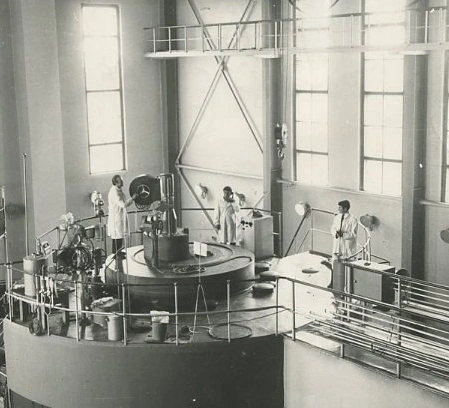
In a photograph from 1969, three people in lab coats stand beside the Măgurele reactor. Follow the facility from its early experiments through decommissioning and the decision to keep its control room.

Start the story ↓
Black-and-white photograph of three people in lab coats beside a railed metal platform.
The 1969 photograph shows the circular platform, people at the instruments and the hall’s high windows. (Source · National History Museum of Romania / Communism in Romania · Reuse with attribution)

1969

Black-and-white photograph of three people in lab coats beside a railed metal platform.
The 1969 photograph shows the circular platform, people at the instruments and the hall’s high windows. (Source · National History Museum of Romania / Communism in Romania · Reuse with attribution)

1969

A working hall at Măgurele

In a photograph from 1969, three people in lab coats stand at instruments on a platform with a railing. They are in the hall of the research reactor at Măgurele, near Bucharest. The National History Museum holds the photograph in its collection on the communist period. [1]

Light falls through high windows. The platform and its instruments fill the lower half of the frame. The photograph shows the workplace, while other records explain the installation’s purpose and what happened after its working life. [1] [3]
Black-and-white photograph of three people in lab coats beside a railed metal platform.
The 1969 photograph shows the circular platform, people at the instruments and the hall’s high windows. (Source · National History Museum of Romania / Communism in Romania · Reuse with attribution)
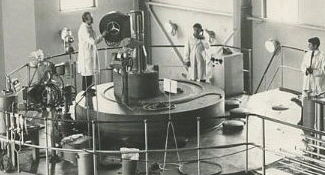
Crop showing people in lab coats at different instruments around the reactor.
Detail from the same archive photograph. Several people stand at different positions around the platform. (Source · National History Museum of Romania / Communism in Romania · Reuse with attribution)

1956–1957

The institute took shape outside Bucharest

The institute’s history describes the 1956 division of the Academy’s original Institute of Physics. Horia Hulubei directed the Institute of Atomic Physics at Măgurele. The Bucharest Institute of Physics was based at the university’s Faculty of Physics. [2]

Two Soviet-built facilities came into operation at Măgurele, the reactor and a cyclotron, a kind of particle accelerator. The reactor started operating in 1957. [2] [3]
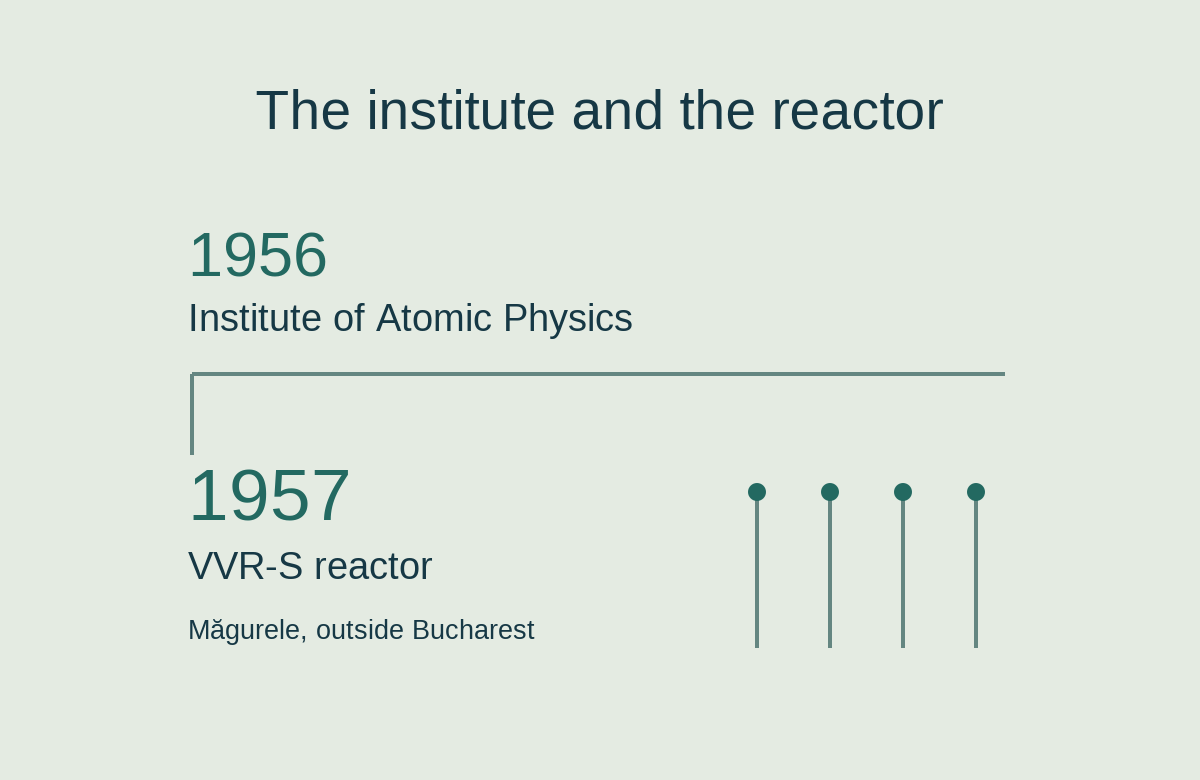
Two consecutive dates, 1956 for the institute and 1957 for the reactor.
The institute took this form in 1956. The reactor came into operation the following year. (Source)

During operation

Experiments and radioisotopes

The reactor served nuclear physics experiments and produced radioisotopes, radioactive forms of elements. It operated for four decades. The regulator reports a maximum thermal power of 2 MW, a measure of the heat produced. [3]

It was called a research reactor because of what people used it for. The photograph shows instruments on the platform, and the report describes their facility’s purpose. Electricity for the power grid came from other kinds of plant. [1] [3]
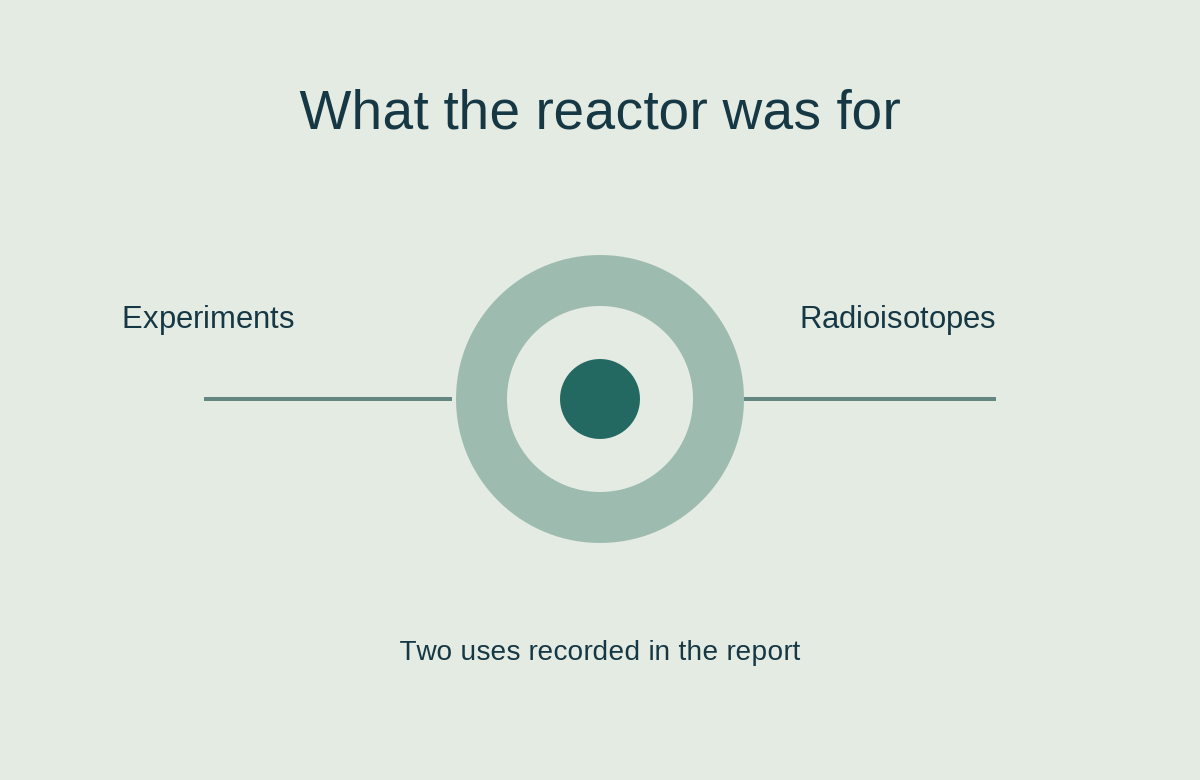
A circle connected to two labels, experiments and radioisotopes.
The regulator’s report describes nuclear physics research and radioisotope production. The circles symbolise the two uses. (Source)
Crop showing people in lab coats at different instruments around the reactor.
Detail from the same archive photograph. Several people stand at different positions around the platform. (Source · National History Museum of Romania / Communism in Romania · Reuse with attribution)

1997 and 2002

Between shutdown and the decommissioning decision

The reactor stopped operating in 1997. In 2002, the government ordered permanent shutdown for decommissioning and assigned the work to the institute that had operated it. [3] [4]

The two dates answer different questions. When did work with the reactor end? When was dismantling it formally decided? Article 1 sets out the decision for the second stage. [3] [4]
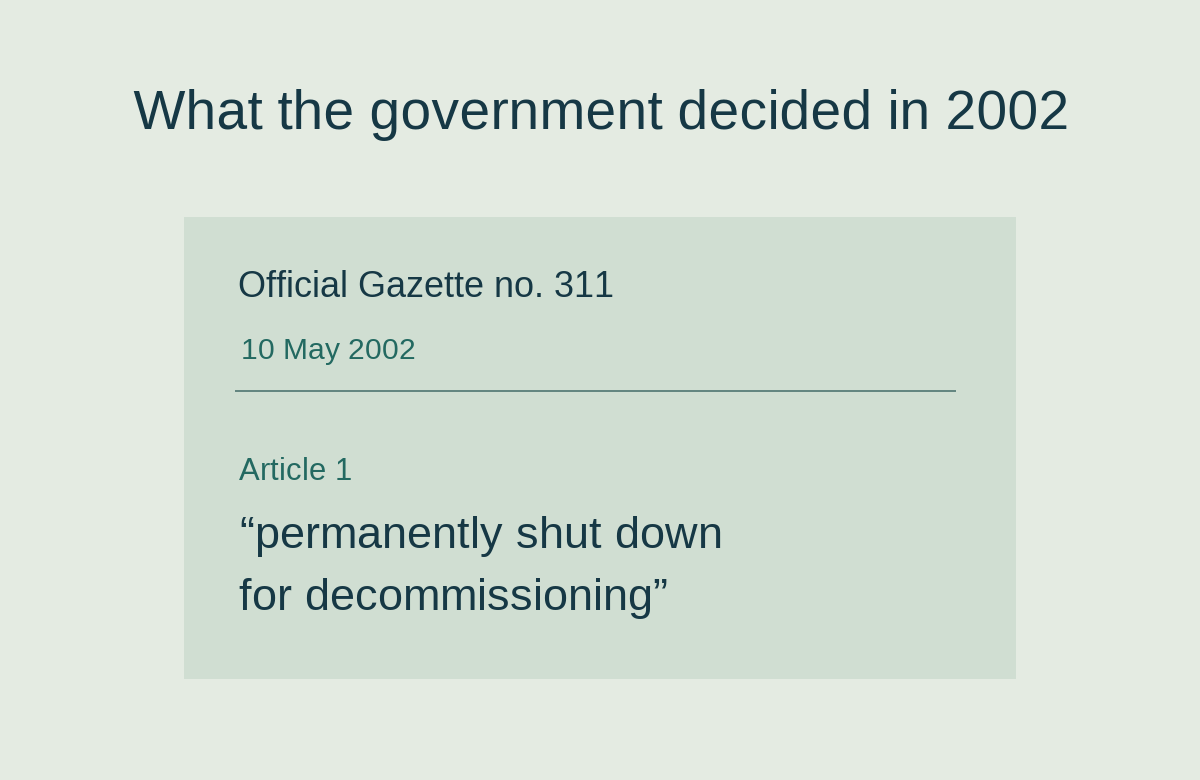
Excerpt from the decision ordering permanent shutdown for decommissioning.
An excerpt from article 1, translated here. The decision took effect in May 2002, after the facility stopped in 1997. (Source)

2013–2020

What decommissioning involved

The used fuel went back to its country of origin before dismantling. The project lead, Mitică Drăgușin, says the work of taking the installation apart began in 2013. In a December 2020 interview he described its completion and the measurements required before releasing the building. [5] [3]

The regulator records how the resulting waste was managed. Some went to the national repository at Băița Bihor after treatment at Măgurele. Decommissioning continued for years after the reactor stopped. [3] [5]
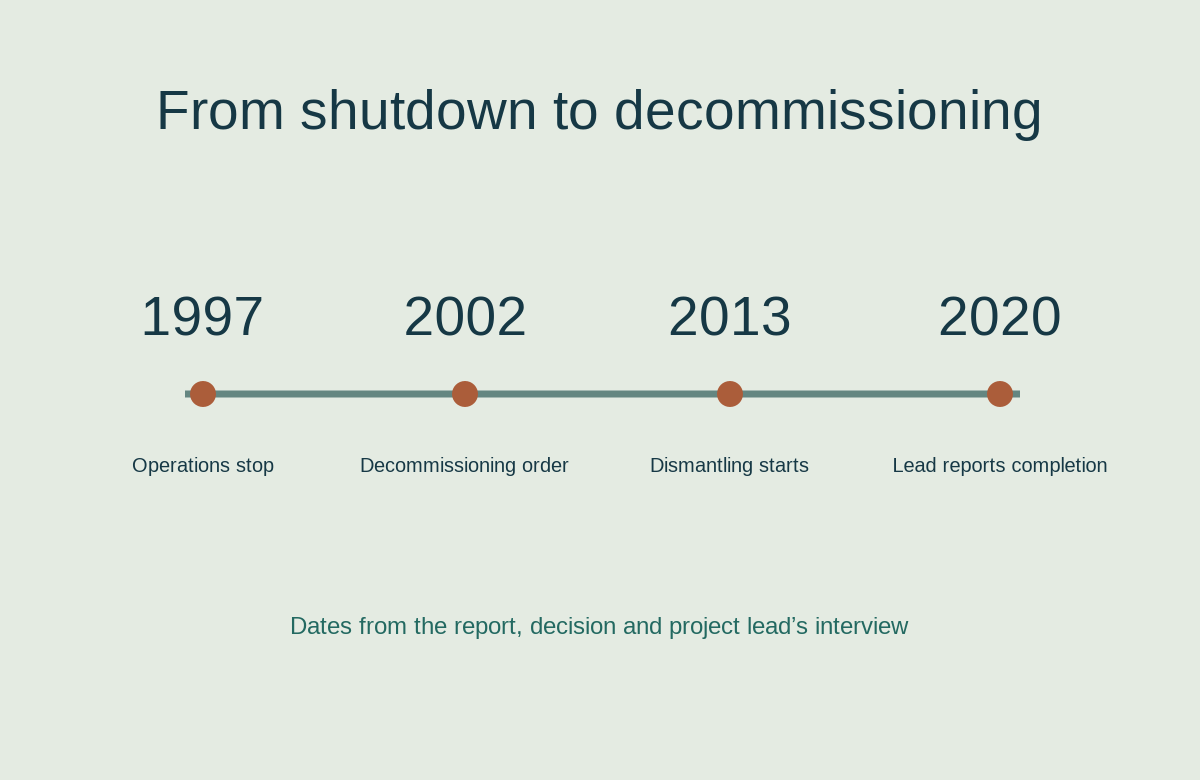
Timeline marked 1997, 2002, 2013 and 2020.
The end of operation, the government decision, the start of dismantling, and the project lead’s 2020 announcement are separate events. (Source)

After decommissioning

The control room was kept

Drăgușin says the team kept the control room in its original form as a record of the installation. The report published in 2023 confirms that decommissioning was complete and that the reactor building and its site had been released from nuclear regulatory control. [5] [3]

The map marker identifies the institute area at the stop on Reactorului Street. The 1969 photograph, the 2002 decision and the 2023 report show the same facility at work, on paper and after dismantling. [6] [1] [4] [3]
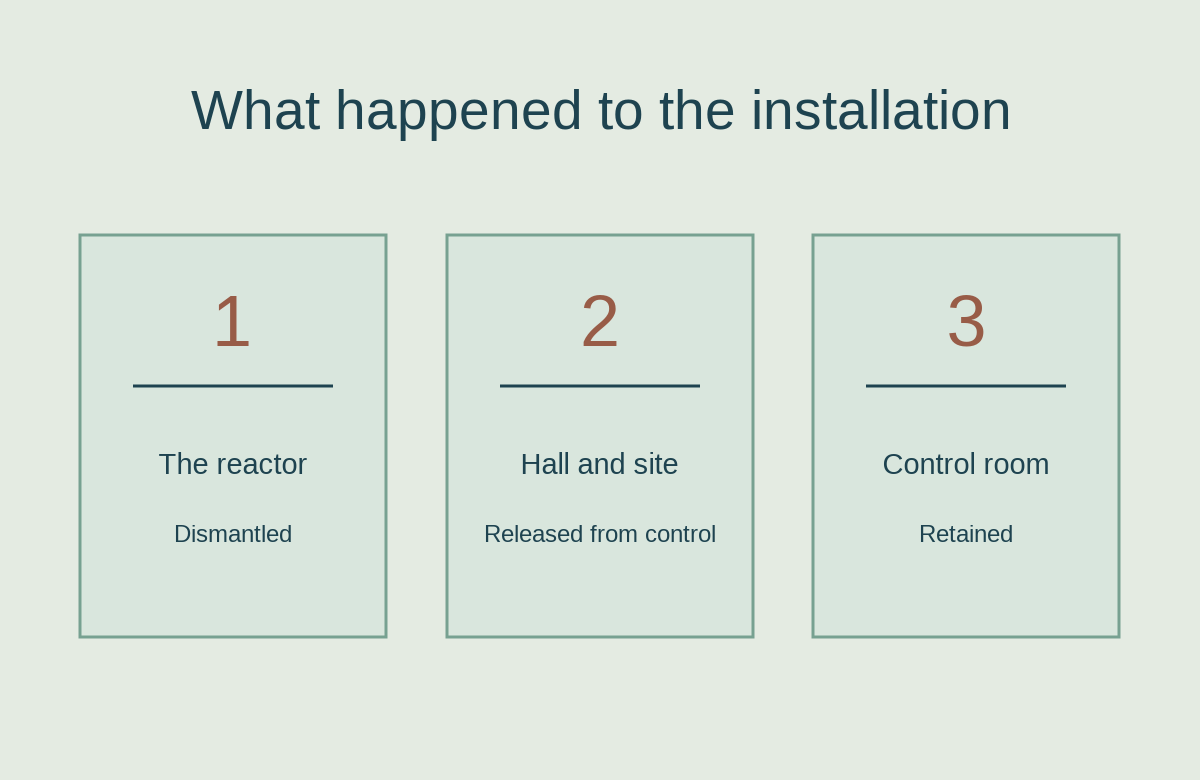
Three panels distinguish the dismantled reactor, released hall and retained control room.
The regulator records decommissioning and the release of the building and site. The project lead says the control room was retained. (Source)

Sources

The reactor operated from 1957 to 1997. The team dismantled the equipment and kept the control room as a record of the workplace.

  1. National History Museum of Romania, the Institute of Atomic Physics reactorUncredited photograph from 1969 in the Communism in Romania collection. The museum permits reuse with attribution.
  2. IFIN-HH, the institute’s historyThe 1956 division of the institutes, Horia Hulubei’s role and the facilities brought into operation at Măgurele.
  3. National Commission for Nuclear Activities Control, 2023 reportSection 4.4 records the reactor’s operating years and purpose, the decommissioning decision, and the release of the building and site from regulatory control.
  4. Government Decision no. 418/2002, article 1Reproduction of the decision published in Official Gazette no. 311 on 10 May 2002.
  5. Mitică Drăgușin, interview published by the Town of Măgurele in December 2020The decommissioning lead describes the work and the decision to preserve the control room.
  6. Bucharest Transport Company, Institutul IFIN stopThe marker is at the stop on Reactorului Street and identifies the institute’s area in Măgurele.