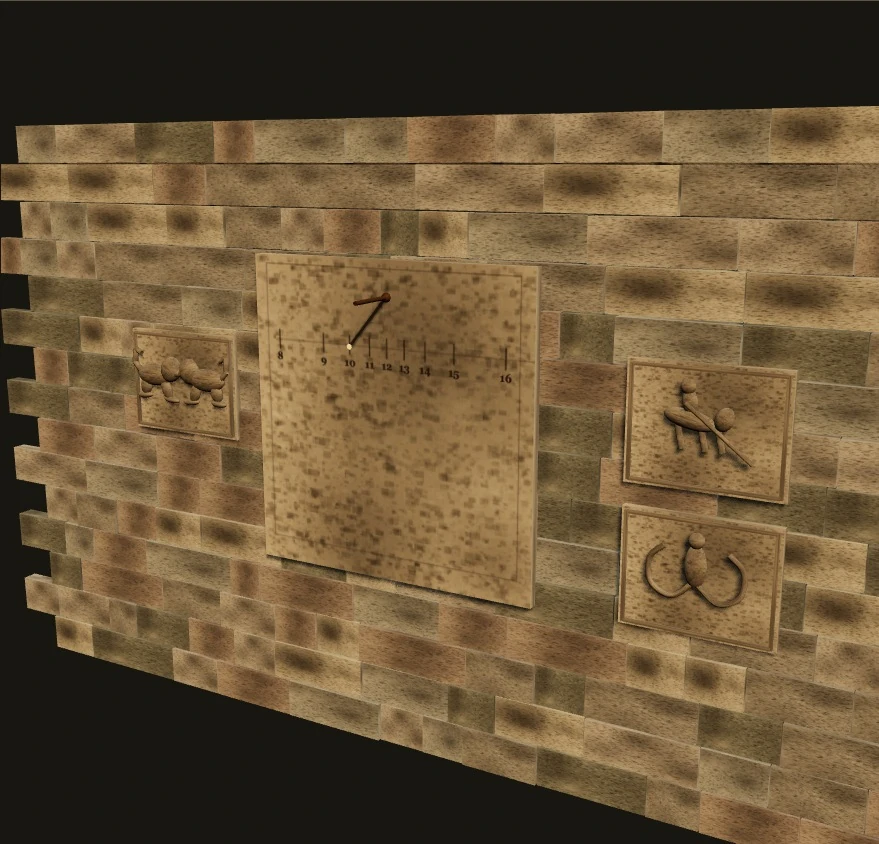
A stone wall with a shadow across a sundial and carved stone reliefs.
The wall in morning light

Mănăstireni, Cluj

The shadow on the wall

On the walls of the Reformed church in Mănăstireni, medieval figures survive in stone alongside a sundial. The sculptor and the person who marked the hours both worked with shadow. 1 2 3

Change the solar time, compare the seasons and light the carvings from the side to see what becomes visible.

Start the story

The carvings

When light comes from the side

Beside the dial, Dan-George Uza describes three reliefs: Saint George and the dragon, a siren with two snakes, and a pair of lions. The lions may have belonged to a Roman funerary monument. 1 2

Low light catches the ridges and casts shadows into the recesses. Raise the angle and watch how quickly the outline changes.

Angle of the light
20°

The geometry of an hour

The rod projects horizontally

The rod at Mănăstireni projects horizontally from the wall. The model marks where its tip casts a shadow at the equinox on a wall that faces due south. Watch the tip as you change the time. 2

Change the solar time. At local noon, with the sun due south, the rod’s shadow drops vertically below the point where it enters the stone.

Solar time
12 h

The sun’s altitude

Same hour, different shadow

At noon, the tip of the shadow remains below the rod and moves up or down with the seasons. In summer it reaches farther down the wall. At other hours, the shadow’s direction also changes. 2

Switch seasons at solar noon. Look first at the direction of the shadow, then at its tip.

Season

Reading the wall

Finding noon in the stone

On a clear day you can see solar noon on the wall. Its difference from 12 o’clock on your phone reflects the time zone, daylight saving time and the variation in the sun’s apparent motion through the year.

Look for the dial about six metres up the south wall. In a 1957 photograph, Uza recognised a different set of hour markings from those he found in his fieldwork. 2

Sources

The model uses the horizontal rod described by Dan-George Uza on an ideal south-facing wall at the latitude of the church. The markings show solar time at the equinox. The reliefs are study models.

  1. Architectural heritage, Cluj County Council

    The church inventory and interpretations of the Romanesque carvings.

  2. Dan-George Uza, Sundials of Transylvania

    Regional context for Transylvanian sundials and their interpretation.

  3. Reformed church, Cluj Tourism

    Monument identification and historical background.