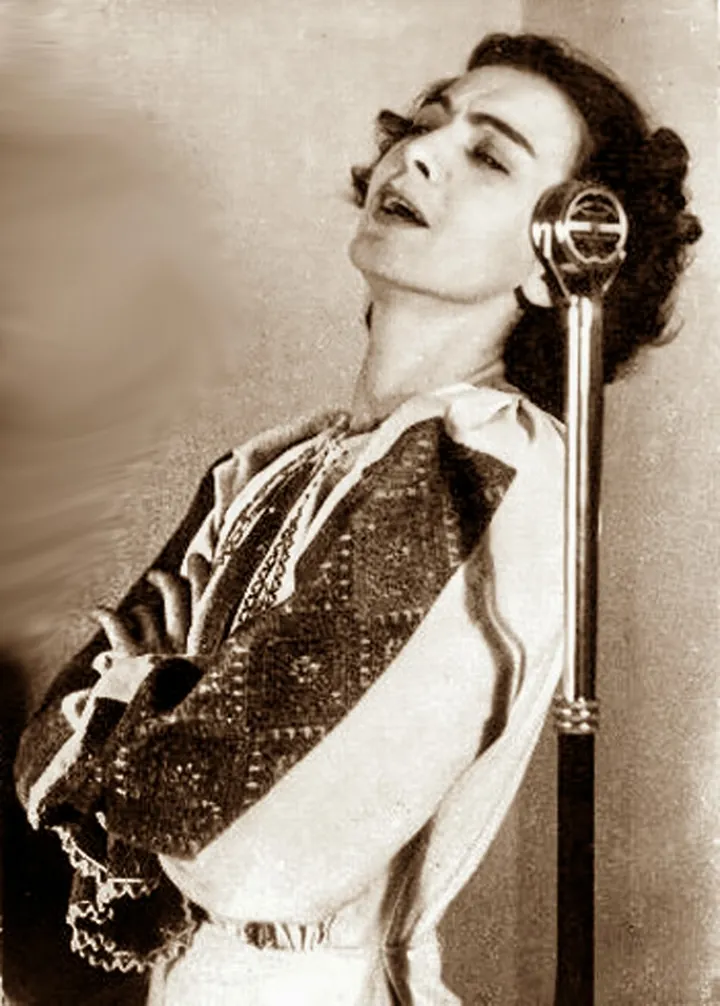
The story, in 12 stops
From the Cărămidari quarter to Bellu: each stop links to the songs of its years.
Stop 1
The girl from Cărămidari
1913
Born on 25 September 1913, third child of the florist Ion Coandă Tănase, an Oltenian from Gorj, and Ana Munteanu from Cârța in Sibiu county. The biographies add that the women in her father's nursery sang her childhood its first doinas.
Sources: date and family from the biographies and the AGERPRES documentary; the childhood doinas from English Wikipedia.
Stop 2
Cărăbuș: Mary Atanasiu
1934
Hired in May 1934 at the Cărăbuș Theatre; on 2 June she debuts in the Cărăbuș-Express revue under the stage name Constantin Tănase chose for her. In the same period she cuts her first record for Lifa, the romance Mansarda, attributed by the cited discography to 1934.
Sources: the biographies and the AGERPRES documentary; the disc's 1934 from the cited discography.
Songs of this stop
Stop 3
First folk records
1937
In 1937 she records her first folk songs for Columbia, supervised by Constantin Brăiloiu and Harry Brauner, according to the biographies.
Source: the cited biographies (the Brăiloiu-Brauner supervision, the Vraciu taraf).

Songs of this stop
Stop 4
The radio debut
1938
On 20 February 1938, according to the biographies, she debuts on Radio Romania, live on Ora satului: 8 songs with the Ion Matache taraf from Argeș. The year differs between accounts (1937 or 1938); the near-weekly bookings also come from the biographies. On 17 August, at Vălenii de Munte, Nicolae Iorga names her the Magic Bird; in September she launches to great acclaim at the Alhambra, after the AGERPRES documentary.
Sources: the biographies (date, programme, taraf); the AGERPRES documentary (the Alhambra). Other accounts give 1937.

Songs of this stop
Stop 5
New York: the Romanian House
1939
On 16 April 1939 she leaves for the New York World's Fair, opened on 30 April; the Romanian pavilion was inaugurated on 5 May, according to the biographies. She sings at the Romanian House with the Grigoraș Dinicu orchestra and the panpiper Fănică Luca; an account in Independența Română says she also sang before President Franklin D. Roosevelt. She meets Enescu and Brâncuși. She returns in July.
Sources: the NYC municipal archives (opening on 30 April 1939); the biographies (pavilion, orchestra, meetings); Independența Română (Roosevelt).
Songs of this stop
Stop 6
The ban
1940–1941
In the autumn of 1940, during the National Legionary State, the Propaganda Ministry ordered, according to the cited accounts, the destruction of her discs in the Radio library and of the Columbia matrices, on the pretext that she distorted folklore; later accounts link the persecution to her circle of Jewish and democratic friends. She was temporarily kept off the stage. Last concert: 20 October, in Focșani. The Timpul paper announces her radio return on 16 February 1941.
Sources: later accounts cited in the biographies; the period order was not directly consulted.
Stop 7
War and the stage
1941–1947
In March 1941 she tours Turkey, with the Melody Revue in Istanbul; then she sings for the war wounded beside Enescu, George Vraca and Constantin Tănase. Then come the operetta Mascota (1944), The Living Corpse (1945), The Hollywood Sphinx (1946) and the film Romania (1947).
Sources: the biographies and the AGERPRES documentary (the Turkey tour, the Melody revue).

Stop 8
The folk chair
1950–1953
In December 1950 she marries the jurist Clery Sachelarie, according to the biographies. From 1952 she teaches at Music School No. 1 in Bucharest, in the newly created folk chair. In the summer of 1953 she launches Dragi mi-s cântecele mele at the World Youth Festival.
Sources: the cited biographies (marriage, teaching chair, 1953 festival).
Stop 9
Back in the studio after 11 years without new records
1954
The recording gap (last dated appearance 1943; the next, 1954) ends: she records for Radio and Electrecord. The cited biographies record the Order of Labour (9 June 1954), the State Prize (1955) and the Honoured Artist title (1 October 1957).
Sources: the cited discography (the 1943–1954 gap); the biographies (honours, with exact dates unverified against decrees).
Songs of this stop
Stop 10
The Ciuleandra years
1956–1958
The discs attributed to 1956: Ciuleandra, Butelcuța mea and Doina din Dolj, on her own lyrics. In 1958 she records the French-language EPC 138, translated by her sister-in-law Nicole Sachelarie, and appears in The Thistles of the Bărăgan.
Sources: the cited discography (attributed years, EPC 138); the biographies and AGERPRES (the film).
Songs of this stop
Stop 11
The last tour
1963
In Târgu Jiu she takes the folklorist post with the Gorj taraf, in 1962, according to the biographies. Editura Muzicală publishes her Cântecele mele brochure of 20 songs in 1963. On 1 May 1963 she gives her last concert, in Hunedoara, and breaks off the tour, ill. She dies on 22 June 1963 at Fundeni, aged 49, and rests at Bellu, after the AGERPRES documentary; the biographies name lung cancer as the cause.
Sources: the biographies (the taraf, the 1963 brochure, cause of death); the AGERPRES documentary (Hunedoara, Fundeni, Bellu).
Stop 12
The grand prize, the festival, the poll
After her
Her Le Chant du Monde record takes the 1965 Grand prix du disque from the Charles Cros Academy, after the biographies and the AGERPRES documentary. Since 1969 Craiova has held the festival-competition in her name; the 28th edition ran in September 2025. In 2006 a nationwide vote placed her among the 100 greatest Romanians, according to the biographies.
Sources: the biographies and AGERPRES (the prize, the 2006 poll); the press (the 28th edition).


