MECIPT-1, built in Timișoara in western Romania, was the first computer made at a Romanian university. It did about 50 operations a second: roughly one for each turn of its magnetic drum. Here it is rebuilt from its published specifications. Give it a sum, and wait as Timișoara waited.
Scroll
1961
Over 2,000 valves in an old school
MECIPT-1 (Mașina Electronică de Calcul a Institutului Politehnic Timișoara, the electronic calculating machine of the Timișoara Polytechnic Institute) went into service in 1961. It was built in the former Piarist high school in central Timișoara, in western Romania; the building then housed the Faculty of Electrical Engineering. It came after the CIFA machines of the Institute of Atomic Physics near Bucharest, and was the first computer designed and built at a Romanian university.
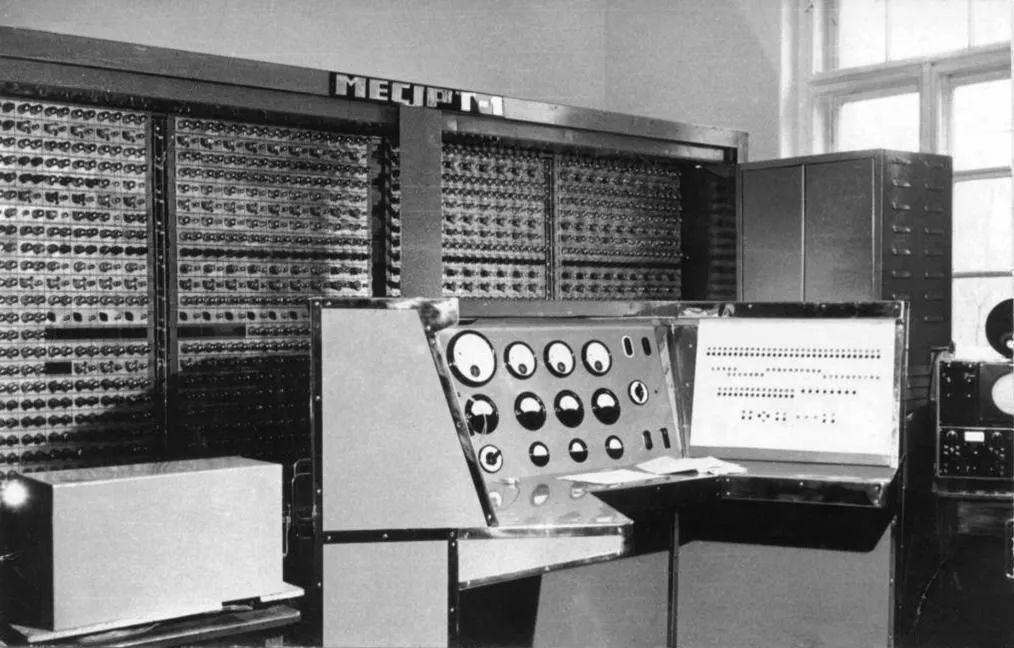
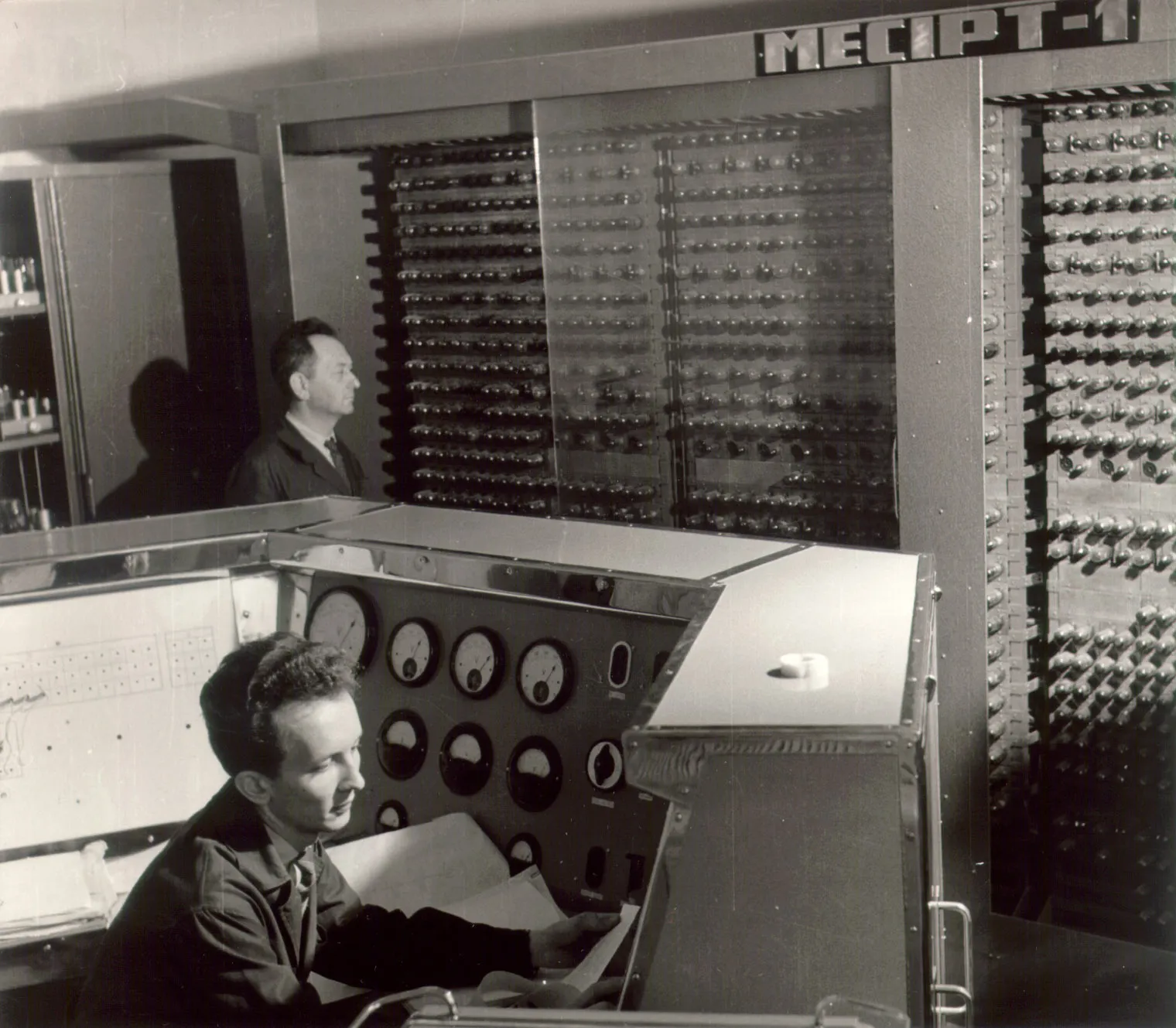
It used more than 2,000 valves (vacuum tubes), over 20,000 resistors and capacitors, 30 km of wire and 100,000 solder joints, and drew about 10 kW. A binary 0 was 65 volts and a 1 was 185 volts. On hot days the temperature in the room rose above 40 °C, so in summer the team often worked at night.
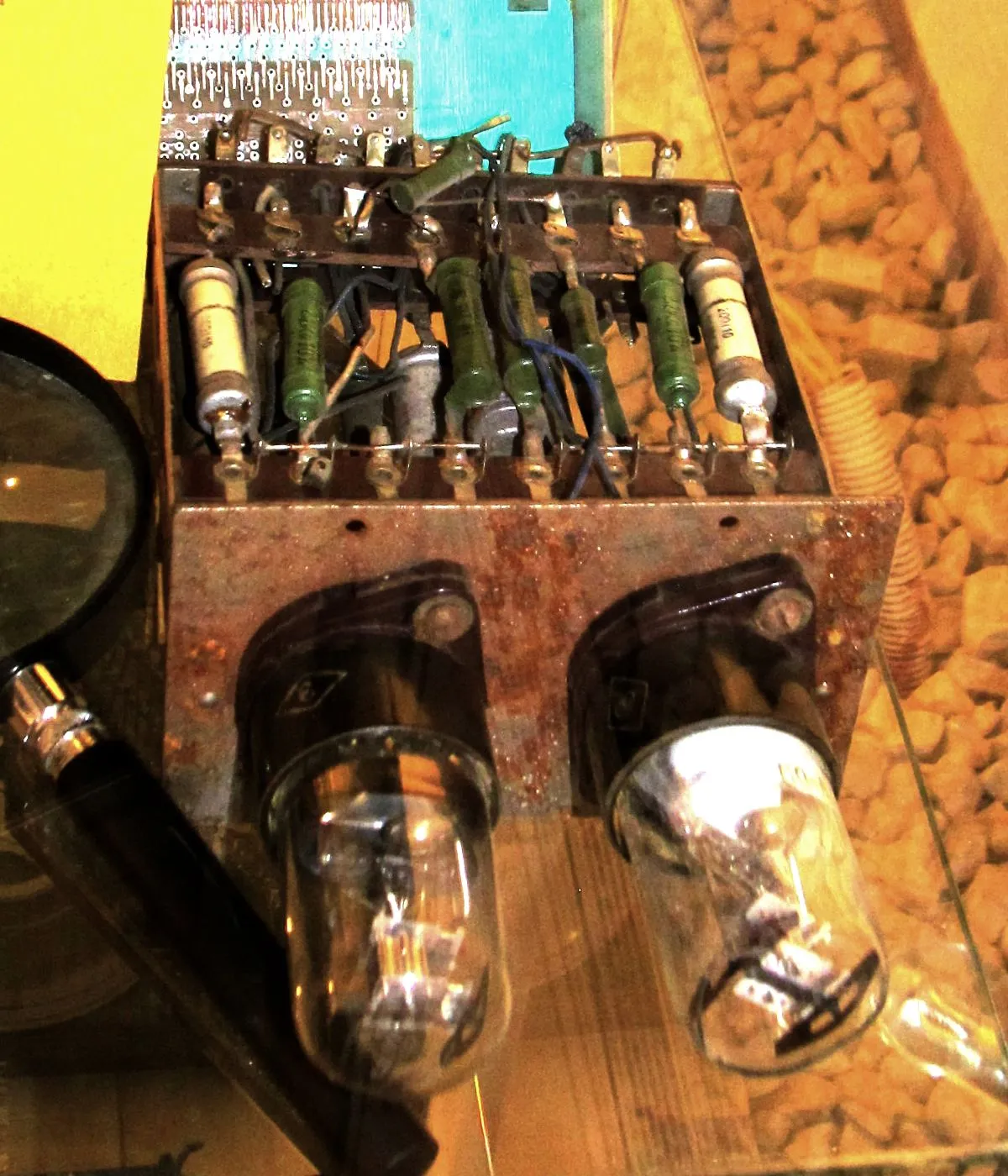
MECIPT-1 in 1961: the valve cabinets behind the control desk. Photographer unknown; published by the Timișoara Polytechnic Institute in 1962; public domain, via Wikimedia Commons.One flip-flop of MECIPT-1: a single bit, held by two valves. Photo: Turbojet, Wikimedia Commons, CC BY-SA 4.0.
Memory
The memory came from Budapest
By the time the logic circuits were finished there was still no memory, Iosif Kaufmann, its principal designer, said later. Talks between the Romanian and Hungarian academies of science solved it: Budapest sent a magnetic drum of the kind built for the Soviet-designed M-3 computer, free of charge. The unit was “the size of a small cupboard”.
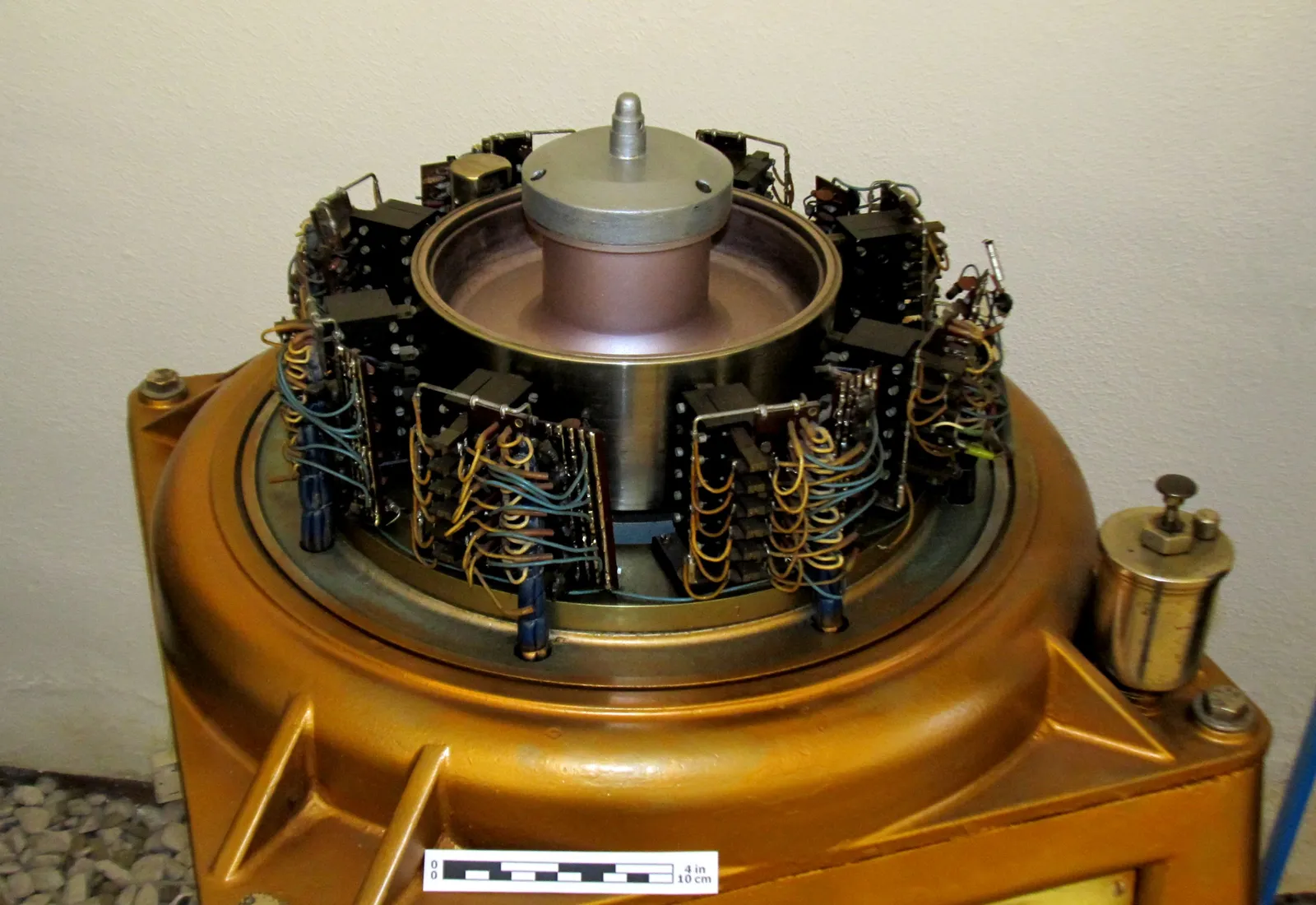
The drum carried 33 tracks, each with its own fixed head; the heads were arranged in eight groups around it. Thirty-one tracks held the 31 bits of a word, one gave the pulses for counting addresses and one marked the start of the turn. Each track held 1,024 bits, so the drum held 1,024 words, just under 4 kilobytes. It turned 50 times a second and normally kept its contents when the power was off.
The restored drum at the Museum of Banat, 2015: the drum in the middle, the eight groups of heads around it. Photo: Turbojet, Wikimedia Commons, CC BY-SA 4.0.
31 bits
One word: 31 bits, and numbers strictly between −1 and 1
A word could hold a number, two instructions of 15 bits, or six letters of five bits. A fixed-point number was a sign and 30 binary places after the point: a value strictly between −1 and 1, in steps of about a billionth, or roughly nine decimal places. Programmers scaled their problems to fit, and wrote routines that spread larger floating-point numbers over two words.
Corrections were keyed into the control desk by hand, in octal, three bits at a time. Dan Farcaș, its first full-time programmer, said keying with three fingers at once was like playing the piano. He also remembered 0.1 in binary, 0.000110011…, a fraction that never ends: the machine could not hold 0.1 exactly. The lamps below show register M, the word just read from the drum.
20 ms
One instruction, one turn of the drum
An instruction was a 5-bit operation code and a 10-bit address: “add the number at address 517”. The circuits did only addition directly; subtraction, multiplication and division were microprograms, short sequences of additions and shifts, an idea taken from Maurice Wilkes’s work at Cambridge.
The 1,024 addresses ran round the drum, so the machine waited for each word to come under the heads. In practice “an instruction was carried out in one rotation”, Farcaș wrote; at 50 turns a second, MECIPT-1 managed about 50 operations a second on average. Vasile Baltac, a young engineer on the team, recalled raising it to 70–80 operations a second by laying the even addresses on one half of the drum and the odd ones on the other.
Your turn
Your sum, at 50 instructions a second
Give MECIPT-1 two numbers between −1 and 1. The program uses the machine’s own instruction set. Each instruction is given one turn of the drum, 20 milliseconds, and the typewriter strikes the answer digit by digit.
Three instructions do the sum: U (load), A (add) and ME (store). The rest type the answer and stop the machine.
21 February 1962
The sine test of 21 February 1962
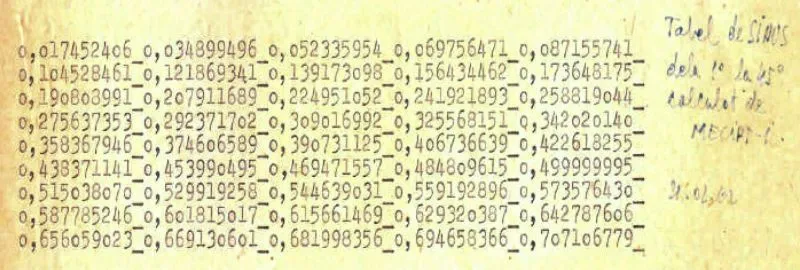
The proof that MECIPT-1 worked was a table of sines from 1° to 45°, typed by the machine and dated by hand 21 February 1962. The sheet survives; the program that typed it has not been found. The one here is a rebuild in MECIPT-1’s own instructions and 30-bit arithmetic: 6,868 instructions, about 2 minutes 17 seconds at one turn each.
The sheet is not quite right, and its small errors are the test. Every value on it falls just below the true sine: sin 30° is typed 0,499999995, not 0.5. Cutting off the end of each product, instead of rounding it, produces that pattern. The rebuild does so and types 0,499999995 too; it matches all nine decimal places in 15 rows and comes within two billionths in 44 of the 45.
The sheet of 21 February 1962: “Table of sines from 1° to 45° calculated by MECIPT-1”. Public domain, via Wikimedia Commons (Vasile Baltac).
The sheet and the rebuild, row by row
Grey: the 1962 sheet. Below each value, the rebuild; decimals that differ are marked.
1°0,0174524060,017452405
2°0,0348994960,034899495
3°0,0523359540,052335955
4°0,0697564710,069756472
5°0,0871557410,087155741
6°0,1045284610,104528461
7°0,1218693410,121869340
8°0,1391730980,139173099
9°0,1564344620,156434462
10°0,1736481750,173648175
11°0,1908089910,190808993
12°0,2079116890,207911688
13°0,2249510520,224951051
14°0,2419218930,241921892
15°0,2588190440,258819042
16°0,2756373530,275637352
17°0,2923717020,292371702
18°0,3090169920,309016990
19°0,3255681510,325568151
20°0,3420201400,342020140
21°0,3583679460,358367946
22°0,3746065890,374606588
23°0,3907311250,390731124
24°0,4067366390,406736639
25°0,4226182550,422618256
26°0,4383711410,438371142
27°0,4539904950,453990495
28°0,4694715570,469471558
29°0,4848096150,484809616
30°0,4999999950,499999995
31°0,5150380700,515038070
32°0,5299192580,529919259
33°0,5446390310,544639030
34°0,5591928960,559192898
35°0,5735764300,573576430
36°0,5877852460,587785246
37°0,6018150170,601815018
38°0,6156614690,615661470
39°0,6293203870,629320386
40°0,6427876060,642787605
41°0,6560590230,656059023
42°0,6691306010,669130600
43°0,6819983560,681998354
44°0,6946583660,694658365
45°0,7071067790,707106775
Today
The same program on your phone
Now the same 6,868 instructions, run by an imitation of MECIPT-1 on the device in your hand, as fast as it will go.
1962–1965
What 50 operations a second were for
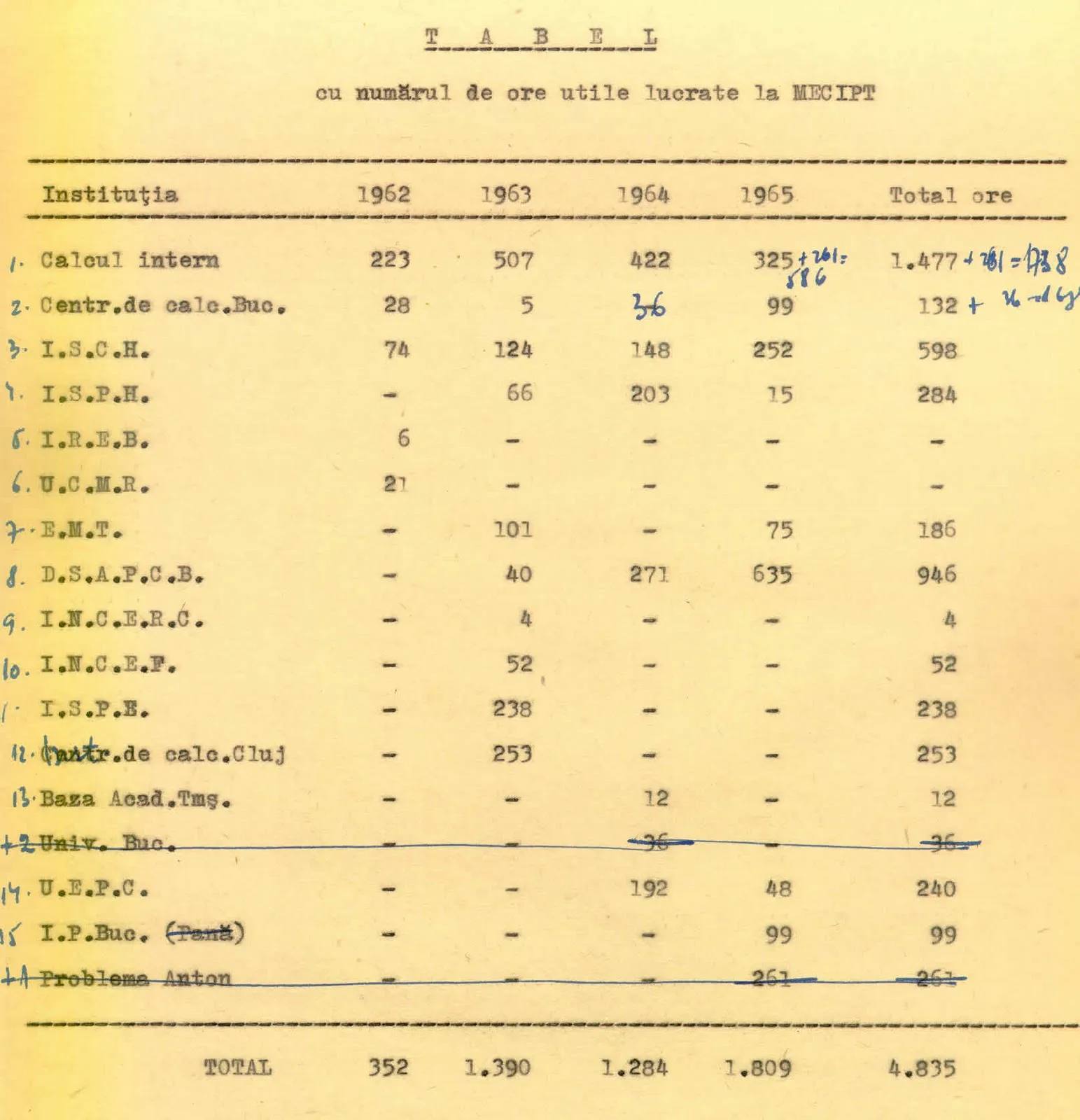
A tally typed at the end of 1965 records 4,835 useful hours since 1962, internal work included, for institutions in Timișoara, Bucharest and Cluj. Baltac names two of them: the calculations for pouring concrete at the Vidraru dam on the Argeș river, and the new dome of the central pavilion at the Bucharest exhibition grounds, today Romexpo, after the old one caved in under snow. A press report of the time, Farcaș recalls, put the dam work at 18 days, final tables included, against about nine months by hand. Baltac wrote the dome program and watched it run through July 1963.
In 1962 MECIPT-1 translated a sentence from English into Romanian, put to it on the spot.
Useful hours a year, from the typed tallyThe tally of useful hours, 1962–1965. Photo: Vbaltac, Wikimedia Commons, CC BY-SA 4.0.
The team
The people who built it
Iosif Kaufmann, a mathematician, was its principal designer; Wilhelm Löwenfeld, an engineer, led the team. Both had been held in forced-labour camps during the Second World War. Kaufmann, Baltac wrote, was employed as a mechanic from 1956 to 1964, as punishment for having asked to emigrate to Israel, and conceived MECIPT-1 in those years.
Baltac joined as a final-year student in 1961; Farcaș, hired in September 1962, recalled being the first full-time programmer in Romania outside the Institute of Atomic Physics. Baltac’s list of the pioneers adds Ioan Weber, Herbert Hartmann, Gavril Gavrilescu, Ștefan Mărușter, Alexandru Cicortaș, Tiberiu Ilin, Viorel Vițan, Victor Megheșan and Sergiu Budu.
Wilhelm Löwenfeld (back) and Vasile Baltac at the control desk, early 1960s (an Agerpres photograph, dated 1963 in Baltac’s memoir). Photo: Vbaltac, Wikimedia Commons, CC BY-SA 4.0.
Romania
Before and after
Romania’s first computer, CIFA-1, was finished in 1957 at the Institute of Atomic Physics at Măgurele, near Bucharest, by a team led by Victor Toma. More CIFA machines followed there from 1959; MECIPT-1 was built in Timișoara in those same years. Its successor, MECIPT-2, was announced in 1964 and in full use by 1966. From 1970 Romania built the Felix C-256 mainframe under a French licence: another story.
Today
Where it is now
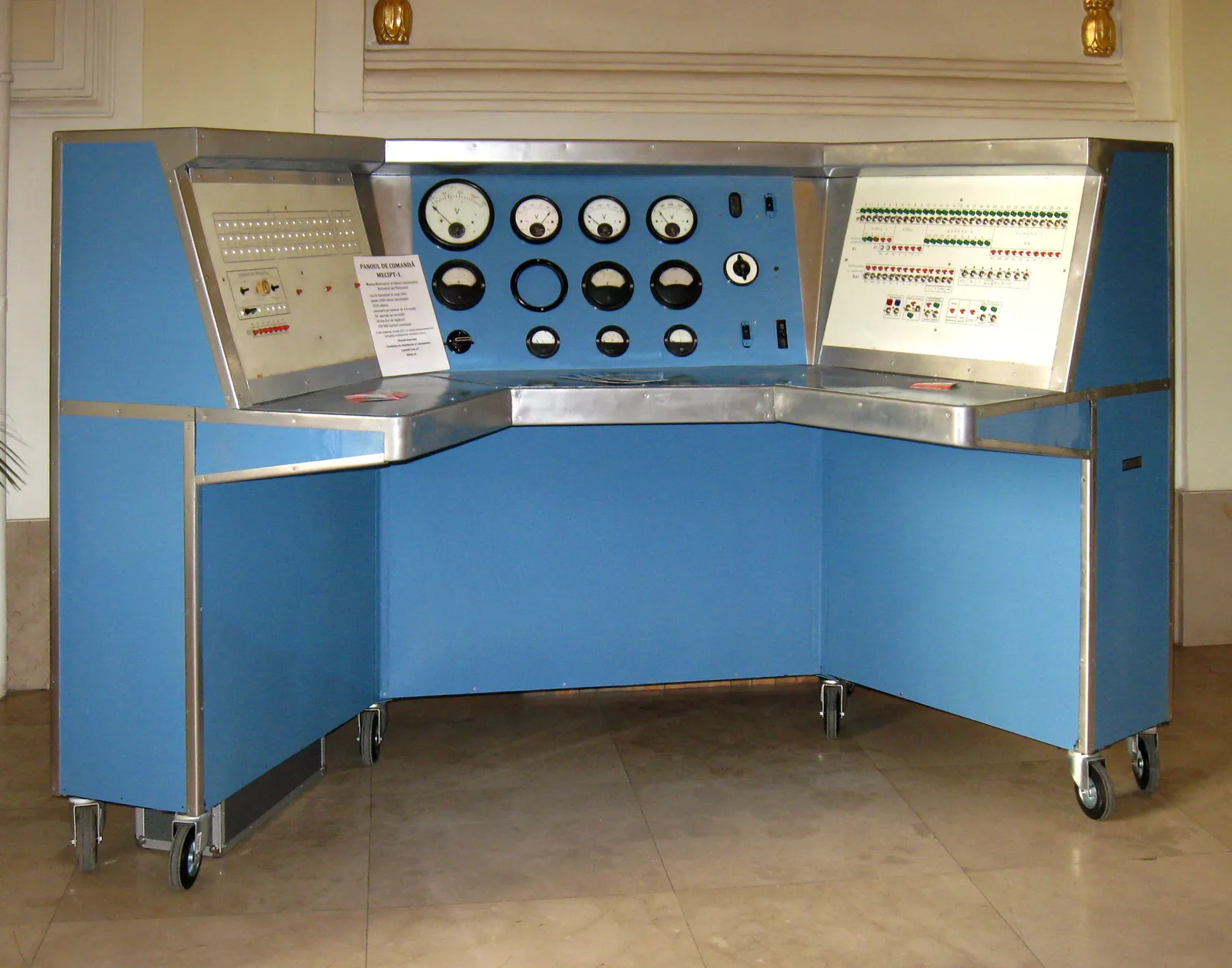
MECIPT-1 worked for about ten years, by most accounts, and no longer runs. Its control desk, logic circuits and drum were restored at the Museum of Banat in Timișoara, where the photographs of the drum on this page were taken.
Published: over 2,000 valves; 1,024 words of 31 bits on 33 tracks; 50 turns a second; about one instruction per turn, 50 a second on average; the 5 + 10-bit instruction and its codes; ones’ complement numbers between −1 and 1; the sheet of 21 February 1962.
Rebuilt: the sine program (the sheet survives, the program has not been found) and the typing routine, both in MECIPT-1’s own instructions. Minus zero is treated as zero; the typewriter’s codes for space, comma and minus are assumed.
Not known, so not added: the extra time of multiplication and division, and the speed of the typewriter. The clock counts drum turns only.
Drawn: the drum is about 20 cm across, measured from a museum photograph with a scale; the cabinet follows the photographs; the model shows 2,000 valves in a drawn arrangement.
Share
Send someone the machine that waited for its drum.
Share
Sources
Memoirs of two team members, Vasile Baltac and Dan Farcaș, give most of the technical figures; documents of the time (the sine sheet, the hours tally, a 1962 program listing) check them.