The biggest shark that ever lived
One megalodon's backbone alone was 11 metres long
The best-preserved megalodon backbone, found in Belgium, has 141 vertebrae. Laid end to end, the vertebrae alone measure about 11 metres. Add the head and the tail fin and the shark reaches 16.4 metres: longer than a bus, and slimmer than a giant great white.
Let it swim past youMegalodon swims past you
The red figure is you, 1.35 metres tall. From the right comes the Belgian shark, drawn at the same scale. Before you scroll, guess: how long is it?
The head
The first 1.8 metres are the head. Nobody has ever found a megalodon skull, because its skeleton was cartilage, which rarely fossilises. The length of the head is worked out from the proportions of related sharks, living and fossil.
The backbone
Now the backbone goes by, the only part that survived: 141 vertebrae from a single shark. Laid end to end they measure about 11 metres. Some vertebrae are missing, so the backbone was at least that long.
The tail fin
Here the part measured from vertebrae ends. Next comes the tail fin, another 3.6 metres, also worked out from the proportions of related sharks.
16.4 metres
That is the length of the Belgian shark in the calculation published in 2025. A city bus is 12 metres. The model gives it about 30 tonnes. Judging by its scales, it usually cruised slowly, at 2–3.5 kilometres an hour.
One backbone, three answers
The same vertebrae, three different lengths
The Belgian backbone is the best evidence of what a megalodon's body was like. Researchers worked out the shark's length from it in 1996, 2022 and 2025, and got different answers, because each assumed a different shape for the rest of the body.
1996: a whole shark of 9.2 metres
Michael Gottfried's team compared the widest vertebra, 15.5 centimetres across, with the vertebrae of 16 modern great whites, all small, between 1.9 and 3.7 metres long. The comparison gave a whole shark of 9.2 metres.
The problem shows in the dotted outline: laid end to end, the vertebrae alone measure 11 metres. The shark worked out in 1996 is shorter than its own backbone. The mismatch was noticed in 2022, and in 2024 researchers showed what it meant: a longer, slimmer shark.
- 9.2 mcalculated length
- 11 mbackbone alone
2022: a giant great white, 15.9 metres
Jack Cooper and colleagues scanned the vertebrae and, on a computer, wrapped the backbone in the scanned body of a great white. They got a shark 15.9 metres long, thick and heavy: 61,560 kilograms, almost 62 tonnes.
The model assumes megalodon was shaped like a great white. The researchers who came after them say its jaws are too big for its vertebrae.
- 15.9 mlength
- 62 tweight
2025: a slender shark, 16.4 metres
Kenshu Shimada and 28 other researchers also started from the 11-metre backbone. They added a head and a tail fin using the proportions of related sharks, living and fossil, and got 16.4 metres.
In their model the body is much slimmer, about six times longer than it is deep, a little like a lemon shark today. The shark weighs about 30 tonnes, less than half the weight of the 2022 one.
- 16.4 mlength
- 30 tweight
The shape matters more than it seems. At almost the same length, the 2022 shark weighs 62 tonnes and the 2025 one about 30. For comparison, a blue whale 17 metres long weighs 37 tonnes.
What nobody knows. No megalodon has been found with its head, jaws or fins. Every drawing of one, the slender one included, is a calculation based on other sharks, living and fossil. The authors of the 2025 study call their own result “hypothetical”: the same backbone with other proportions would give a shorter or a much longer shark.
The estimate comes from the largest of about 20 vertebrae from the same shark, dug out of a clay pit at Gram, in Denmark, in 1978. It is 23 centimetres across, the largest shark vertebra known.
It is 1.484 times as wide as the widest Belgian vertebra. If the Danish shark had the same proportions, it was 24.3 metres long and weighed about 94 tonnes. The authors say the calculation is hypothetical and that a shark this size was a rare exception.
In 1989, during a move from one store to another, the vertebrae were badly damaged and thought lost. Some of the surviving pieces were identified only in 2017, in the collection of the Natural History Museum of Denmark. In 2026 researchers confirmed that the largest really was 23 centimetres across.
Which is longer: the biggest megalodon estimate or the longest blue whale in the whaling records?
The blue whale. The longest in the whaling records, caught in Antarctic waters in 1930, was 33 metres. Old measurements above 30.5 metres are treated with caution, but even then the whale is longer: the Danish megalodon is estimated at 24.3 metres. You can see both, at the same scale, in the comparison below.
Everyone, at the same scale
Great white: about 6 metres, perhaps a little over 7 in the biggest reported. Whale shark, the largest fish alive: 18.8 metres, the most reliable measurement. The bus: a Mercedes-Benz Citaro city bus, 12.1 metres.
Why the books give different lengths
Each study measured something different
Between 1996 and 2025, studies gave megalodon lengths from 9 to 24 metres. The differences come from what they measured and from the living shark they compared it with.
- worked out from vertebrae
- worked out from teeth
- the largest individual estimated
The tooth-based figures start from the great white: they assume the ratio of tooth size to body length was the same in megalodon and the great white. Newer studies consider the resulting lengths too small, because megalodon was longer for its teeth.
The much-repeated 18 metres comes from older tooth-based maximums worked out with the great white. Newer studies question that method. Nor is the length of an ordinary adult known: the only study showing how common each size was uses estimates from teeth, made with the older method.
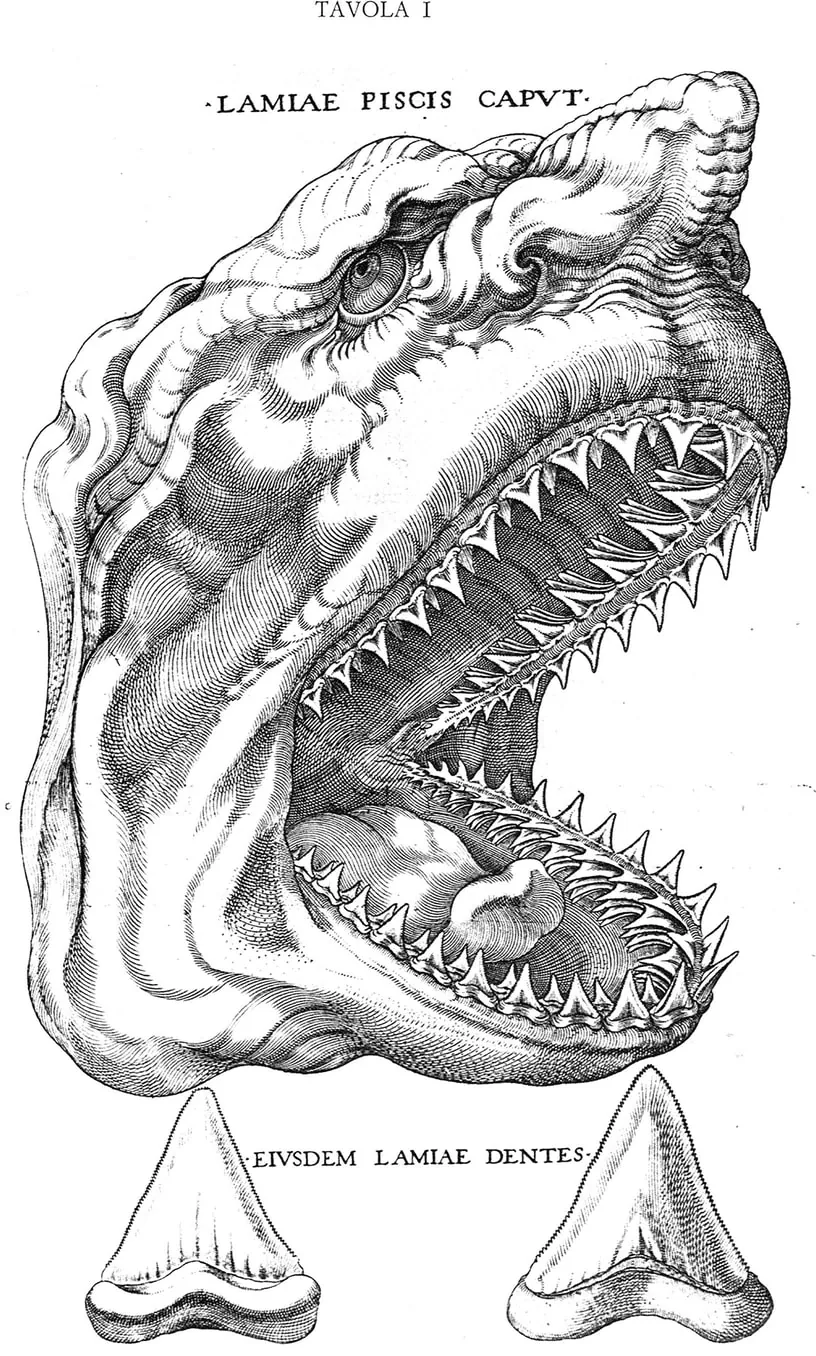
A shark replaces its teeth all its life. In 1667 Nicolaus Steno counted more than 200 teeth in the mouth of a single shark and wrote that new ones grew every day. Teeth are hard and fossilise easily, while a cartilage skeleton rarely survives. That is why fossil teeth are everywhere and skeletons almost absent.
How tall do you think the tallest megalodon tooth on display in a museum is? Drag the slider, then check.
The tallest megalodon tooth on display in a museum, at the Field Museum in Chicago, is 16.2 centimetres tall, including the root. A great white's tooth is 5 centimetres at most.
True size on your screen
Hold a bank card over the dotted rectangle and move this slider until they match. The teeth above will then be shown at their real size.
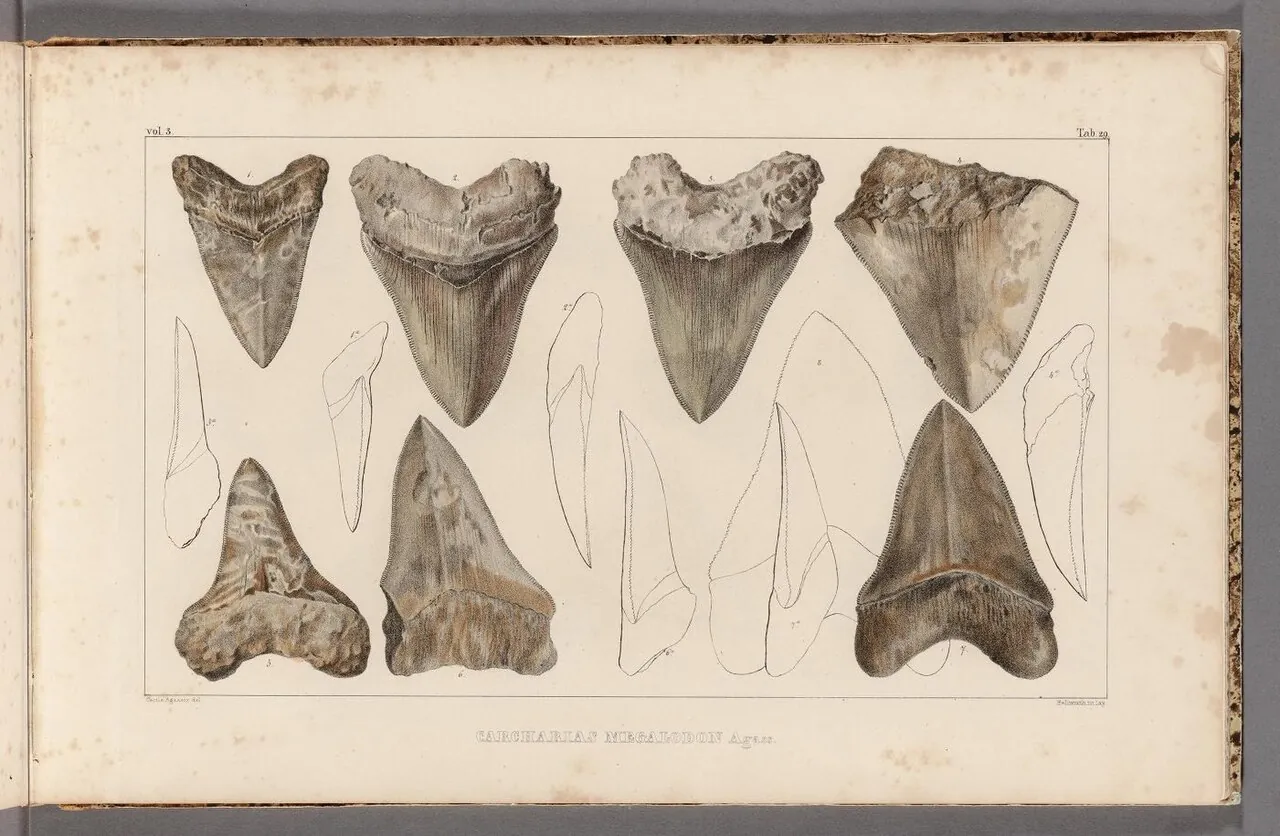
The name is Greek for “big tooth”. It was given by the Swiss naturalist Louis Agassiz, in his volumes on fossil fish published between 1833 and 1843. He noted that no living shark has teeth even half as big.
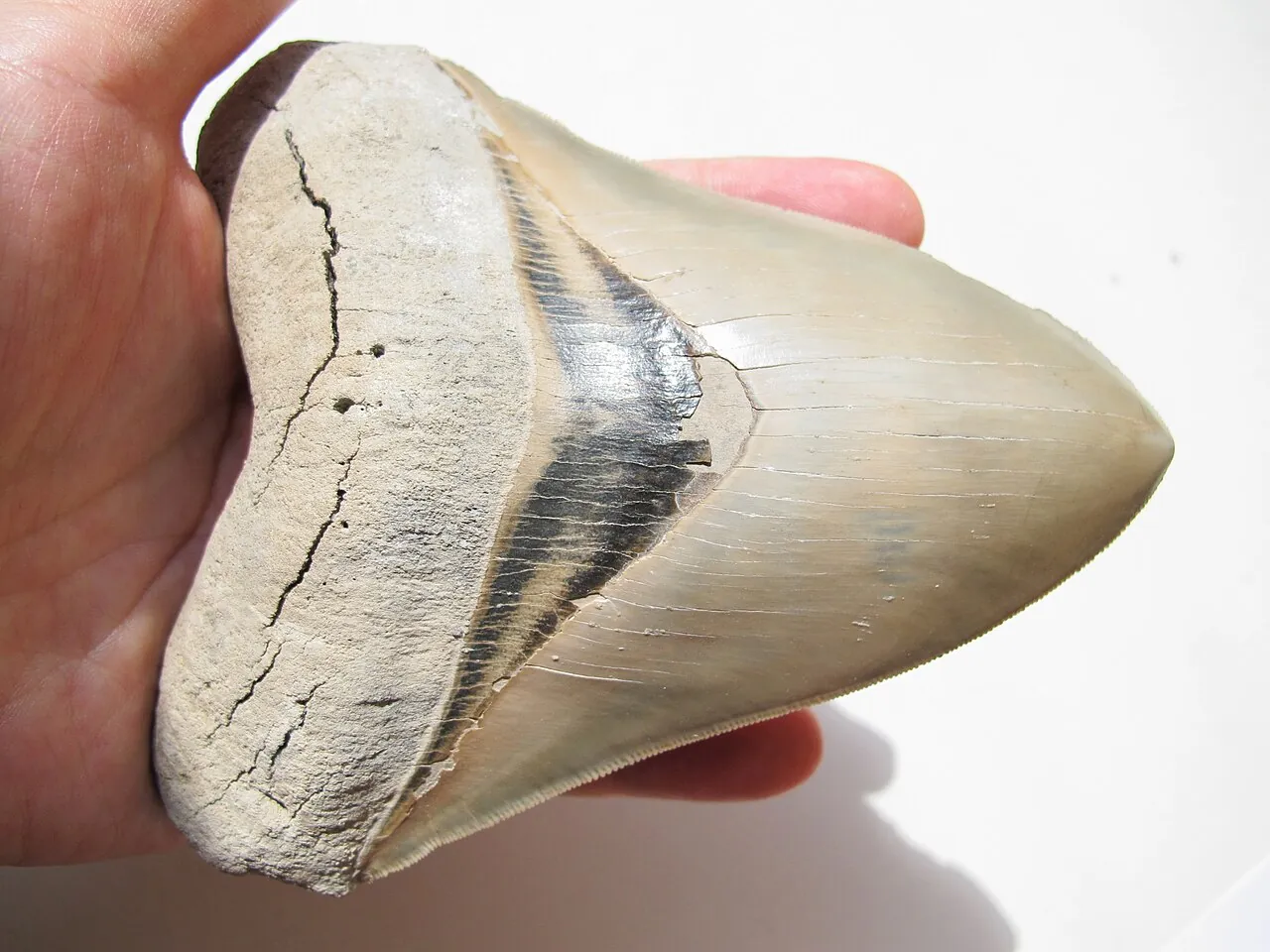

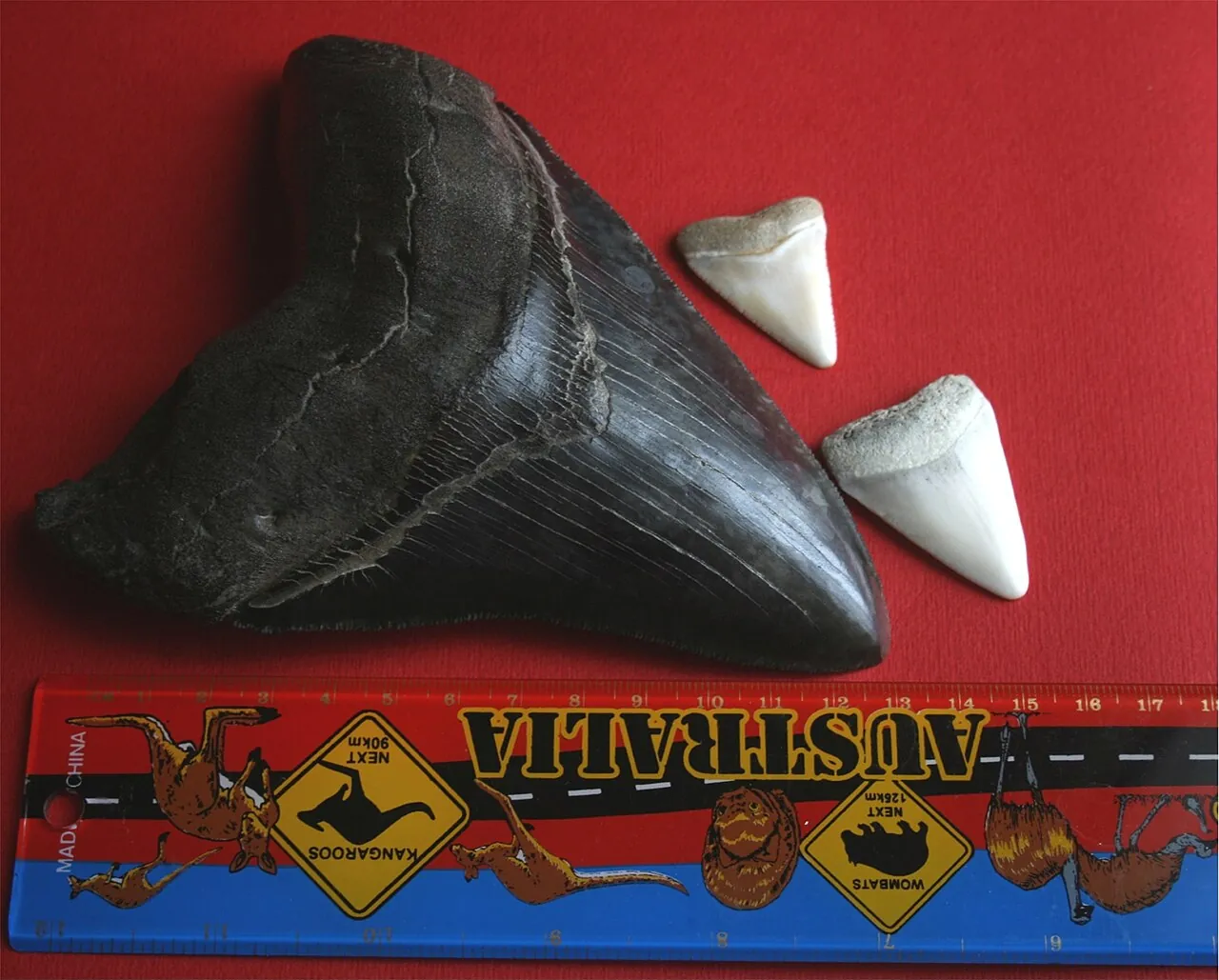

Long before that, people found the teeth in rocks and called them “tongue stones”. Pliny the Elder believed they fell from the sky. In the early 17th century Fabio Colonna argued that they were sharks' teeth, and in 1667 Steno compared one with the teeth of a shark caught off the coast of Tuscany: they were alike “as one egg to another”.

_(7267241882).jpg)
Teeth and a few bitten bones reveal a surprising amount about its life.
Pups
By the 2025 calculation, they were born 3.6–3.9 metres long, about as long as an ordinary great white. They were possibly the biggest newborns in the whole history of fish. They probably grew inside their mother by eating eggs, as their living relatives do.
Food
Its tooth marks survive on bones of small whales, one of them about 5 metres long, on tail vertebrae of toothed whales, on seal bones, and even on a sperm whale's tooth. The bitten vertebrae show no healing. It is not always possible to tell whether the shark killed the animal or found it dead.
How high in the food chain
The nitrogen in its teeth places it higher in the food chain than any sea animal known, living or extinct. That means much of what it ate was itself a predator.
A warm body
The chemistry of its teeth shows a body about 7 degrees warmer than the water. A warm body needs a lot of food, which may have made it vulnerable when its prey grew scarce.
A computer model from 2022, using a great white's body, estimated that a 5-metre whale could be eaten in three bites. The model assumes a bigger mouth than later studies allow, so the number is at best a rough guide.
What nobody knows. Whether pups grew up in “nurseries”, warm shallow bays, is still disputed. The teams that found many small teeth in Panama and Spain say yes; the team that recalculated the pups' size in 2025 thinks such large newborns needed less protection, which makes nurseries less likely.
About 14–15 million years ago a warm sea dotted with islands covered much of Transylvania and the Banat hills. The water may have been warmer than 21 °C. Megalodons reached this sea too: Romanian museums hold fewer than ten megalodon teeth.
In 2016 two teeth were described and photographed for the first time, from Lăpugiu de Sus, in Hunedoara county, and Borzești, in Cluj county. The Borzești tooth had been found in 1987 by a geology student and sat unpublished in a university drawer in Cluj for almost 30 years. Of the known teeth, only the Lăpugiu de Sus one, found in a stream, was collected this century.
In 2017 three old teeth from the museum in Aiud were added, from Cetea, Gârbova de Sus and Lopadea Veche, and in 2024 a tooth from Coșteiu de Sus, probably picked up in the 19th or early 20th century and kept ever since at the Natural History Museum in Vienna. Hungarian geologists had mentioned the species in Transylvania as early as 1896, but without describing a single tooth.
Judging by the size of the teeth, the authors of the 2016 study estimate the sharks at 8–10 metres: large youngsters or adults. In 2017 Nicolae Trif and Vlad Codrea noted that almost no bones of sea mammals have turned up in these rocks, so the big sharks may only have been passing through this sea.
The sea left something else behind. As it evaporated, it laid down the salt of the mines at Turda, Praid and Ocna Sibiului. The salt layers are a little younger than the beds with the teeth. The salt shows the sea was there; it says nothing about the sharks.
What nobody knows. The Romanian teeth are few and isolated, and the sharks' sizes come from a method dating from 2003 that, according to newer studies, gives values that are too small. Nobody knows how often megalodons passed through the sea here, or whether they raised their young in it.
Still alive?
Megalodon died out about 3.6 million years ago
Could megalodon still be alive, hiding in the deep ocean?
No. The youngest securely dated teeth are about 3.6 million years old. A 2014 study had said 2.6 million, but when the fossils were checked again in 2019, 10 of the 42 records were thrown out and most of the others turned out older.
Some teeth dredged from the seabed looked young, a few tens of thousands of years old. That date gave the age of the manganese crust that grew on an old tooth while it lay in the water, not the age of the tooth.
Nor is the deep ocean a likely hiding place. Megalodon lived in warm and temperate seas, and young ones' teeth have been found in shallow coastal water. And below 3,000 metres sharks of any kind are practically absent from every ocean.
In 2013 a TV channel broadcast a film with actors playing scientists hunting a living megalodon. Researchers protested: no evidence suggests it still exists.
Why it died out
Nobody knows for sure. Studies suggest several possible causes, without being able to say which mattered most: its range was already shrinking, the small whales it fed on were declining, the great white appeared and hunted similar prey, and a warm body needed a lot of food.
The game
True or false?
Eight statements about megalodon. Some are stories repeated everywhere.
The answers:
- False. Megalodon looked like a great white, only bigger. The Belgian backbone is too long for a great white's body. The 2025 reconstruction gives it a slimmer body, about six times longer than deep; its exact shape is unknown. Sternes et al. 2024; Shimada et al. 2025
- False. The Belgian shark's backbone alone is longer than a city bus. Close, but no: the backbone is 11 metres, the bus 12.1. With the head and tail fin added, the whole shark reaches 16.4 metres and beats the bus. Shimada et al. 2025; Mercedes-Benz Citaro
- True. A megalodon pup was born about as long as an ordinary great white. By the 2025 calculation, pups were 3.6–3.9 metres at birth. Measured great whites average 3.8 metres. Shimada et al. 2025; McClain et al. 2015
- False. Megalodon died out 2.6 million years ago. That was the 2014 estimate. When the fossils were checked again in 2019, the extinction was placed about 3.6 million years ago. Boessenecker et al. 2019
- False. The biggest megalodon estimate is longer than the longest blue whale on record. The Danish megalodon is estimated at 24.3 metres. The longest blue whale in the whaling records was 33 metres. Shimada et al. 2025; McClain et al. 2015
- True. Nobody has ever found a megalodon skull. Its skeleton was cartilage, which rarely fossilises. What survives is teeth and, now and then, vertebrae. Griffiths et al. 2023
- True. Megalodon's body was warmer than the water around it. The chemistry of its teeth shows about 7 degrees more than the sea. That is cooler than a whale, but warmer than the great whites studied. Griffiths et al. 2023
- False. In 2013 a TV channel showed real scientists hunting for a living megalodon. They were actors. The film was fiction presented as a documentary, and shark scientists complained. National Geographic 2013
How we know
Sources
The lengths, weights and ages are estimates made by the authors of the studies below, from incomplete fossils. Where only a study's abstract was available, the list says so. The shark silhouettes are drawn from the proportions the studies describe: a great white's shape for 1996 and 2022, and the slender shape, six times longer than deep, for 2025.
The length of 16.4 metres means 1.826 metres of head, 11 metres of backbone and 3.586 metres of tail fin, as the 2025 study gives them.
Size and shape
- Shimada, K. et al. (2025). Reassessment of the possible size, form, weight, cruising speed, and growth parameters of the extinct megatooth shark, Otodus megalodon. Palaeontologia Electronica 28(1): a12. doi:10.26879/1502
- Sternes, P. C. et al. (2024). White shark comparison reveals a slender body for the extinct megatooth shark, Otodus megalodon. Palaeontologia Electronica 27(1): a7. doi:10.26879/1345
- Shimada, K. et al. (2026). Rediscovery of the associated gigantic vertebrae of the extinct megatooth shark, Otodus megalodon, from the Upper Miocene Gram Formation in Denmark. Palaeontologia Electronica 29(2): a27. doi:10.26879/1674
- Cooper, J. A. et al. (2022). The extinct shark Otodus megalodon was a transoceanic superpredator: inferences from 3D modeling. Science Advances 8: eabm9424. doi:10.1126/sciadv.abm9424
- Cooper, J. A., Pimiento, C., Ferrón, H. G., Benton, M. J. (2020). Body dimensions of the extinct giant shark Otodus megalodon: a 2D reconstruction. Scientific Reports 10: 14596. doi:10.1038/s41598-020-71387-y
- Perez, V. J., Leder, R. M., Badaut, T. (2021). Body length estimation of Neogene macrophagous lamniform sharks (Carcharodon and Otodus) derived from associated fossil dentitions. Palaeontologia Electronica 24(1): a09. doi:10.26879/1140
- Shimada, K. (2019). The size of the megatooth shark, Otodus megalodon, revisited. Historical Biology. doi:10.1080/08912963.2019.1666840 (abstract only)
- Pimiento, C., Balk, M. A. (2015). Body-size trends of the extinct giant shark Carcharocles megalodon. Paleobiology 41(3): 479–490. doi:10.1017/pab.2015.16
- McClain, C. R. et al. (2015). Sizing ocean giants: patterns of intraspecific size variation in marine megafauna. PeerJ 3: e715. doi:10.7717/peerj.715
- Mercedes-Benz Buses. Citaro, technical data. mercedes-benz-bus.com
Life and extinction
- Boessenecker, R. W. et al. (2019). The Early Pliocene extinction of the mega-toothed shark Otodus megalodon: a view from the eastern North Pacific. PeerJ 7: e6088. doi:10.7717/peerj.6088
- Pimiento, C., Clements, C. F. (2014). When did Carcharocles megalodon become extinct? A new analysis of the fossil record. PLoS ONE 9(10): e111086. doi:10.1371/journal.pone.0111086
- Griffiths, M. L. et al. (2023). Endothermic physiology of extinct megatooth sharks. PNAS 120(27): e2218153120. doi:10.1073/pnas.2218153120
- Kast, E. R. et al. (2022). Cenozoic megatooth sharks occupied extremely high trophic positions. Science Advances 8: eabl6529. doi:10.1126/sciadv.abl6529
- Pimiento, C. et al. (2010). Ancient nursery area for the extinct giant shark Megalodon from the Miocene of Panama. PLoS ONE 5(5): e10552. doi:10.1371/journal.pone.0010552
- Collareta, A. et al. (2017). Did the giant extinct shark Carcharocles megalodon target small prey? Bite marks on marine mammal remains from the late Miocene of Peru. Palaeogeography, Palaeoclimatology, Palaeoecology 469: 84–91. doi:10.1016/j.palaeo.2017.01.001 (abstract only)
- Godfrey, S. J. et al. (2018). Carcharocles-bitten odontocete caudal vertebrae from the Coastal Eastern United States. Acta Palaeontologica Polonica 63(3): 463–468. doi:10.4202/app.00495.2018
- Godfrey, S. J., Nance, J. R., Riker, N. L. (2021). Otodus-bitten sperm whale tooth from the Neogene of the Coastal Eastern United States. Acta Palaeontologica Polonica 66. doi:10.4202/app.00820.2020
- Priede, I. G. et al. (2006). The absence of sharks from abyssal regions of the world's oceans. Proceedings of the Royal Society B 273: 1435–1441. doi:10.1098/rspb.2005.3461
Teeth and their history
- Natural History Museum, London. What can shark teeth tell us? nhm.ac.uk
- DePaul University, via Taylor & Francis Newsroom (2019). Paleobiologist clarifies scientific record of the size of extinct megatooth shark. newsroom.taylorandfrancisgroup.com
- Steno, N. (1667). Elementorum myologiae specimen… cui accedunt Canis carchariae dissectum caput. Florence. archive.org
- University of Reading Special Collections (2021). Stones, sharks and Steno's De Solido. collections.reading.ac.uk
- National Geographic (7 August 2013). The real megalodon: prehistoric shark behind doc uproar. nationalgeographic.com
Megalodon in Romania
- Trif, N., Ciobanu, R., Codrea, V. (2016). The first record of the giant shark Otodus megalodon (Agassiz, 1835) from Romania. Brukenthal. Acta Musei XI.3: 507–526. brukenthalmuseum.ro
- Trif, N., Codrea, V. (2017). Some Badenian fish teeth from western Transylvania (Romania). Oltenia. Studii și comunicări. Științele Naturii 33(1). olteniastudiisicomunicaristiintelenaturii.ro
- Seghedi, A., Rădan, S., Briceag, A. (2021). Salt-related geological and cultural heritage in Romania. GeoEcoMarina. geoecomar.ro
- Trif, N. (2024). A new-old occurrence of the giant shark Otodus (Megaselachus) megalodon from Romania. Brukenthal. Acta Musei XIX.3: 485–489. brukenthalmuseum.ro