A date in a catalogue
A date in a catalogue
What does 1800 mean?
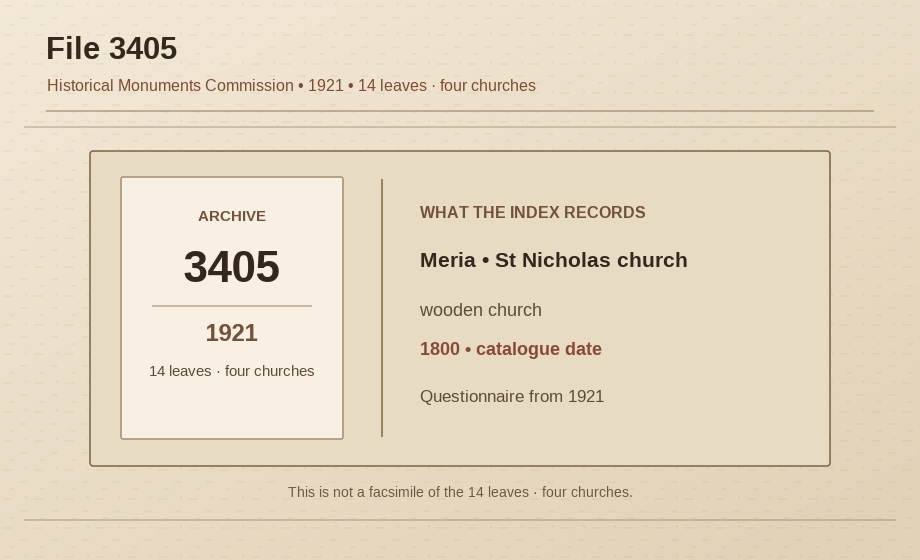
The current catalogue of the Historical Monuments Commission archive lists the wooden St Nicholas church at Meria with the year 1800. File 3405 lists a questionnaire from 1921. Its 14 leaves cover four churches in the area. [1]
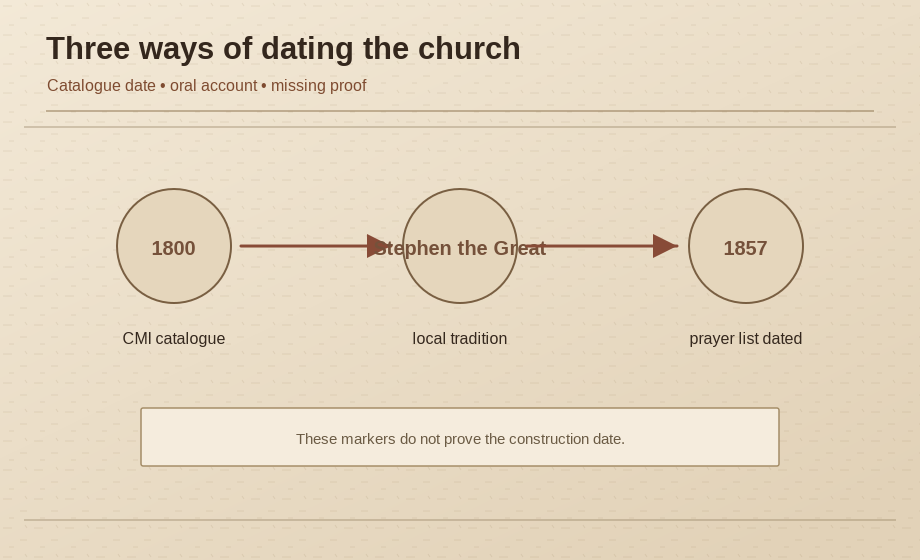
In a 2009 feature, priest Dragoș Orghidan says he had found no writing that fixed the construction date. He describes a tradition that the church was built in the time of Stephen the Great. A local study published in 2021 repeats that the date is not known with certainty. An index entry reading “1800” and an oral tradition are not the same kind of evidence. [2] [5]
A name in the narthex
The prayer list dated 1857
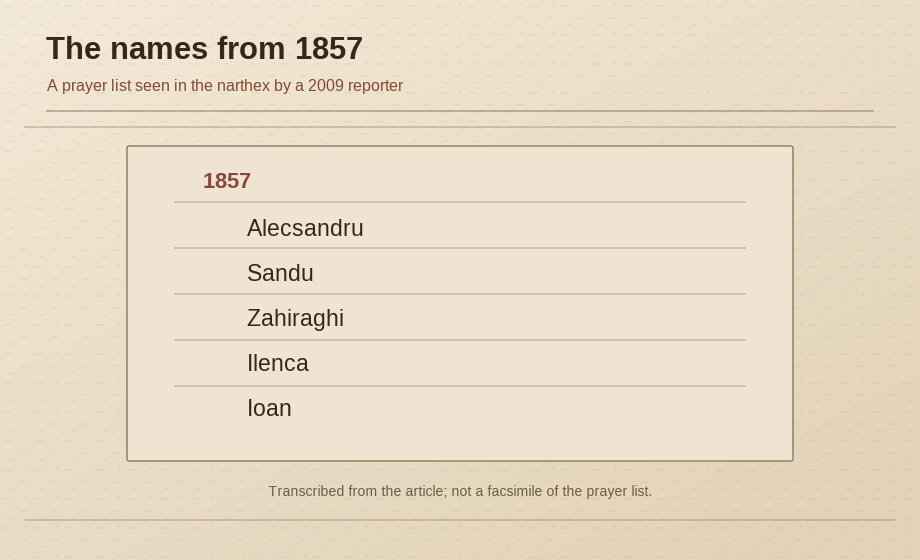
In 2009, journalist Victor Cilincă describes a memorial prayer list in the narthex, dated 1857 and bearing names such as Alecsandru, Sandu, Zahiraghi, Ilenca and Ioan. A pomelnic is a list of people for whom prayers were said. The feature preserves several names but does not provide a photograph or a full transcription of the object. [2]
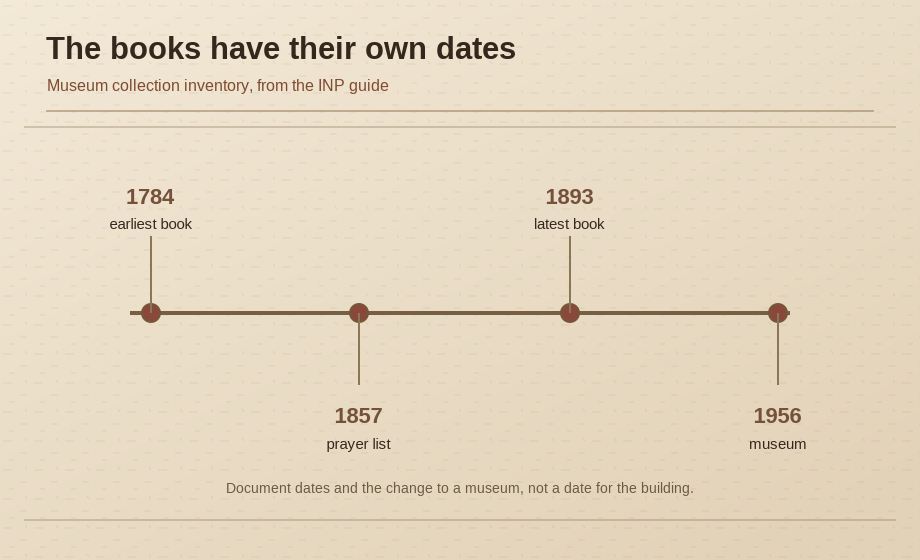
The date belongs to the list of names. The reporter found it in the entrance room among the things kept in the church. Alongside the books and icons in the museum inventory, it shows what the community preserved. The date of the object leaves the age of the building open. [2] [8] [3]
Altar and oak
Roots beneath the altar table
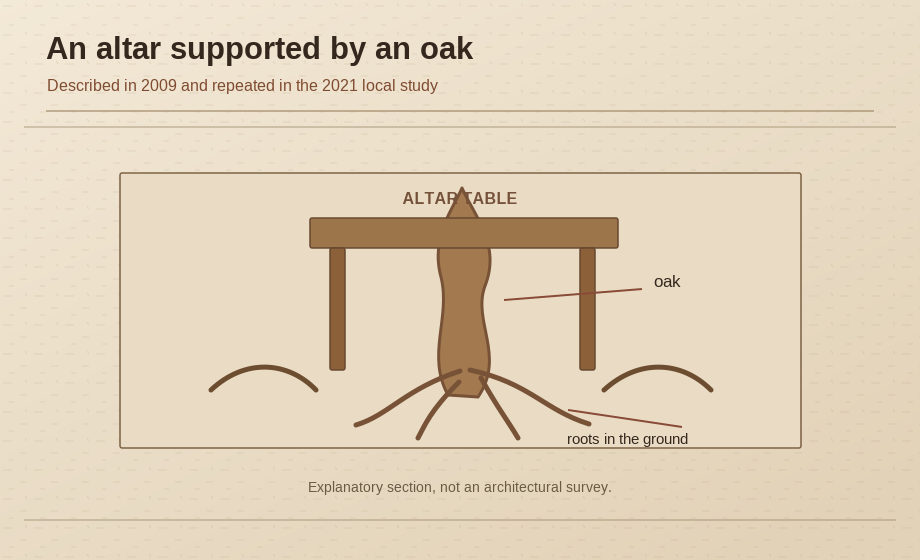
The 2009 feature says the altar table’s support is an oak that continues into the ground through its roots. The priest explains to the journalist that the table and trunk are connected. The 2021 local study repeats the description. This is a concrete feature of the building, but the section drawing here is schematic: no measured survey shows the roots’ shape, depth or dimensions. [2] [5]
This feature helps explain why local memory tied the church to an oak: the altar was described as resting on a rooted trunk. The account does not prove the tree was there when the church was built, nor does it establish the wood’s age. Testing those claims would require study of the timber and controlled access to the building; neither source used here provides that analysis. [2]
The wooden church
Beams, clay and a stone base
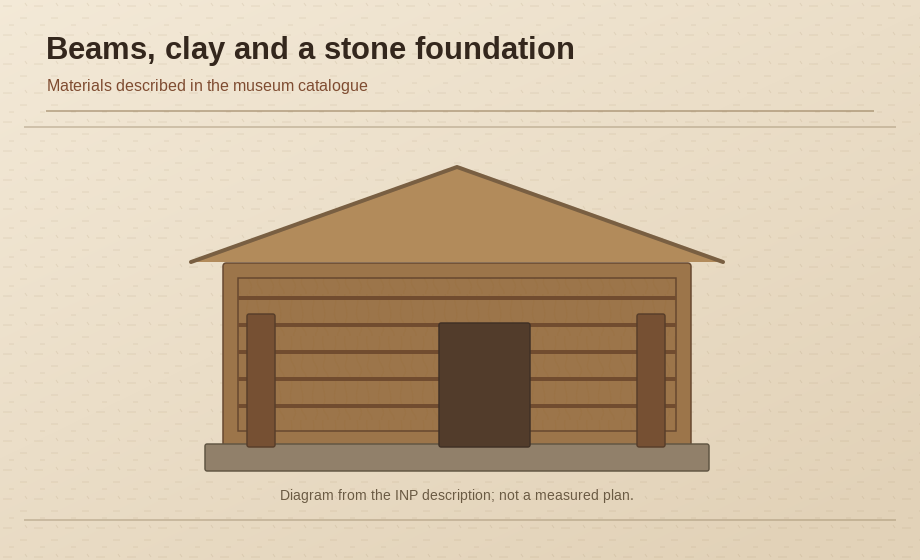
The National Heritage Institute guide describes the church as built from woven beams and clay on a stone foundation. In a 2009 feature, the reporter notes that the exterior had been clad in boards from the new church, while the roof was tin. These descriptions come from different moments and source types; the drawing below shows only the material combination named in the guide. [3] [2]
The materials speak to a building technique and to repairs that changed the exterior. The 2009 report mentions cracks, a concrete intervention at the foundation and later-added outer boards. We cannot assume that same condition exists today; we use the report as a dated observation, not a recent inspection. [2]
1956
Services move, objects remain
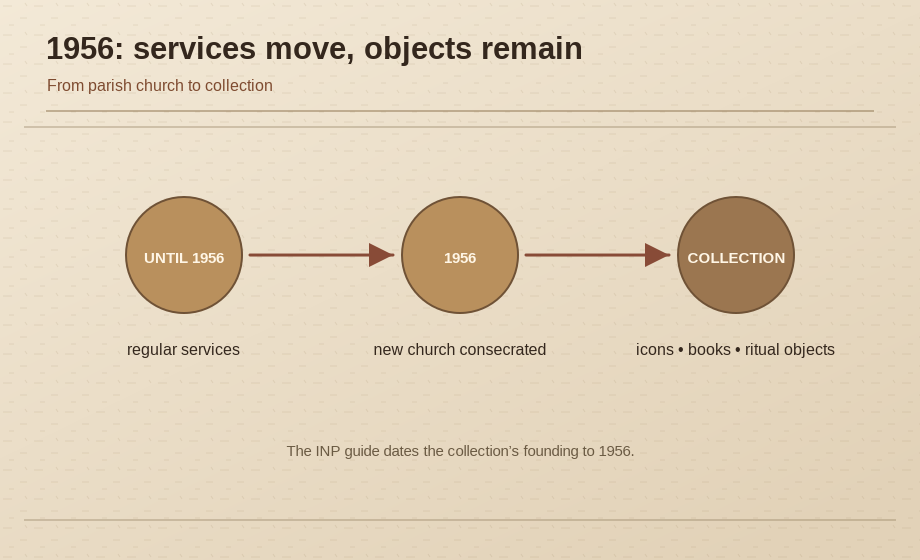
The INP guide says priest Teodor Cudrițescu founded the museum collection in the old church in 1956, when the parish’s new church was consecrated. Services had been held here regularly until then. The change did not strip the building of its religious function: ritual objects and books remain on display in connection with the parish’s history, according to the inventory. [3]
The collection includes icons and lithographs from the seventeenth to nineteenth centuries, three epitaphs, ritual objects and church books dated from 1784 to 1893. These dates do not establish when the building was constructed. They do show that village religious life left objects in the church, used or preserved across several generations. [3]
What we can say now
What each record establishes
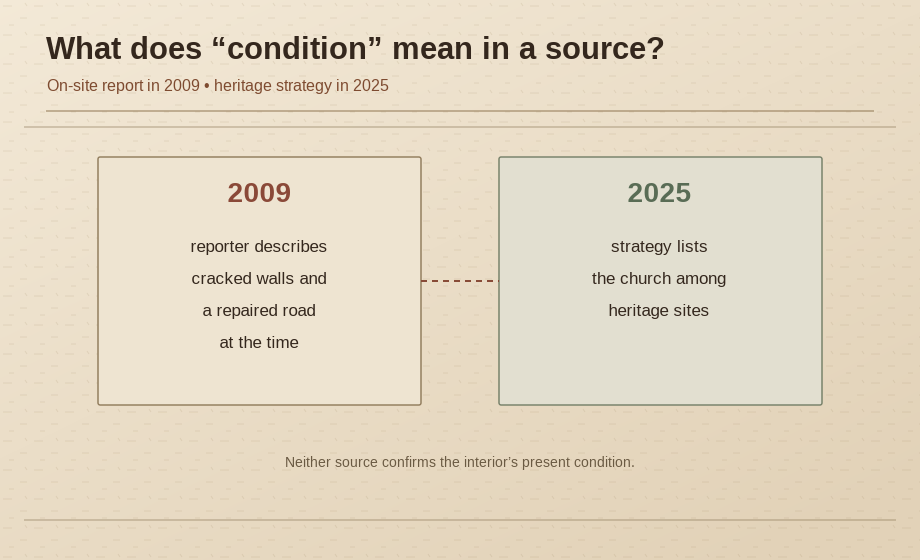
The 1921 file, the 1857 prayer list and the museum guide answer different questions. The index gives the year 1800; the reporter saw a memorial list and spoke with the priest; the guide inventories the collection. A 2025 tourism document still lists the church among heritage sites, but its photograph and entry do not confirm the interior’s condition or visitor hours. [1] [2] [3] [6]
The current catalogue assigns the church the year 1800. The questionnaire it indexes dates from 1921. In 2009, the reporter saw the 1857 memorial list in the entrance room. The museum guide dates the collection to 1956. Studying the building and the full file could establish when the church was built. [1] [2] [3]