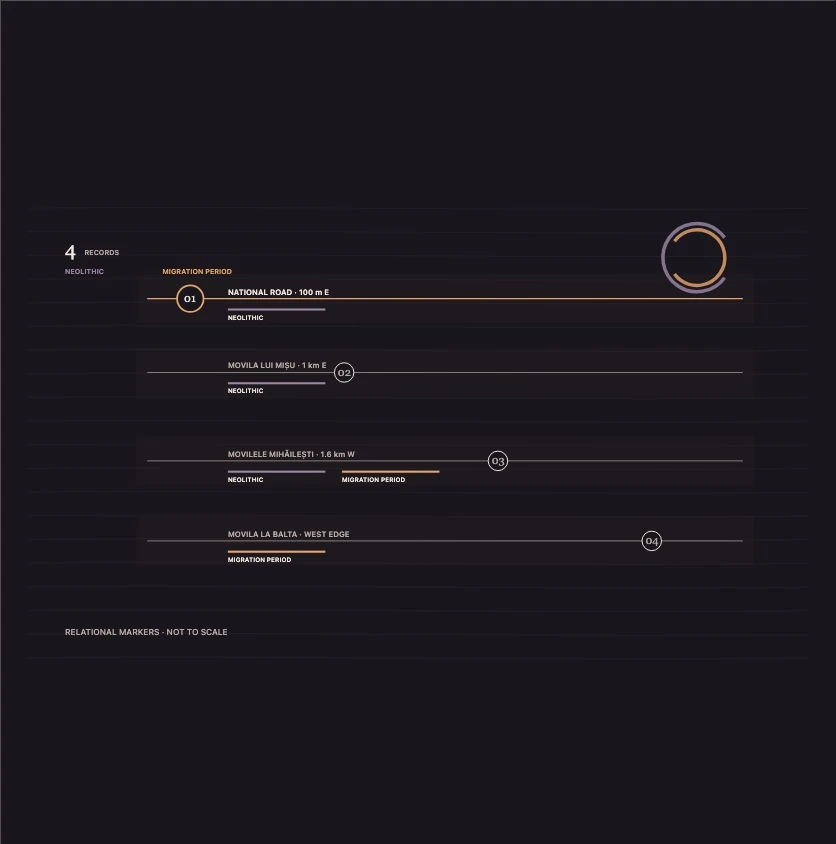
Four archaeological markers light up on a diagram without a scale. They distinguish Neolithic sites, Migration-period sites and one record assigned to both periods.
Romania’s archaeological repertory has four burial-ground records for Mihăilești commune.

Mihăilești, Buzău

Four burial grounds around a village

Mihăilești has four burial-ground records: one beside the national road, one named Movila lui Mișu, one for Movilele Mihăilești west of the village, and one for Movila la Balta on its western edge. 1 2 3 4

These are four site sheets, not a count of graves. Each gives a landmark and a period, with varying levels of precision.

Start the story

Late Neolithic

One point east of the national road

The repertory lists a Late Neolithic burial site here. Its location is given as a distance from the national road, without a grave plan or object list. 1

A second Neolithic record, Movila lui Mișu, is described one kilometre east of the Buzău–Bucharest road, opposite the former agricultural machinery station. 2

Movilele Mihăilești

West of the village, across the pond

Movilele Mihăilești is recorded as a burial site from both the Neolithic and the Migration period. The sheet does not separate those classifications into numbered graves or separately dated areas. 3

The marker covers both periods. We do not turn it into two cemeteries with outlines that the source does not provide.

Migration period

Another label at the western edge

The fourth record is described simply as lying at the western edge of the village and classified as Migration period. The site sheet gives no object inventory or grave count. 4

Together, the records put two broad periods on one commune’s map. They do not say how long each use lasted.

Two classifications

The Neolithic and the Migration period

Three of the four records include a Neolithic classification; two include the Migration period. One point appears in both categories. This counts records carrying each label, not people or graves. 1 2 3 4

The comparison can guide a question about place. Answers about ritual, objects or communities need excavation reports that these site sheets do not provide.

What the record cannot say

Recorded heritage, without invention

The sources give site names, approximate locations and broad periods. They do not give a grave count, people’s identities, burial objects or precise dates for each record. 1 2 3 4 5

The map stays schematic because the descriptions use distances from roads, the village and a pond, rather than exact coordinates for every site.

Compare the recorded periods

The filter follows the labels in the four site records.

Sources

The four locations appear in a relational diagram without a scale. Official sheets describe directions and distances from roads, the village and a pond, rather than exact coordinates for every point. Periods are the register’s own labels; this source set does not provide burial inventories or numbers of interments.

  1. National Heritage Institute, National Archaeological Repertory, Neolithic burial site at Mihăilești

    47587.01: Late Neolithic burial site about 100 m east of the national road.

  2. National Heritage Institute, National Archaeological Repertory, Movila lui Mișu

    47587.04: Neolithic site one kilometre east of the Buzău–Bucharest road, near the former agricultural machinery station.

  3. National Heritage Institute, National Archaeological Repertory, Movilele Mihăilești

    47587.02: the sheet assigns both the Neolithic and Migration period; west of the village, across the pond.

  4. National Heritage Institute, National Archaeological Repertory, Movila la Balta

    47587.03: Migration-period burial site at the western edge of the village.

  5. Buzău County Council, county spatial plan, heritage section

    The county planning document reproduces the four archaeological inventory locations.