Behind the text, a live flock of thousands of starlings wheels over a reedbed at dusk; a falcon can be sent to chase it.
Drag across the sky to hunt. Press Done to go back.
A murmuration of starlings
Thousands of starlings, no leader. How do they turn as one?
On autumn and winter evenings, starlings pour and fold across the sky before they drop into their roost. No bird is in charge and they don’t collide. The trick: each one keeps track of just six or seven neighbours. See for yourself: press Fly the falcon and chase them.
In the winter of 2005–06 a team of physicists stood on a museum roof in Rome, facing the trees where starlings roost by Termini station. With cameras 25 metres apart shooting ten frames a second, they worked out where every bird was in three dimensions, in flocks of up to 2,600.
Working back from how the birds were arranged, they found that each starling responded to its six or seven nearest neighbours, 6.5 on average. Across flocks where the average spacing to the nearest bird ranged from about 0.7 to 1.5 metres, that number stayed the same. What counts is how many neighbours, not how far away they are.
The ringed bird follows the birds its lines point to. They are its nearest in any direction; there are fewest directly ahead or behind.
The birds nearest a peregrine react first; the rest take their cue from their neighbours, and the flock opens around the attacker.
Filming 182 hunts at two roosts in Rome, researchers catalogued what flocks do: they flash outward, darken, send waves rippling away from the falcon, open a hole, string out into a thin cordon, or split.
The falcons failed most of the time: in another Rome study only 23% of 328 hunts ended in a catch. Still, they caught at least one bird every evening.
Storms and colleagues, 2019; Zoratto and colleagues, 2010
A bird at the edge swerves, and turning birds light up in colour. Its neighbours copy it, then theirs, and the turn runs through the flock bird by bird.
In real flocks the turn travels at 20 to 40 metres a second while the birds fly at 7 to 12. It barely fades on the way, and can sweep through 400 birds in little more than half a second.
When a falcon attacks, dark bands race away from it through the flock. Observers first read them as birds bunching together.
A computer model of starling flocks produced the same bands another way: birds that briefly roll sideways and back to dodge show more wing to someone watching from the side. Drawn as balls, which look the same from every angle, the model’s birds made no bands. Real flocks have not settled the question yet.
This flock draws its birds by the same logic. Try it:
Procaccini and colleagues, 2011; Hemelrijk and colleagues, 2015
A bird could follow every bird within a certain distance instead. In a calm flock the two rules come to the same thing, because the six or seven nearest starlings are all within about one to three metres. They differ when a falcon tears the flock apart.
Both flocks below start identical, 400 birds each. On the left every bird follows its seven nearest birds. On the right every bird follows all birds within 1.7 metres, which in this calm flock also means about seven. Press Send the falcon through.
The seven nearestWhat starlings doEveryone within 1.7 metresThe other possible rule
The falcon cuts both flocks. A bird pushed more than 1.7 metres from everyone on the right has nobody left to follow, so it flies on alone and the flock sheds stragglers and small clumps. On the left, even a stray still has seven nearest neighbours to respond to, however far away they now are, so the flock pulls it back.
The Rome team ran a similar test in a simple two-dimensional simulation. After an attack, flocks that follow a fixed distance most often ended in five pieces; flocks that follow a fixed number of neighbours most often stayed whole.
The birds on this page follow simplified steering rules. The six or seven neighbours come from measurements of real flocks; the rest is a model and its speeds are not calibrated.
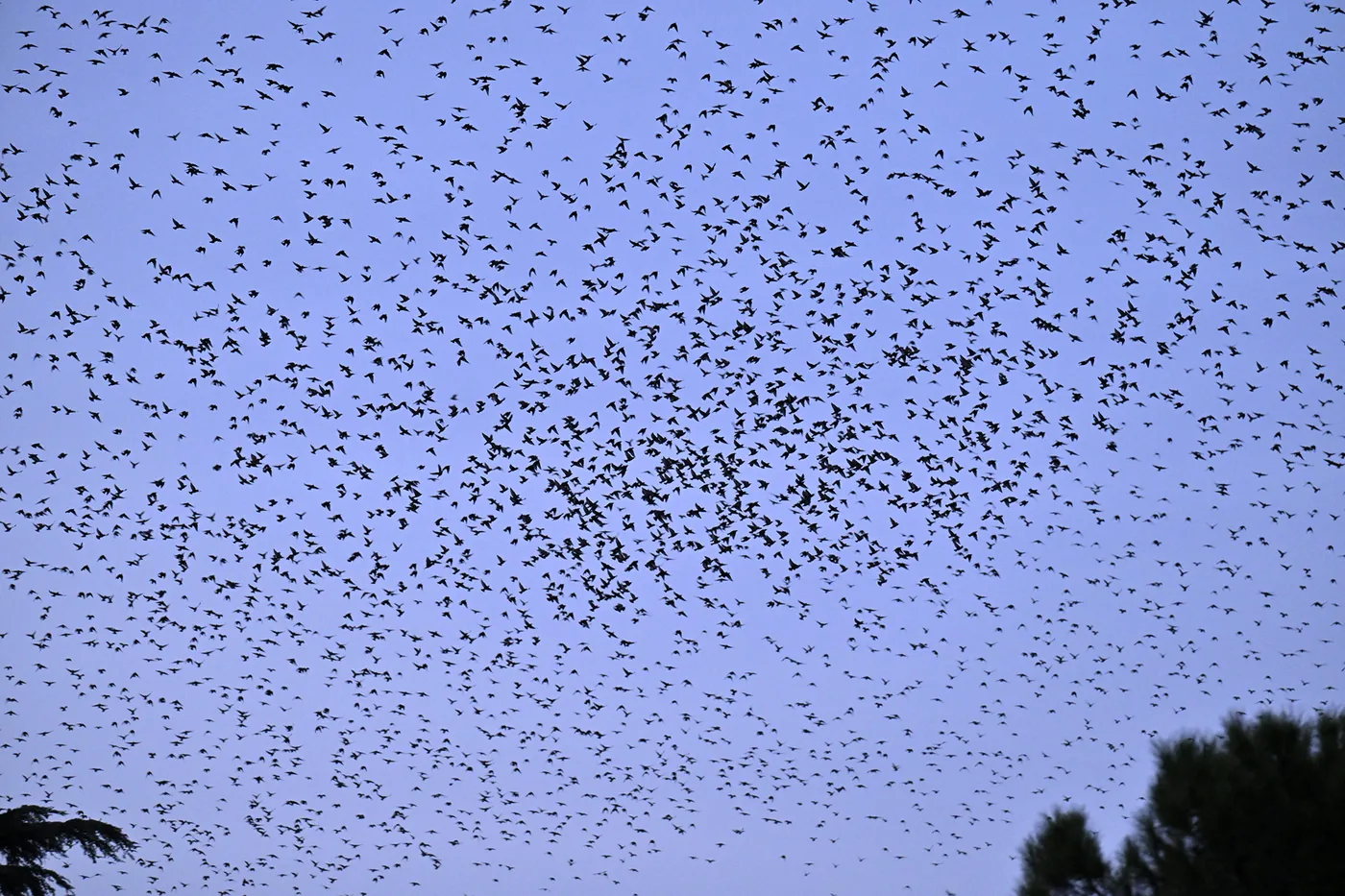
The same sky the physicists photographed: starlings over Termini station, Rome, December 2024.Moskenes, CC BY-SA 4.0, Wikimedia Commons
Nobody knows for sure. Members of the public sent in more than 3,000 reports, mostly from Britain. Across the confirmed murmurations in the survey, the reported average was about 30,000 birds; the largest estimate was 750,000.
Safety in numbers
Best supported
A bird of prey was seen at 30% of the murmurations reported, and murmurations with predators around were bigger and lasted longer. In Rome, falcons succeeded more often against lone birds than against flocks. The survey’s authors warn that the arrow could point the other way: big murmurations may attract predators.
A warmer roost
Untested
Joining a big crowd could draw more birds into large, warm roosts for the night. When the survey was published in 2017, nobody had tested this for starlings.
Just see-through
One explanation for density
Big flocks block between a quarter and three fifths of the sky behind them. One study argues that this is as dense as a flock can get while each bird can still see out.
Goodenough and colleagues, PLOS ONE, 2017; Pearce and colleagues, PNAS, 2014
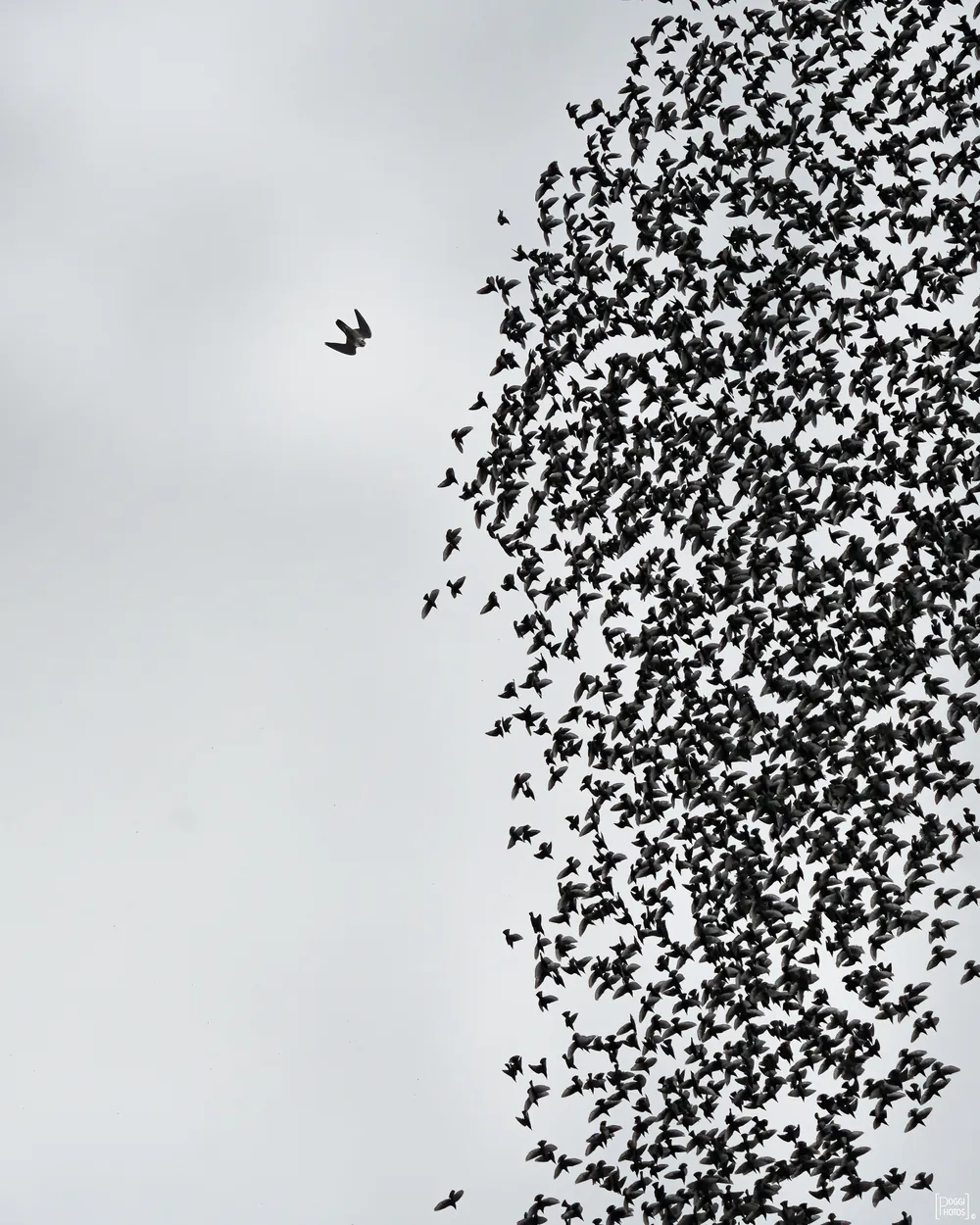
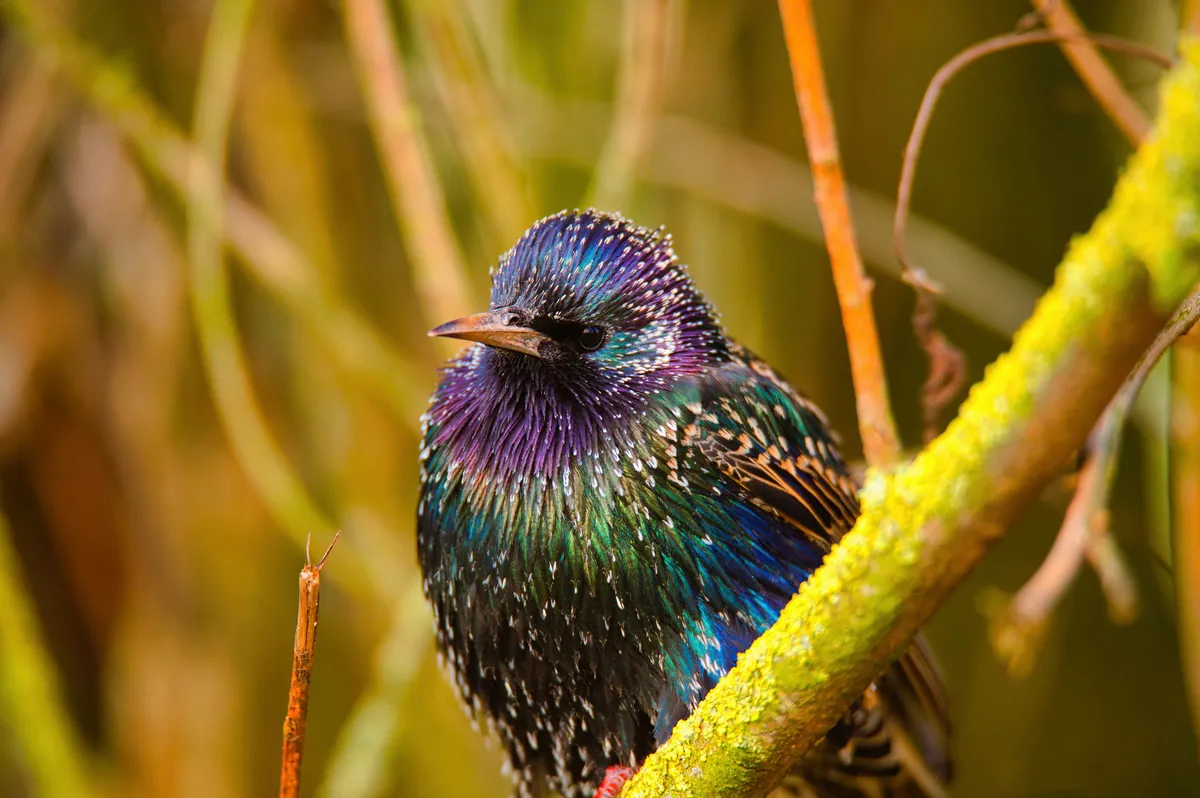
A peregrine hunting starlings over Rome, 17 October 2022.Andrea Poggi, CC BY 4.0, iNaturalist / Wikimedia CommonsUp close, a starling weighs about 85 grams and its black plumage shines purple and green.Fotografiedanielhayungs, CC BY-SA 4.0, Wikimedia Commons
Murmurations grow from October to early February, then shrink until March. They happen at dusk, just before the birds settle for the night; in British reports the display lasted 26 minutes on average.
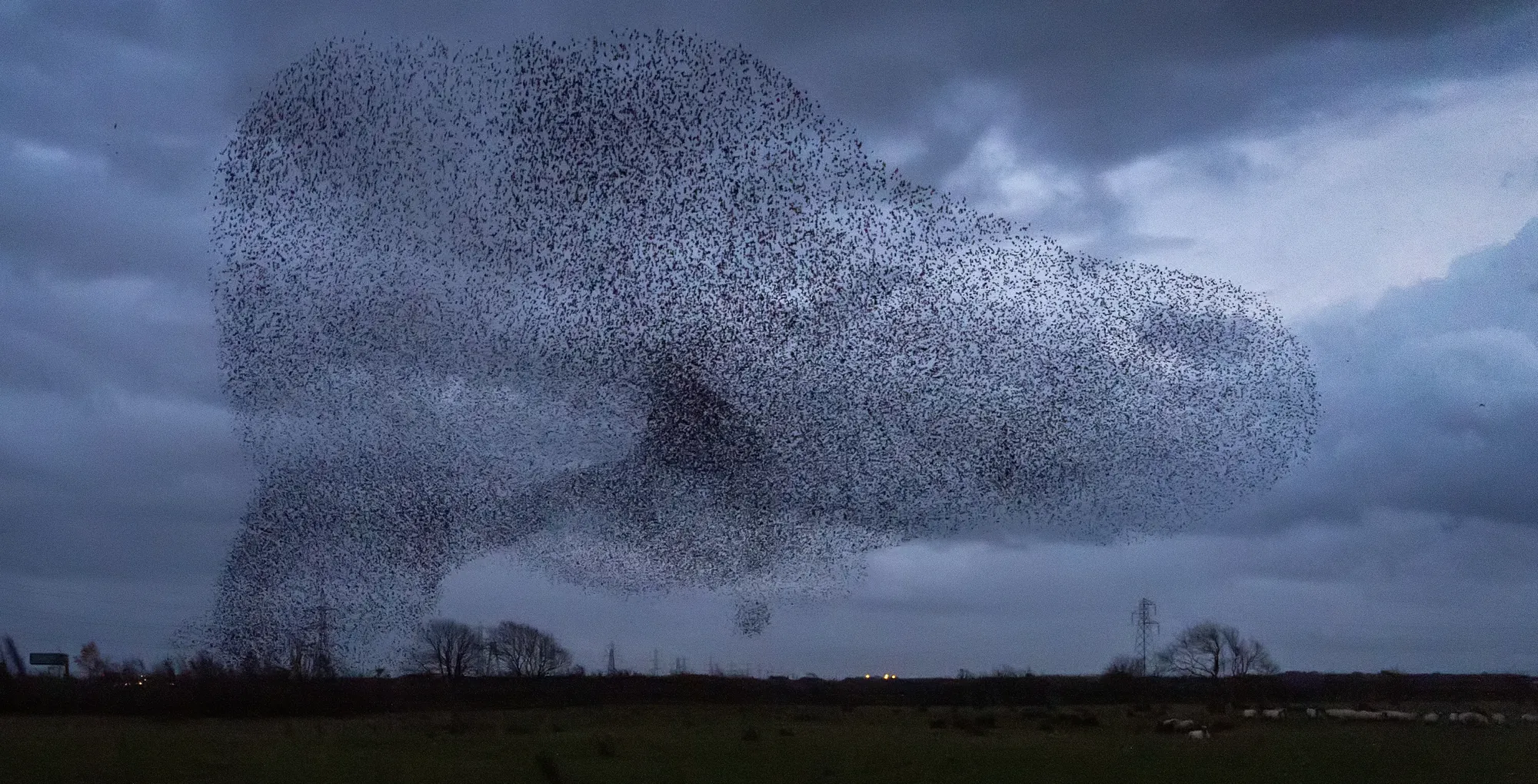
Gretna, on the border between Scotland and England, 12 November 2018.Caroline Legg, CC BY 2.0, Wikimedia Commons
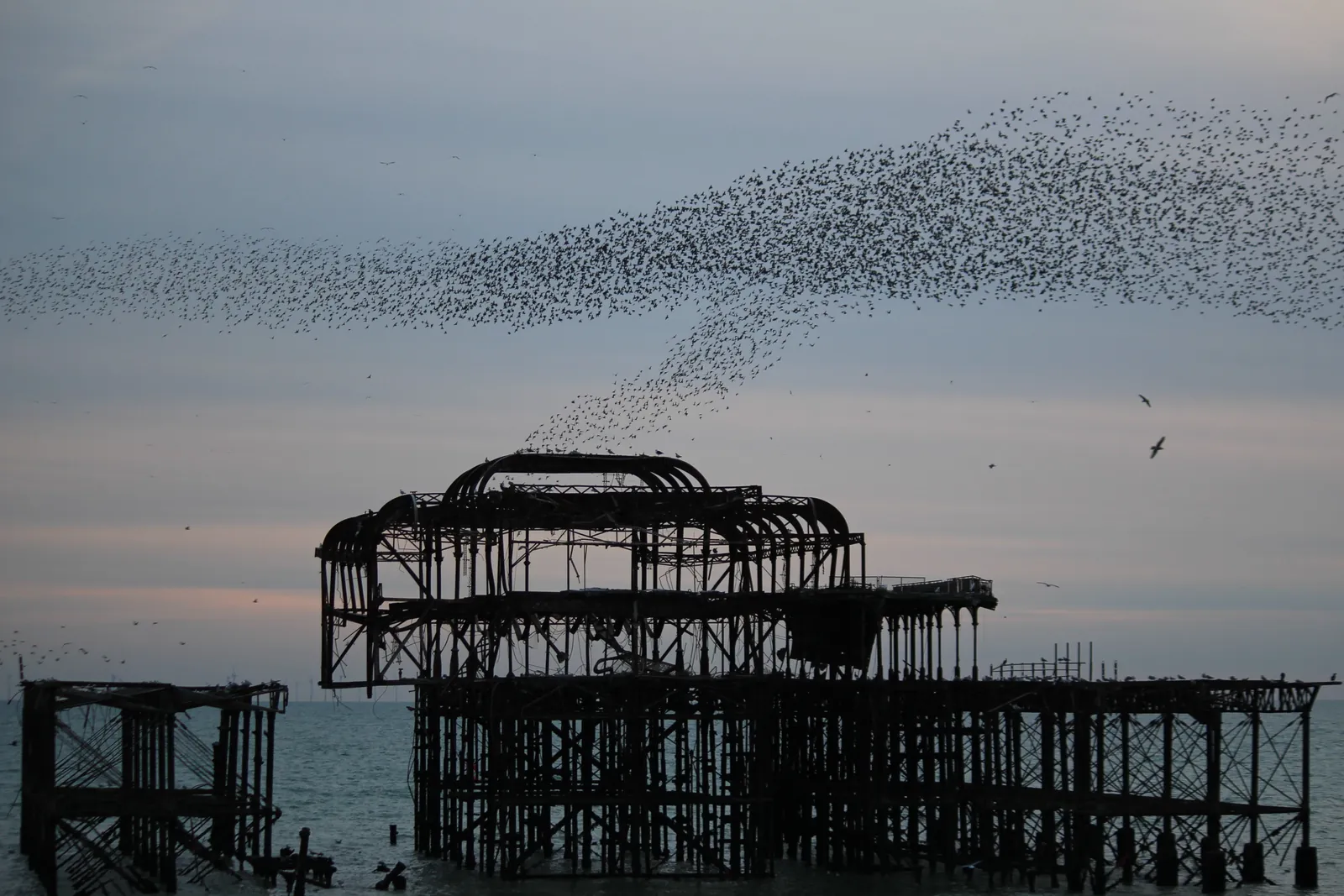
BritainPiers at Brighton and Aberystwyth, Gretna in southern Scotland, the reedbeds of the Somerset Levels. The largest British roosts can pass a million birds; winter flocks are swelled by starlings from northern Europe.
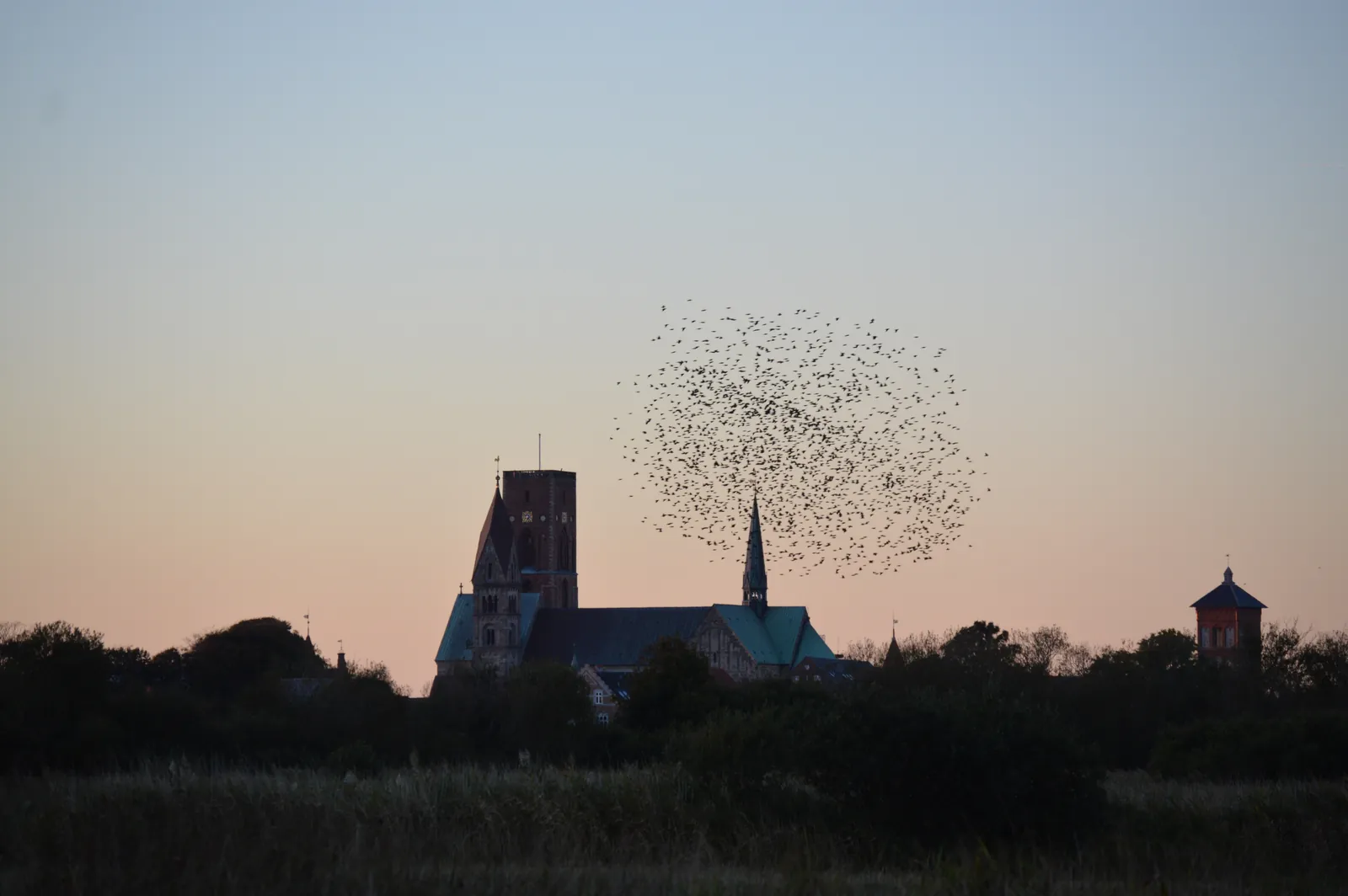
Denmark“Sort sol”, the black sun, over the marshes near Tønder and Ribe in autumn: flocks that can top half a million birds at a time, according to BirdLife Denmark.
RomeStarlings still gather above Termini station, where the physicists took their measurements; one expert estimated 500,000 to a million starlings in the city in 2022.
RomaniaIn November 2018 Romsilva posted a ranger’s film of a great swirling flock of starlings in the Măcin Mountains National Park, in Dobrogea. If you see one, note the place and the date: reports like these are how the British numbers above were collected.
Get there before sunset and look for reedbeds, piers or a clump of trees where starlings gather. If the flock suddenly darkens or splits, look for the falcon.
Starlings are still common, but the UK has lost about nine in every ten since the late 1960s, according to the British Trust for Ornithology’s long-term index.
Brighton’s West Pier, one of the best-known places in Britain to watch them.NormanofOxfordshire, CC BY-SA 4.0, Wikimedia Commons“Sort sol”, the black sun, over Ribe Cathedral in Denmark, 5 October 2016.Thomas Dahlstrøm Nielsen, CC BY-SA 4.0, Wikimedia Commons
The flock at the top of the page is a model. Each of up to 4,000 birds (2,400 on a phone) finds its seven nearest neighbours in three dimensions, keeps at least about a metre from them, matches their heading and moves towards them. It also keeps to cruising speed, circles a slowly drifting roost and flees a falcon that comes within 15 metres. A bird’s bank angle follows its turn, and each bird is drawn with the wing area a viewer on the ground would see. These rules follow Craig Reynolds’s boids (1987) and the StarDisplay model of Hildenbrandt, Carere and Hemelrijk (2010).
In the side-by-side flocks, 400 birds fly on a flat sky. The distance on the right, 1.7 metres, is the median distance to the seventh-nearest bird in the calm model flock. The counts under each flock are groups of birds separated from the rest by more than six metres.
Ballerini et al. (2008). Interaction ruling animal collective behavior depends on topological rather than metric distance. PNAS 105(4). doi.org/10.1073/pnas.0711437105
Storms, Carere, Zoratto & Hemelrijk (2019). Complex patterns of collective escape in starling flocks under predation. Behavioral Ecology and Sociobiology 73. doi.org/10.1007/s00265-018-2609-0
Zoratto et al. (2010). Aerial hunting behaviour and predation success by peregrine falcons on starling flocks. Journal of Avian Biology 41(4). doi.org/10.1111/j.1600-048X.2010.04974.x
Hemelrijk, van Zuidam & Hildenbrandt (2015). What underlies waves of agitation in starling flocks. Behavioral Ecology and Sociobiology 69. doi.org/10.1007/s00265-015-1891-3
Hildenbrandt, Carere & Hemelrijk (2010). Self-organized aerial displays of thousands of starlings: a model. Behavioral Ecology 21(6). doi.org/10.1093/beheco/arq149
Goodenough et al. (2017). Birds of a feather flock together: insights into starling murmuration behaviour revealed using citizen science. PLOS ONE 12(6). doi.org/10.1371/journal.pone.0179277