The miners’ collection
The miners’ collection
The museum began in mining-company cabinets
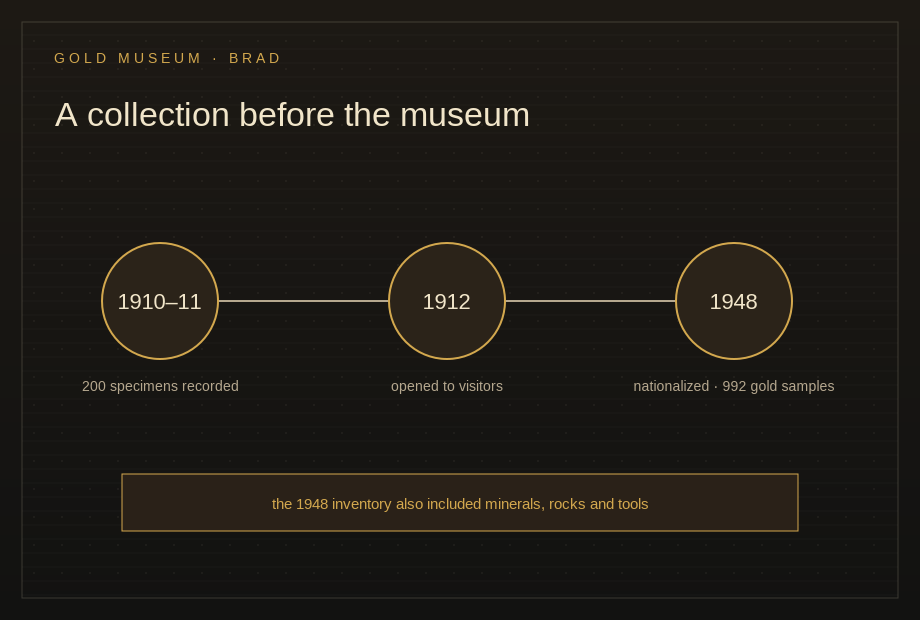
The mineral collection grew around Brad’s mines in the late nineteenth century. In a 1910–11 report, geologist Friedrich Schumacher described a cabinet with about 200 gold specimens; he later added more than 160 specimens of minerals and rocks. [1]
From 4 July 1912, people outside the mining company could visit the collection. When MICA was nationalized in 1948, the inventory recorded 992 native-gold specimens, 383 minerals and 53 rocks, alongside mining tools and objects. [1]
The provenance labels
Brad is a mining region, not the source of every specimen
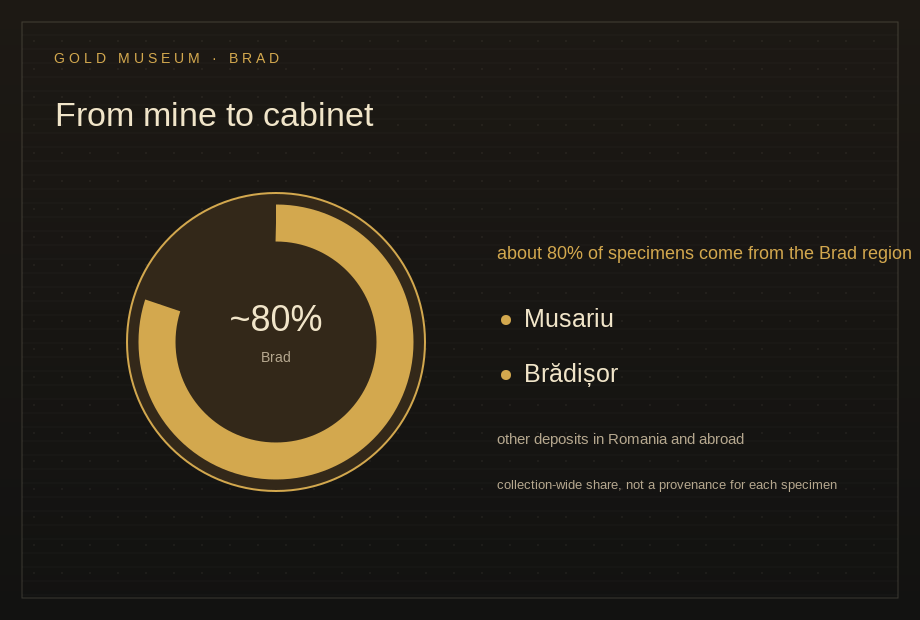
The 2013 mineral catalogue says about 80% of displayed specimens came from the Brad region, especially the Musariu and Brădișor deposits. The same catalogue records other specimens from Romanian deposits and from abroad. [1]
Provenance is part of each specimen’s story. Three famous forms in the catalogue have separate numbers and are explicitly assigned to the Musariu deposit; those labels cannot be extended to the whole collection. [1]
A specimen with a number
The Ballerina: name first, crystal second
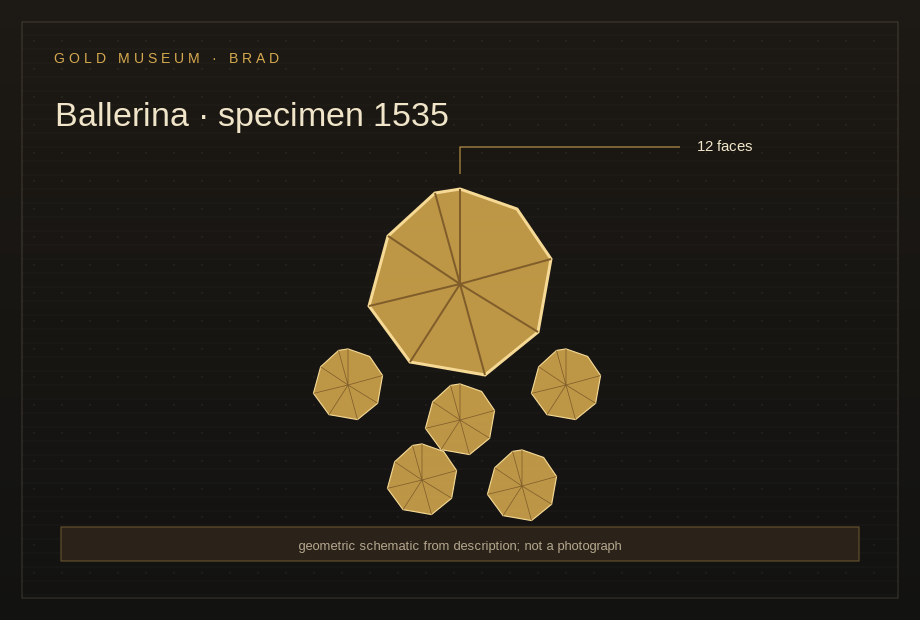
The catalogue identifies the Ballerina as specimen 1535 from Musariu. It describes a group of dodecahedral gold crystals on quartz and sulfides. The upper crystal shows twelve faces; the crystals beneath it are less regular. [1]
“Ballerina” is a human name for a mineral form. The geological term is dodecahedron: a crystal with twelve faces. This drawing interprets the description; it does not claim to show the real specimen. [1][2]
Two more Musariu specimens
A map and a plume, described by their minerals
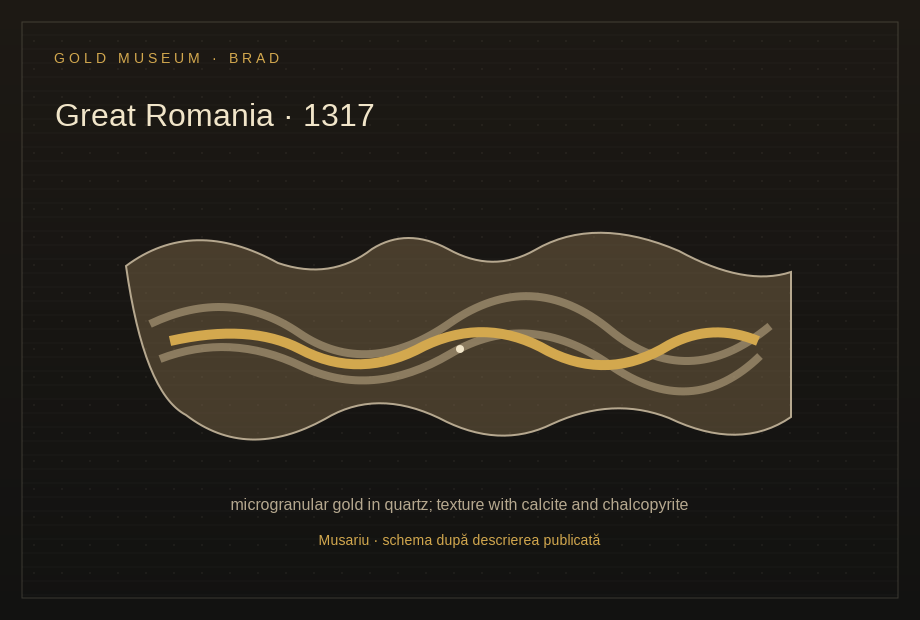
The mineral catalogue also uses memorable names. “Great Romania”, specimen 1317, is described as microgranular gold within quartz, in a nearly concentric texture with chalcopyrite and calcite. The catalogue plate identifies it as a Musariu specimen. [1]
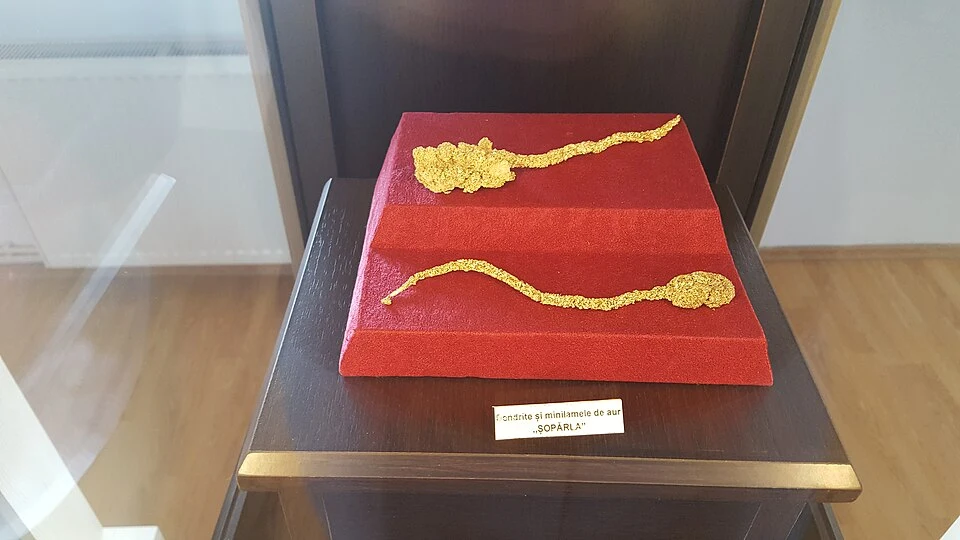
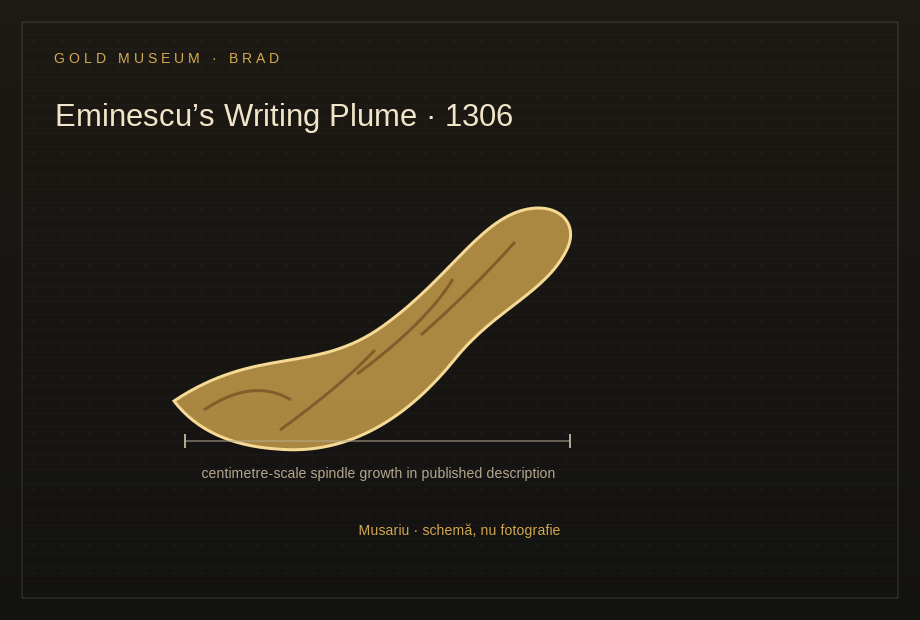
“Eminescu’s Writing Plume”, specimen 1306, is microlamellar gold with a centimetre-scale spindle-shaped lamellar growth. This specimen is also attributed to Musariu. Open each view to compare the described textures; the nickname does not replace the mineral description. [1]

Catalogue and heritage
The number that links two records
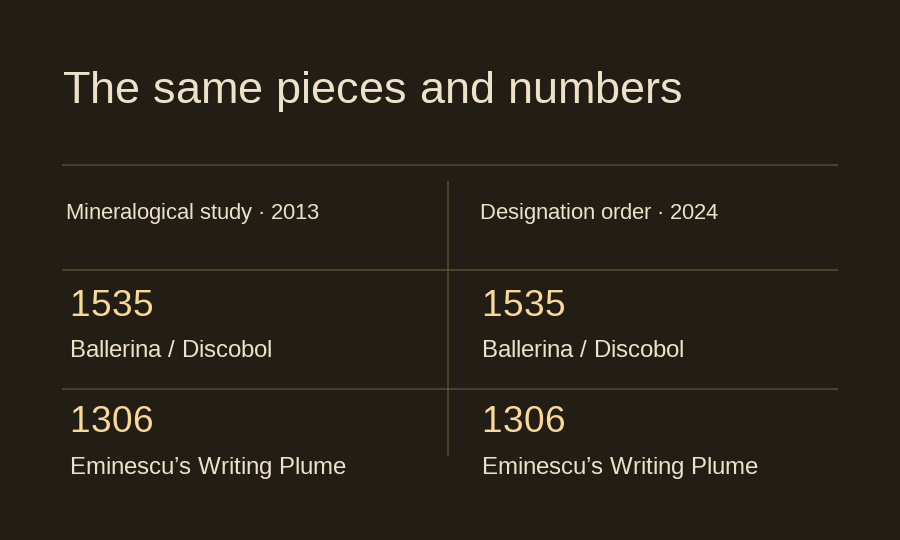
With Order 3285 of 2 October 2024, the Ministry of Culture classified eight pieces from the museum as national treasures. The annex lists the Ballerina or Discobol at number 1535 and Eminescu’s Writing Plume at number 1306. [2] [4]
The same numbers appear on the plates of the 2013 mineralogical study, where the specimens are attributed to the Musariu mine. The number lets you follow the piece across the two records. The study describes mineral structure and origin, and the order establishes heritage status. [1] [4]