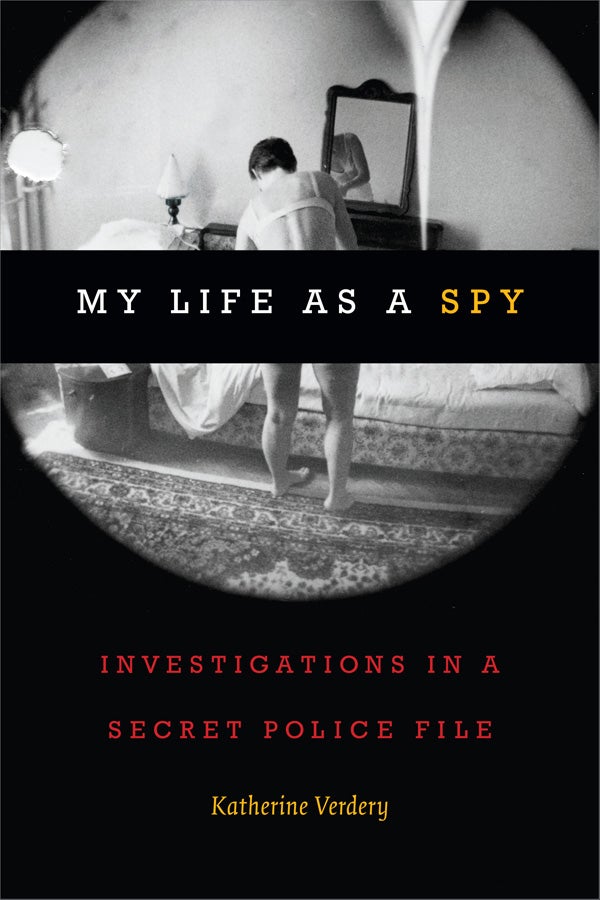
01 / The double
The file did not leave her identity alone.
Its most memorable invention is a rival self: a version of Katherine Verdery that looks more coherent in the documents than the living researcher ever felt.
The Securitate gave her different names for different suspicions. "Folclorista" was the folklorist treated as a military spy in 1973-74. "Vera" was the woman watched in Cluj in the 1980s for an alleged connection to the Hungarian diaspora. "Vanessa" was the target tracked from Baltimore for contact with Romanian dissidents. The names changed as the alleged mission changed.
The important distinction is between a dossier's confidence and its accuracy. A report can become operationally powerful while remaining wrong about the person it describes. Once an institution gives that description a name, a file number, and a chain of signatures, the description gains a life of its own.
The publisher's summary names the file's catalogue of selves: a spy, a CIA agent, a Hungarian agitator, a friend of dissidents — finally, an enemy of Romania. Those labels show how suspicion gathered force by moving her among familiar political types.
The book's "spy" is a role the system needed to fill. Verdery reads the role as evidence of how suspicion works.
Book, prologue02 / Three readings
Every page can hold three researchers.
Verdery makes the book's method visible through typography. The past fieldworker, the Securitate file, and the present author share the page, then disagree about what the same event means.
The book's note on fonts marks present narrative, field notes and letters, and Securitate reports as distinct materials. That small design decision asks the reader to compare their authority instead of flattening them into one seamless account.
Change the lens
Use the same incident to see what each record can know. This switch changes emphasis, not the underlying evidence.
What she thought she was doing
A young researcher learning how to be there
Her letters and field notes show an anthropologist improvising. She makes a wrong turn, learns how to move through a new social world, and builds friendships that make the research possible. The notes are immediate, partial, and situated in the life they record.
Source: the book's preface, note on voices, and Part IWhat the state made it mean
An itinerary becomes an intelligence problem
The reports extract movements, hotel absences, correspondence, conversations, and friendships from their setting. The file treats the practices of ethnography, including note-taking and broad information gathering, as signs of concealed purpose.
Source: the book's prologue and the 1970s chapterWhat the book does now
The archive becomes a second field site
Verdery reorganizes a chaotic file, compares it with her own records, and interviews people who appear inside it. Her later self is another instrument of inquiry, with access to more evidence and a different set of responsibilities.
Source: the book's prologue, Excursus, and Part IIWhy this matters. The book's form is part of its argument. The reader does not receive one authoritative account and then a correction. The reader watches accounts collide, and can ask which details each one makes visible.
03 / The file's time
A motorbike, a report, a dossier.
The Securitate file was assembled in fragments and stored out of order. The chronology below is Verdery's reconstruction, which is already an act of interpretation. In the prologue, she describes forty months of research in four places between July 1973 and November 1988.
- Arrival in Romania
Verdery enters on a tourist visa while waiting for a research visa and a village site. She is twenty-five and beginning doctoral fieldwork.
- The wrong turn
Riding a motorbike near Lunca Cernei, she enters an area marked "Entry prohibited to foreigners." A military report carries the incident into the Securitate system.
- The official file opens
The book distinguishes the early surveillance around her from the later moment when an official surveillance file was created.
- "Vera" in Cluj
The file recasts her research and contacts as a campaign on behalf of the Hungarian diaspora in the United States.
- "Vanessa" in Baltimore
The alleged threat follows her home. The case moves from fieldwork to contact with Romanian dissidents.
- Access, copying, and the careful read
After petitioning for the file, Verdery is told it is ready in late 2007. She receives the pages in 2008, then reads them closely in 2010 after finishing another book.
- The second fieldwork
She talks with informers, friends, CNSAS colleagues, and former officers. The book's chronology extends through conversations recorded up to 2016.
Limit Eleven volumes, four identifying numbers, and documents that sometimes run backward in time do not add up to a complete biography. The archive is a surviving selection shaped by officers, supervisors, and later archival decisions.
04 / The human network
Surveillance entered through relationships.
The book's emotional center is not the hidden camera. It is the friend, landlord, colleague, hotel worker, or acquaintance who becomes a channel into someone else's life.
That range creates the book's hardest moral problem. "Informer" is a legal and archival category, yet the people inside it occupied very different situations. Some gave neutral details. Some passed on damaging falsehoods. Some explained that threats, career pressure, or the need to protect family had narrowed their choices. Verdery does not make the differences disappear. She uses them to ask how a system can turn ordinary sociality into an instrument.
The portraits of informers are where the dossier's machinery becomes social. A report is never only a report: it records a relationship, a hope, a fear, or a bargain between people who may have believed they were managing an ordinary situation.
The result is a more uncomfortable picture than a story of watchers above and citizens below. The officers needed relationships to gather information. People also used relationships with officers to seek favours, solve problems, or create a small horizon of normality. The apparatus worked through society's existing ties, which is why its effects reached intimacy so efficiently.
05 / The ethical turn
The archive changes the researcher too.
Verdery is both the target in the file and the person deciding what the public gets to know from it. That double position makes the book's ethics visible.
Privacy
The file contains intimate photographs, names, and details about other people. The book keeps some identities masked and creates new pseudonyms for people who agree to talk.
Accuracy
Verdery usually leaves the file's distortions in place instead of silently correcting them. The reader sees what an officer wrote and then sees the author's response.
Position
She wants to understand the officers without softening the harm of the institution they served. Interviews make them more human and the system harder to reduce to a single mood.
This is where memoir becomes method. Her anger, embarrassment, guilt, attachment, and confusion are part of the evidence, then objects of analysis. The book asks what ethnography can learn from that tension without pretending the researcher has escaped it.
06 / What carries forward
The durable question is about who gets to name the trace.
Verdery connects the archive to present surveillance, while keeping the book's strongest evidence close to her own case.
The useful contemporary lesson is a mechanism. When an institution treats ordinary contact as data, it can change the meaning of a friendship before the people inside that friendship know they are being watched. A record can outlast the moment that produced it, then reorganize how a person understands the past.
Digital platforms, intelligence services, and the Securitate do not form one interchangeable system. The comparison is an invitation to ask a narrower question: who can collect your traces, who can interpret them, and what happens when their interpretation becomes the official version of you?
Interpretation This transfer to present-day surveillance is a reading of the book's method, not a claim that today's institutions operate identically to Romania's communist secret police.
A way into the book
Read the form as carefully as the story.
My Life as a Spy is a hybrid by design. The publisher's contents divide it into research under surveillance, reflections on reading the file, and an examination of surveillance's mechanisms. The structure gives the reader a route through a chaotic archive without pretending the chaos has been solved.
Source trail
What this page checked.
The book's documents, memories, and later conversations are read together here, with the file's categories kept distinct from the life they claim to describe.
About the research and limits
The guide checks the book's preface, contents, prologue, chapter openings, descriptions of the archive, and closing argument against the publisher's record and public interviews. Its focus is the book's method: how a selective archive is assembled, interpreted, and returned to the people inside it.
Some people in the book remain under pseudonyms, and the guide leaves those protections in place. The contemporary comparison is marked as interpretation; the case remains one researcher's encounter with one archive.