Marius ComperNegru Vodă, Constanța
Română

Constanța · the railway and the border

Negru Vodă, a station on the new border

In 1940, a new border cut across the Medgidia–Bazargic railway. Negru Vodă’s station and customs office took on border duties before they had adequate facilities. Records from the following years show what happened to people and goods passing through.

Compare the route in 1915 and 1940 ↓
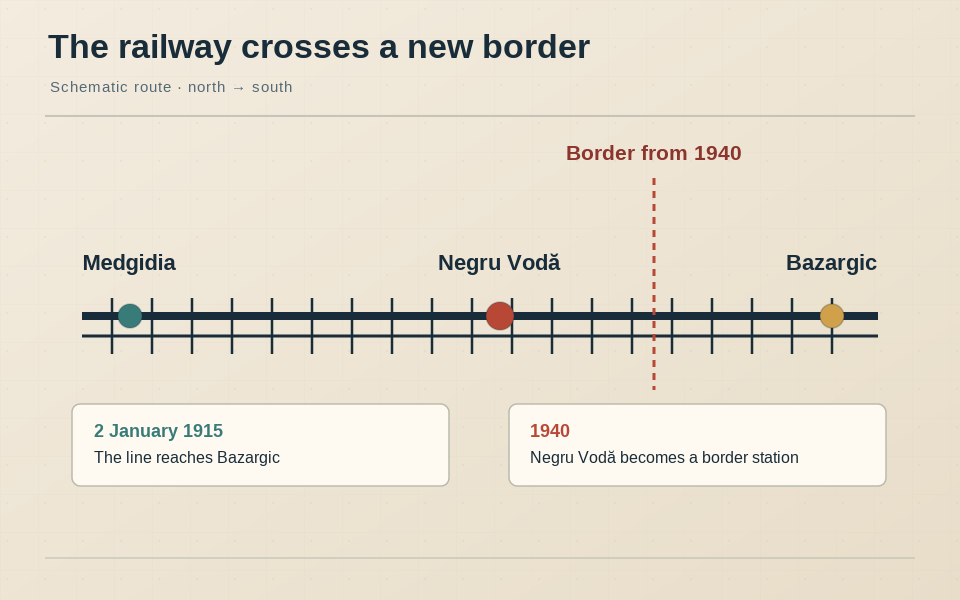
Medgidia–Bazargic line, with the new border shown schematically between Negru Vodă and Bazargic.
After the border shifted, Negru Vodă became a border station. The line continues to Bazargic. The border location is schematic. (Source · Original diagram, released CC0 1.0. · CC0 1.0)

The railway

Medgidia–Bazargic line, with the new border shown schematically between Negru Vodă and Bazargic.
After the border shifted, Negru Vodă became a border station. The line continues to Bazargic. The border location is schematic. (Source · Original diagram, released CC0 1.0. · CC0 1.0)

The railway

A railway opened to Bazargic

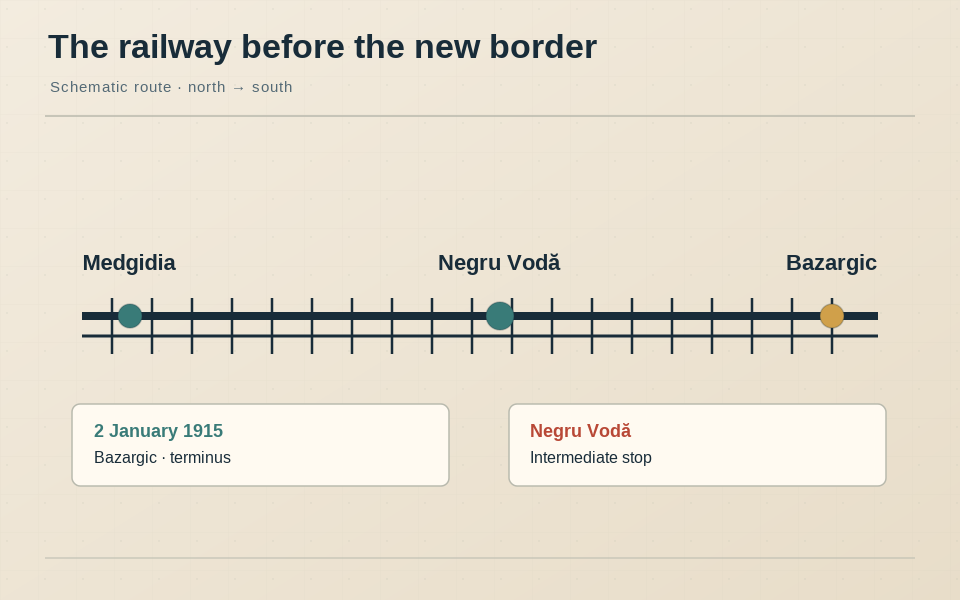
The railway from Medgidia to Bazargic opened on 2 January 1915. Bazargic is now Dobrich, in Bulgaria. The trains called at Negru Vodă along the way and continued south. [1]

The Treaty of Craiova changed the border between Romania and Bulgaria in 1940. The tracks stayed in place, and Negru Vodă became a border station on the line to Bazargic. Switch from 1915 to 1940 to compare the stations’ roles. [1] [4] [2]
Medgidia–Bazargic line, with the new border shown schematically between Negru Vodă and Bazargic.
After the border shifted, Negru Vodă became a border station. The line continues to Bazargic. The border location is schematic. (Source · Original diagram, released CC0 1.0. · CC0 1.0)
The same line from Medgidia to Bazargic in 1915, with Negru Vodă as an intermediate station.
The railway opened on 2 January 1915, running to Bazargic with a stop at Negru Vodă. (Source · Original diagram, released CC0 1.0. · CC0 1.0)

Customs and station

A new border, two unready stations

In late September 1940, the customs office at Bazargic moved to Negru Vodă. Citing contemporary press coverage, Florin Anghel describes new checkpoints established without adequate buildings or equipment. [3]

A year later, the Official Gazette reproduced a report from a Romanian–Bulgarian convention: Negru Vodă and Harman were the border stations, but neither met the requirements. A shared station between them was accepted only in principle, “when possible”. The document shows how much remained to be built after the border moved. [2]
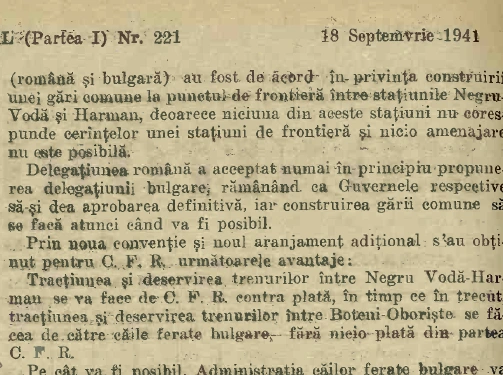
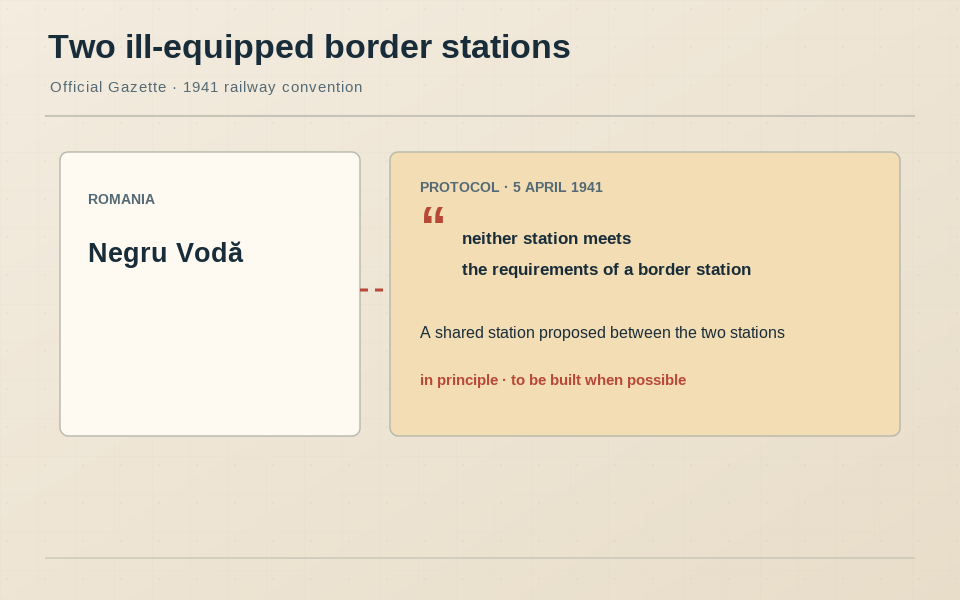
First paragraphs of the right column. The text says that neither station met the requirements.
In the right column, the report says neither station met the requirements for border service. The Romanian delegation agreed in principle to a joint station. (Source · Official Gazette, 18 September 1941, p. 5556 · Wikimedia Commons · Public domain)
Two stations divided by the border line and a document excerpt about a proposed shared station.
Transcribed excerpt from the ministerial report in the Official Gazette, 18 September 1941, p. 5556. A shared station was only accepted in principle. (Source · Original diagram, released CC0 1.0. · CC0 1.0)
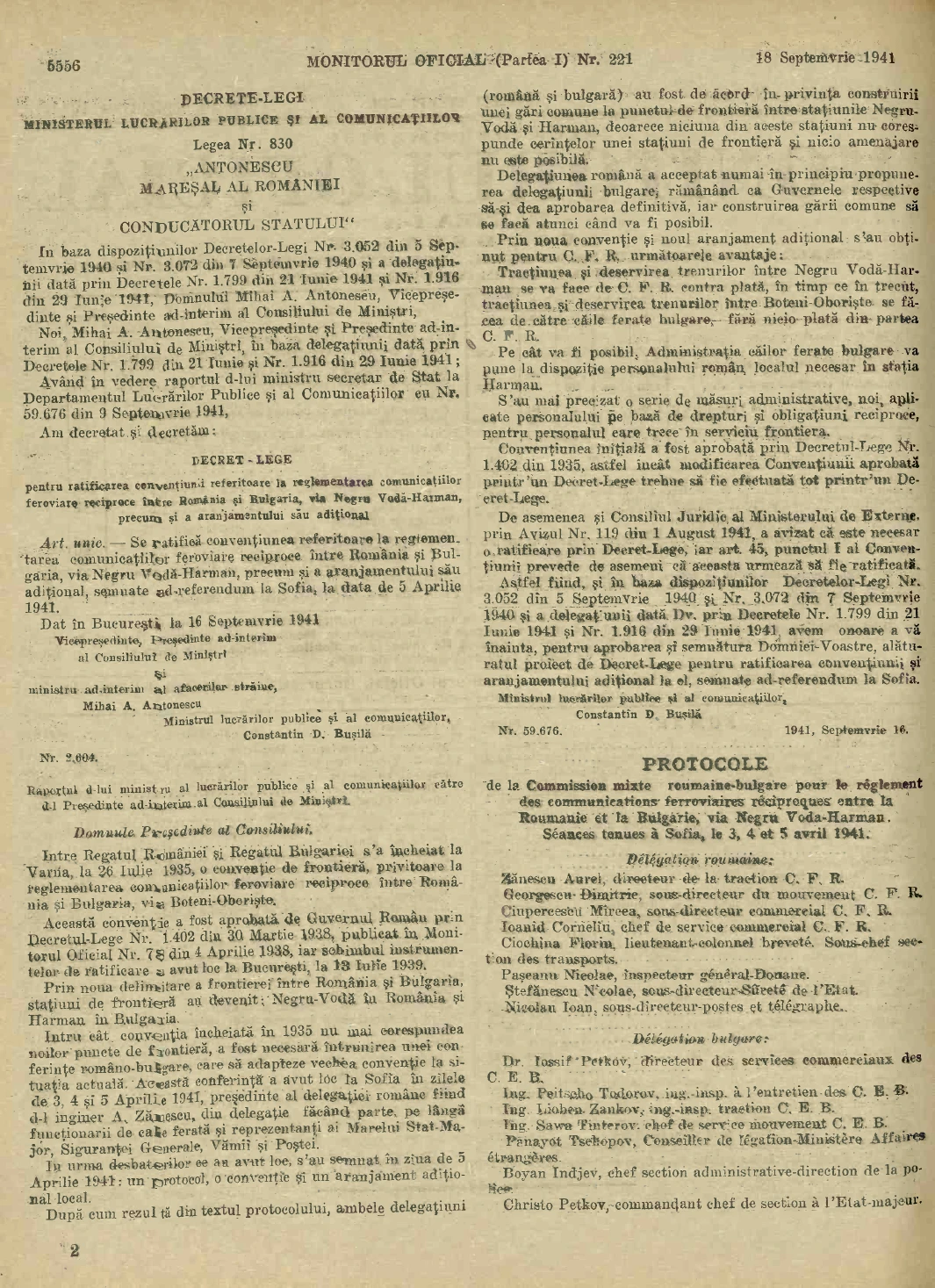
Full Official Gazette page from 18 September 1941, with the report and railway protocol.
The date and page number appear in the header. The railway report begins at the foot of the left column and continues on the right. (Source · Official Gazette, 18 September 1941, p. 5556 · Wikimedia Commons · Public domain)

Forced transfer

The treaty required a compulsory population transfer

Article III of the Treaty of Craiova and the attached agreement required Romanian citizens of Bulgarian origin in the specified areas of Tulcea and Constanța counties to move to Bulgaria. Romanian citizens of Romanian origin in Durostor and Caliacra, the two ceded counties, had to move to Romania. People covered by the exchange were required to leave their homes. [4]

In a synthesis based on archival records, Răzvan Limona reports 25,741 household heads and 106,621 people evacuated from the two counties. He says residents of the Balcic, Șabla and Casim districts were settled between Tuzla, Mangalia and Negru Vodă. These figures describe the regional operation; the source gives no local total for Negru Vodă. [5]
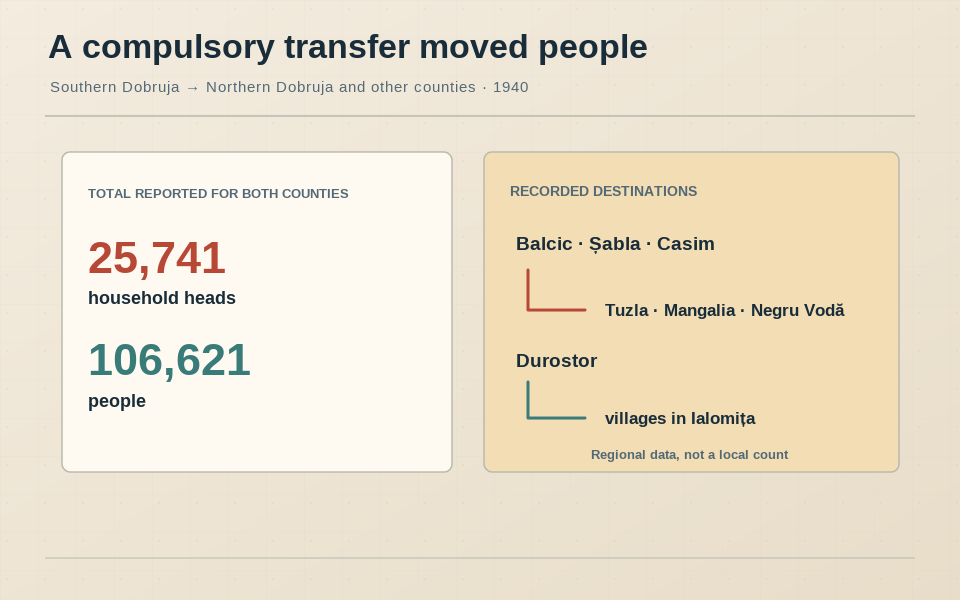
Two regional counts and arrows from Balcic, Șabla and Casim to Tuzla, Mangalia and Negru Vodă.
Counts cover both transferred counties. The second schematic maps destinations named in the source; it does not show how many families reached Negru Vodă. (Source · Original diagram, released CC0 1.0. · CC0 1.0)

Another flight

In 1944, the mayor records shelter for Crimean refugees

Cezar Aurel Banu describes Crimean Tatar refugees arriving in Dobruja in spring 1944 as Soviet forces retook the peninsula. An April report says some hoped to reach Turkey. In May, the Soviet authorities ordered the deportation of Crimean Tatars to Uzbekistan and other Central Asian republics. [6]

On 19 July 1944, the mayor of Negru Vodă wrote to the Constanța prefecture that local Tatars were sheltering and caring for refugees from Crimea. Banu quotes the report, which records the local help without giving a count of those who received it. [6]
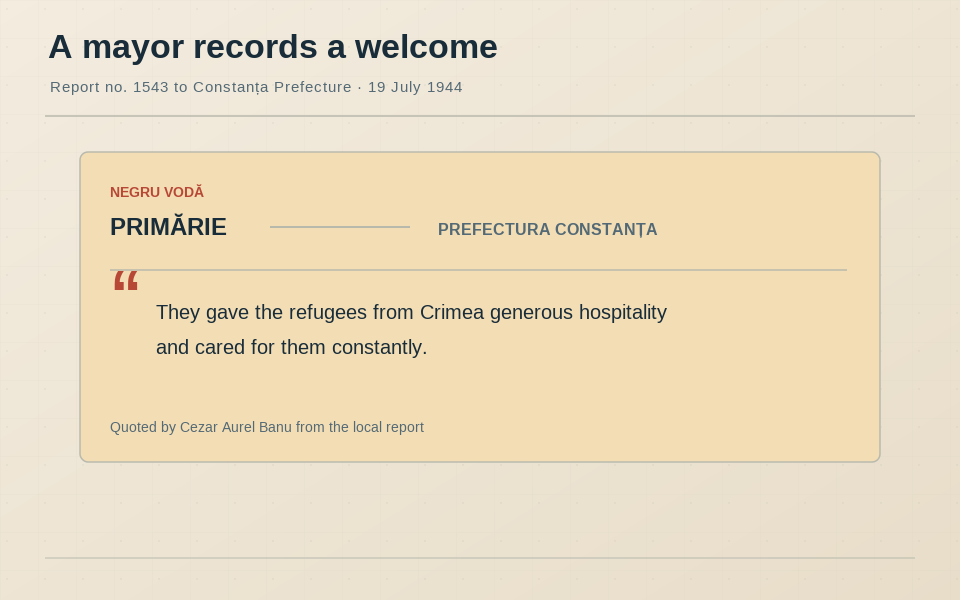
A quotation from the mayor’s report, connected by a line from Crimea to Negru Vodă.
Transcribed quotation from mayoral report no. 1543, 19 July 1944, preserved through Cezar Aurel Banu’s citation. This is not a photograph of the original document. (Source · Original diagram, released CC0 1.0. · CC0 1.0)

After the armistice

Local hospitality and later pressure appear in different records

After 23 August 1944 and the signing of the Armistice Convention on the night of 12–13 September, Soviet authorities pressed for the return of Crimean Tatars to the USSR. In later years, Banu also records arrests for helping Crimean refugees. [6]

The mayor’s report describes refugees finding shelter in Negru Vodă in July. The later documents Banu cites describe what changed in Dobruja and Constanța County, without following the families sheltered in the town. [6]
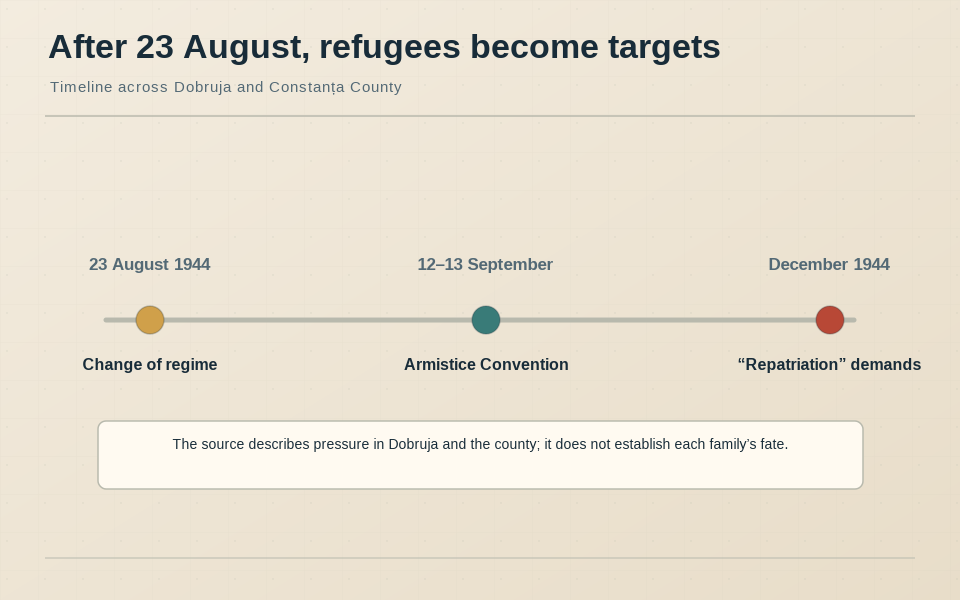
Three chronological markers, noting that the later demands are described at Dobruja and county level.
The timeline marks the political change and armistice; December demands are described regionally, not as a verified local fact for every refugee. (Source · Original diagram, released CC0 1.0. · CC0 1.0)

The customs report

In October, customs reports shipments without detail

On 12 October 1944, the customs chief sent a confidential report to the Customs Directorate. He accused the Soviet army of taking trains of petroleum products out of the country and later doing the same with wagons carrying livestock, meat and grain. He said the railway papers omitted quantities and sometimes the type of goods. He also reported Soviet military lorries passing without stopping at a road checkpoint he placed six kilometres from the customs office. [7]

The customs chief asked his superiors to intervene. The report records his complaint, and the dispatch registers would be needed to check the shipments. The article reproducing the report gives the archive reference: Constanța Customs Inspectorate collection, file 13/1944–1945, folio 107. [7]
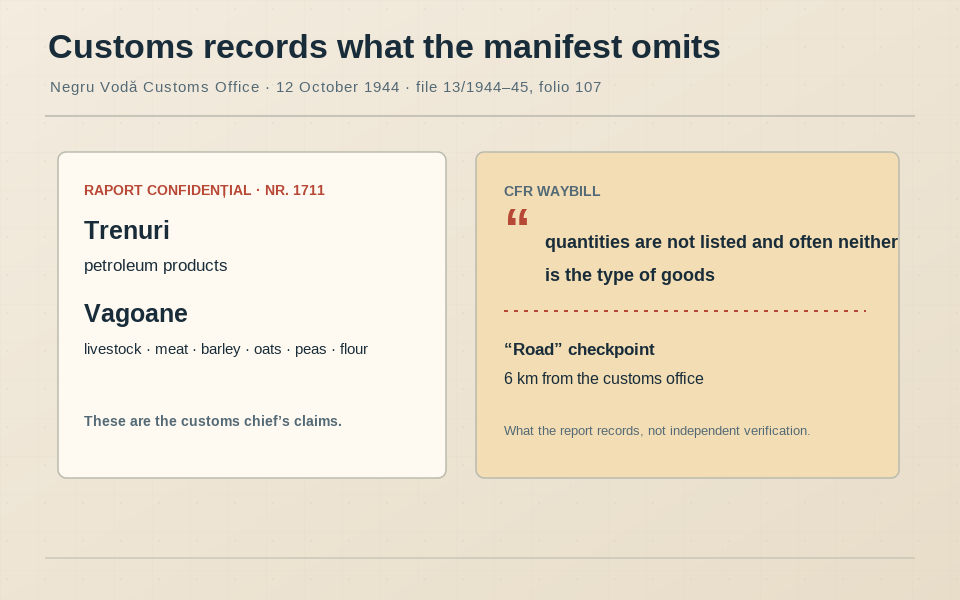
Confidential report with named goods and blank fields for quantity and type of goods.
Transcribed excerpt from report no. 1711, 12 October 1944. It says CFR waybills omitted quantities and often the type of goods; the allegations remain attributed to their author. (Source · Original diagram, released CC0 1.0. · CC0 1.0)

Sources

A border is clearest in records trying to make it work: a railway convention saying the stations are unfit, a mayor’s report about refugees, and a customs complaint about incomplete papers. Together, they show what can be said about Negru Vodă in 1940–44—and where the records stop short of a local answer.

  1. Documentation for the Encyclopaedia of Romanian Railway Stations, “Medgidia–Negru Vodă line”The work dates the opening of the Medgidia–Bazargic line to 2 January 1915 and says Negru Vodă station became a border station in 1940.
  2. Official Gazette, Part I, no. 221, 18 September 1941, p. 5556The decree-law ratifies a Romanian–Bulgarian railway arrangement. The ministry report says Negru Vodă and Harman had become border stations, but neither was suitable; a shared station remained a proposal in principle.
  3. Florin Anghel, “Southern Dobruja represented…”, Acta 2023, p. 76; cites Universul, 24 September 1940The author cites Universul of 24 September 1940 in discussing the relocation of customs offices, including the move from Bazargic to Negru Vodă.
  4. Official Gazette, Part I, no. 212, 12 September 1940, Treaty of Craiova and population-transfer agreementThe issue ratifies the treaty and its annexes, including the population-transfer agreement. Article III provides for a compulsory transfer between Romanian citizens of Romanian origin from Durostor and Caliacra and Romanian citizens of Bulgarian origin from Tulcea and Constanța.
  5. Răzvan Limona, The population of Dobruja in the interwar period, pp. 76–77The synthesis reports 25,741 household heads and 106,621 people evacuated from both counties; residents of the Balcic, Șabla and Casim districts were placed between Tuzla, Mangalia and Negru Vodă. These are regional figures, not a count for the town.
  6. Cezar Aurel Banu, “Turks and Tatars in Dobruja: resistance and repression”, pp. 54–57The author cites Negru Vodă mayor’s report no. 1543 of 19 July 1944 to Constanța Prefecture on hosting refugees from Crimea. He then describes county-wide and Dobruja-wide pressure for their “repatriation” after 23 August 1944.
  7. Negru Vodă customs chief’s report, no. 1711, 12 October 1944; transcription and archival citation in ZIUA de ConstanțaThe customs chief says CFR waybills omitted quantities and sometimes the type of goods; he describes trains, lorries and the “Road” checkpoint, 6 km from the customs office. ZIUA cites Constanța County Archives, Customs Inspectorate, file 13/1944–45, folio 107. This is an official allegation, not independent verification of the shipments.
  8. OpenStreetMap, object 74493031, Negru VodăMapping object used to locate the settlement; it does not identify the 1940 border or the road checkpoint in the customs report.