Marius ComperNoșlac-Livada · Alba
Română

Noșlac-Livada cemetery

The fingerprint on a counterfeit coin from Noșlac

Three Roman denarii ended up in one grave at the Noșlac-Livada cemetery. One imitated an issue of Marcus Aurelius. It had a copper core, a silver coating and the mark of a finger.

Skip to the fingerprint ↓
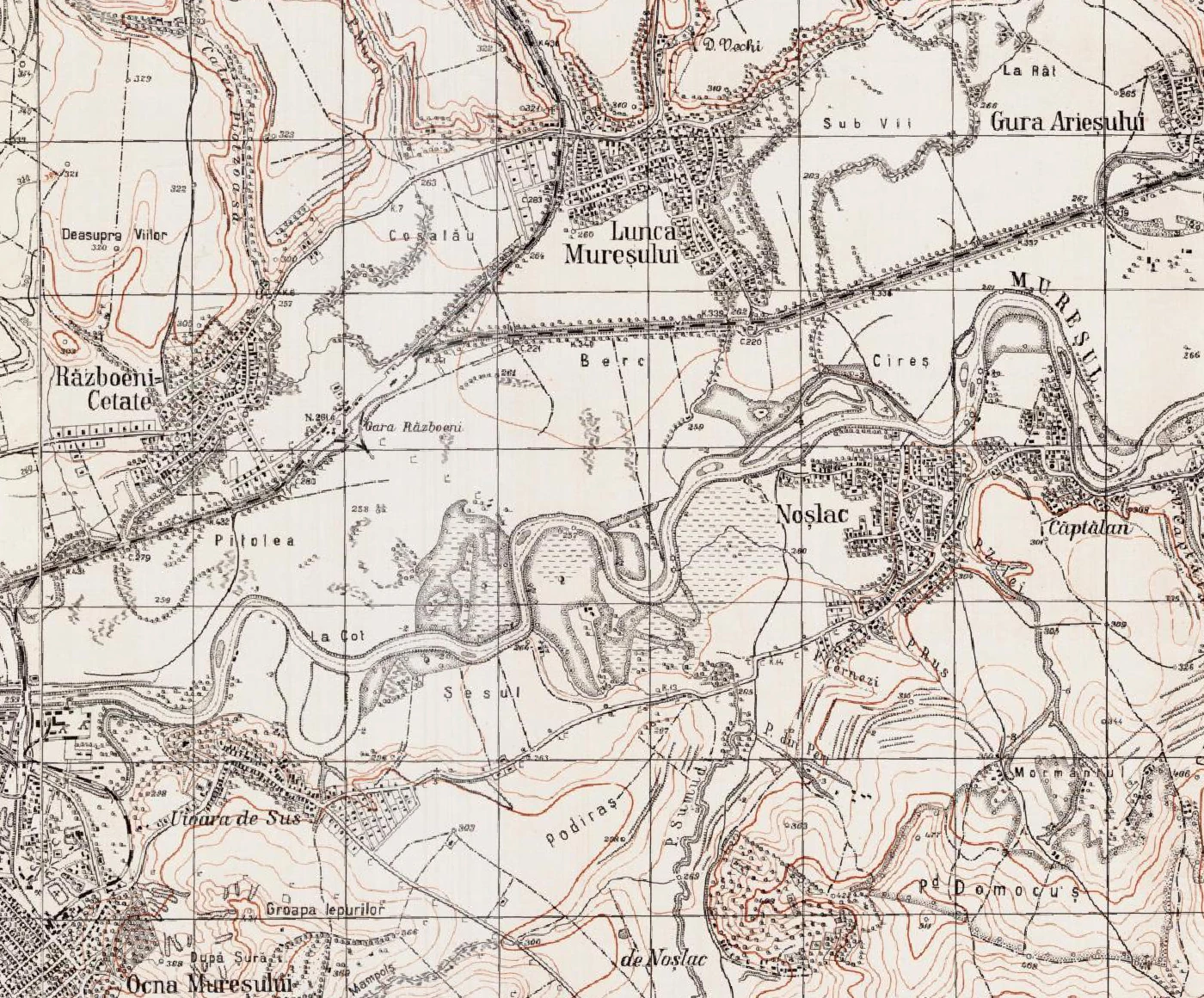
Military topographic map showing the Mureș meandering past Noșlac on the south bank, with Lunca Mureșului and Războieni-Cetate on the north bank.
Crop from the Planurile Directoare de Tragere series. The labels Noșlac, Lunca Mureșului and Războieni-Cetate orient the reader; the sheet date and the cemetery’s exact position are not shown in this crop. (Source · Serviciul Geografic al Armatei · digitizare eHarta / geo-spatial.org)

The place

On a terrace above the Mureș

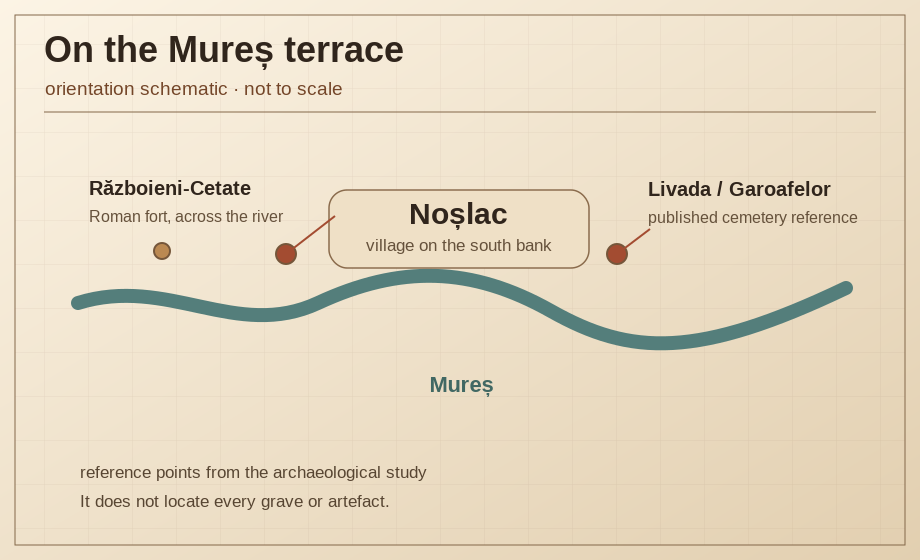
The archaeological point called Livada lies west of Noșlac on the first terrace above the Mureș. Several settlements and cemeteries from different periods have been investigated here. This project is pinned to the Livada / Garoafelor Street reference published in 2024; its coordinate does not identify an individual grave.

A military map preserves the river’s meanders and the names of places on both banks. Războieni-Cetate lies across the water; Lunca Mureșului is to the north, Noșlac to the south. The map helps read the landscape, but the sheet date is not visible here and it does not mark the cemetery.
Military topographic map showing the Mureș meandering past Noșlac on the south bank, with Lunca Mureșului and Războieni-Cetate on the north bank.
Crop from the Planurile Directoare de Tragere series. The labels Noșlac, Lunca Mureșului and Războieni-Cetate orient the reader; the sheet date and the cemetery’s exact position are not shown in this crop. (Source · Serviciul Geografic al Armatei · digitizare eHarta / geo-spatial.org)
The Mureș between Noșlac, Livada and Războieni-Cetate.
Orientation schematic based on landmarks described by researchers. It is not to scale and does not reproduce archaeological boundaries. (Source)

The excavations

One cemetery, several campaigns

The team led by Mircea Rusu excavated at Noșlac between 1960 and 1963 and recorded 114 graves from the Avar-period cemetery. The 2022 study describes two excavation zones about 220 metres apart; only two test trenches were opened between them. The authors warn that many graves remain unexcavated and that some may have been destroyed by building work.

Research resumed in 2023 and 2024, when a further 42 graves were documented, mostly south of the old trenches. The institute’s project page distinguishes phases: many burials from the sixth to seventh centuries in the central zone, with a later phase to the south. Two graves opened in 2024 near the old northern area belong to an eighth-century phase. “Avar period” is an archaeological label for this dating; it does not tell us how the people buried here identified themselves.
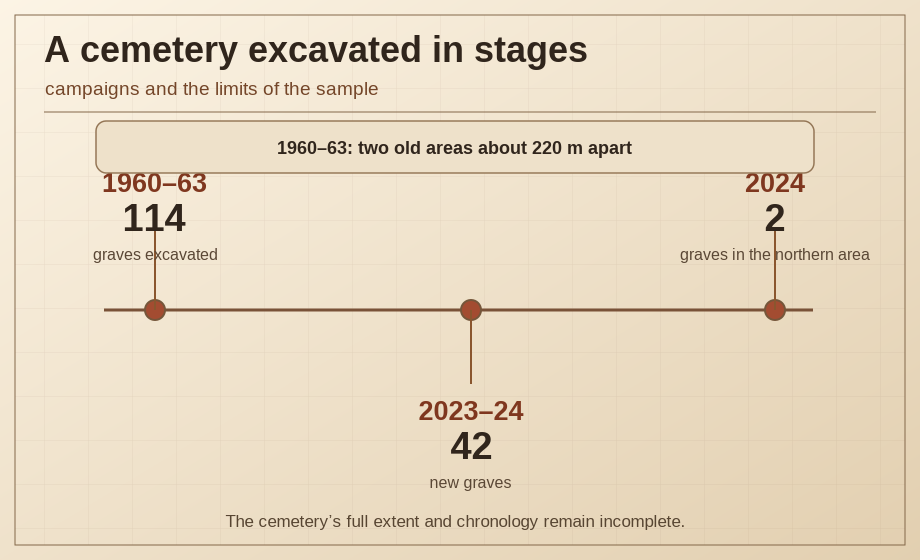
Excavation timeline: 114 graves in 1960–63, 42 in 2023–24 and two in the northern area in 2024.
Counts are graves excavated and reported by the teams; they are not the cemetery’s total. (Source)

The objects

Roman objects in an early medieval cemetery

Dobos and Nyulas identified 17 Roman-period objects in 11 of the graves excavated in the 1960s: coins, belt fittings, two small bells, a fragment of armour scale, an engraved gem and other objects. Those 11 graves are 9.65% of the 114 excavated. The percentage describes the excavated sample, not everyone buried here.

The objects did not all reach the graves in the same way. Eight coins came from six graves; all were found in graves assigned to men, and none was pierced. Coins were usually found near the pelvis, leading the authors to consider a purse or small bag. That conclusion does not fit every object position equally well.
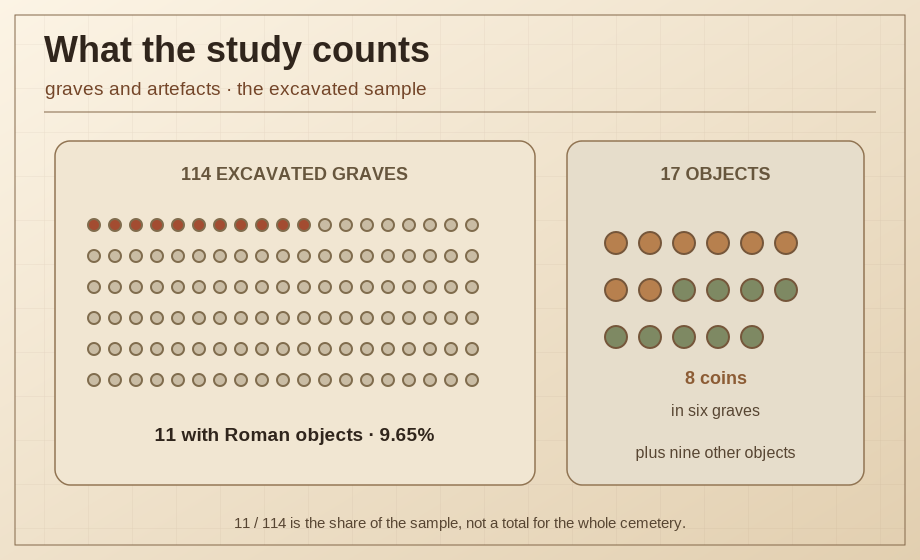
Comparison: 11 of 114 graves with Roman objects; 8 coins in 6 graves; 17 objects in total.
The study reports 17 Roman objects from 11 graves. Separately, it counts eight coins in six graves. (Source)

Grave 102

From Nero to Marcus Aurelius: three coins

The authors describe grave 102 as belonging to a child, archaeologically classified as male. It contained three denarii: one of Nero, dated AD 67–68; one of Vitellius, from AD 69; and a denarius imitating an issue of Marcus Aurelius, struck in AD 180 or later. The exact date of this last coin’s production is unknown.

The coins come from or imitate first- and second-century Roman issues. They were buried in a cemetery used in the sixth to eighth centuries. The published evidence gives no exact burial year. Age and sex were inferred archaeologically, without an anthropological examination. [1]
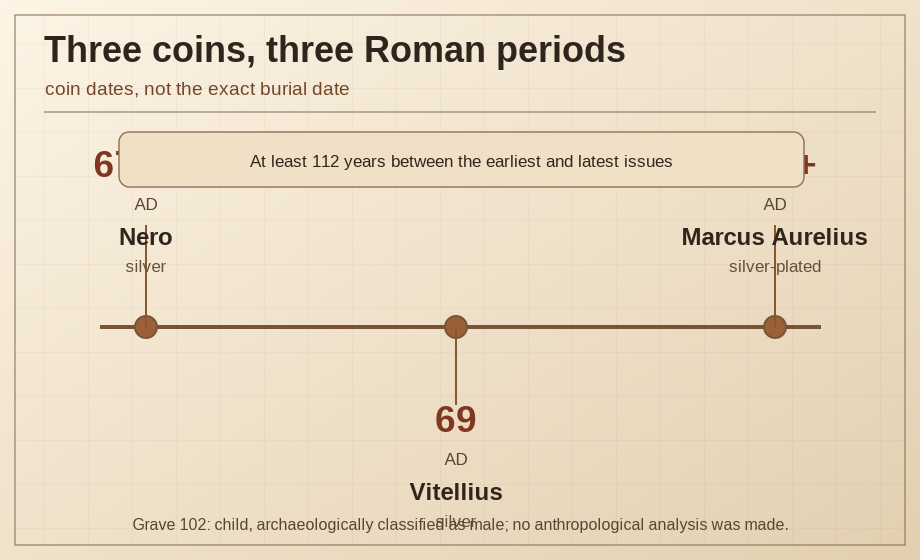
Nero AD 67–68; Vitellius 69; imitation of Marcus Aurelius, 180 or later.
The timeline shows the issue dates assigned to the coins. It does not date the grave. (Source)

Context

A coin cannot explain by itself why it was kept

In another grave, G33B, a coin on the left hip lay with two knives, flints, copper-alloy fragments and a buckle. Dobos and Nyulas interpret the group as a purse fixed to a belt and closed with the buckle. Here the objects are linked by where they were found and by their association in the grave.

For G102, the study publishes three coins and a grave plan, but does not identify a pouch that held them. The body shapes in this diagram are teaching aids, not archaeological plans. The comparison helps us distinguish an observed group of objects from an interpretation that cannot automatically be transferred to another burial.
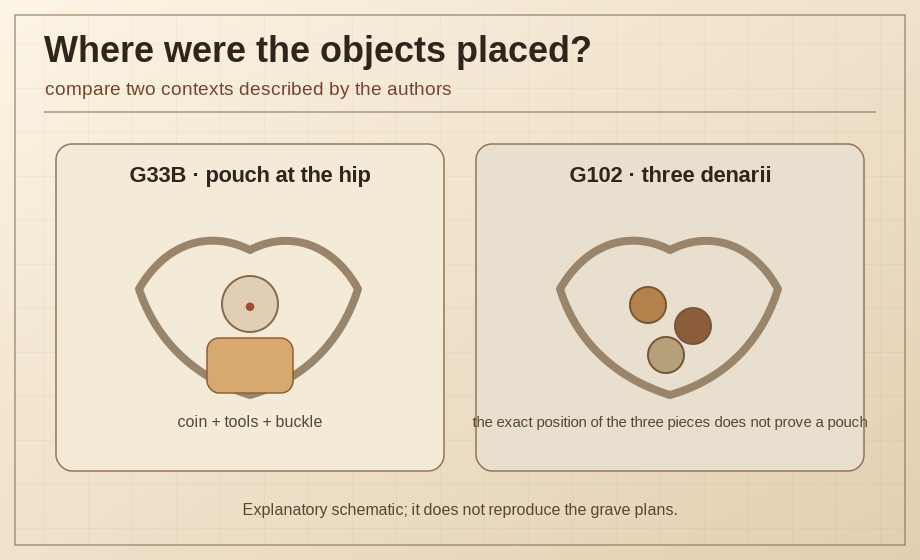
Two grave schematics marked G33B and G102; the pouch is documented as an interpretation for G33B, not G102.
G33B: a coin and tools interpreted as a belt pouch. G102: three denarii; the study does not say they were in a pouch. (Source)

Metal analysis

The forgery has silver at the surface and copper inside

At first glance, the Marcus Aurelius denarius looked genuine. Electron microscopy and X-ray energy-dispersive analysis measured areas on its surface and inside a crack at the edge. In the sampled outer areas, silver made up 62.8–71.3% of the analysed mass. In the exposed interior, copper made up 48.6–54%; at the deepest measured point, silver fell to 4.6%. [8] [9]

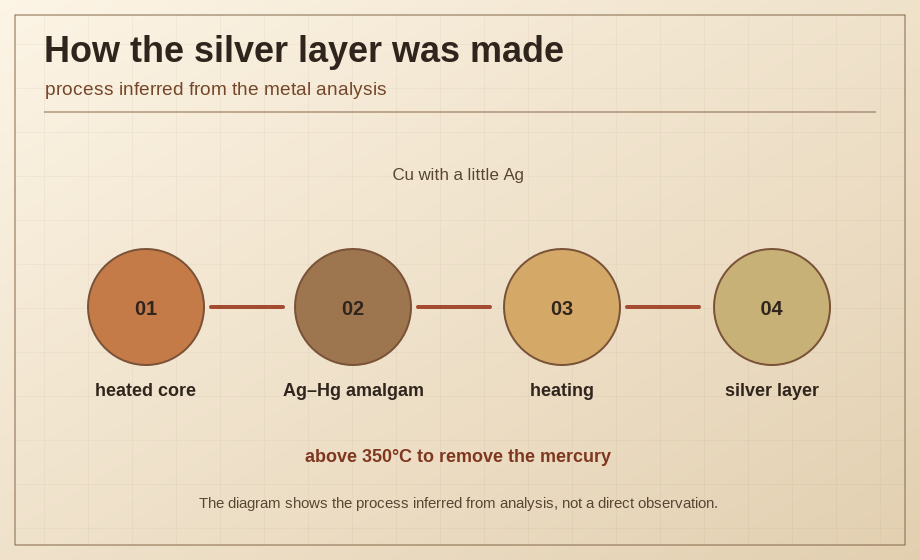
These results show a copper core with a silvered surface, not a coin made of solid silver. The authors reconstruct a process in which the core was heated and coated with a silver–mercury amalgam, then reheated to remove the mercury. The analysis supports that method; it does not tell us where the craftsperson worked or who made the coin.
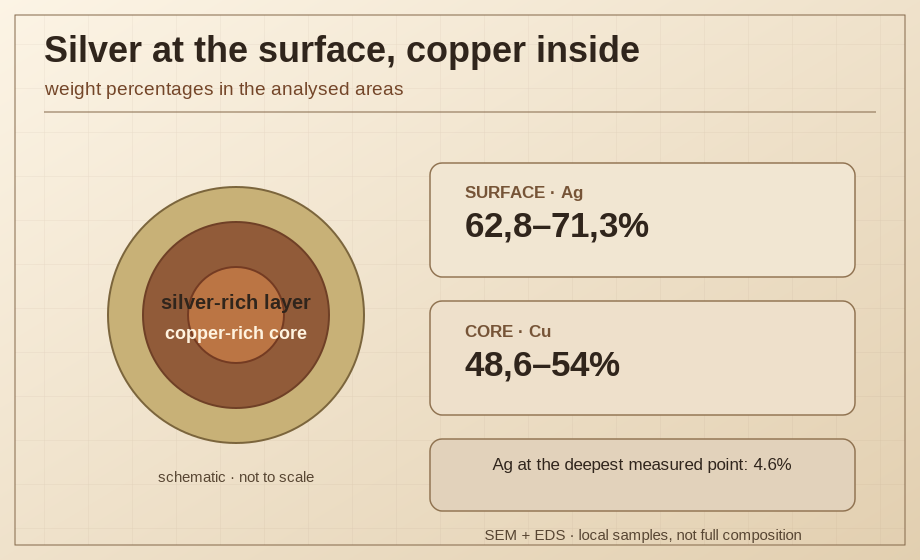
Schematic section: silver-rich layer over a copper-rich core; chart of measured Ag and Cu percentages.
The ranges are results from sampled areas, not percentages that should sum to 100% for the whole coin. (Source)
Four stages of the plating process proposed by SEM–EDS analysis; conceptual diagram.
The diagram summarizes the process inferred by the authors: copper-rich core, silver–mercury amalgam, heating, then a silvered surface. (Source)

The fingerprint

A mark on the coin; an unknown person

During conservation, researchers noticed concentric semicircular ridges on the denarius’s obverse. They used a video spectral comparator, microscopes and infrared examination; the published image shows the mark on the coin’s surface. The analyses confirmed a fingerprint, but its state of preservation did not allow precise conclusions about the individual. [7]

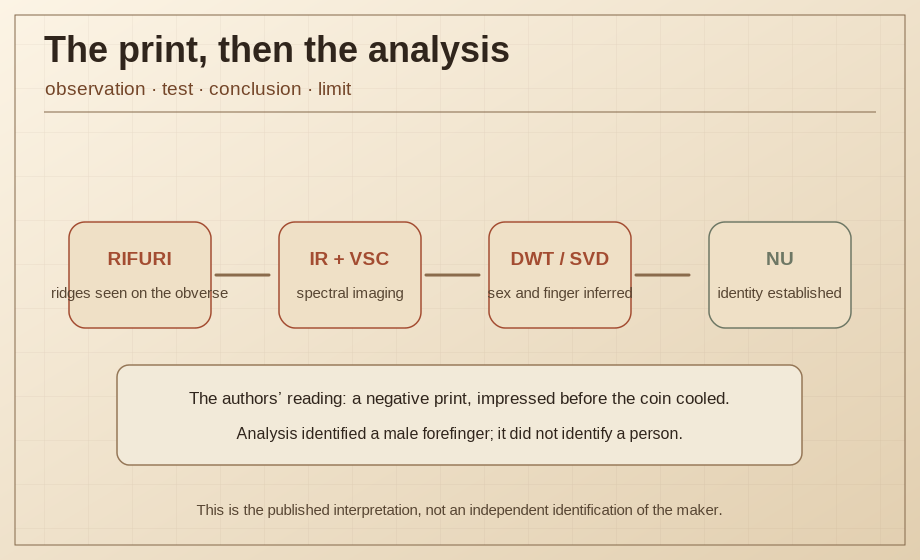
Digital methods used by specialists supported the conclusion that the mark came from the forefinger of a male. The authors interpret the negative print as having been impressed into silver while it was still hot, before the coin cooled. The person’s name, age and identity remain unknown; the conclusion about when the mark was made is their published interpretation.
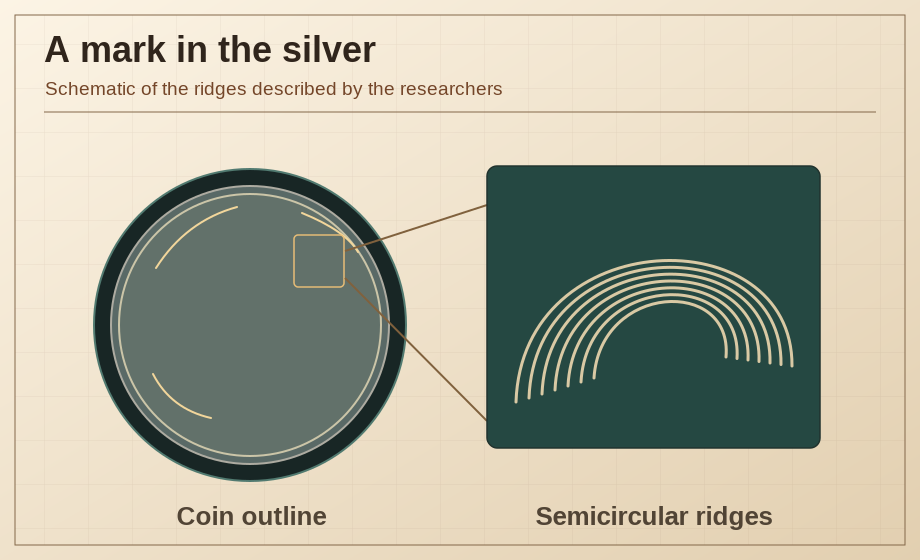
A schematic magnifier shows several semicircular lines on a small area of a disk.
The drawing illustrates semicircular ridges. Open plate 1 to see the photograph of the surviving mark. (Source)
Evidence chain: observation, spectral examination, digital analysis, limit on identity.
From observed ridges to forensic tests, then a limited conclusion: sex and finger type, not identity. (Source)

A second life

Roman objects moved through a landscape of visible remains

A Roman bell may have become an amulet; an old coin may have travelled in a pouch without its wearer knowing the emperor on it. In G108, an engraved gem and a crescent-shaped pendant were found with other objects at a woman’s feet; the authors think they may have been in a small bag. They stress that archaeology cannot reliably distinguish a personal possession from a gift left by mourners.

Roman sites lay around Noșlac at Războieni-Cetate, Lunca Mureșului and Ocna Mureș. The study suggests people may have recovered objects from local ruins, which could still have been visible, but it also considers short-distance exchange or gifts. None of these possibilities establishes the route of the three denarii in G102. The print on the counterfeit shows a moment in its manufacture; after that, its history remains open.
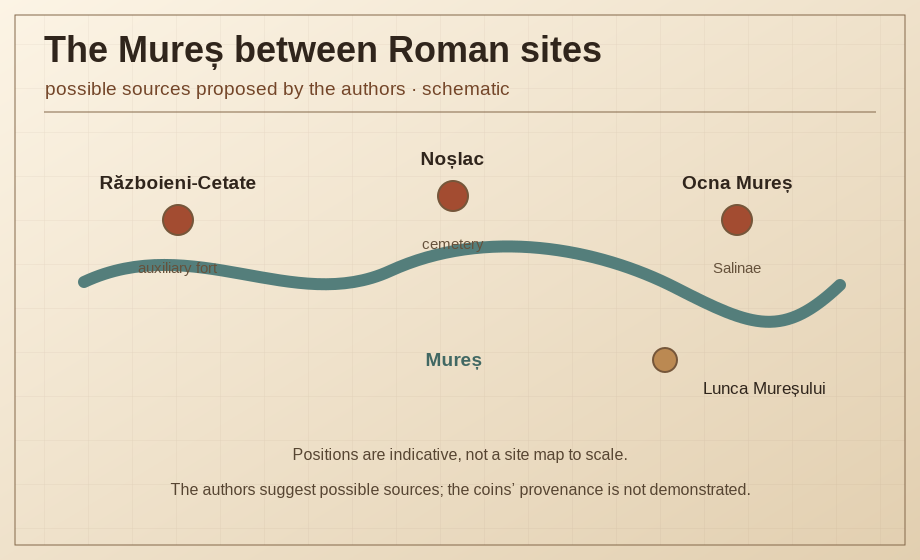
Indicative schematic of the Mureș, Noșlac, Războieni-Cetate fort, Lunca Mureșului settlement and Salinae at Ocna Mureș.
Researchers identify nearby sites as possible sources of old objects, but the coins cannot be assigned to any one of them. (Source)

Sources

A grave preserved three coins older than the cemetery around them. One was carefully forged: silver over a copper core. A fingerprint remained on its face, but not the name of the person who left it. That is what the analyses establish; the coin’s route to Noșlac remains unknown.

  1. Alpár Dobos and Dorottya Nyulas, “Souvenirs from the past. Roman objects as grave-goods in the Avar Age cemetery at Noșlac (Alba County)”, in FABER: Studies in Honour of Sorin Cociș, Mega, Cluj-Napoca, 2022, pp. 165–185, especially pp. 165–167, 170–176 and pl. IV, p. 185.Analyses 17 Roman objects from 11 graves, including the coins from G102; compares their positions in graves and discusses interpretive limits. “Avar Age” is the authors’ archaeological period label.
  2. Cristian Găzdac and Călin Cosma, “A Counterfeiter’s Fingerprint on a Forged Denarius of Marcus Aurelius”, The Numismatic Chronicle 174, 2014, pp. 125–128, especially pp. 125–127 and pl. 17.Publishes the identification of the Noșlac coin, examination of the print and the authors’ argument about the plating technique and when the print was impressed.
  3. Cristian Găzdac and Călin Cosma, “A Counterfeiter’s Fingerprint on a Forged Denarius of Marcus Aurelius”, Acta Musei Porolissensis 35, 2013, pp. 239–246; methods pp. 241–242; plate 1, p. 244; analysis plates pp. 245–246.Presents SEM–EDS results from the coin’s surface and edge crack, and the published reasoning about the negative fingerprint.
  4. Institute of Archaeology and Art History, Cluj-Napoca, “Archaeological research at Noșlac-Livada, Alba County”, project page, accessed 26 November 2026.Institutional summary of the 1960–1963 excavation and 2023–2024 campaigns; distinguishes the zones and phases studied.
  5. Erwin Gáll, Florin Mărginean, Mihály Huba Hőgyes, Viktória Horváth and Levente Daczó, “Thinking in Space! Why Are Funerary Sites Absent in Eastern Parts of Transylvania in the 7th–11th Centuries?”, Dacia N.S. 68, 2024, pp. 323–382, table 30, p. 351.The table identifies the Livada / Garoafelor Street reference and publishes the coordinates used to place this project. The point is not a coordinate for grave 102.
  6. Romanian Army Geographic Service, sheet from the Planurile Directoare de Tragere series, Noșlac–Lunca Mureșului area; digitized by eHarta / geo-spatial.org. The sheet date is not visible in the crop.Historical topographic sheet used to orient the villages, Mureș River and terrain. It does not locate the cemetery or individual graves.
  7. Open the infrared photograph, plate 1c–dS. Alămoreanu’s photograph of the surviving mark, printed page 244.
  8. See the measured surface, plate 2SEM-EDS micrographs and tables for the measured outer areas.
  9. See the measured edge, plate 3The areas measured in a crack at the edge of the coin.