Infrastructure · Romanian rail timetables, 1939–2026
Ten Hours Fifty to Timișoara
In 1977 the fastest train to Timișoara covered those same 533 kilometres in seven and a half hours. The map below computes, from the official timetable, how many rail hours from Bucharest each of the country's 1,583 passenger stations sits. Timișoara is not the worst case.
Bucharest to Timișoara, the fastest train of the day in each edition. In 1939, 9h17 means Timișoara Fabrică; the scanned copy gives 9h40 to Timișoara station.
1939 timetable
9h17
Timișoara Fabrică · figure published by Vlad Barză, located in the supplied scan1977 timetable
7h30
533 km · express rapid 11 · read from the official timetable2026 timetable
10h50
533 km · 49 km/h · 3h20 above 1977The map
How much of the country still fits inside a given number of hours
Every dot is a passenger station in the 2025–2026 timetable, valid from 14 December 2025 to 12 December 2026. The colour shows the shortest rail connection from Bucharest North on an ordinary Wednesday, changes included. The Timișoara route is drawn in red; the slider cuts the map at an hour threshold.
The map is drawn with JavaScript. The table below carries the same figures for 42 towns.
Six hours out of Bucharest takes in Moldavia as far as Suceava, all of Dobruja, Oltenia as far as Târgu Jiu, and Sibiu. Northern Transylvania and the Banat stay outside. At eight hours the map reaches Alba Iulia and stops. Cluj takes eight hours and fifty-four minutes, Oradea thirteen hours and twenty-seven, and Sighetu Marmației sixteen hours and thirty-three.
The remotest halt on the network, Guruslău in Sălaj county, sits seventeen hours and forty-six minutes from Gara de Nord.
The shape of the map says something plain about the country's geography: the capital sits in the south-eastern corner and everything else runs away on a diagonal. That diagonal was shorter fifty years ago, and on some headings it was shorter eighty-seven years ago too.
| Town | Fastest connection |
|---|---|
| Ploiești | 36 min |
| Slobozia | 1h31 |
| Călărași | 1h31 |
| Târgoviște | 1h37 |
| Buzău | 1h43 |
| Pitești | 1h59 |
| Constanța | 2h01 |
| Brașov | 2h15 |
| Giurgiu | 2h22 |
| Focșani | 2h48 |
| Alexandria | 2h48 |
| Brăila | 3h03 |
| Sfântu Gheorghe | 3h13 |
| Galați | 3h38 |
| Craiova | 3h45 |
| Slatina | 3h48 |
| Bacău | 4h01 |
| Miercurea Ciuc | 4h13 |
| Vaslui | 4h35 |
| Tulcea | 5h01 |
| Sibiu | 5h28 |
| Iași | 5h34 |
| Târgu Jiu | 5h34 |
| Suceava | 5h36 |
| Râmnicu Vâlcea | 6h00 |
| Piatra Neamț | 6h11 |
| Drobeta-Turnu Severin | 6h40 |
| Alba Iulia | 7h21 |
| Botoșani | 7h31 |
| Deva | 8h10 |
| Târgu Mureș | 8h43 |
| Cluj-Napoca | 8h54 |
| Bistrița | 9h40 |
| Arad | 10h09 |
| Timișoara | 10h50 |
| Reșița | 11h31 |
| Zalău | 11h35 |
| Baia Mare | 12h13 |
| Oradea | 13h27 |
| Satu Mare | 13h49 |
| Sighetu Marmației | 16h33 |
Four timetables
The same towns, four editions of the timetable
The 1948 and 1977 figures were read for this page directly from the scanned official timetables, column by column. The 2026 figures are computed from the timetable now in force. For 1939, Vlad Barză’s published figure remains the comparison point; a scanned copy supplied by a reader shows exactly which stop the 9h17 reaches and adds 9h40 to Timișoara station.
| Town | 1939 | 1948 | 1977 | 2026 | Against 1939 | Against 1977 |
|---|---|---|---|---|---|---|
| Timișoara | 9h17 | — | 7h30 | 10h50 | +1h33 | +3h20 |
| Oradea | 13h45 | 12h53 | 10h00 | 13h27 | −18 min | +3h27 |
| Cluj-Napoca | — | 10h02 | 7h31 | 8h54 | — | +1h23 |
| Brașov | 3h10 | 3h36 | 2h12 | 2h15 | −55 min | +3 min |
| Constanța | 2h28 | — | — | 2h01 | −27 min | — |
| Suceava | 7h07 | — | — | 5h36 | −1h31 | — |
| Buzău | 1h28 | — | — | 1h43 | +15 min | — |
The 1977 figure is the one that checks out best. Rapid 11 left Gara de Nord at 23:12 and stood in Timișoara Nord at 6:42: seven and a half hours for 533 kilometres, an average of 71 kilometres an hour. Today those same 533 kilometres take ten hours and fifty minutes, and the average falls to 49.
The 1977 timetable is the peak on the other headings too. Rapid 35 reached Brașov in two hours and twelve minutes, and rapid 31, the Balt Orient Express, left at 22:55 and was in Cluj by 6:26 and in Oradea by 8:55. On all four corridors read straight from the timetables, today's train is slower than the 1977 one, and Oradea lost the most: three hours and twenty-seven minutes.
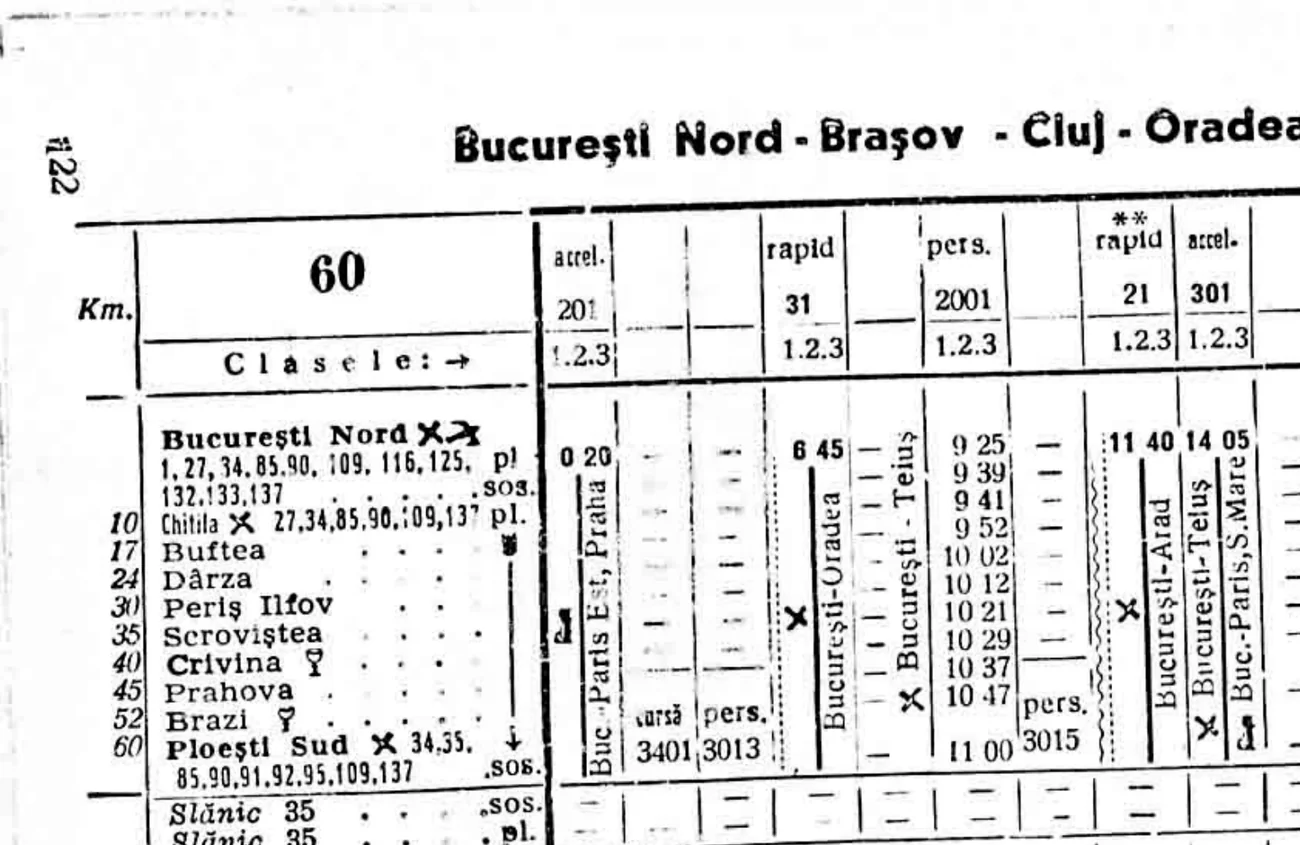
In 1948, with the network barely repaired after the war, rapid 31 left Gara de Nord at 6:45 and called at Brașov at 10:21, Cluj at 16:47 and Oradea at 19:38. Those same three towns are reached today in two and a quarter hours, in eight hours and fifty-four minutes, and in thirteen hours and twenty-seven minutes. Brașov and Cluj have come closer since 1948. Oradea has fallen thirty-four minutes behind it.
The 1939 figure published by Vlad Barză can now be read more precisely because a reader supplied a scanned copy. Table 1 of the edition valid from 15 May shows Rapid Simplon 11 leaving Bucharest North at 10:05, reaching Timișoara Fabrică at 19:22 — nine hours and seventeen minutes — and arriving at Timișoara station at 19:45 — nine hours and forty minutes. The 9h17 therefore remains the figure comparable with Barză’s article, while 9h40 is the time to the final station in the scanned table. The copy’s original provenance is undocumented; it is used as a checked editorial extract, without republishing the images.
Some headings gained. Constanța now takes two hours and one minute, twenty-seven minutes faster than in 1939. Suceava takes five hours and thirty-six minutes, an hour and a half faster. Buzău, on the other hand, needs fifteen minutes more than it did between the wars.
The explanation
The line that was renewed and the line that was not
CFR publishes, magistrala by magistrala, how many kilometres are past their renewal date. The gap between the top and the bottom of that list is almost a hundred percentage points.
| Magistrala | Past renewal | Electrified |
|---|---|---|
| M900 · Bucharest – Craiova – Drobeta – Caransebeș – Timișoara | 96.05% | 92.47% |
| M500 · Bucharest – Bacău – Suceava – Vicșani | 94.90% | 91.47% |
| M400 · Brașov – Deda – Dej – Baia Mare – Satu Mare | 86.59% | 63.65% |
| M600 · Făurei – Tecuci – Bârlad – Vaslui – Iași – Ungheni | 63.20% | 3.34% |
| M300 · Bucharest – Brașov – Cluj-Napoca – Oradea | 41.21% | 77.66% |
| M200 · Brașov – Sibiu – Simeria – Arad – Curtici | 35.25% | 49.43% |
| M700 · Bucharest – Urziceni – Făurei – Brăila – Galați | 7.32% | 41.77% |
| M800 · Bucharest – Fetești – Constanța | 1.44% | 90.43% |
Magistrala 800, Bucharest–Fetești–Constanța, has 1.44% of its length past renewal and 90.43% electrified. It is the best-kept main line in the country, and the run to the sea is now twenty-seven minutes quicker than it was in 1939.
Magistrala 900, Bucharest–Craiova–Drobeta–Caransebeș–Timișoara, has 96.05% of its length past renewal. It is the road on which the three hours and twenty minutes since 1977 are lost.
The link has its limits. Magistrala 500, which runs to Suceava, is 94.90% past renewal and still carries a faster train than the 1939 one, because it is 91.47% electrified and runs across the Siret plain. A passed renewal date measures the age of the permanent way, a different quantity from the speed at which trains actually run.
The Iași train runs on diesel
Today's fastest Bucharest–Iași train, an intercity of five hours and thirty-four minutes, runs under wires as far as Tecuci, on magistrala 500 through Buzău, Râmnicu Sărat and Focșani. At Tecuci it changes to a diesel locomotive and turns onto magistrala 600, through Bârlad and Vaslui.
Magistrala 600 officially begins at Făurei and runs 395 kilometres to Ungheni. Its first eighty-eight kilometres, between Făurei and Tecuci, have dropped out of passenger service: in the timetable now in force, no passenger train calls at both stations. Of what is left, the Tecuci Nord–Bârlad–Vaslui–Iași stretch of roughly 164 kilometres carries no catenary, and CFR's 2025 report puts the magistrala at 3.34% electrified.
On 28 July 2026 CFR's Iași branch signed the feasibility study for electrifying that stretch with TPF Inginerie: 29 million lei and twenty-eight months of work, funded through the 2021–2027 transport programme.
The mechanism
Seven hundred and eighty places where the train slows down
Every ten days, CFR's eight regional branches publish the speed-restriction bulletin: every stretch of line where trains must run slower than the line allows, with the opening kilometre, the closing kilometre and the imposed speed. The bulletins for 11–20 September 2026 were read in full for this page.
780
distinct restrictions on open and through line, in the September 2026 bulletins
2,028 km
total length under restriction, against the 1,688 kilometres CFR reported at 31 December 2025
511
of the restrictions impose 30 km/h or less, over 894 kilometres
1,346
separate restrictions on station turnouts and diverging lines
CFR's own 2025 activity report counts, on its own record, 567 speed restrictions over 1,687.93 kilometres at 31 December 2025, against 553 over 1,331.21 kilometres at the start of the same year. Over the year 430 restrictions were lifted and 444 introduced.
The report splits them into two categories that change what the number means. 226 restrictions, over 502.89 kilometres, are “covered by running times”: the timetable has already been rewritten around them, and the delay has been turned into schedule. The other 341, over 1,185.04 kilometres, are “uncovered”: the train meets them on top of the published time.
The first category explains why the Timișoara train is booked at ten hours and fifty minutes today. The second explains why it tends to arrive later than that. In 2025, passenger trains ran to time in 67.84% of cases, at an average commercial speed of 42.61 kilometres an hour.
CFR describes its own position in the report: long underfunding has degraded the lines and the structures, some of which are over a hundred years old, and the only measure left to the company for the safety of traffic is to lower maximum speeds.
How the page was made
Method
The map and every 2026 duration come from the GTFS export of the official passenger timetable valid from 14 December 2025 to 12 December 2026. For each station I computed the shortest journey from Bucharest North on an ordinary Wednesday, 16 September 2026, searching from every quarter hour, with at most four trains and a ten-minute minimum connection. Duration is counted from the real departure of the first train. Trains replaced by bus are excluded.
The 1948 and 1977 durations were read from the scanned official timetables held publicly on the Internet Archive: the edition valid from 3 October 1948 and the 1977–1978 edition. For each town I followed the train's column to the destination row and kept the shortest difference between the Bucharest North departure and the arrival.
For 1939 the table keeps the figure published by Vlad Barză in his HotNews.ro analysis, whose exact timetable edition is unnamed. A scanned copy later supplied by a reader makes the endpoint checkable: table 1, valid from 15 May 1939, gives 9h17 to Timișoara Fabrică and 9h40 to Timișoara station. Because the copy’s original provenance and rights are undocumented, it is treated as a checked editorial extract and its images are not republished.
The 1906 timetable is used as context rather than as a fifth point in the Bucharest–Timișoara table: express no. 3 took 9h03 from Bucharest to Vârciorova over 381.1 km. Vârciorova is a different endpoint, and the edition prints onward connections into the international network.
The speed restrictions were extracted from CFR's regional bulletins for 11–20 September 2026 and counted once nationally, by section, kilometre posts and speed. 639 of them appear on the map, those whose section name matches stations in the current timetable; the plotted position is the midpoint of the section named in the bulletin.
Distances for 1939, 1948 and 1977 are those printed in each edition's own kilometre column. Each average speed is worked out with the distance from its own year.
Sources
- Vlad Barză, “Cum mergeau trenurile românești în 1939 și cum merg astăzi”, HotNews.ro, 10 February 2014. Source of the 1939 figures. www.hotnews.ro/stiri-esential-16580378-analiza-cum-m…
- Căile Ferate Române, “Mersul trenurilor vapoarelor, avioanelor și autobuzelor”, 27th official edition, valid from 15 May 1939. Scanned copy supplied by a reader; table 1, printed pages 34–39, used to check the Timișoara Fabrică and Timișoara stops. The copy’s provenance and rights are undocumented; the images are not republished.
- Căile Ferate Române, “Mersul trenurilor”, valid from 18 April / 1 May 1906. Scanned copy supplied by a reader; printed pages 19–20, used for the Bucharest–Vârciorova context. The copy’s provenance and rights are undocumented; the images are not republished.
- Vlad Barză, “O istorie a vitezei trenurilor românești din 1906 până în prezent”, HotNews.ro, 20 December 2020. Context for the 1970s and 1990s. hotnews.ro/o-istorie-a-vitezei-trenurilor-romnesti-d…
- Căile Ferate Române, “Mersul trenurilor de călători”, valid from 3 October 1948, first official edition. Public scan, Internet Archive. archive.org/details/mersul_trenurilor_1948…
- Căile Ferate Române, “Mersul trenurilor de călători 1977–1978”. Public scan, Internet Archive. archive.org/details/Mersul_Trenurilor_1977…
- CNCF “CFR” SA, 2025 activity report, version 1.0, 28 February 2026. Speed restrictions, infrastructure past renewal, electrification, commercial speed. cfr.ro/wp-content/uploads/2026/03/Raport-activitate-…
- CNCF “CFR” SA, speed-restriction bulletins for 11–20 September 2026, branches of Bucharest, Brașov, Cluj, Constanța, Craiova, Galați, Iași and Timișoara. cfr.ro/ct-menu-item-116-2-2/…
- “Pas important pentru electrificarea căii ferate Iași–Vaslui–Bârlad–Tecuci”, Monitorul de Vaslui, 28 July 2026. The feasibility-study contract for line 600. www.monitoruldevaslui.ro/2026/07/pas-important-pentr…
- Passenger timetable data: S.C. Informatică Feroviară S.A., via data.gov.ro. GTFS conversion: Vasile Coțovanu. Analysis and processing: Marius Comper. github.com/vasile/data.gov.ro-gtfs-exporter…
- Contains public sector information licensed under the Open Government Licence v1.0 (Romania, OGL-ROU-1.0), for six railway operators. data.gov.ro/pages/licence…
- Ferotrafic data is published under CC BY 4.0. creativecommons.org/licenses/by/4.0/…