Snowflakes: myth and measurement
Someone found two matching snowflakes
The saying is almost true. Two large stellar flakes, alike down to the smallest detail, have never been found. But one pair of matching crystals entered the record books in 1988, and the lab grows twins to order.
Grow your flakeSimulator
Grow your own snowflake
An ice crystal is a crowd of water molecules lined up in a hexagonal lattice. In 2005 the mathematician Clifford Reiter showed that a model with two settings grows strikingly lifelike flakes on a computer. Below is a simplified version of his model.
Guess before you grow: which setting makes thin branches?
With little water and slow freezing, the model grows thin fernlike branches. As freezing speeds up, the branches widen until they fill in and a plate comes out. The paper says the same: high freezing values give plates, low values give dendrites. Now move the sliders yourself and grow it again.

Reiter's model is a simplified version: no needles or columns come out of it. The author hunts for lifelike shapes from simple rules instead of fitting the equations of physics. Reiter grew on a grid of about 400 by 400 cells for up to 10,000 steps; the grid here is smaller, so your flake grows before your eyes.
Every flake above started from a single cell of ice. The same happens in the clouds: everything begins from a small seed, and the final shape is decided by the journey through cold, damp air. That is why six matching arms come out: all of them lived the same history, at the same time.
Nothing keeps them in step. The six arms each grow on their own account, sending no signals, as the physicist Kenneth Libbrecht shows. They look alike because they went through the same changes at the same time, like neighbours' umbrellas on a rainy day.
The shape map
The cold decides the shape
The Japanese physicist Ukichiro Nakaya grew flakes in the laboratory in the 1930s and wrote down which shape comes out at each temperature. His map is still in use.
The answers, in short:
- −2 °C: near freezing, thin little plates come out.
- −5 °C: around minus 5 degrees, slender needles come out.
- −15 °C: around minus 15 degrees, the largest and thinnest stellar plates come out.
- below −25 °C: below minus 25 degrees, mostly short columns come out.
When the temperature changes while the flake grows, mixed shapes come out, like a column with a little plate at each end. And sometimes twelve-armed flakes come out: two crystals stuck together, after colliding at an angle of about 30 degrees.
Why exactly these temperatures, nobody fully knows. After decades of research, the link between cold and shape stays largely a mystery. It is one of the few simple questions physics has yet to answer.
The count
How many flakes fell on your street?
An ordinary flake holds about a quintillion water molecules. From there, with the 10-to-1 rule of fresh snow, comes the count below.
That many flakes fell:
334 trillion
334,000,000,000,000
Wet and dry snow move the count between about 167 trillion and 669 trillion.
On every square metre, each centimetre of snow brings about 33.4 million flakes.
Every flake in the count holds about a quintillion molecules: a 1 followed by 18 zeroes.
The count assumes fresh snow, with the 10-to-1 rule, and ordinary flakes of about a quintillion molecules. Numbers are rounded to three significant figures.
The 10-to-1 rule says that 10 centimetres of fresh snow melt down to one centimetre of water. Wet snow packs the same water into less snow, and dry fluffy snow spreads it into more: from 5-to-1 to 20-to-1.
The story
Three hundred years of watching flakes
Flakes were drawn before they were photographed, and photographed before they were grown in a laboratory. Each of the people below left a milestone.
1665
Robert Hooke draws flakes under the microscope
In Micrographia, the Englishman Robert Hooke sketches the forms of snowflakes with a microscope little stronger than a hand lens of today.
1864
Frances Chickering cuts flakes from paper
A minister's wife from Maine watches flakes land on her windowsill and cuts paper copies on the spot, later gathered into the album Cloud Crystals.
1885
Wilson Bentley photographs the first flake
The farmer from Jericho, Vermont, clamps a microscope to a bellows camera and, after years of trying, becomes the first person to photograph a single snowflake.
1903
500 prints reach the Smithsonian
Bentley sends 500 prints of his flakes to the Smithsonian Institution, hoping they might interest Secretary Samuel Langley. They are part of the archive today.
1931
The book with over 2,400 images
Snow Crystals, Bentley's book, appears with over 2,400 images. Together with his 5,000-odd photographs, they spread the saying that no two flakes are alike.
1936
Nakaya grows the first artificial flake
At Hokkaido University, Ukichiro Nakaya manages the world's first artificial snow crystal.
1966
80 shapes in a single list
Choji Magono and Chung Woo Lee publish the classification of natural flakes: 80 classes, from plates to capped columns.
1988
The pair that entered the record books
Nancy Knight, a researcher at America's National Center for Atmospheric Research, finds two matching flakes in a Wisconsin storm. Her paper is titled as a question.
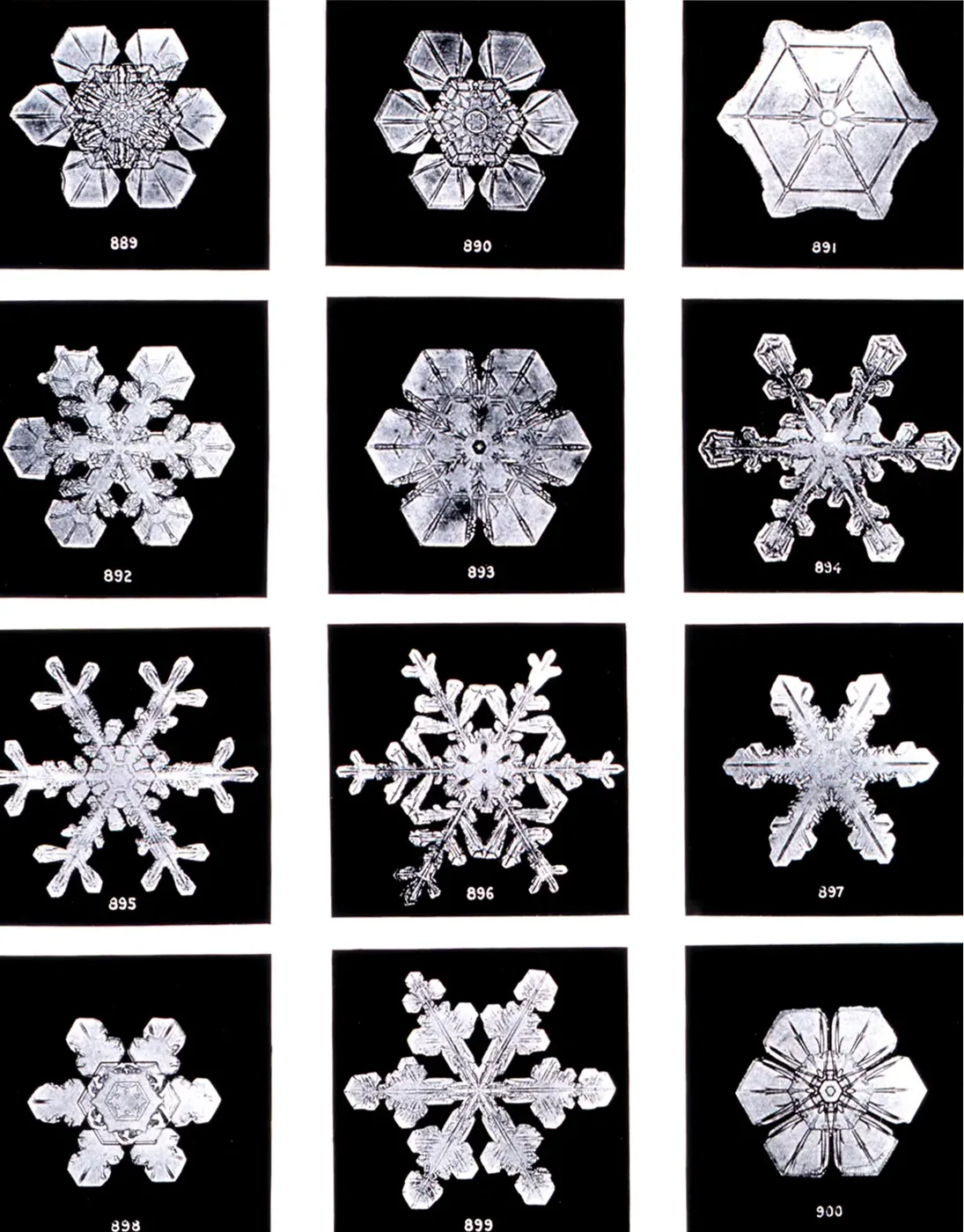
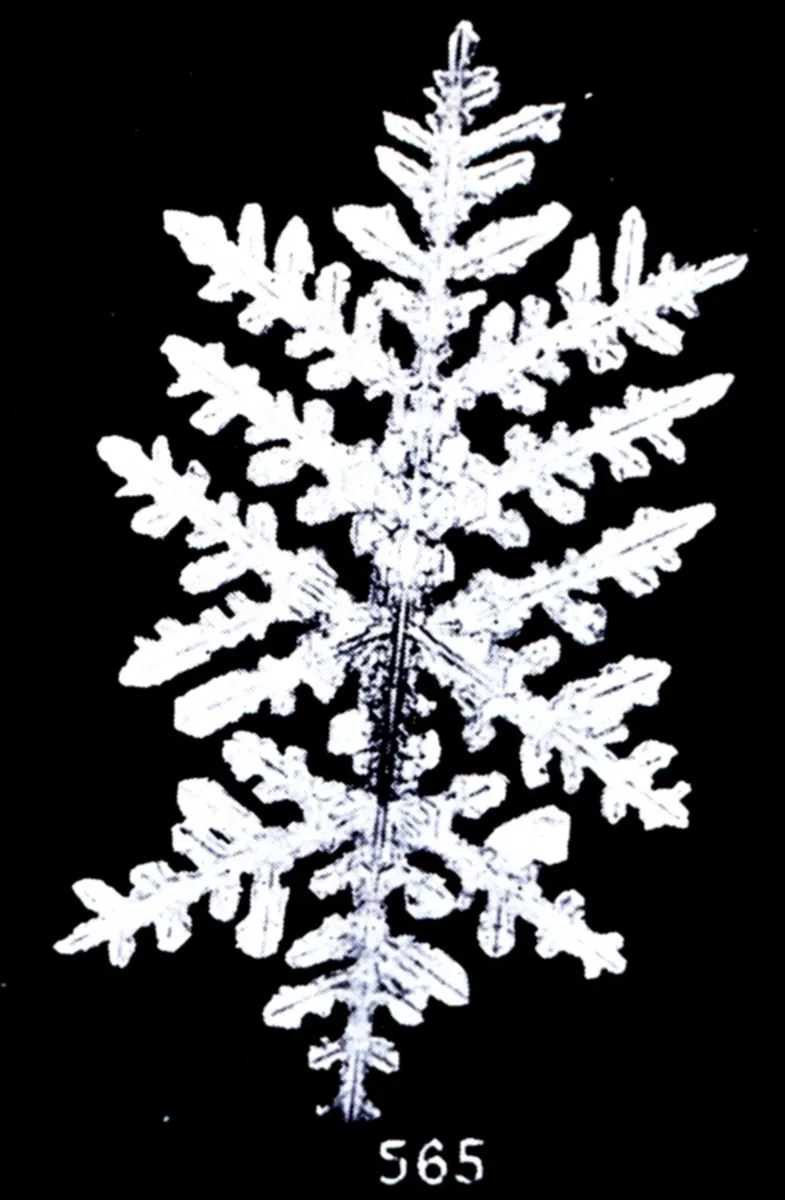
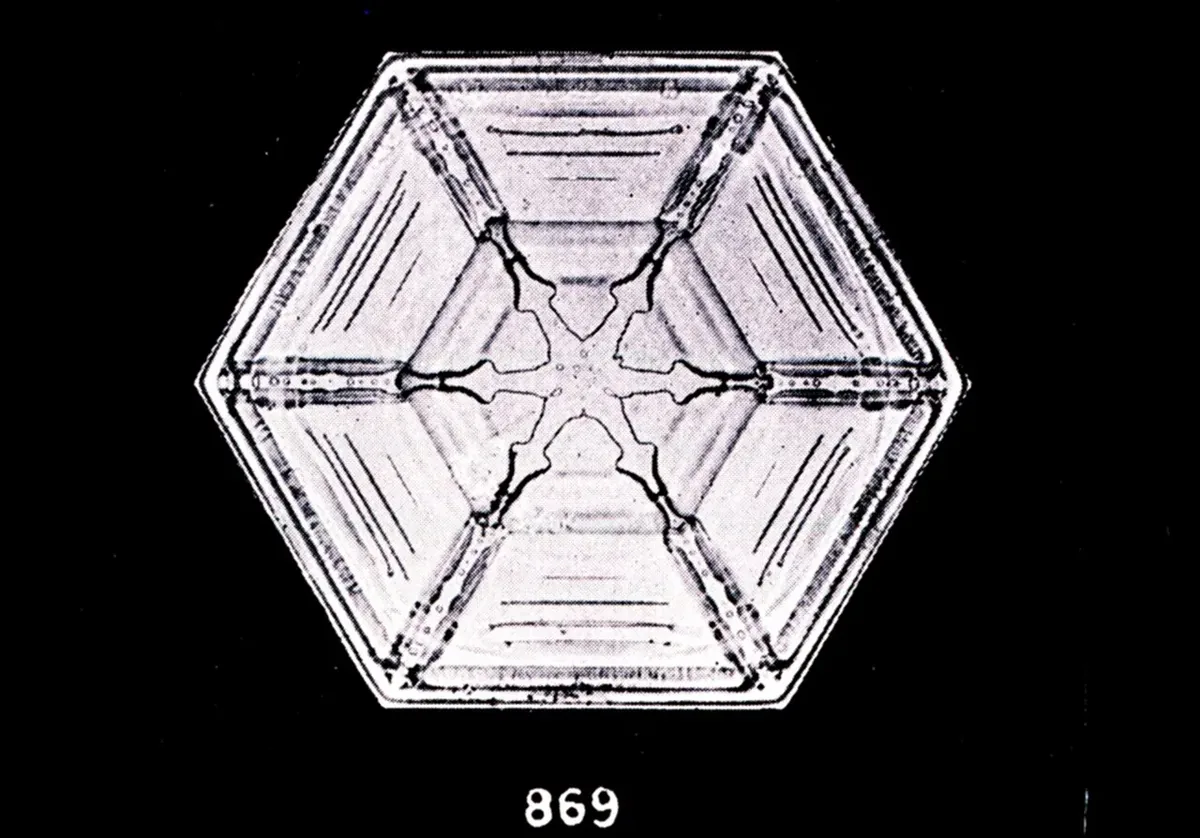

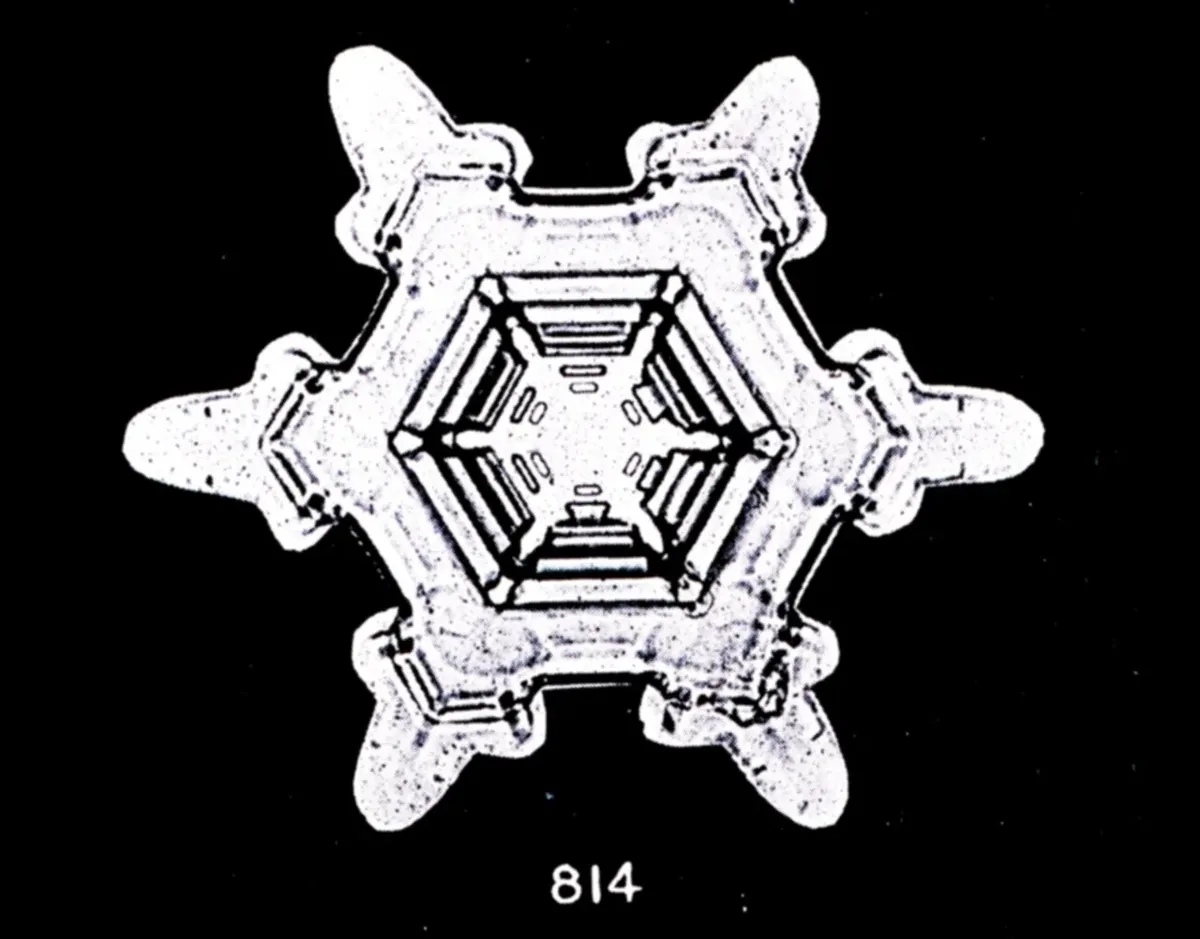

Every photograph on this page is Bentley's and over a hundred years old: three come from his 1902 study, printed in the journal of the day, the Monthly Weather Review, and the twelve-flake plate comes from the historic collection of the US weather service and is likewise from the winter of 1902.
The exceptions
Twice it matched
The saying has two cracks, and each one teaches something about how a flake grows.
The 1988 pair
In 1988 Nancy Knight, a researcher at the National Center for Atmospheric Research in Boulder, Colorado, found two identical flakes while looking through the microscope at the crystals of a Wisconsin storm. The record books list them as the first identical flakes ever found.
The original paper could not be read for this page: the journal keeps it behind a technical barrier. Its title is a question, “No Two Alike?”, and what the record books say is all that can be stated with certainty about the pair.
The lab twins
Kenneth Libbrecht, a physicist at Caltech, grows near-matching pairs of flakes in the laboratory: he lays two seed crystals side by side and runs them through the same changes of temperature and humidity. One pair he filmed grew for 16 minutes and reached two millimetres from tip to tip, a bit larger than a pinhead.
His twins are clearly very similar, as he himself says, but not precisely identical. And another researcher objects: flakes grown under tightly held conditions are a bit of a cheat. In the clouds, no flake goes through the same history twice.
The tallest story: the 38-centimetre flake
The record books list as the largest flake one 38 centimetres wide and 20 centimetres thick, fallen on 28 January 1887 near Matt Coleman's ranch at Fort Keogh, Montana: flakes “larger than milk pans”, as the story goes.
But the chain of the story is long and thin: a letter in the New York World of 14 February 1887, quoted by Samuel Lockwood in Nature, picked up by the Monthly Weather Review only in 1915, 28 years later. The journal itself writes that the event had not been recorded at the time.
And the largest lone crystal ever photographed is 10 millimetres from tip to tip. If the 38 centimetres are real, what fell was a clump of thousands of stuck crystals. This page says “reported”, because “measured” would be saying too much.
What is not known
After decades of research, nobody fully knows why exactly these temperatures grow exactly these shapes. Nakaya's diagram describes the world of flakes without explaining it to the end.
Also missing here are two things this page could not verify: what the 1988 pair looked like exactly, and whether Bentley ever said, in his own words, that he had found no two flakes alike. What is certain is that his photographs spread the saying.
Game
True or false?
Eight statements about flakes. Some sound like fairy tales and are true.
The eight statements and their answers:
- False. A snowflake is a single crystal of ice. Often hundreds or thousands of crystals stick together as they fall and form a puff-ball. A lone crystal has six corners; a flake can be anything that falls from the winter clouds. Libbrecht, SnowCrystals.com
- False. Snowflakes are frozen raindrops. A crystal appears when water vapour turns straight into ice, without first becoming liquid water. Frozen drops are something else: sleet. Libbrecht, SnowCrystals.com
- False. Most snowflakes are perfectly symmetrical stars. Irregular crystals are by far the most common kind. Near-perfect stars are hunted by photographers precisely because they are rare. Libbrecht, SnowCrystals.com
- False. Every snow crystal has six arms. Needles, columns and plain plates all occur, depending on temperature. And twelve-armed flakes are really two crystals stuck together. Libbrecht 2007, American Scientist
- True. Two matching snowflakes were found in 1988. The record books list Nancy Knight and her pair of crystals from Wisconsin as the first identical snowflakes. But her 1988 paper is titled as a question: “No Two Alike?” Guinness World Records
- True. In 1887 a snowflake 38 centimetres wide was reported. Reported, not measured in front of a scientist: the story started as a newspaper letter, and the weather journal printed it 28 years later. Monthly Weather Review, 1915
- False. Scientists fully understand why each temperature grows its own shape. Nakaya's diagram is decades old and many of its features remain a mystery. How shape follows temperature is still largely an unsolved puzzle. Libbrecht 2007, American Scientist
- True. An ordinary snowflake holds about a quintillion water molecules. A 1 followed by 18 zeroes. With that many molecules and a changing path through the clouds, two large flakes never repeat. Chutko, The Conversation, 2023
Sources
How we know all this
Measurements and dates come from published studies; where the full text could not be opened, the list below says so. The 1988 paper about the pair of flakes was read only on the journal's page, because the file is blocked to automated programs, so for the pair this page quotes the record books.
Large numbers are rounded to three significant figures. The count of flakes in a snowfall starts from about a quintillion water molecules per flake and the 10-to-1 rule of fresh snow, with the 5-to-1 to 20-to-1 range beside it. The simulator is a simplified version of Reiter's model, with values chosen by this page, and its flakes are computer drawings, not photographs.
Three things you will meet elsewhere are absent here, because they were not found in a source read in full: what the 1988 pair looked like, a personal statement by Bentley that he found no two flakes alike, and the copyright status of the 1931 book Snow Crystals, which is why the photographs come from the winter of 1902, not from the book.
Shapes and growth
- Libbrecht, K.G. (2007). The Formation of Snow Crystals. American Scientist 95(1). americanscientist.org — Nakaya's temperature bands, the humidity rule, the remaining puzzle
- Libbrecht, K.G. Snowflake Science. SnowCrystals.com. snowcrystals.com — what a flake is, why six arms, why no repeats
- Reiter, C.A. (2005). A local cellular model for snow crystal growth. Chaos, Solitons & Fractals 23. doi:10.1016/j.chaos.2004.06.071 — the two-parameter model behind the simulator (author's manuscript read)
- Magono, C., Lee, C.W. (1966). Meteorological Classification of Natural Snow Crystals. J. Fac. Sci. Hokkaido Univ. Ser. VII, 2(4). hdl.handle.net/2115/8672 — the 80 shapes and the double nuclei of twelve-branched flakes
- Nemo, L. (2021). Snowflake Structure Still Mystifies Physicists. Scientific American, 11 February 2021. scientificamerican.com — twelve-branched flakes are two crystals stuck together
People and years
- Smithsonian Institution Archives (2011). Snowflake Study through Photomicrography, 1890. Smithsonian Insider. insider.si.edu — 1885: the first photographed flake; 1903: the 500 prints; 1931: the book
- Hokkaido University: An Introduction (OCW material). ocw.hokudai.ac.jp — 1936: Nakaya's first artificial flake
- Knight, N.C. (1988). No Two Alike? (correspondence). Bull. Amer. Meteor. Soc. 69(5). journals.ametsoc.org — the 1988 pair (journal page only; the full text could not be opened)
- Libbrecht, K.G. Identical-Twin Snowflakes. SnowCrystals.com. snowcrystals.com — the lab-grown twins, “not precisely identical”
Numbers and records
- Libbrecht, K.G. Snowflake Fun Facts. SnowCrystals.com. snowcrystals.com — the 10 mm flake, the ten-minute snowman, the half of humanity without snow
- Chutko, K. (2023). How do snowflakes form? The Conversation Canada (reprinted by Phys.org). phys.org — about a quintillion molecules in one dendrite
- Haby, J. Hard to forecast: snow accumulation. TheWeatherPrediction.com. theweatherprediction.com — the 10-to-1 rule and the 5-to-1 to 20-to-1 range
- National Weather Service, Lubbock (2007). January 20, 2007 Explanation for Lack of Snow. weather.gov. weather.gov — the 10-to-1 rule, confirmed by the US weather service
- Guinness World Records: First identical snow crystals. guinnessworldrecords.com — the 1988 pair, in the record books
- Guinness World Records: Largest snow crystal. guinnessworldrecords.com — the 38 cm record, as the book tells it
- Gigantic snowflakes (unsigned note). Monthly Weather Review 43(2), February 1915: 73. archive.org — the 1915 note and its chain of sources, back to the newspaper letter
The images
Three photographs are from the plates of “Studies among the Snow Crystals”, printed in the annual summary of the Monthly Weather Review for 1902; the twelve-flake plate comes from the historic collection of the US weather service. All are in the public domain.
- Snow flakes by Wilson Bentley, winter 1902 (NOAA Historic NWS Collection): Wilson Bentley, Wikimedia Commons, Public domain
- Image 869 of Studies among the Snow Crystals, Monthly Weather Review annual summary for 1902: Wilson Bentley, Wikimedia Commons, Public domain
- Image 814 of Studies among the Snow Crystals, Monthly Weather Review annual summary for 1902: Wilson Bentley, Wikimedia Commons, Public domain
- Image 565 of Studies among the Snow Crystals, Monthly Weather Review annual summary for 1902: Wilson Bentley, Wikimedia Commons, Public domain

