Ms. 377
Ms. 377
Why the year began in September
Nucet Monastery stands south of Târgoviște, in Dâmbovița. A manuscript now kept by Romania’s National Archives records some of its income and expenses. Historian Gheorghe Lazăr published the ledger and arranged the sums by accounting year. [7] [1] [5]
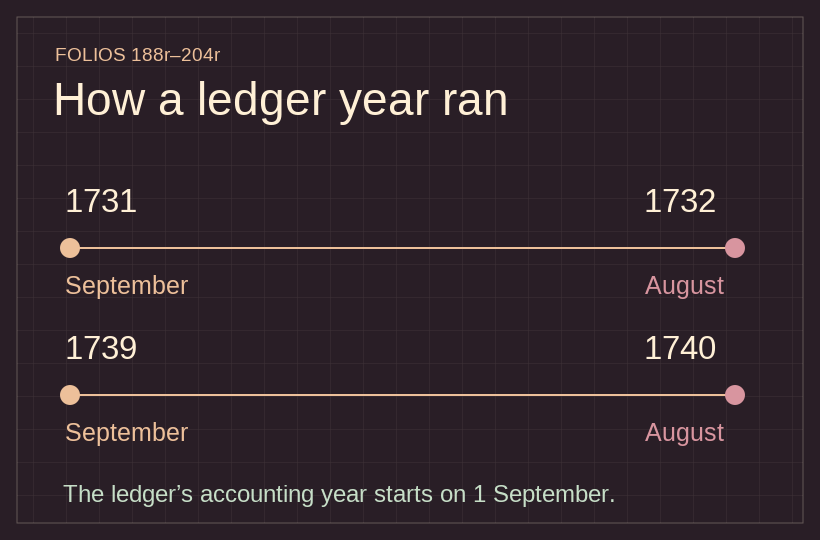
Each accounting year began on 1 September and ended the following August. In the study, 1731 and 1739 are the first and last year labels. The last period runs through August 1740. Look at where the line crosses between calendar years before comparing any two sums. [1]
The cellar in Bucharest
What brought the money in?
Wine, and to a lesser extent rachiu, a distilled spirit,, brought in most of the money. The 1732 accounts contain 15 thalers for building a cellar in Bucharest. The capital offered a market for some produce from the estates. Lazăr uses that expense alongside other records to trace the trade. [3]
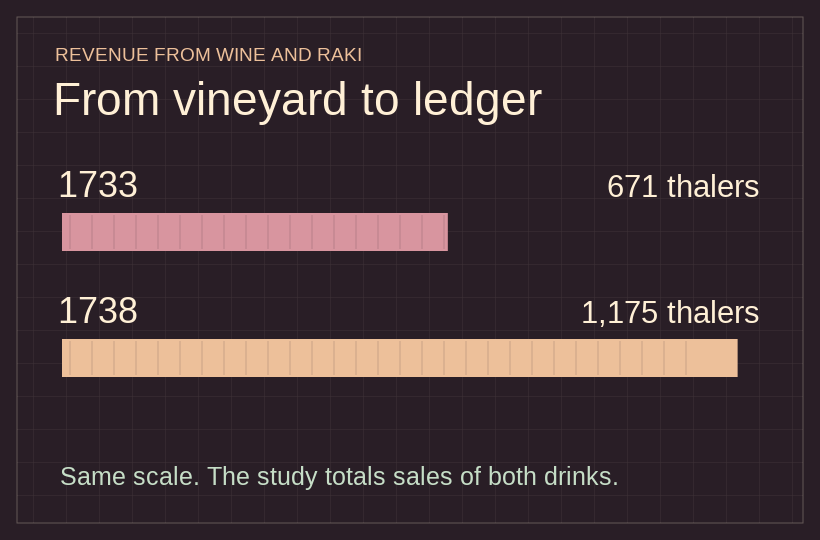
In 1733, sales of wine and distilled spirits brought in 671 thalers. In 1738 they brought in 1,175, as tabulated in the Romanian edition. Over the nine accounting years, drink sales brought in around 68% of recorded revenue. [3] [5]
On the same scale
What comes in and what goes out
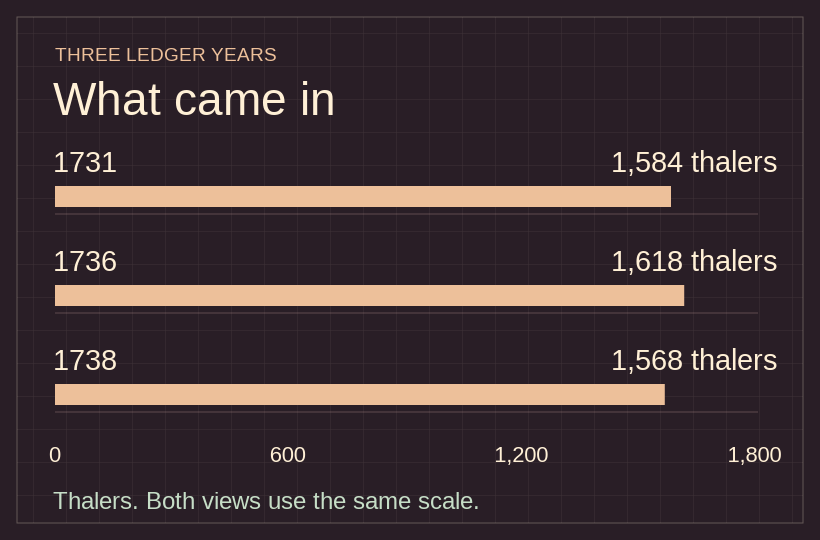
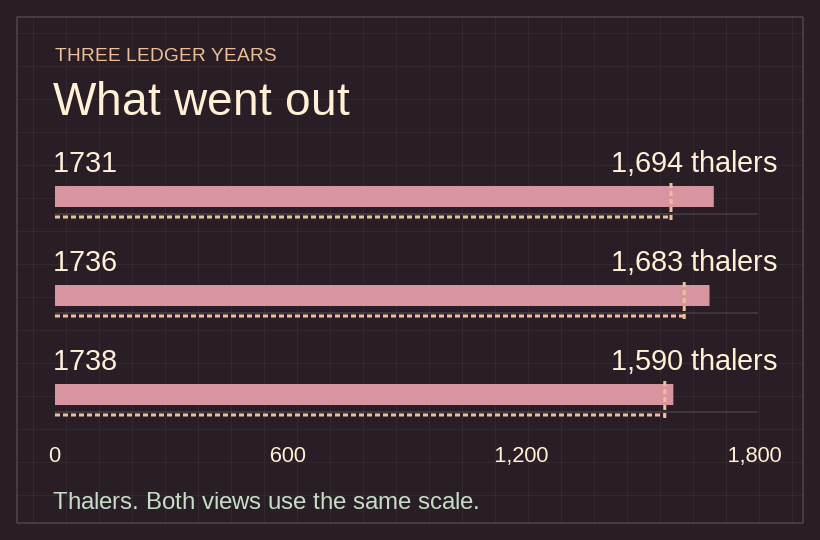
In 1736, the largest year by recorded revenue, 1,618 thalers came in. Recorded expenses that year reached 1,683. For 1731 and 1738 the displayed totals are 1,584 against 1,694, and 1,568 against 1,590. Switch views and follow the same three years. [2]
The gaps in the published accounts are about 110, 65 and 22 thalers, in that order. The ledger lets us compare recorded receipts and payments. It takes other documents to work out what reserves the monastery held or what its property was worth. [1] [2] In the expenses view, the dashed marks retain each year’s income. For 1737 another folio shows income above expenses. [5]
To the treasury
Some years put more pressure on the ledger
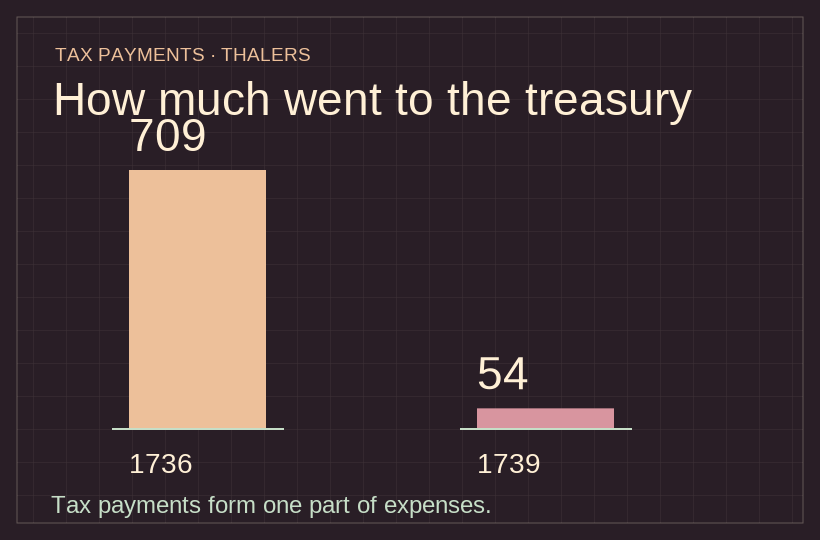
In 1736 the ledger records 709 thalers paid to the princely treasury. By 1739 the amount was 54. Taxes can be read separately from spending such as transport, labour and upkeep. [4]
The comparison spans a war that pitted Russia and Austria against the Ottoman Empire. The study associates some of the changes with war and fiscal policy. The ledger tells us how much Nucet paid in the two years. [4]
Within and beyond Wallachia
What the charter and payments tell us
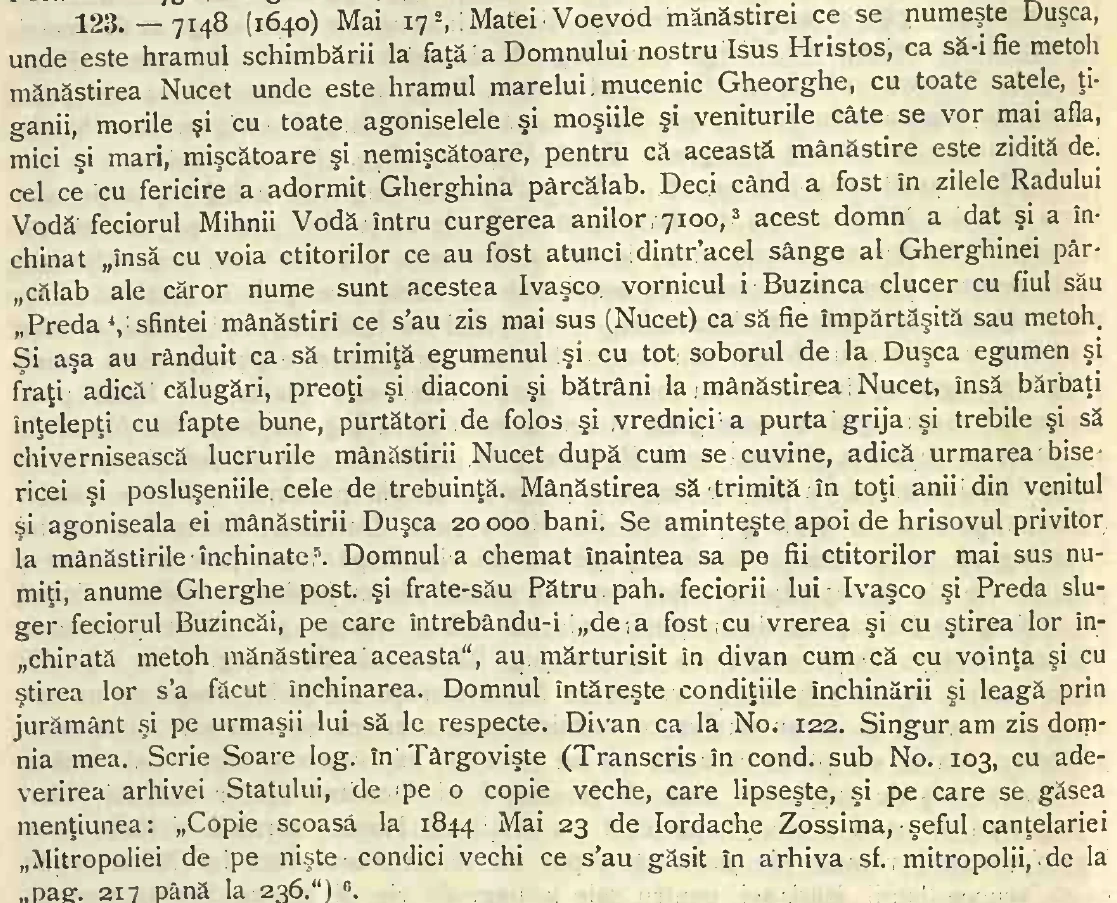
In May 1640, Matei Basarab confirmed the link between Nucet and Dousikou. The charter required an annual payment of 20,000 bani. Find the monastery’s name, the date and the amount in the archival summary. This obligation comes from a separate document and period from the payments in the ledger. [8] [4]
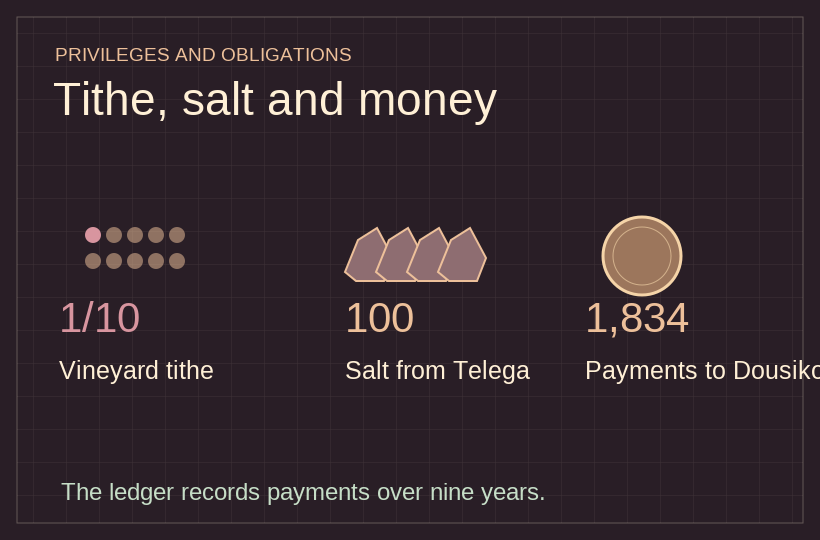
Nucet had been dedicated to Dousikou monastery in Rumelia. A dependent house of this kind was known as a metochion. Over the nine years covered by the accounts, the historian totals 1,834 thalers sent to Dousikou. The dedication and the rows of expenses together show what that relationship meant in cash. [4] [8]
Dionisie’s account
Who covered the difference?
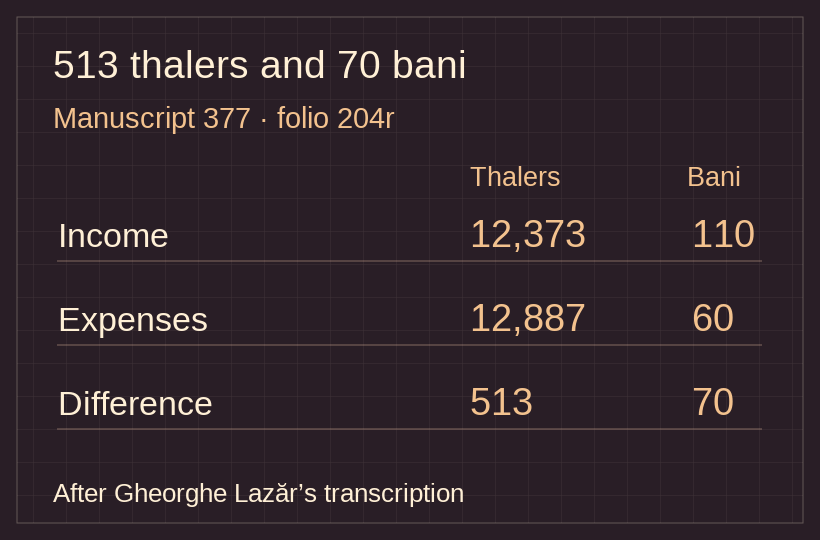
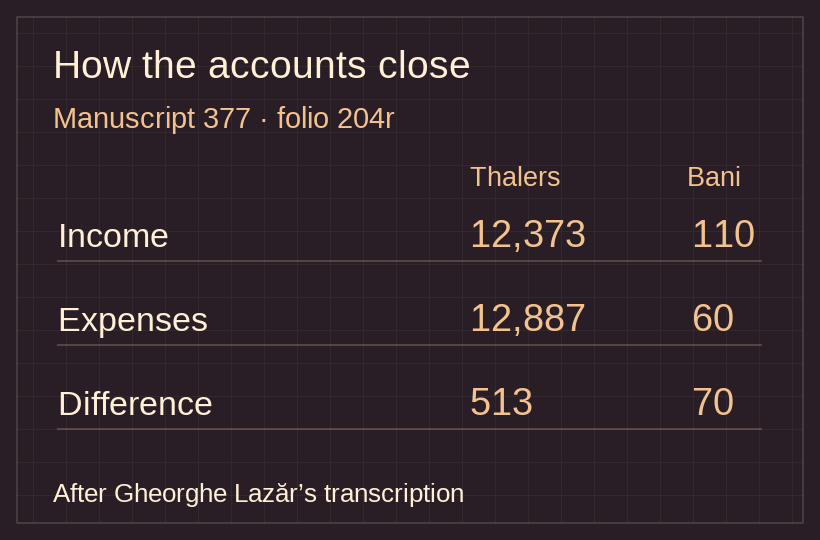
Folio 204r puts receipts at 12,373 thalers and 110 bani. Expenses came to 12,887 thalers and 60 bani. At 120 bani to a thaler, the difference is 513 thalers and 70 bani. These are the totals given by the document. [5]
Abbot Dionisie says he traded with his own resources and with the monastery’s revenue and spent the surplus on building work. That is the explanation he gives in the accounts. Lazăr’s edition preserves his statement where the sequence of sums ends. [5] [1]