MHCLG’s estimate for people sleeping rough on a single night in June.
HOUSING / ENGLAND · 29 AUGUST 2026
For local teams, councillors, reporters and readers interpreting rough-sleeping statistics.
One night sees less than half the month.
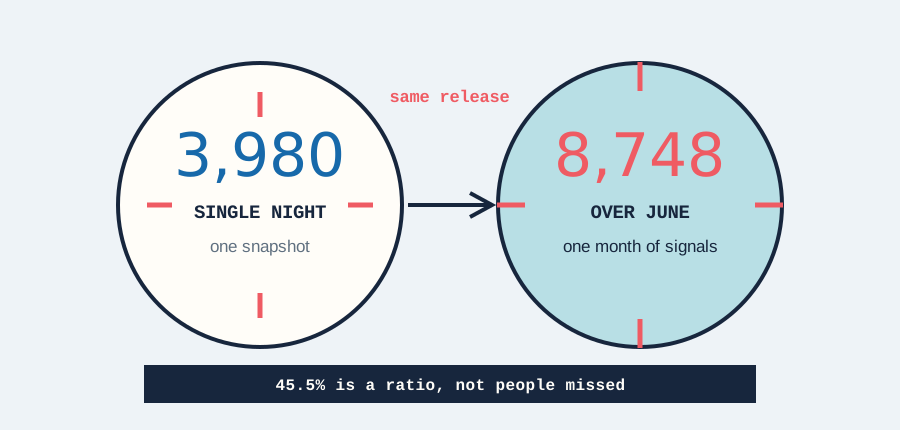
In June 2026, MHCLG estimated 3,980 people sleeping rough on a single night and 8,748 identified across the month. The one-night figure is 45.5% of the monthly figure, but the difference is not a count of people “missed”.
Short answerOne night is a snapshot; a month is a flow of signals. The estimates are not a person-by-person matched cohort and they are not a national census.
MHCLG · published 27 August 2026 · England · June 2026
TWO CLOCKS / 01
night / month
45.5%
estimatenot a cohort
01 / CONCLUSION
More time, more signals.
The monthly figure is larger because it identifies people at different points in June. The single-night figure answers a narrower question: who was estimated then?
People estimated to have slept rough at some point during June.
You cannot subtract one to obtain a number of people the snapshot “missed”.
02 / ARITHMETIC
45.5% is a ratio, not a cohort.
The arithmetic is simple and reproducible. The interpretation must be as precise as the denominator.
The single-night figure divided by the monthly figure.
Rounded to one decimal place; not a share of matched people.
8,748 ÷ 3,980, the monthly-to-night ratio.
What we do not calculate
4,768 is only the arithmetic difference between two measures with different grains. This page does not turn it into extra people, missed people, or an annual flow.
03 / THE CLOCKS
A snapshot and a month of observations.
Both measures use local identification work, but the time window changes the question the number can support.
On one night
See the people estimated to be sleeping rough that night, within the reported definition and coverage.
Across the month
Collect identifications made at different points across June.
The question left
How broad was local coverage, and how does the result change when missing returns are handled?
04 / MEASUREMENT SURFACE
The number comes with a method.
MHCLG describes the information as management data gathered mainly through outreach and sometimes through partner referrals.
| Window | Can say | Cannot say alone |
|---|---|---|
| One night | How many people were estimated that night. | How many people slept rough across the month or year. |
| One month | How many people were identified at some point in the reported month. | That every person can be linked to the single-night figure. |
| Both | An England estimate with published boundaries. | The causes, everyone without a safe place to sleep, or a national census. |
05 / LIMITS
Coverage changes what the number means.
The release says the information is subject to uncertainty, and quality depends on outreach coverage and local data systems.
Read the figures as estimates, not a complete count of every person.
The release describes seasonality and prefers comparisons with the same period in the previous year.
This page publishes no individual records and does not turn the figures into a person-level path.
The useful question for the next release
Not “how many were missed?” but “what time window and local coverage does this estimate describe?”
06 / PROVENANCE
An official release, read at its grain.
The copy used for checking is archived locally and has a SHA-256 digest. No personal or local-authority records were added.
Primary source
- Rough sleeping data framework, April to June 2026MHCLG · published 27 August 2026 · England data
- Publication packageRelease, data and methodology
Fact register
- Month
- June 2026
- Night
- 3,980 estimated
- Month
- 8,748 estimated
- Ratio
- 2.2× · not a cohort