Dogs and wolves
Puppy-dog eyes: a small muscle that dogs have and wolves mostly lack
A dog lifts the inner ends of its eyebrows and its eyes go wide and sad. The muscle that does it turned up in five of six dissected dogs and, as a separate muscle, in none of four wolves. Try it on the dog below: look at him, then turn your back.
 Drawn dog
A drawing, not a measurement. In 2017, 24 pet dogs lifted their inner brows about twice as often when a person faced them as when the person turned away; the researchers found no overall effect of showing food. Not every study finds this (see “How solid is it?”).
The small muscle behind the look
It is called the levator anguli oculi medialis, “the one that lifts the inner corner of the eye”. You do not need to remember it. What matters is what it does: it pulls the inner end of the eyebrow up, and the eye opening looks bigger and taller, as the researchers put it. The raised ends give the face a sad look, and the movement resembles one people make when they are sad. Try it in a mirror: lift only the ends of your eyebrows that are closest to your nose.
- 5 of 6
dissected dogs had a distinct muscle. In the sixth, a Siberian husky, it could not be found.
- 0 of 4
dissected wolves had a distinct muscle. They had only a few thin fibres in connective tissue, or a small tendon (Kaminski and colleagues, 2019).
The muscle is not a dog invention. Every one of ten coyotes dissected had it (Cunningham and colleagues, 2024), and the authors suggest it is an old trait of the dog family that grey wolves lost. It has also been reported in one African wild dog and in four South American canid species (twelve animals).
Who lifts the brows more, dogs or wolves?
In 2019 researchers filmed 27 dogs from British shelters and nine wolves from two wildlife parks for about two minutes each, while a stranger stood a few metres away. The typical dog (the median) lifted its inner brows 10 times in those two minutes, the typical wolf twice. Wolves also lifted them, less often and less strongly; only dogs made the strongest lifts.
Drawn pair: the wolf lifts less, and less often. The proportions are illustrative.
A 2025 study of eleven dogs and eleven wolves in Austria, all hand-raised, greeting people they knew, found the same direction: dogs held their inner brows up for longer.
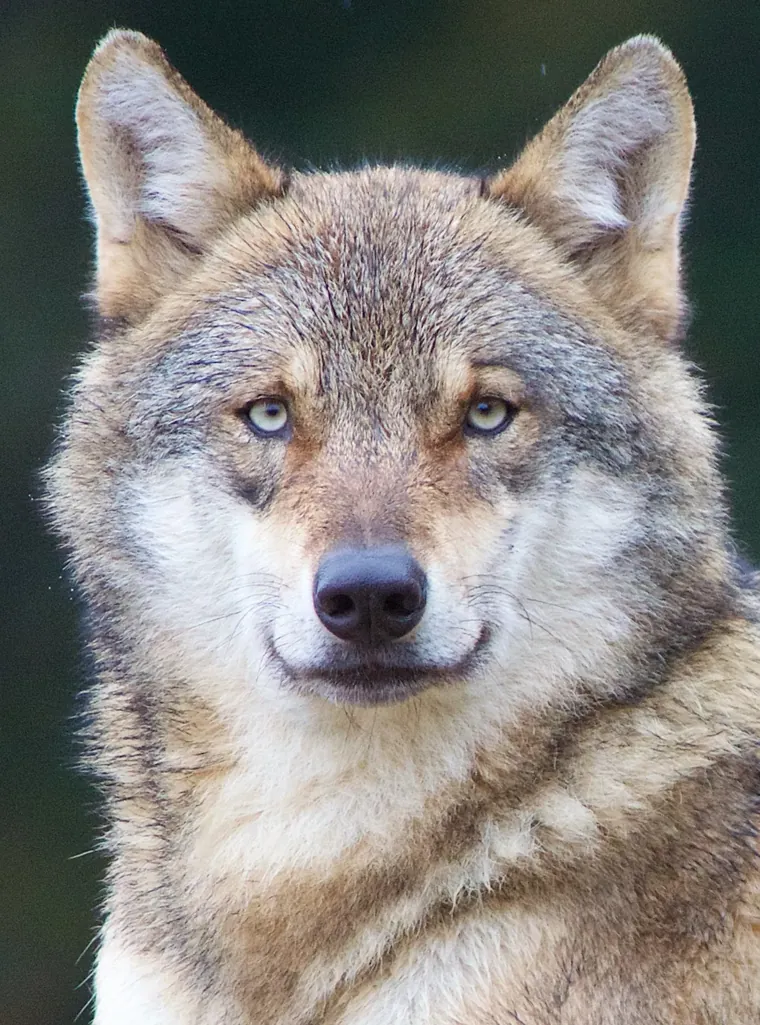
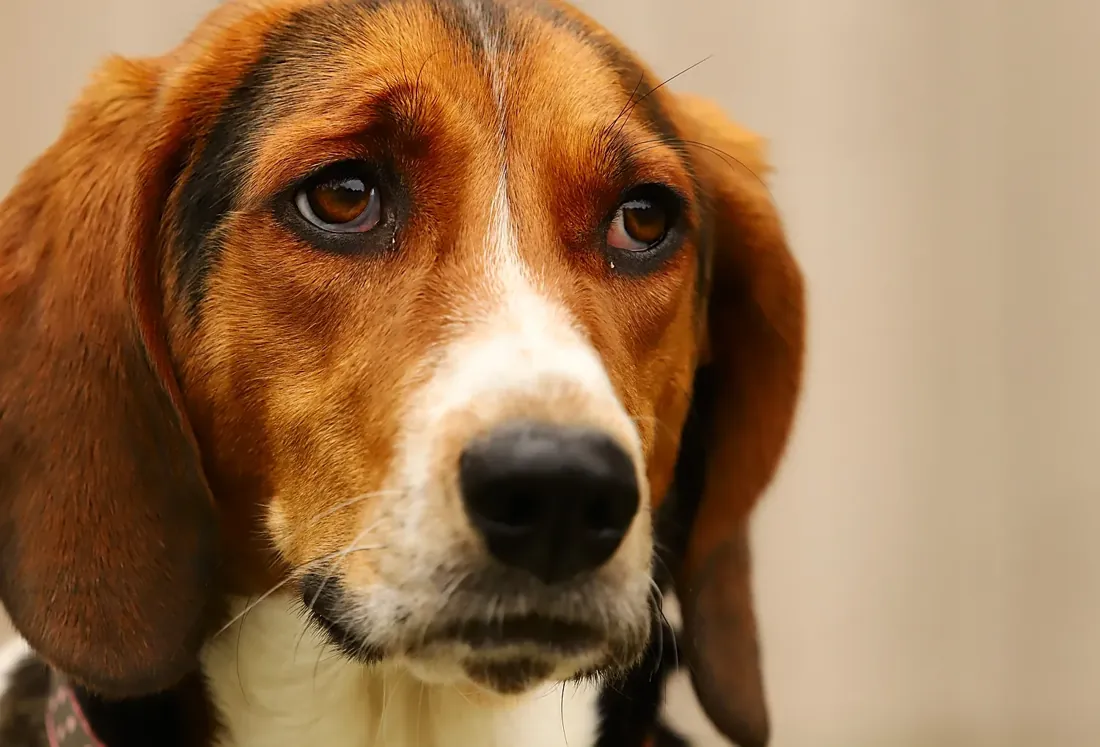
Photographs of single animals, not of an average.
Eight dogs, two minutes, one goes home with you
In 2013 a British team filmed shelter dogs for two minutes each and counted how often each lifted its inner brows; the published analysis uses 27 dogs, after two others were left out as outliers. Then they noted how many days passed from the dog being put up for adoption until it left the shelter.
The drawings are invented, and so is the timing of each lift. What is real is the record each drawing carries: the brow count and the days until leaving of one dog from the study. The eight records are spread evenly across the study’s counts. Watch the two minutes sped up to 24 seconds, then pick a drawing to see how long that dog stayed.
All 27 dogs analysed in the study
| # | Lifts | Days | Age (months) |
|---|---|---|---|
| 1 | 1 | 100 | 36 |
| 2 | 1 | 206 | 24 |
| 3 | 1 | 98 | 36 |
| 4 | 2 | 57 | 30 |
| 5 | 2 | 133 | – |
| 6 | 4 | 27 | 96 |
| 7 | 4 | 86 | 15 |
| 8 | 5 | 23 | 7 |
| 9 | 6 | 16 | 24 |
| 10 | 6 | 147 | 16 |
| 11 | 6 | 41 | 15 |
| 12 | 7 | 58 | 84 |
| 13 | 7 | 19 | 16 |
| 14 | 8 | 58 | – |
| 15 | 8 | 70 | 18 |
| 16 | 9 | 37 | 18 |
| 17 | 9 | 30 | 18 |
| 18 | 9 | 19 | 12 |
| 19 | 10 | 21 | 24 |
| 20 | 10 | 78 | 30 |
| 21 | 11 | 44 | 11 |
| 22 | 12 | 25 | 9 |
| 23 | 13 | 32 | 24 |
| 24 | 16 | 44 | – |
| 25 | 18 | 17 | 84 |
| 26 | 19 | 62 | 36 |
| 27 | 25 | 14 | 24 |
How solid is it?
What the studies can and cannot say.
The shelter result is small and shaky.
27 dogs, all of bull-type breeds, from four British shelters. The link between brow lifts and days until leaving is moderate (Spearman −0.50, p = 0.008) and, the authors write, would not survive a correction for multiple comparisons: “these exploratory findings should be taken with caution”. The five dogs that lifted their brows least (once or twice) stayed a median of 100 days; the five that lifted them most (13 to 25 times), 32 days. In between, the scatter above is wide.
Nobody asked the adopters why they chose.
The study measured the dogs, not the people. The authors list other explanations: adopters may have reacted to sadness, or to the white of the eye that shows when the brows lift, rather than to a baby-like look. We found no study that shows people photographs of dogs differing only in this movement and measures what they choose.
The 2013 and 2019 dogs may overlap.
The 2019 paper also filmed 27 dogs from British shelters for two minutes each, the same way as in 2013. It does not say whether they are the same dogs, so read the two as possibly one sample, not two independent confirmations.
Four wolves is a small number.
The anatomy rests on six dogs and four wolves, two of the wolves from Michigan, a region where, the authors of the coyote study note, species of Canis interbreed. The 2019 paper has no section on its own limits, and its text describes the wolf muscle in different ways (scant fibres, a tendon, “never present”) and calls the muscle “uniformly present” in dogs although one husky lacked it. Its dogs were filmed in shelter kennels and its wolves in parks, so the two groups did not live under the same conditions.
“Made for humans” is a hypothesis.
The 2019 authors call it a hypothesis: dogs with expressive eyebrows had a selection advantage. Since then the muscle has turned up in coyotes and other wild canids. In a 2021 study of 21 Labradors (one a cross), the movement went with eye movements and was more frequent when the reward came from a machine than from a person facing the dog; a person sat nearby in both conditions. A 2022 study found no audience effect on it. In the 2017 study almost every facial movement rose a little when the person was attentive (blinking did not), so the brows were not the only thing that changed, though they changed most.
And the long look?
A 2015 Japanese study reported that when dogs and owners gazed at each other for a long time, oxytocin rose in both, but not with hand-raised wolves. Other researchers re-analysed the data and found a larger effect of the owner’s sex and no statistically significant dog-versus-wolf interaction in the owners’ response. It is a story about gaze, not brows, and it is still open.
And in Romania?
The reports we searched give adoption totals but no figures on how long dogs wait in shelters, and we found no Romanian study linking waiting time to brow lifts. The numbers that exist are about adoptions. ANSVSA, Romania's veterinary authority, reported that more than 65,000 dogs were adopted from Romanian shelters in 2024, against more than 48,500 in 2021; it did not publish its method. Bucharest's municipal shelters (ASPA) rehomed 2,047 dogs in 2025, about 40% more than in 2024, and 276 of them found a family at adoption fairs.
Questions people ask
Why do dogs have puppy-dog eyes?
A small muscle lifts the inner end of the eyebrow, which makes the eyes look bigger and sadder. Researchers think people may have favoured dogs that did it, but that is a hypothesis: coyotes have the muscle too.
Do wolves have puppy-dog eyes?
Wolves can lift their inner brows, less often and less strongly than dogs. In the 2019 dissections of four wolves the muscle was not found as a separate muscle.
Do dogs with puppy-dog eyes get adopted faster?
In one 2013 study of 27 British shelter dogs, those that lifted their inner brows more often left the shelter sooner on average. The study was small and exploratory and cannot show cause.
Sources
Everything on this page rests on these papers and reports. Each number was checked against the text.
- Kaminski J, Waller BM, Diogo R, Hartstone-Rose A, Burrows AM (2019). Evolution of facial muscle anatomy in dogs. PNAS 116(29): 14677–14681. doi:10.1073/pnas.1820653116 — 6 dogs and 4 wolves dissected; 27 dogs and 9 wolves filmed; medians 10 and 2.
- Waller BM, Peirce K, Caeiro CC, Scheider L, Burrows AM, McCune S, Kaminski J (2013). Paedomorphic facial expressions give dogs a selective advantage. PLoS ONE 8(12): e82686. doi:10.1371/journal.pone.0082686 — 27 shelter dogs; brow lifts and days before leaving; raw data file (CC BY 4.0).
- Kaminski J, Hynds J, Morris P, Waller BM (2017). Human attention affects facial expressions in domestic dogs. Scientific Reports 7: 12914. doi:10.1038/s41598-017-12781-x — 24 pet dogs; person facing or turned away, with or without food.
- Cunningham P, Shankar M, vonHoldt B, Brzeski KE, Kienle SS (2024). Coyotes can do ‘puppy dog eyes’ too. Royal Society Open Science. doi:10.1098/rsos.241046 — The muscle in 10 of 10 coyotes.
- Capitain S, Wirobski G, Önsal Ç, Pedretti G, Bevilacqua V, Marshall-Pescini S, Range F (2025). Differences in dogs’ and wolves’ human-directed greeting behaviour. Animal Cognition 28. doi:10.1007/s10071-025-01978-7 — 11 dogs and 11 wolves, all hand-raised; dogs held the inner brow raise longer.
- Bremhorst A, Mills DS, Stolzlechner L, Würbel H, Riemer S (2021). ‘Puppy Dog Eyes’ Are Associated With Eye Movements, Not Communication. Frontiers in Psychology 12: 568935. doi:10.3389/fpsyg.2021.568935 — 21 Labradors (one a cross); the movement went with eye movements and was more frequent when no person faced the dog.
- Pedretti G et al. (2022). Audience effect on domestic dogs’ behavioural displays and facial expressions. Scientific Reports 12: 9747. doi:10.1038/s41598-022-13566-7 — No audience effect on the inner brow raiser.
- Sexton CL, Diogo R, Subiaul F, Bradley BJ (2024). Raising an Eye at Facial Muscle Morphology in Canids. Biology 13(5): 290. doi:10.3390/biology13050290 — The muscle is not unique to dogs (coyotes, other canids).
- de Souza-Junior P et al. (2026). Beyond Domestication: Occurrence of LAOM and RAOL in Four Neotropical Canid Species. Anatomia, Histologia, Embryologia 55: e70121. doi:10.1111/ahe.70121 — The muscle in 12 specimens of four South American canid species.
- Smith HF, Felix MA, Rocco FA, Lynch LM, Valdez D (2024). Adaptations to sociality in the mimetic and auricular musculature of the African wild dog. Anatomical Record 307: 3327–3343. doi:10.1002/ar.25441 — The muscle in one African wild dog.
- Nagasawa M et al. (2015). Oxytocin-gaze positive loop and the coevolution of human-dog bonds. Science 348: 333–336; re-analysis: Kekecs Z et al. (2016), Frontiers in Neuroscience 10: 155. doi:10.1126/science.1261022 — Gaze and oxytocin; the re-analysis (10.3389/fnins.2016.00155).
- ANSVSA (3 Apr 2025). Romania records progress in managing stray dogs. www.ansvsa.ro — More than 65,000 dogs adopted in 2024; more than 48,500 in 2021.
- ASPA Bucharest (2026). Activity report for 2025. aspa.ro — 2,047 dogs adopted in 2025; 276 at adoption fairs.
How the numbers were made
The scatter and the row of dogs use the authors’ own data file for the 2013 study (Raw Data S1, CC BY 4.0): 27 dogs, brow lifts counted in two minutes and days from being put up for adoption until the dog left the shelter. Recomputing it gives the paper’s own results (Spearman −0.50, curve 114.12 × lifts to the power −0.515). The eight dogs in the row are picked by rank of brow count (spread evenly by rank, from the fewest lifts to the most, roughly every fourth dog), not by their outcome, and are shuffled onto the drawings at random each time. The visit is sped up five times. The two dogs the authors left out as outliers are not in the data file. Wolf and dog drawings are invented; how often and how far the drawn dogs lift their brows is illustrative.
Photographs
- Hound: Richard Probst – Shot in a Frame (Dog Light Photography), CC BY 2.0, via Wikimedia Commons (File:Sad eyes^ Explore March 18, 2023 - Flickr - Dog Light Photography.jpg). creativecommons.org/…
- Wolf: Raoul Feignoux, CC BY-SA 4.0, via Wikimedia Commons (File:Loup portrait.jpg). creativecommons.org/…
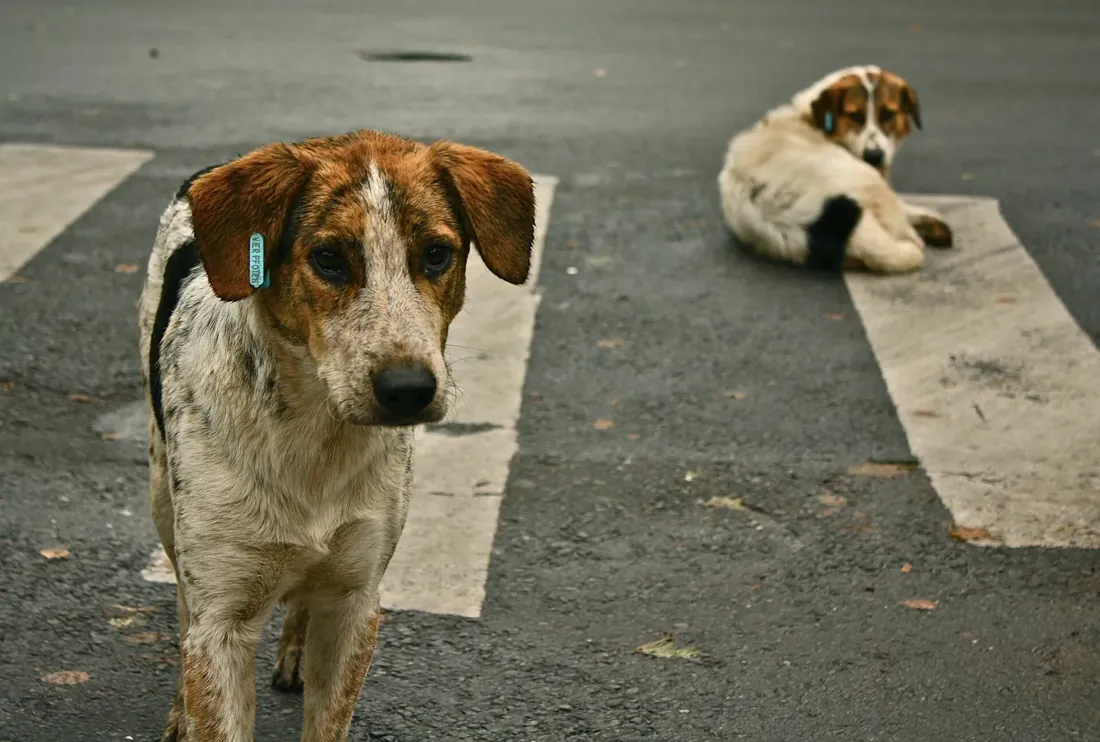
- Bucharest dogs: Columbo222, CC BY-SA 3.0, via Wikimedia Commons (File:Stray dogs crosswalk.jpg). creativecommons.org/…