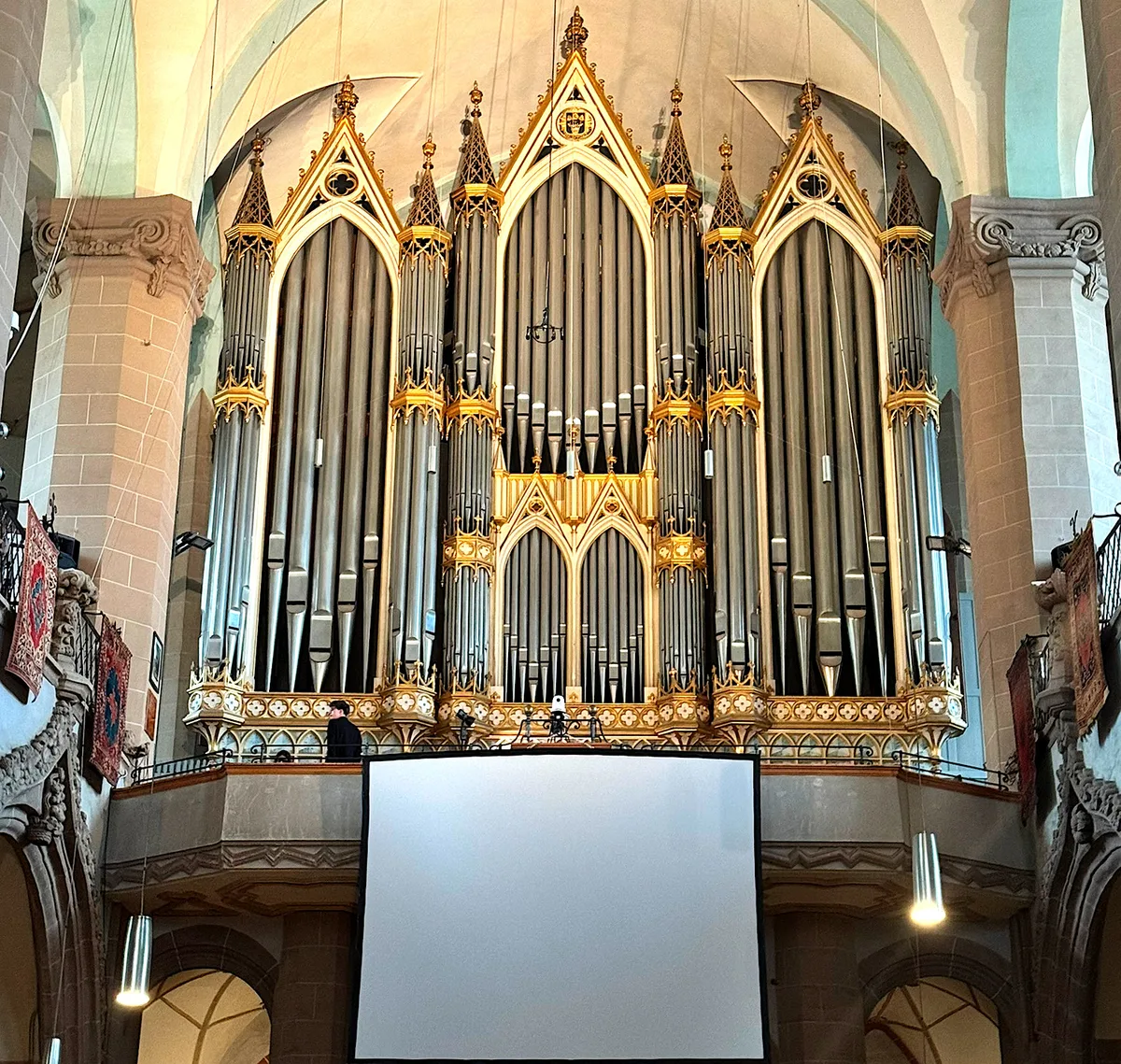
The organ has stood on the west gallery of the Black Church, the Lutheran church of Brașov, since April 1839. The Berlin organ builder Carl August Buchholz built it between 1836 and 1839. The parish data sheet lists four manuals, a pedal and 62 stops; other databases count 63, with an extra Violino 8′. It is the largest organ with mechanical action in Romania.
The gallery parapets carry Ottoman rugs from one of Europe’s richest collections. They are part of how the room sounds.
From the nave you see the neo-Gothic case: six round towers, three flats under pointed arches, gilded gables with rosettes and finials. The front pipes are polished metal, with their mouths turned to the church.
Inside one of them is written the name of Heinrich Maywald, one of Buchholz’s pupils. The longest front pipes measure, on the photograph, about 6.5 metres from mouth to top. If they speak, an open pipe that long sounds at about 26 hertz, close to the bottom edge of hearing.
The description of the instrument splits it by floor. At the bottom, at the sides, stands the pedal, with the tallest pipes. On the middle floor, at the front, is the Oberwerk, with a direct sound. Behind it, shut in a box, is the Unterwerk, which sounds like an echo. At the top, at the front, is the Hauptmanual; behind it, also enclosed, the Rohrwerk, which sounds from further away.
The parish sheet numbers the manuals I to IV, without names. The Sonus Paradisi stop list gives the names, and the stops agree: the third, with the trumpet, the bassoon and the clarinet, is the Rohrwerk; the fourth, with only soft stops, is the Unterwerk.
Tap a floor to hear it alone.
Foundthe case and front, from photographs: polished metal, gold, white
Deducedthe pipes inside, at the length their pitch requires: matte metal
Assumedwhere each row of pipes stands: a ghost outline
In a pipe open at both ends, the fundamental has a wavelength of about twice the pipe’s length. So its length is roughly the speed of sound divided by twice the frequency. The lowest C of the pedal’s 32-foot Principal is 16.4 hertz, and the calculation gives about 10.4 metres.
Each octave up halves the pipe: 5.2 metres, then 2.6, then 1.3, down to a few centimetres. The feet in a stop’s name (32′, 16′, 8′) are the nominal, rounded length of its lowest pipe: 32 feet is 9.75 metres. A pipe stopped at the top sounds an octave lower than an open one of the same length. That is why the Untersatz 32′ reaches the same note with pipes half as long.
The console is set into the base of the case, with the stops in two jambs, left and right. Everything is mechanical: every key and every stop works directly, through rods and levers. Buchholz used wedge-shaped sliders, Keilschleifen. They are how his organs, and those of his pupils, are recognised.
Four chorales can be heard here in Bach’s settings, among them “Ein feste Burg ist unser Gott”, to a tune by Martin Luther.
The sheet also records that two stops were replaced and two mixtures changed in 1966. In 2001 the original pipes were put back, and the organ now has only four new pipes.
Four chorales
Johann Sebastian Bach’s four-part settings: soprano, alto and tenor on a manual, the bass on the pedal, each chorale with its own stops. Tap again to stop.
Play it yourself
Computer keyboard: the A–L row (W, E, T, Y, U, O, P for sharps).
* The sheet gives mixtures only by their number of ranks. The make-up used here is assumed.
The organ has been described as an instrument “in between the times”. It keeps the Baroque structure of foundation stops, mutations and mixtures, but its colours are Romantic: 8-foot stops dominate, and the divisions have whole families of flutes, principals and strings. The stops blend so well that no single stop dominates the full organ.
Listen as they are added in steps, from an 8-foot Rohrflöte and a pedal Subbass to all 62 stops. The chords were written for this page and are not a piece from the repertoire.
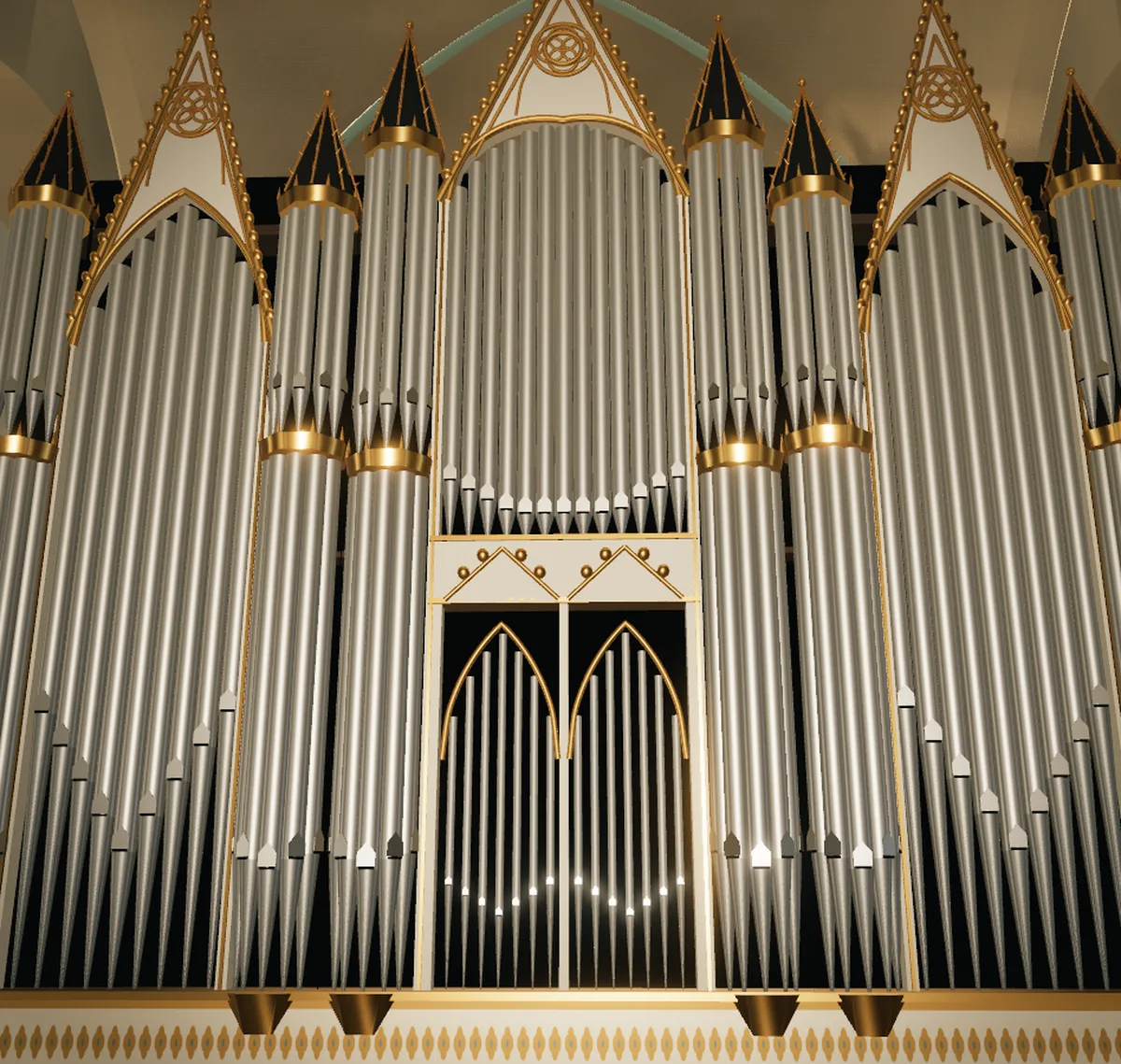
The photograph the front is drawn from. Photo: Peterwchen, CC BY 4.0, Wikimedia Commons.The reconstruction, from the same angle.
How exact the reconstruction is
The church and the case are drawn from photographs, not from a survey. The case is taken to be 12.6 metres wide, and the other dimensions follow from the frontal photograph at 82 pixels to the metre. The margin of error is about 15%. The length of the front pipes is known the same way: about 6.5 metres, give or take one.
The front is copied element by element from the photograph: towers, flats, arches, gables, friezes. The number of pipes in each tower is simplified to five per tier.
The pipes inside are given the length calculated for a speed of sound of 340 metres per second. Their diameter halves every 16 notes, a proportion rule assumed here. The sheet does not say how many keys each manual has. If the manuals have 54 each and the pedal 27, an assumption, the stop list means at most 3,800–3,900 pipes. On the same assumption the real number would be somewhat lower, because some stops do not run the whole compass: the Cornett starts only at g.
Where the rows of pipes stand on their chests is assumed, from the description by floor. Pipes too tall for the case are shortened in the drawing; in reality such pipes are mitred (bent).
The sound is a model built from the stop list, with no recording of the organ. Each stop has the usual colour of its family (principal, flute, string, reed). The church’s reverberation, about 4.6 seconds, is assumed, not measured.
The light is that of an October morning, with the sun in the south-east, 24 degrees above the horizon. The hour was chosen for the picture, not calculated.