Chatsworth and London, 1849–1851
The Crystal Palace
In November 1849, a giant waterlily leaf at Chatsworth held an eight-year-old girl. The gardener who weighed it sketched on blotting paper, at Derby, the most extensive building in Europe — and over six million people walked through it. Load the leaf yourself, until it holds Annie.
Sound starts as you scroll; you can stop it any time.
The leaf that holds
Chatsworth, August 1849
Kneel by the tank in the hothouse at Chatsworth, in August 1849. A seedling of the giant waterlily had arrived from the Royal Gardens at Kew on 3 August; on 10 August it was moved into the tank — a twelve-foot square, with a hillock of prepared soil in the middle.
In 79 days its leaves had filled a tank 18 feet 8 inches by 19 feet 1 inch — 647 square inches a day, “the most remarkable instance of the rapidity of vegetable development we have on record”.
9 November 1849
On 9 November the first flower opened — “a yard in circumference”; within about a month the seeds had ripened, and by 16 February 1850 young plants were already up.
Early in November, with leaves four feet eight inches across, the gardener wanted to know what they would bear. He placed his eight-year-old daughter, all of 42 pounds (19.1 kg), on a leaf — on a copper lid of 15 pounds to equalize the pressure — 57 pounds (25.9 kg) together. “This weight the leaf bore extremely well” — as did several others, four feet two inches to four feet nine inches across.
The Chatsworth account never names the girl; the name comes from Douglas Jerrold's poem — “to Miss Annie Paxton, who drest as a fairy, stood upon a leaf of the Victoria Regina” — and from the Illustrated London News engraving's caption: Annie, Paxton's daughter.
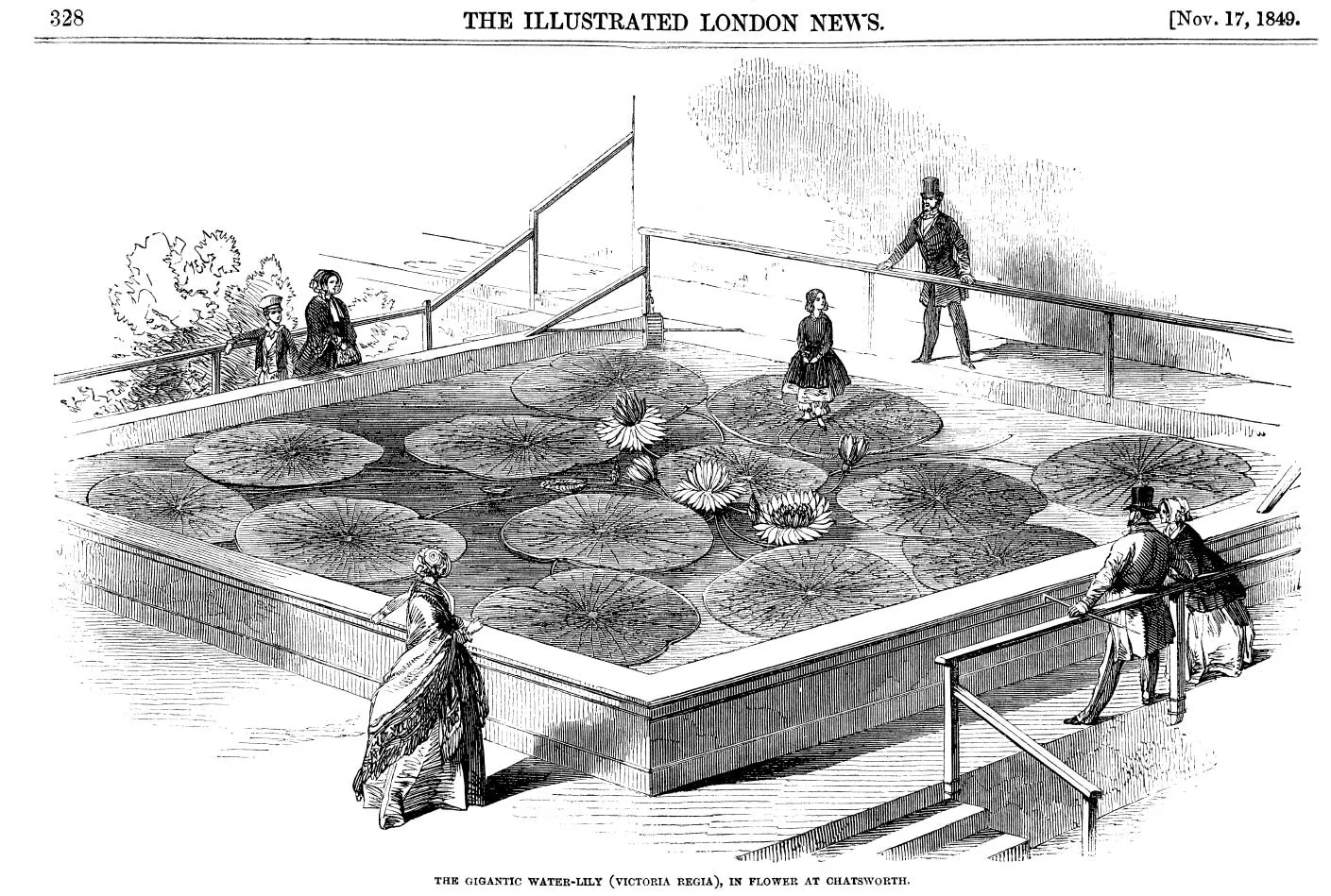

May 1850
Early in May a leaf of about five feet (1.52 m) was moved into the brook by the gardens, with a very light circular trellis laid over it to spread the weight. 112 pounds (50.8 kg) it bore “for some minutes before any water flowed upon it”; then a man of upwards of ten stone (140 pounds, 63.5 kg), for two or three minutes; then a person of eleven stone (154 pounds, 69.9 kg), “for nearly the same time”. Afterwards, ladies and gentlemen from eight to eleven stone.
Kew says the same today: leaves carry over 40 kg at 1.5 m wide.
Load the leaf
Hold the button down: the weights pile onto the leaf in the order of the Chatsworth trials. Holding the space bar works too.
The leaf floats empty
The rib underneath holds it all: eight main ribs with arched cross ties. Wills would write that “the first parent of the most extensive building in Europe was the largest known floral structure in the world”.
From underneath, the leaf is a structure: eight main ribs diverging from the stalk, strengthened by arched cross ribs and ties, the margin turned up two to four inches — and between the ribs so thin that “a straw falling perpendicularly from five feet would penetrate its substance”. At the Society of Arts, on 13 November 1850, Paxton described the leaf as a girder — cantilevers “nearly two inches deep”, with cross girders between them — as a secondary study from 2010 quotes him.
The Victoria Regia house — sixty feet by forty — was “the immediate precursor of the gigantic structure in Hyde Park”. The man behind it: “Mr. Paxton, the celebrated horticulturist of the Duke of Devonshire's celebrated Chatsworth”. Scroll on: the leaf stays behind, the rib goes further.
The Derby blotting paper
June 1850
One morning, at an early sitting of the House of Commons, with his friend Ellis, the idea of sending in a design of his own came to him: “if you will introduce such a clause, I will go home, and, in nine days hence, I will bring you my plans all complete”. So Paxton told it later, at the Derby Institute, as Walford quotes him.
Derby, June 1850
At Derby, chairman of the Midland Railway's Works and Ways Committee, trying an offending pointsman — before him, a virgin sheet of blotting paper. “This is not a draft of the pointsman's case, but a design for the Great Industrial Building to be erected in Hyde Park”: elevations, sections, working details and specifications, complete in ten days.
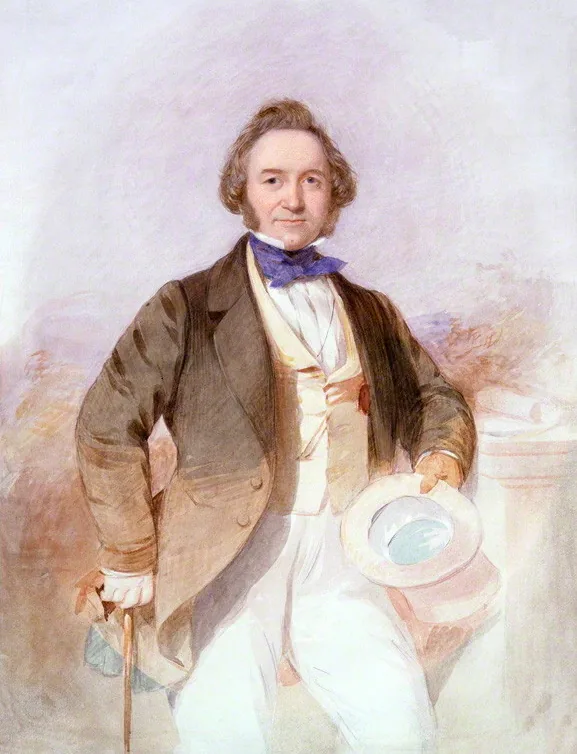

Nearly two hundred and fifty plans had come in and none had satisfied; the committee had drawn a design of its own, with a dome of gigantic proportions — unpopular. Paxton's design won the public through the Illustrated London News, and the committee rejected its own and recommended his unanimously. Stephenson examined his plans on the train; Brunel brought the measurement of the trees the next morning.
16 July 1850
On 16 July, the tender of Fox and Henderson for Paxton's design — £79,800 — was verbally accepted; on 30 July they took possession of the site. The rival tenders asked between £120,000 and £150,000 for the use only of the materials. Scroll on: the first column rises.
The building site
26 September 1850
The first column was raised on 26 September 1850; by 1 May 1851 everything was complete — “erected and finished in seven months”, from the first column to the opening.
The plan, after Berlyn: a parallelogram 1,848 feet by 408 (563 by 124 metres), besides a north projection 48 by 936; the main avenue 72 feet wide and 66 high; the transept 72 by 108 — set where “a row of large trees, which it was resolved to inclose”. 772,784 square feet, about 19 acres.
The Commissioners' address of May 1851 gives the extreme measure: 1,851 feet long and 456 in extreme breadth, more than eighteen acres, room for 40,000 visitors, with more than ten miles of frontage. Two measures, two sources — never mixed here.
The transept enclosed “a row of fine old elm-trees”; two further groups of trees remained as open courts, under the sky.
The greater part of the glass came from Chance & Co. of Birmingham: squares 49 inches by 10 — “the greatest length of sheet glass that has ever been made in this country”. 293,655 panes, 400 tons, blown by hand in 39 weeks at Spon Lane, Smethwick.
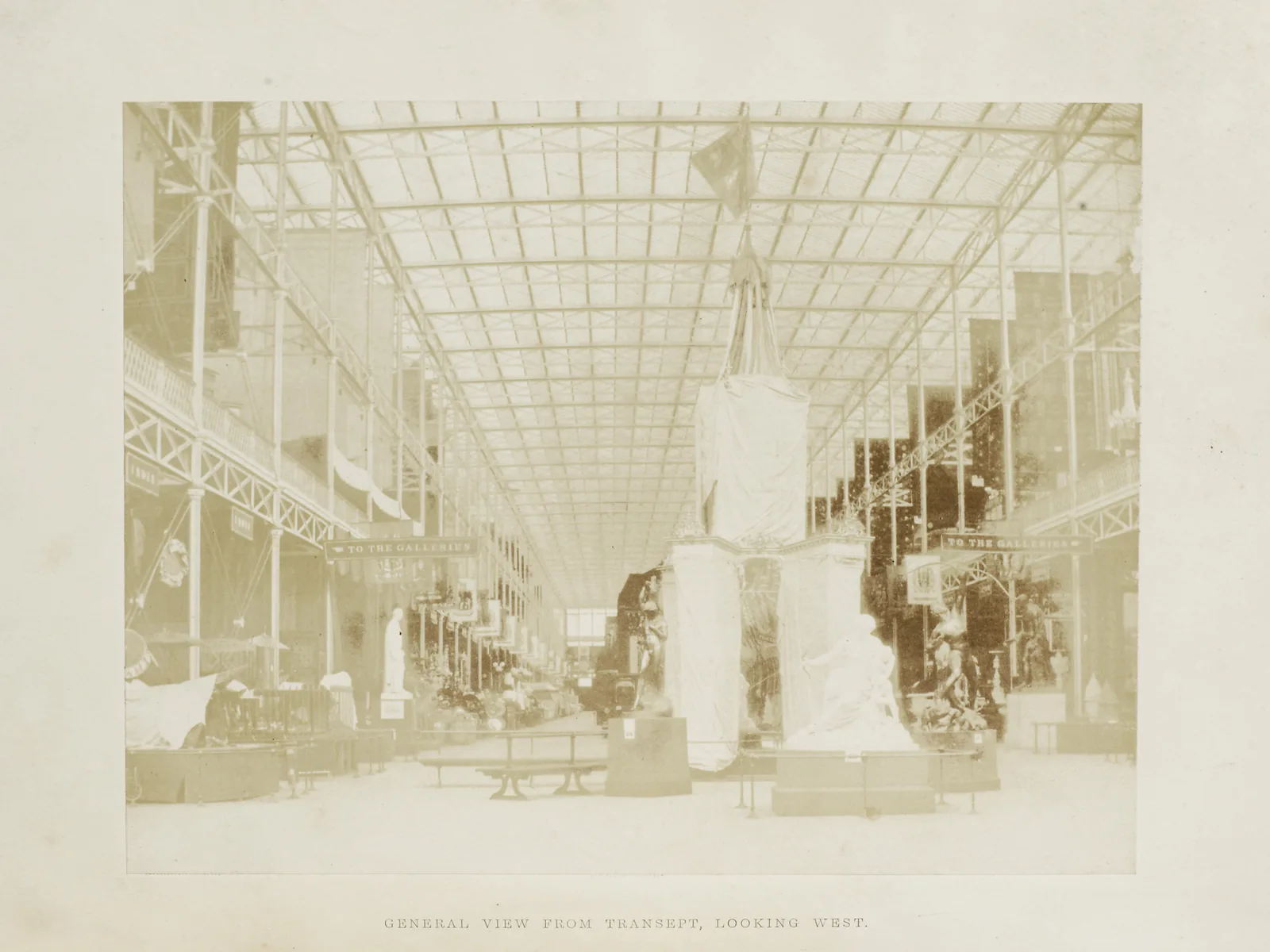

Over six million people
1 May 1851
The exhibition opened on 1 May 1851 — Queen Victoria herself, in person.
The V&A keeps the building's account: 3,300 supporting columns, 2,224 principal girders — 3,800 tons of cast and 700 tons of wrought iron; 600,000 cubic feet of timber, 205 miles of glazing bar and 900,000 square feet of glass.
In 141 days, 6,039,195 people, at a daily average of 42,831. Approximately 14,000 exhibits, in four main classes, from 8,200 exhibitors.
Among the curiosities: the famous Koh-i-noor, the “Mountain of Light”, “specially lent by Her Majesty… one of the greatest curiosities of the Exhibition”.
11 October 1851
The exhibition closed on 11 October 1851 — the date on which both sources agree.
The numbers
The palace's accounts come from hands that must not be mixed: the V&A gives the iron frame and the glass, Berlyn gives the measure in feet, the Commissioners give the extremes. Touch each number: it answers with its source attached.
Touch a number and read its full reserve
Each note repeats the numbers, the source and the ambiguity, because you may open only one.
The columns: 3,300 supporting columns and 2,224 principal girders — the V&A's account of the Hyde Park frame. Same V&A, same account: 600,000 cubic feet of timber and 205 miles of glazing bar.
Opened 1 May, closed 11 October: 141 days, 6,039,195 people — and the building, taken down piece by piece, went south.
The hill
Between 1852 and 1854 the structure was dismantled and rebuilt on Sydenham Hill; it was gone from Hyde Park altogether before the close of 1852 — on a 300-acre estate, “raised again in increased grandeur and beauty”.
On the night of 30 November 1936 the palace was devoured by the flames in a matter of hours.
The glass went in a single night. The hill is still called Crystal Palace.
The mechanism, in short
In August 1849 a seedling of the giant waterlily came from Kew to Chatsworth; in 79 days it filled its tank, and on 9 November the first flower opened. Early in November a four-foot-eight leaf held an eight-year-old girl — 42 pounds on a 15-pound copper lid, 57 together — and in May 1850 a five-foot leaf, moved into the brook, bore 112 pounds, then a man of upwards of ten stone and a person of eleven stone. The girl was Annie, Paxton's daughter — after Jerrold's poem and the engraving's caption.
The gardener who weighed the leaf sketched, at Derby, in June 1850, on a sheet of blotting paper, the design of the great industrial building: ten days from idea to plans. Nearly two hundred and fifty rival designs had satisfied nobody; Paxton's won the public through the Illustrated London News. On 16 July the tender of Fox and Henderson — £79,800 — was verbally accepted; on 30 July they took possession of the site.
The first column rose on 26 September 1850; by 1 May 1851 all was complete — seven months, from the first column to the opening. Berlyn's plan — 1,848 by 408 feet, the 108-foot transept over the elms — and the Commissioners' extremes — 1,851 by 456, 40,000 visitors — are never mixed here. The glass, mostly from Chance of Birmingham, meant 293,655 panes in 39 weeks. The exhibition ran 141 days, for 6,039,195 people, and closed on 11 October.
Between 1852 and 1854 the palace was taken down and rebuilt on Sydenham Hill. On the night of 30 November 1936 it was devoured by the flames in a matter of hours. The glass went in a single night. The hill is still called Crystal Palace.
Sources and method
Every number carries its unit and its source, and measures from different sources are never merged: Berlyn's plan (1,848 by 408 feet, the 108-foot transept) stands beside the Commissioners' extremes (1,851 by 456, 40,000 visitors), and the frame is the V&A's account (3,300 columns, 2,224 girders, 3,800 plus 700 tons of iron). The weights on the leaf always come with their leaf and their conditions: the copper lid, the trellis in the brook, the water flowing over the edge, the minutes.
The tank, the leaf, the ribs and the palace are drawn illustratively; the rib-to-girder passage is an illustration, labelled as such. The leaf panel is illustrative, not a simulation: its readout speaks Allen's trial stages — Annie, 112 pounds, ten and eleven stone — and never grams beyond Allen. The three pictures are the true witness: the Illustrated London News engraving of 17 November 1849, Octavius Oakley's portrait of Paxton from around 1850, and Talbot's calotype from the transept, of 1851 — all public domain, each credited beside it.
All sound is recorded, licensed and transcribed: the Romanian bed is a CC0 trickling stream, the English bed is public-domain rain against a window, both certified speech-free (faster-whisper empty on both; Vosk empty on the trickle, one spurious “huh” on the rain) and level-matched to 0.2 dB. The honest level is the one in the file; Boost adds about 12 dB. The strain of the loaded leaf is born on the spot from the same bed, through a lowpass stage — no separate recording. The sound button pauses the recording; it never merely mutes it. No human ear has checked the sound beds yet — the real-phone listen stays open.
What was not read is not cited: the rival accounts of days, visitors and exhibitors, the money from other accounts, the Sydenham reopening, the Derby weekday, the variants of the girl's name, the St Paul's ratio and the Chatsworth archive pages (untouchable that day). Every number that carries weight is carried by the sources below.
- The V&A, object O111683, “The Great Exhibition” — the palace as a “huge glass and iron structure”, the frame, the 141 days and the 6,039,195 visitors (full text) collections.vam.ac.uk
- J. F. Allen, “Victoria Regia” (1854) — the Chatsworth account: the seedling's arrival, the growth, the weight trials, the ribs (full text) victoria-adventure.com
- W. H. Wills, “The Private History of the Palace of Glass”, Household Words, 18 January 1851 — the Derby blotting paper, the Victoria Regia house (full text) archive.org
- P. Berlyn, “The Crystal Palace, its architectural history and constructive marvels” (1851) — the tender, the measures, the glass (full text) archive.org
- E. Walford, “The Great Exhibition of 1851”, Old and New London, vol. 5 (1878) — the Derby speech, the 250 plans, Sydenham (full text) british-history.ac.uk
- BIE Paris, “30 November 1936: the destruction of the Crystal Palace” (2016) — Sydenham 1852–54, the night of 30 November, the 11 October closing (full text) e.bie-paris.org
- Kew, “Hidden Histories” — leaves today carry over 40 kg at 1.5 m wide (full text) kew.org
- The Blanche Paxton album (Romantic Circles ed., Harvard) — Jerrold's poem to Annie Paxton (full text) romantic-circles.org
- The Crafts Council — the 293,655 Chance panes, 400 tons, 39 weeks at Smethwick (full text) craftscouncil.org.uk
- Wikimedia Commons — the ILN engraving (public domain); the Oakley portrait (public domain); the Talbot calotype (public domain); the CC0 trickle; the rain (public domain) commons.wikimedia.org