Marius ComperCălimănel valley · Suceava
Română

Panaci · a local history of schooling

Panaci and the petition for a school

In October 1891, 113 residents of Panaci asked the state for a school. Vasile Agachi began teaching on 1 December. A local monograph reviewed by historian Bogdan Teodorescu follows the first classes, adult literacy lessons and how regularly children got to school.

Start with the petition ↓
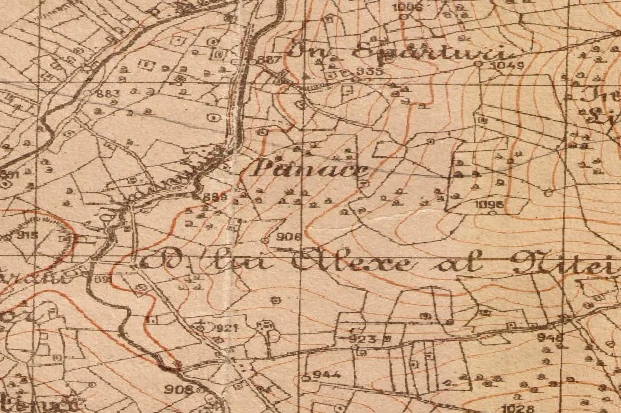
Old survey map of the valley with the Pănaci name, roads and contours.
Detail from the military survey. The name “Pănaci” appears beside the valley and road. (Source · Serviciul geografic al Armatei · geo-spatial.org · Public-domain map, cropped)

The place

Old survey map of the valley with the Pănaci name, roads and contours.
Detail from the military survey. The name “Pănaci” appears beside the valley and road. (Source · Serviciul geografic al Armatei · geo-spatial.org · Public-domain map, cropped)

The place

A school in the Călimănel corridor

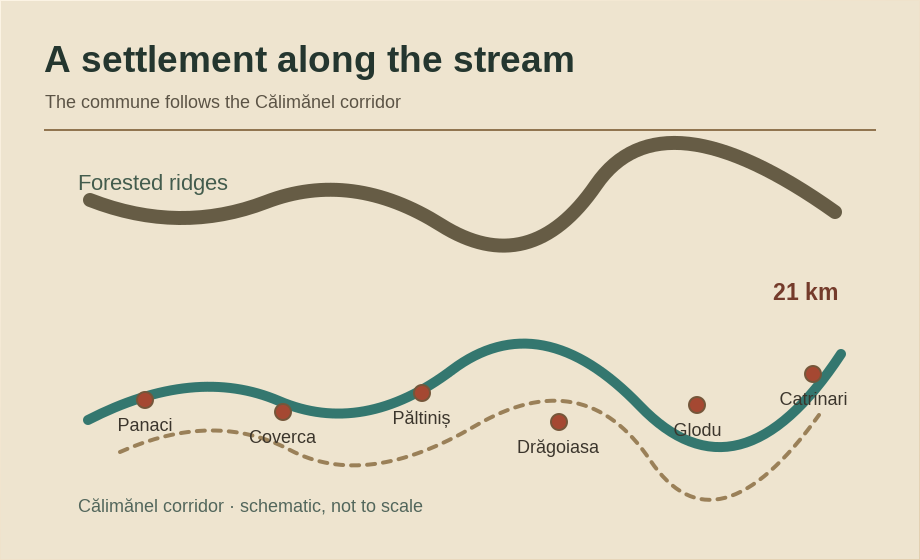
Panaci lies in the Dorna Depression, in a valley cut by the Călimănel between forested ridges. Today the commune includes six villages and stretches for about 21 kilometres; the distances between them help explain why the school in the central village served a wider community.

The town hall’s monograph dates the name Panaci to 1835. It says Iftimie Negrea settled in the present village centre around 1790–91, near the Călimănel stream. This geography gives context to a school request from a dispersed mountain settlement.
Old survey map of the valley with the Pănaci name, roads and contours.
Detail from the military survey. The name “Pănaci” appears beside the valley and road. (Source · Serviciul geografic al Armatei · geo-spatial.org · Public-domain map, cropped)
An elongated valley with a blue line for the Călimănel, six village names and wooded ridges.
The town hall describes the commune as an approximately 21 km corridor, with villages along streams. This is a geographic schematic, not a topographic map. (Source)

The request

113 people ask for a school

Historian Bogdan Teodorescu reviewed a local monograph that, he says, drew on Ministry of Education files and records kept in the village. In that account, 113 residents marked a petition to Minister Petru Poni with fingerprints in October 1891.

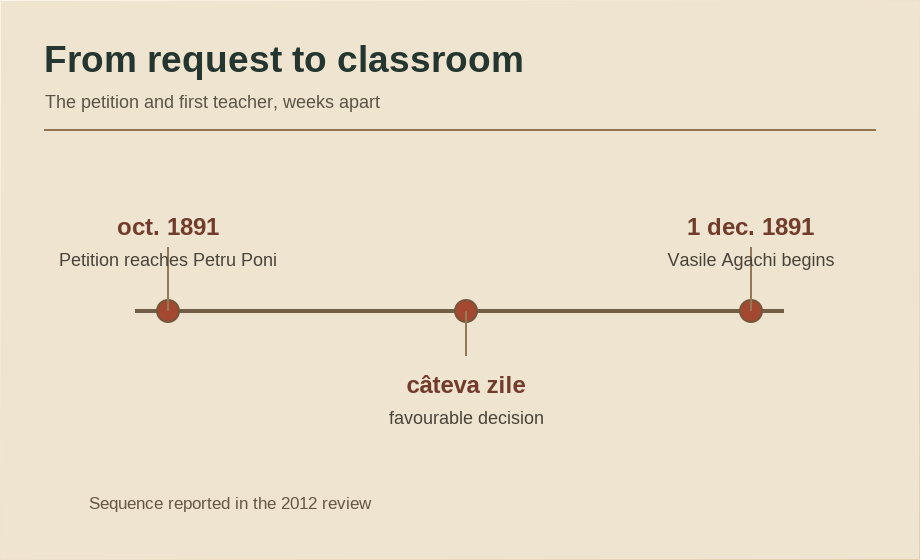
The minister approved the request a few days later. Vasile Agachi, appointed on a provisional basis, began teaching on 1 December 1891. This sequence comes through a review of the monograph; the original petition and its names are not reproduced in the digitised article.
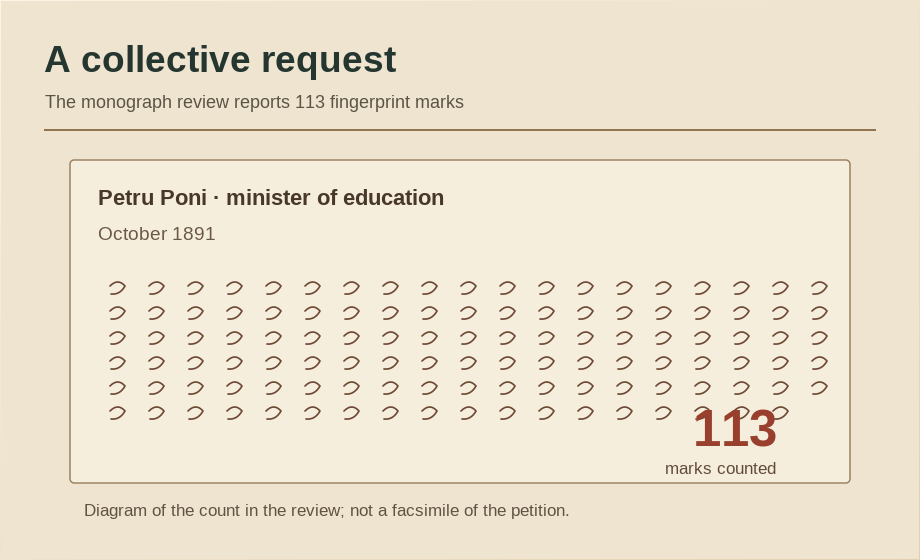
A schematic page with 113 small fingerprint marks addressed to Minister Petru Poni.
Bogdan Teodorescu’s review of Adăniloaie’s monograph reports 113 residents marking the October 1891 petition with a fingerprint. This diagram counts the marks; it does not reproduce the document. (Source)
Timeline of the October petition, approval a few days later and classes beginning on 1 December 1891.
The account says the minister approved the request within days and Vasile Agachi started on 1 December. (Source)

The first class

Twenty-five pupils

The school opened with 25 pupils, 17 of them boys. In a settlement of households spread along the valley, every child in class depended on family work and the journey to school; the source does not describe daily schedules or distances travelled.

The difference between the total and the number of boys is eight. The review does not give the other pupils’ sex, so the diagram leaves them unclassified instead of filling the gap by assumption.
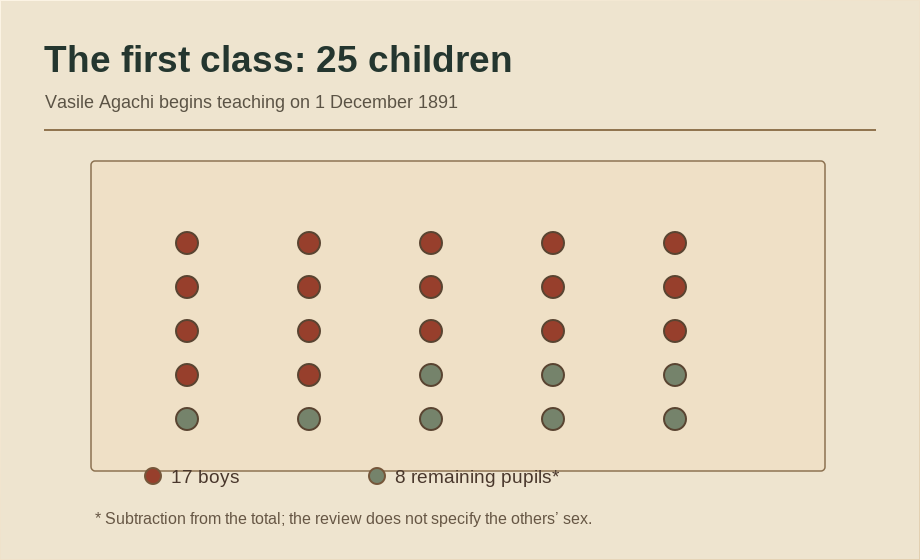
A schematic arrangement of 25 circles; 17 are marked as boys and eight are unclassified in the account.
The first group had 25 pupils, 17 of them boys. The remaining eight circles are the arithmetic difference; the review does not describe them separately. (Source)

School in village life

A library, classes and a bank

Gheorghe Țifescu was appointed teacher at Panaci in 1894. He stayed for 21 years, until 1916. The monograph credits him with widening access to schooling, especially for girls, whose enrolment reportedly grew fivefold; the reviewer warns that the share of school-age children attending cannot be calculated.

Țifescu organised adult literacy classes and helped establish a popular bank. The school library held 500 books. The school appears here as a place for reading and local organisation; the surviving account gives the library’s size, not a borrowing record.
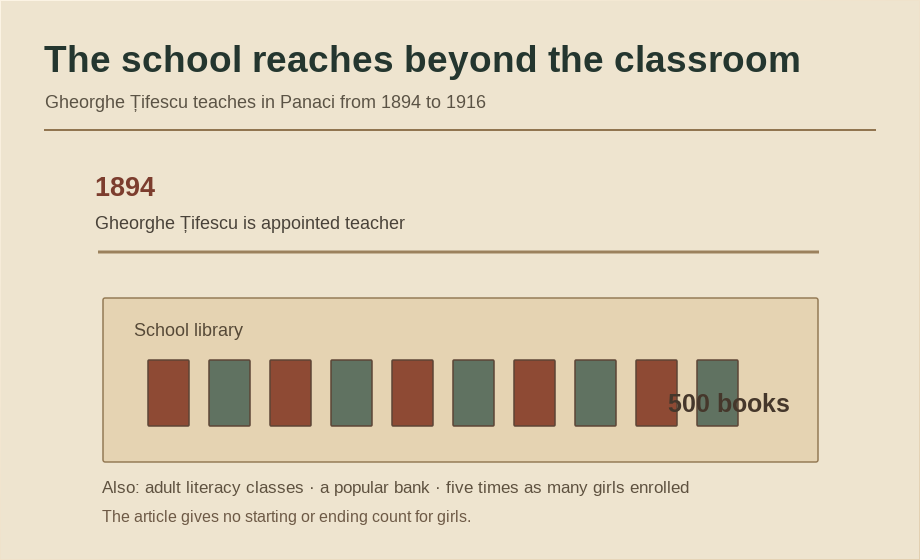
A schematic library labelled with 500 books beside the community roles described in the monograph.
During Gheorghe Țifescu’s 21 years, the monograph notes a 500-volume library, adult literacy classes and a popular bank. Girls’ enrolment reportedly grew fivefold, though the reviewer could not establish the starting number. (Source)

Dispute

The teacher between school and politics

In Țifescu’s final years, complaints accused him of spending time on his farm and in politics instead of teaching, and of using the popular bank to win villagers’ support. The reviewer says he defended himself and that some residents backed him.

The account does not quote the complaints, identify their authors or record a ruling. These remain allegations reported through a review, not findings established by documents reproduced here. The dispute still shows how closely the school had become tied to village public life.
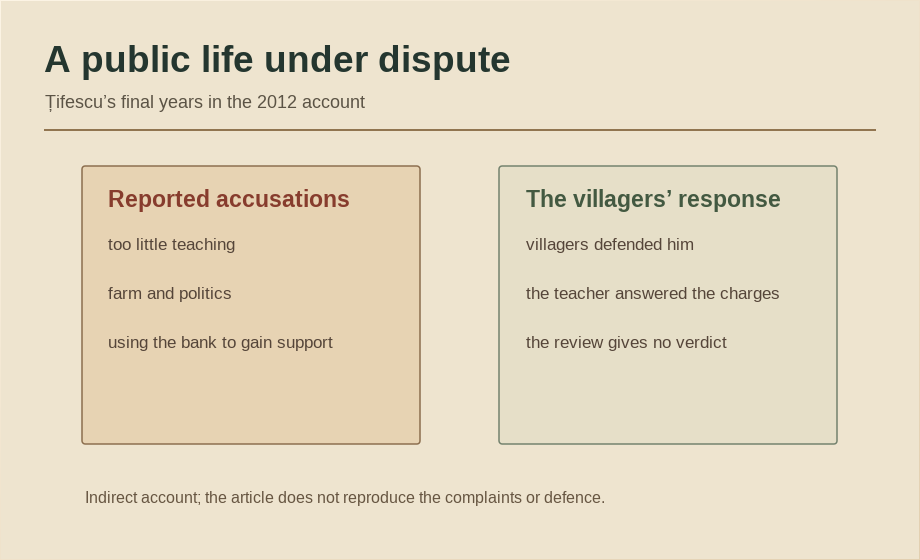
Two columns set out the reported accusations and villagers’ defence, with a note that the original documents are not reproduced.
The reviewer reports accusations that Țifescu neglected teaching for his farm and politics, and used the popular bank to win villagers’ favour. He also says some villagers defended him. The original complaints and any ruling are not reproduced here. (Source)

War

Flight and death in 1916

In 1916 Austro-Hungarian troops occupied the Dorna region and residents fled to nearby areas. During this disruption, Țifescu died on 26 November after a long illness. The review does not say what happened to the school during the occupation and flight.

By then the same teacher had worked at Panaci for 21 years. In 1916 his work ended and the villagers fled the advancing front.
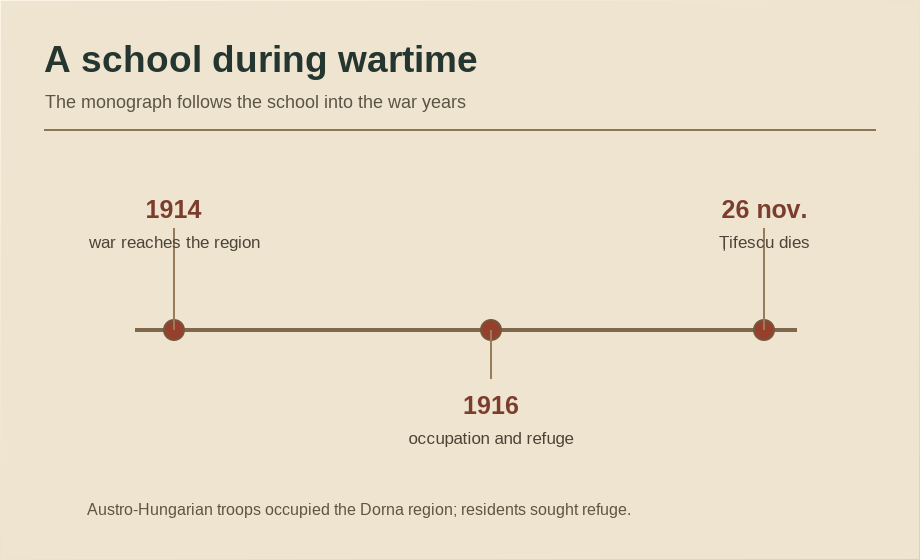
Timeline of wartime occupation, local refuge and the teacher’s death on 26 November 1916.
The reviewer says Austro-Hungarian forces occupied the Dorna region and residents fled to nearby areas. Gheorghe Țifescu died on 26 November 1916 after a long illness. (Source)

Afterward

Who attended regularly?

In 1931 the commune had 1,213 residents in 309 families. The school had 73 pupils enrolled; 52 attended regularly. The source distinguishes enrolment from regular attendance, but does not explain the other 21 pupils’ absences or give the number of school-age children.

Ten years later, all 18 pupils in the final class passed their leaving exam. These markers show the school continued, but they do not by themselves measure literacy across the commune. The petition’s story begins with a collective request and ends in our sources with a practical question: who could reach class, and how often?
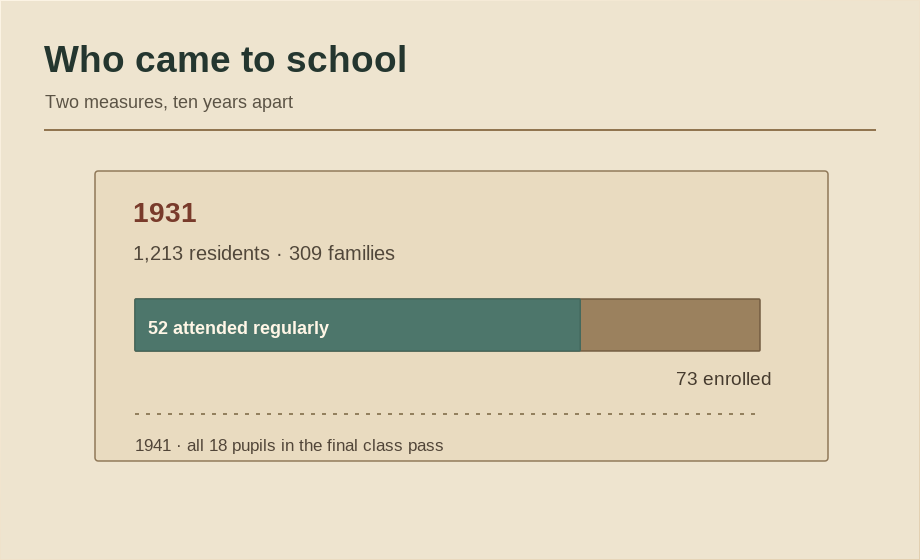
A bar for 73 enrolled pupils, with a 52-pupil regular-attendance segment; below it, the 1941 exam result.
In 1931, 73 pupils were enrolled and 52 attended regularly. The review does not supply the data needed to calculate a literacy rate for the whole commune. In 1941, all 18 pupils in the final class passed their leaving exam. (Source)

Sources

The sources used here do not give us the original petition or a complete pupil register. They do preserve a clear sequence: 113 residents asked for a school, a teacher began work, and classes, a library and adult learning became part of local life.

  1. Bogdan Teodorescu, “Reading journal”, Studii și articole de istorie LXXIX (2012), pp. 317–318Review of *The history of the Panaci school* by Professor Adăniloaie. The reviewer says the monograph uses Ministry of Education files and local records. The petition details here come from that account; the article does not reproduce the petition.
  2. Panaci Town Hall, “Monograph of the commune”Describes the Călimănel corridor, the commune’s extent, the Austrian survey of 1773–1775 and Iftimie Negrea’s settlement around 1790–1791.
  3. Panaci Lower Secondary School, 2022–2023 reportRecent institutional report; used here only to identify the present school, not to claim it occupies the 1891 building.
  4. Suceava County School Inspectorate, 2026–2027 school catchmentsLists Panaci Lower Secondary School at 236 Principală Street. The address locates the current school; it does not establish the site of the 1891 building.
  5. POI Explorer, Panaci school pointThe map places the school area at 47.247, 25.380, rounded to three decimal places. This pin marks the current school, not a documented 1891 parcel.
  6. Romanian military survey, 1:20,000Detail from the mosaic georeferenced by geo-spatial.org.