Olbers' paradox Why is the night sky dark?
In an eternal, unchanging universe filled with stars without end, every line of sight would end on a star and the night would be as bright as the Sun. Ours is not like that: stars have been shining for a finite time, and light from those far enough away has not had time to reach us. And the sky is not even black: it glows everywhere, only too cold for you to see.
See whyThe forest
In a big enough forest, every line of sight ends on a tree

Stand in the middle of a forest and turn slowly. If the forest is sparse or small, you see the fields beyond between the trunks. If it is dense and goes on far enough, every line of sight ends on a tree. No single trunk is large, but there are enough of them to fill the whole horizon.
Move the two controls below the drawing. The yellow dot is you; each line is a direction you look in. The strip underneath is what you see as you turn once around.
40 cm trunks · yellow: the line of sight hits a tree · blue: it leaves the forest
With 250 trees per hectare, a line of sight travels 100 m on average before it hits a trunk.
Only two things matter: how close together the trees stand and how deep the woods go. With 250 trunks 40 cm thick per hectare, a line of sight travels 100 metres on average before hitting one. If the forest goes on for half a kilometre, fewer than 1% of directions still slip between the trees.
Now replace the trees with stars and the forest with the universe.
Tonight's sky
Between the stars, black
On a clear night far from any town you can see a few thousand stars. Between them the sky is black. It seems the one thing that needs no explanation.
The shells
Every shell of stars sends the same light
Divide the sky into shells, like an onion, with the Earth at the centre. A shell twice as far away holds four times as many stars. Each of them looks four times fainter, because its light has spread over a sphere four times larger. The two effects cancel: every shell sends exactly as much light as any other.
If the stars go on for ever, so do the shells, and the light adds up.
A sky of suns
Until no gap is left
The light does not grow without limit, because nearer stars hide the ones behind them, like trunks in the forest. But every direction ends, sooner or later, on the surface of a star.
Then the whole sky, day and night, would be as bright as the Sun's disc, at nearly 5,800 K. You could not pick out the Sun against it, and the Earth would heat up to the same temperature.
How far
How far you would need to see
How deep must the ‘forest’ of stars be? Take all the mass in the universe's stars, count it as suns like ours and spread them evenly. A line of sight would travel 3.5 × 10²⁴ light-years on average before hitting one.
Stars are so sparse in space that their forest would have to be unimaginably deep.
The horizon
The light has not had time to arrive
But the universe is 13.8 billion years old, and stars have shone for somewhat less. No starlight has had longer than that to travel to us. (Travel time is not today's distance to the source: space has expanded meanwhile.) Even if the stars went on for ever, we see only a forest 13.8 billion years of light travel deep, about 1014 times too shallow.
The darkness between the stars is the distance light has not yet had time to cover.
Fainter still
And what does arrive is weakened
The universe is also expanding. Light from distant stars arrives stretched towards the red and weaker. That darkens the sky too, but less than the age does: even in a universe that did not expand, the night would still be black.
The ruler
The missing distance
On a single ruler, the distance at which every line of sight would reach a star is so far away that almost everything else is squeezed into one corner. The oldest light we can receive has travelled for 13.8 billion years. To see a sky full of suns you would need light that had travelled 1014 times longer.
The calculation is simple and can be checked. The universe's stars hold on average about 580 million solar masses in each cubic megaparsec (a cube 3.3 million light-years on a side). In a simplified model where all that mass is made of suns like ours, each 696,000 km in radius, they cover so little of space that a line of sight travels 3.5 × 10²⁴ light-years before hitting one. The astrophysicist Edward Harrison, with older data, arrived at about 1024 light-years in 1974. In 13.8 billion years, light could bring us stars covering 3.9 × 10⁻¹³% of the sky.
Four hundred years
Who asked before us
The question is older than its name. For three centuries very careful people gave wrong answers. The first good one was written down by a poet, who then gave it up.
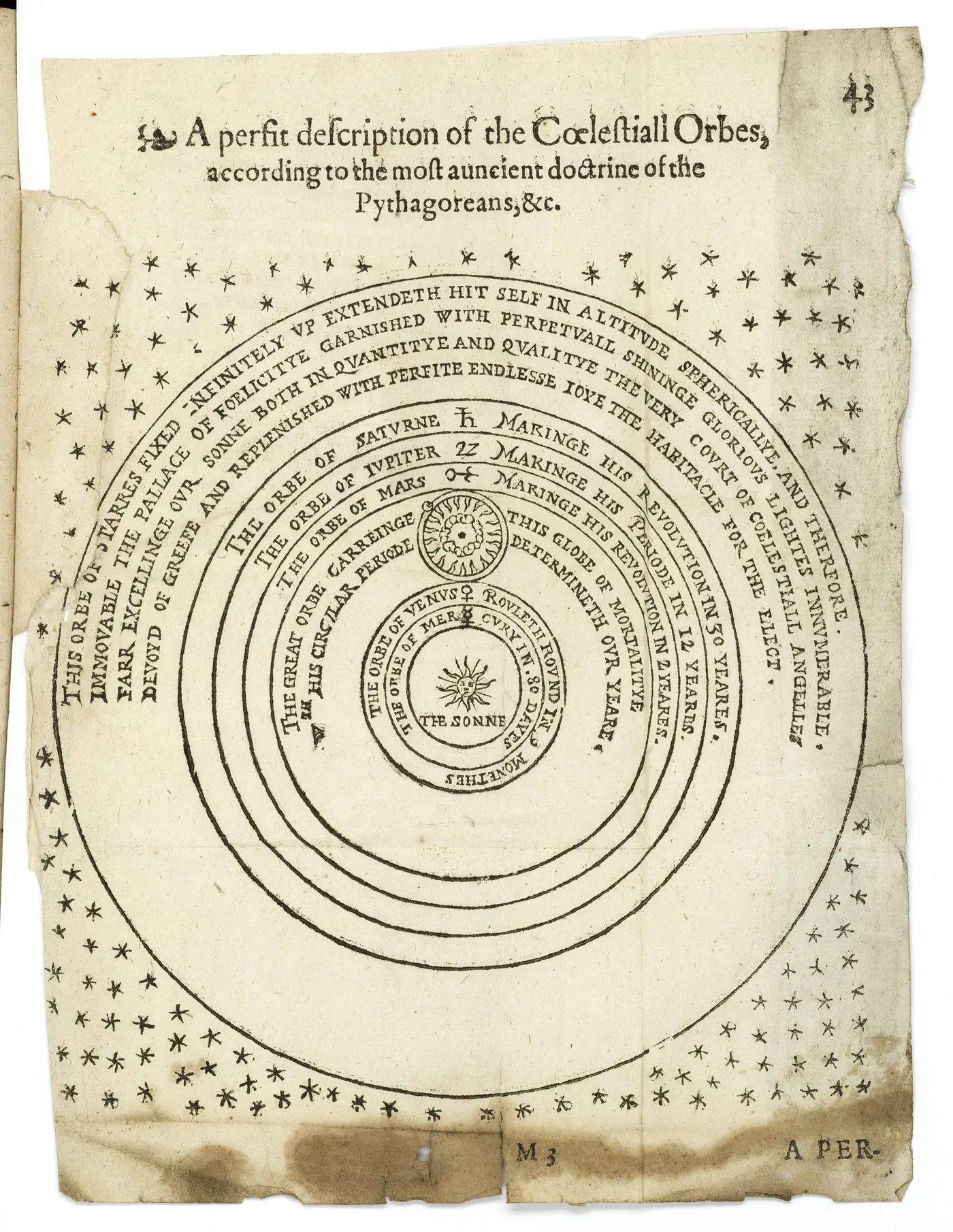
- 1576Thomas Digges
An English mathematician draws the stars scattered without end beyond the sphere of Saturn. He does not ask why the night is dark.
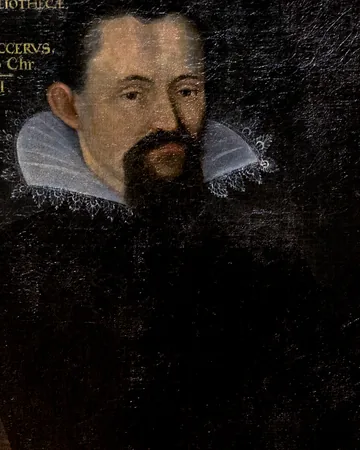
- Johannes Keplernot suns
The first to use the darkness as an argument. If the stars were suns like ours, together they should outshine the Sun. The starry sky is far dimmer, so, he concludes, our world is not one of an endless swarm of suns, as Giordano Bruno had claimed.
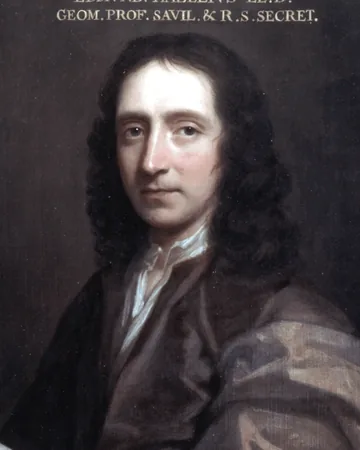
- Edmond Halleytoo faint
Writes in the Royal Society's journal that he has heard the argument: if the stars were more than finite in number, their whole sphere would be luminous. He answers that very distant stars are too faint to matter. The shell argument shows why he is wrong: faint stars are also far more numerous.
- 1744Jean-Philippe Loys de Chéseauxdust
A Swiss astronomer makes the first calculation: if the stars had no end, every point of the sky would shine like the Sun, and the half of the sky above us would send 91,850 times as much light as the Sun. His way out is an extremely thin fluid that absorbs part of the light.
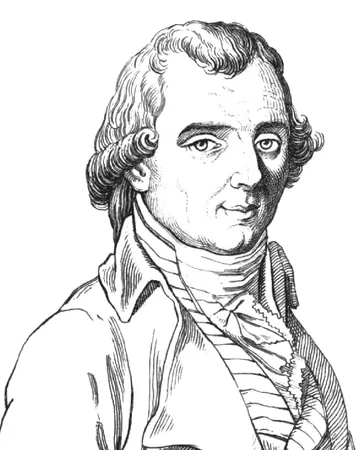
- Heinrich Wilhelm Olbersdust
A Bremen physician and amateur astronomer who discovered the asteroids Pallas and Vesta. He publishes ‘On the transparency of space’ and proposes the same answer: matter between the stars swallows the light. The paradox will bear his name, although he was not the first to pose it.
- Edgar Allan Poethe answer, dropped
In Eureka, a prose poem about the universe, the writer states the right answer: the background might be so far away that its light has not yet reached us. In the next sentences he says he has no reason to believe it, and settles for a finite universe of stars.
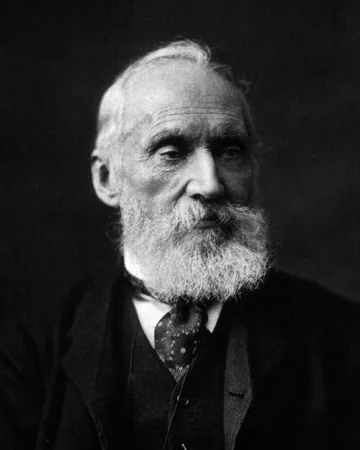
- Lord Kelvinthe answer, calculated
The British physicist does the sums: with stars that shine for a limited time and light that needs time to travel, the discs of the stars cover only a tiny fraction of the sky. The historian of the problem Edward Harrison calls it the first quantitatively correct solution.
- 1952Hermann Bondithe name
According to Edward Harrison, the Austrian-British cosmologist introduces the name ‘Olbers' paradox’ in his cosmology textbook.
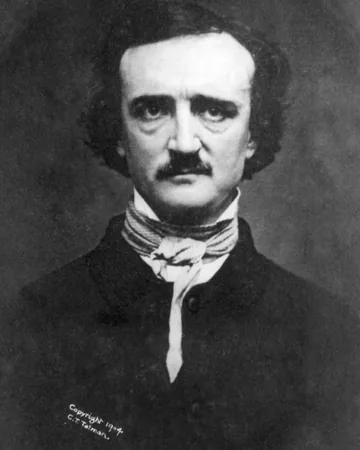


“The only mode, therefore, in which, under such a state of affairs, we could comprehend the voids which our telescopes find in innumerable directions, would be by supposing the distance of the invisible background so immense that no ray from it has yet been able to reach us at all.”
Edgar Allan Poe, Eureka, 1848
Energy
Burning the whole universe would not be enough
There is a second reason, independent of the age. Filling space with light as intense as a star's surface takes an enormous amount of energy. If all the ordinary matter in the universe were turned completely into light, by Einstein's formula, the sky would reach only 15 K. Stars do not manage even that: burning hydrogen releases under 1% of its mass. A sky of suns needs 2.2 × 10¹⁰ times more energy than matter could ever provide.
Why not dust? Chéseaux and Olbers's answer seems natural: clouds of dust between the stars really do block light, which is why we cannot see the centre of our galaxy in visible light. But a cloud that absorbs light warms up, as John Herschel pointed out in 1848. In an infinitely old universe the dust would heat until it glowed as brightly as the stars around it, and the sky would be full of light again.
Why not expansion? An expanding universe stretches light and weakens it, and many textbooks give this as the answer. The calculations show it matters less than the finite age. Paul Wesson and colleagues found in 1987 that expansion makes the sky about half as bright as in a static universe of the same age, which would itself be dark.
The first light
The sky isn't black. It's just too cold to see
Here the paradox comes back. Olbers was right that far enough in any direction you meet something hot; he was wrong only about what. That something is the gas that filled the whole young universe: a thick layer of hot fog, in place of the surfaces of stars. For 372,000 years after the Big Bang this gas was opaque, like fog. Then it cooled enough for light to pass through. The light from that moment still reaches us from every direction.
Back then it was at about 2,970 K, the colour of an incandescent bulb. Since then the expansion of the universe has stretched it 1,091 times. Move the slider to wind the sky back to that moment.
2.73 Ktoday's sky
Today's sky: the same light, stretched into microwaves, peaking at 1.06 mm. An antenna picks it up; an eye does not.
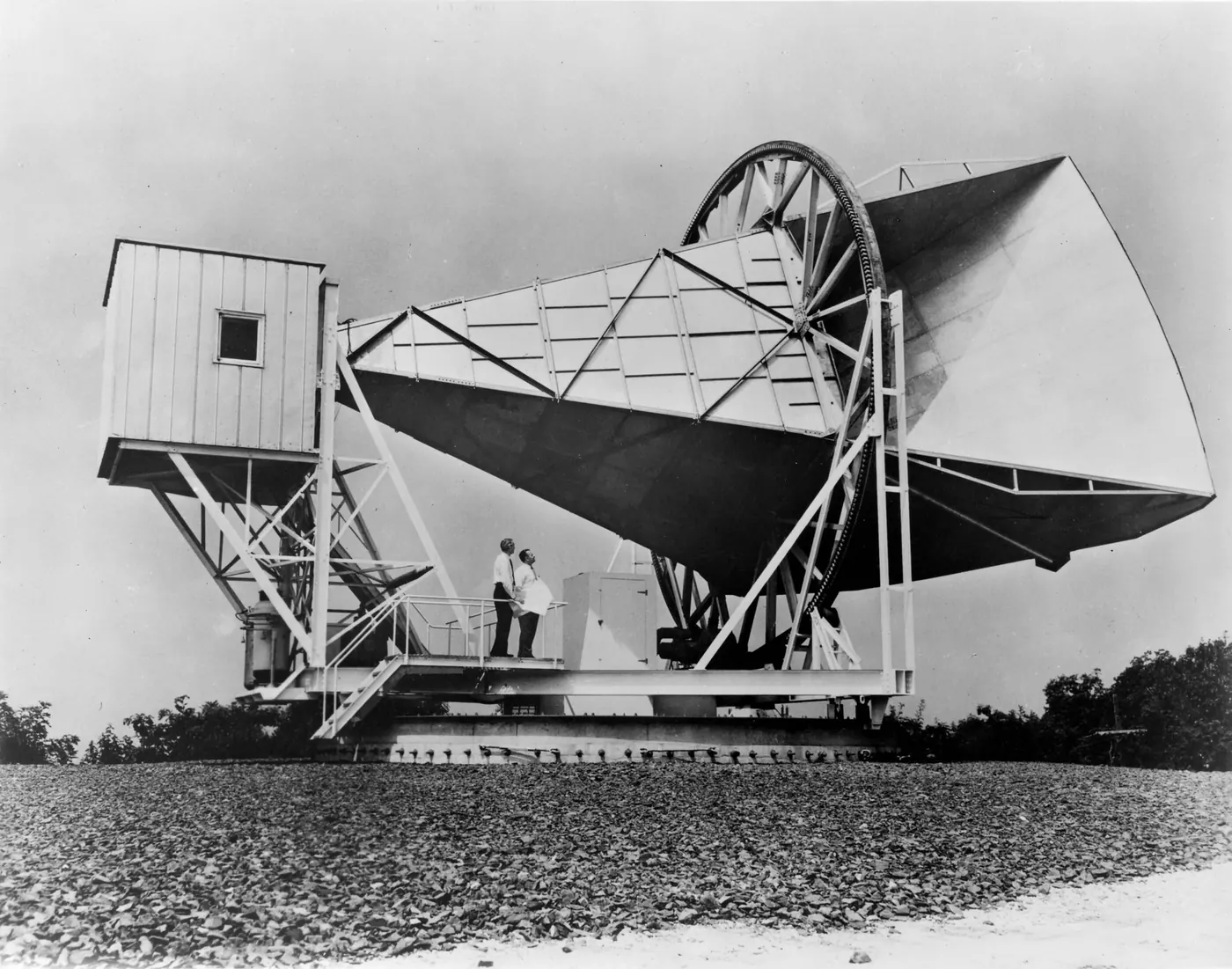
This light was found by accident. In 1964–65 Arno Penzias and Robert Wilson were trying to get rid of a faint hiss in their antenna at Holmdel, New Jersey. They cleaned it and removed the pigeons nesting inside, but the hiss came equally from every direction. It was the sky. They received half of the 1978 Nobel Prize in Physics.
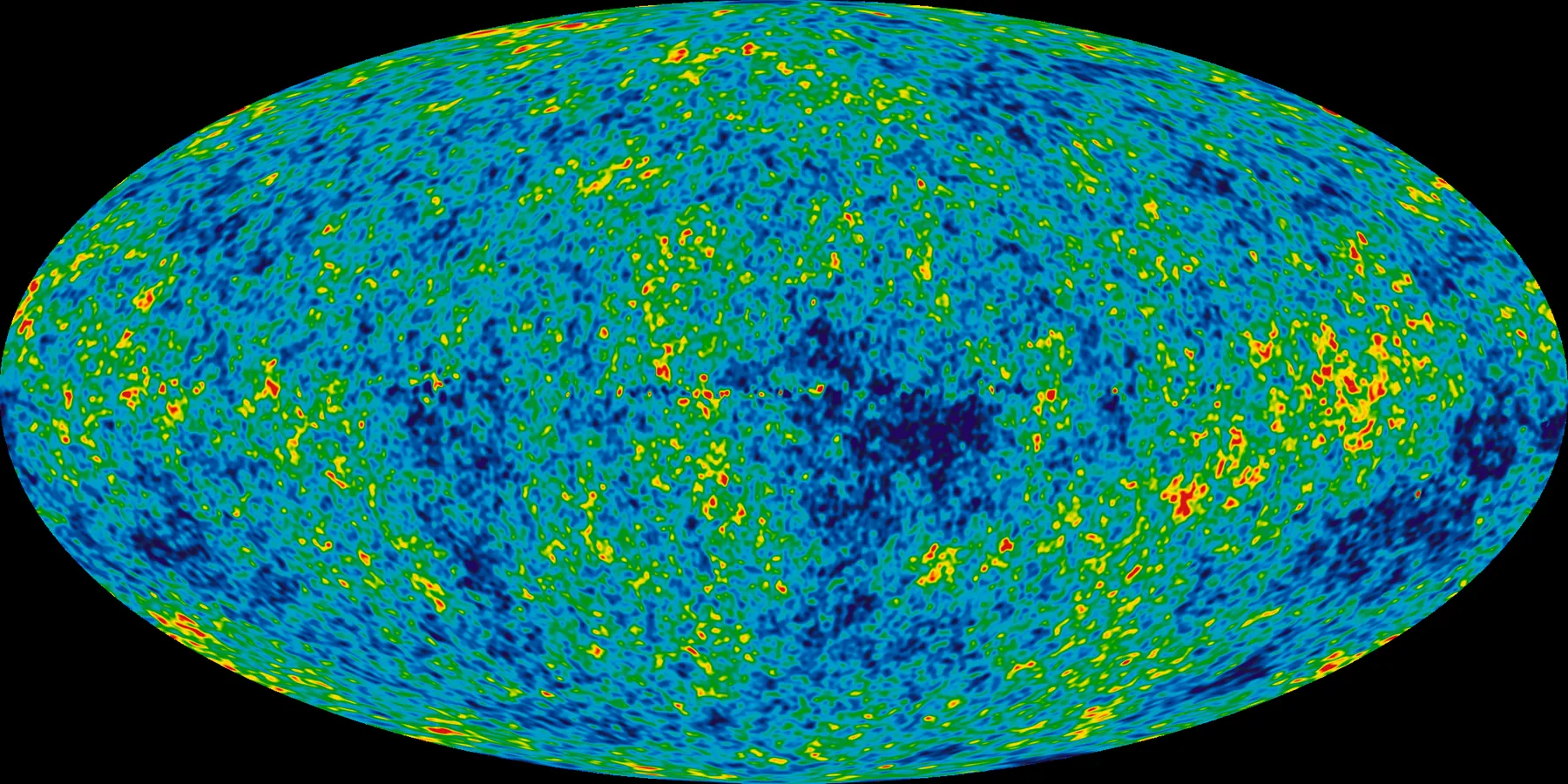
Today that light is at 2.7255 K. The WMAP and Planck satellites mapped it across the whole sky: once the effect of our own motion is removed, the differences from one place to another are typically under a ten-thousandth of a degree, about one part in 100,000. The galaxies later grew from these small irregularities.
How dark
How dark the sky is, measured from beyond Pluto
How dark is the visible sky, really? It is hard to measure from Earth or near it, because dust in the solar system scatters sunlight. The New Horizons probe measured it beyond Pluto, where that dust is almost absent. In 2024 its team published the result: the visible light of the whole background is about 11.2 nanowatts per square metre per steradian, a value consistent with the light of galaxies already counted and nothing else. The unexplained excess reported by earlier measurements has largely disappeared.
Measured at the same wavelength, 0.6 micrometres, a sky covered in suns would be 1.3 × 10¹⁵ times brighter. That is the gap between the night we see and the one an eternal, endless universe would predict.
Next time you are out at night, look between the stars. That darkness says the stars have not been shining for ever on an unchanging universe.
Sources and calculations
Every calculated number (the distance to a star, the share of the sky, the temperatures, the slider's timetable) comes from one calculation using the inputs below. The age of the universe and the moment the light was released are computed from the Planck 2018 parameters for a flat universe with matter, dark energy and radiation.
The average distance to a star assumes all the mass in stars is made of suns like ours, spread evenly. It is an order-of-magnitude geometric model: real stars, with a range of masses and radii, change the effective covering area, but not by 14 orders of magnitude. The share of the sky ignores expansion, which would shrink it further.
The colour in the slider is an on-screen approximation of a black body's colour at the given temperature, at a fixed exposure equal to the brightness at the moment the light was released; temperature follows T = 2.7255 K × (1 + z). At 2.7 K the panel is black because the eye cannot see microwaves, not because there is no radiation. The temperatures in the energy section are equivalent temperatures: those of a black body with the same energy density.
- Thomas Digges, A Perfit Description of the Caelestiall Orbes, 1576 (Wellcome Collection) commons.wikimedia.org/wiki/File:Thomas_Digges%27_diagram_of_the_
- E. Halley, „Of the Infinity of the Sphere of Fix'd Stars”, Philosophical Transactions 31 (1720) doi.org/10.1098/rstl.1720.0006
- J.-P. Loys de Chéseaux, Traité de la comète, Lausanne 1744, appendix II e-rara.ch/zut/doi/10.3931/e-rara-1382
- Britannica, biography of Wilhelm Olbers (the 1823 paper: „Ueber die Durchsichtigkeit des Weltraums”, Astronomisches Jahrbuch für das Jahr 1826) britannica.com/biography/Wilhelm-Olbers
- E. A. Poe, Eureka: A Prose Poem, 1848 gutenberg.org/ebooks/32037
- E. R. Harrison, „Why the sky is dark at night”, Physics Today 27(2), 1974 if.ufrj.br/~orca/intcosmo/122/Harrison_PhysToday_27_30_1974_Why_
- E. R. Harrison, „Kelvin on an old, celebrated hypothesis”, Nature 322, 1986 doi.org/10.1038/322417a0
- P. S. Wesson, K. Valle, R. Stabell, „The extragalactic background light and a definitive resolution of Olbers's paradox”, ApJ 317, 1987 ui.adsabs.harvard.edu/abs/1987ApJ...317..601W
- P. Madau, M. Dickinson, „Cosmic Star-Formation History”, ARA&A 52, 2014 (stellar mass density) arxiv.org/abs/1403.0007
- Planck Collaboration, „Planck 2018 results. VI. Cosmological parameters”, A&A 641, 2020 arxiv.org/abs/1807.06209
- D. J. Fixsen, „The Temperature of the Cosmic Microwave Background”, ApJ 707, 2009 arxiv.org/abs/0911.1955
- IAU 2015 Resolution B3 (nominal solar temperature and radius) arxiv.org/abs/1510.07674
- M. Postman et al., „New Synoptic Observations of the Cosmic Optical Background with New Horizons”, ApJ 972, 2024 iopscience.iop.org/article/10.3847/1538-4357/ad5ffc
- J. Kepler, Dissertatio cum Nuncio Sidereo, 1610, translated by E. Rosen, 1965 gwern.net/doc/science/physics/1965-kepler-keplersconversationwit
- E. R. Harrison, „The dark night-sky riddle, Olbers's paradox”, Science 226, 1984 ui.adsabs.harvard.edu/abs/1984Sci...226..941H/abstract
- F. Arpino, F. Scardigli, „Inferences from the dark sky: Olbers' paradox revisited”, 2000 (Herschel's objection, 1848) arxiv.org/abs/astro-ph/0007428
- The Nobel Prize in Physics 1978 nobelprize.org/prizes/physics/1978/summary/

Images
- Thomas Digges, diagram of the universe, 1576: Thomas Digges / Wellcome Collection · CC BY 4.0
- Heinrich Wilhelm Olbers: Smithsonian Libraries · public domain
- Johannes Kepler, portrait painted in 1627: unknown artist · public domain
- Edgar Allan Poe, 1848: W. S. Hartshorn · public domain
- Edmond Halley, portrait by Thomas Murray: Thomas Murray · public domain
- Lord Kelvin: Dickinson, London · public domain
- The Holmdel horn antenna: NASA · public domain
- Cosmic microwave background, WMAP nine-year map: NASA / WMAP Science Team · public domain
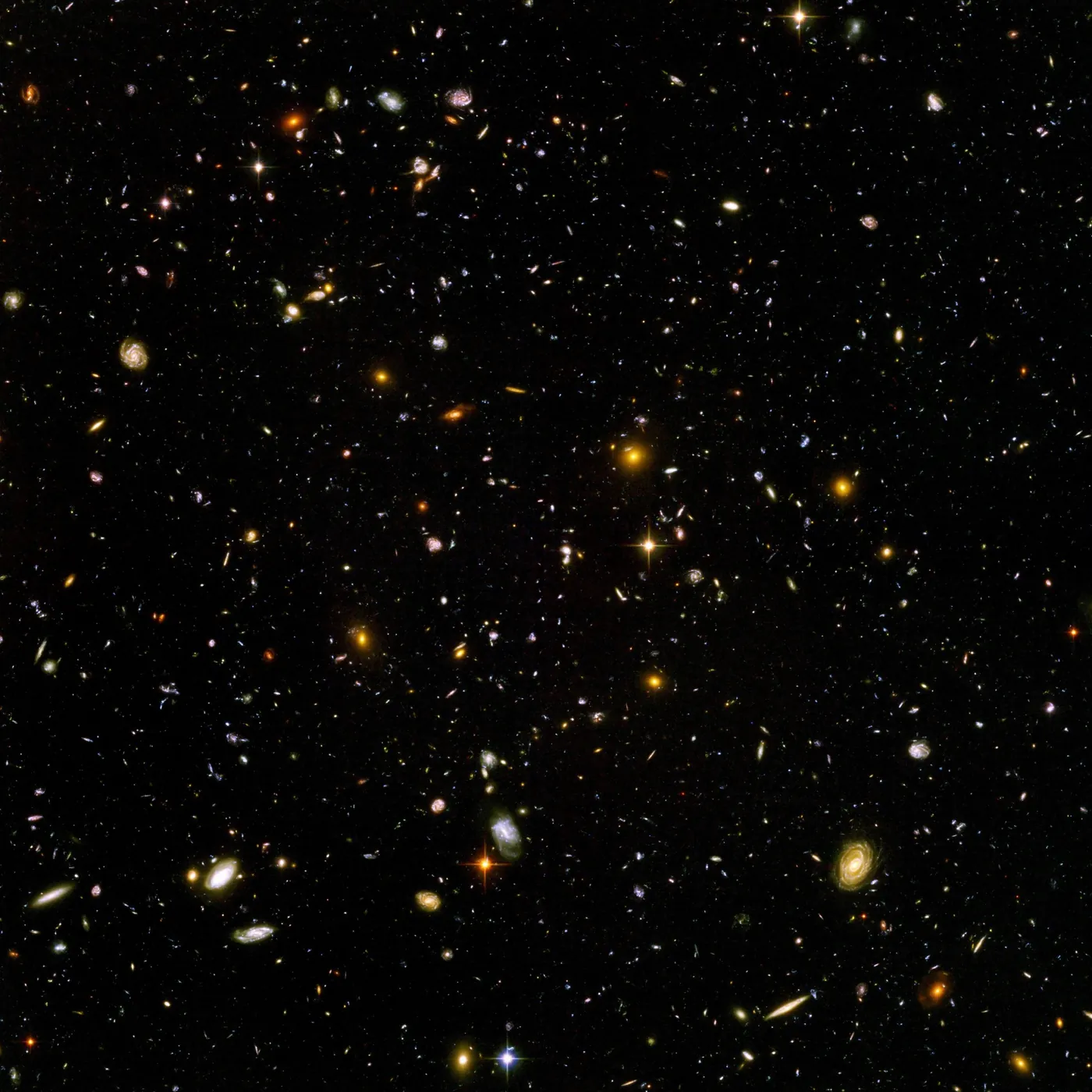
- Hubble Ultra Deep Field: NASA, ESA · public domain
- The Milky Way, 360° panorama: ESO / S. Brunier · CC BY 4.0
- Beech forest in Jasmund National Park, Rügen: Siarhei Besarab · CC BY-SA 4.0


