Pietroasa–Moscow, 1837 – 1956
What happened to the golden hen with her chickens?
In Lent 1837 two quarrymen found 22 gold pieces near Pietroasa; then came the axe, a trial, a ceiling robbery and the long road to Moscow. 12 pieces survived – and a paper trail a century long.
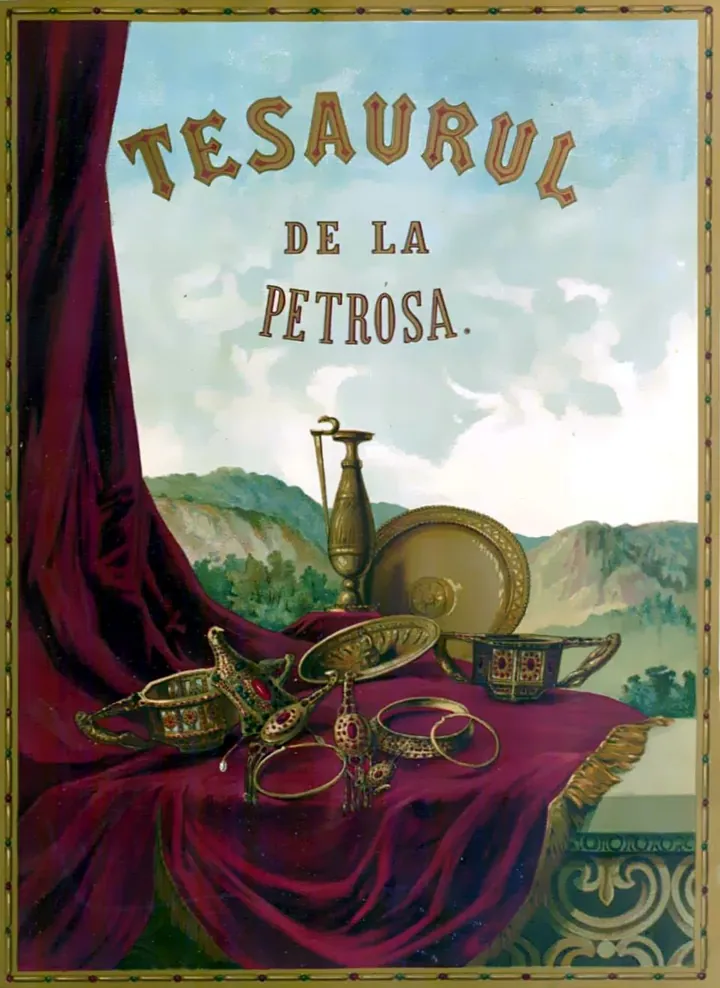
The hoard in four chapters
Representative route
From Pietroasa to Moscow and back
In Lent 1837 the hoard came out of a quarry bank; by 1842 it sat in a Bucharest museum. Exhibitions carried it to Paris, London and Vienna, a thief lifted it through the ceiling, a restorer mended it in Berlin – and in 1916 the road to Moscow opened, for 40 years.
Below, the hoard in four chapters – the find, the museum, the robbery, and Moscow. The routes on the map are representative, drawn through the verified places of the story.
Chapter I
The find
1837 – 1842 · 1837–1842, the find
- Chapter
- 1837 – 1842
- The find
- Lent 1837, Valea Urgoaiei
- The sale
- 4,000 lei to Anastase
- The sentence
- 29 September 1839
In Lent 1837 two quarrymen, Ion Lemnaru and his father-in-law Stan Avram, were cutting stone on Valea Urgoaiei, under the Via Ardelenilor vineyard near Pietroasa, then in the county of Saac. Between two large slabs, close to the surface, they found gold things – vessels and ornaments, some set with stones – with a black earth stuck to them that researchers read as rotted wrapping that shielded them for 1,400 years.
The finders hid the hoard for a year, then sold it to Anastase Tarpa, an arnaut from Bitola known as the Serb, for 4,000 lei. He smashed the pieces with an axe in a villager's house until the stones fell out; the sweepings went into the yard dust, where children later picked them up. Order no. 2987 of 10 July 1838 sent the Buzau police after every receiver, and the interrogations counted the hoard four different ways: 16, 17, 22 and 26 pieces.
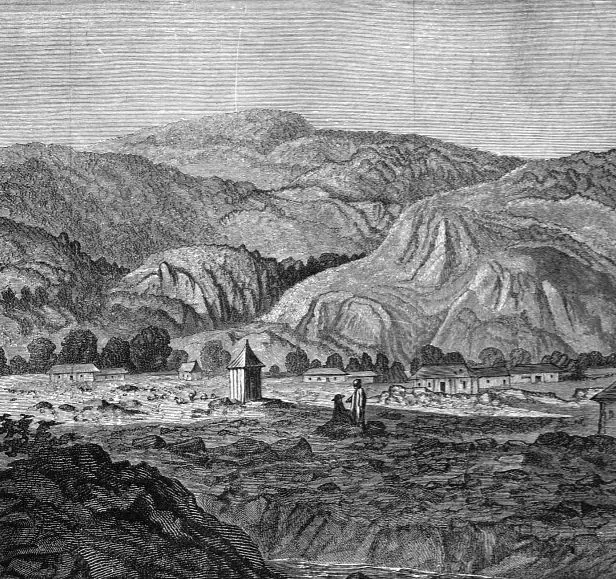


Anastase buried what he had at the Calnau bridge and blamed a flood; made to dig, he produced the figured tray and the rest. On 14 July 1838 the prince ordered the pieces into the National Museum, and in 1839 the court tried the case: the two finders died in prison, two villagers got 30 lashes and a year each, and Anastase – the smasher – was acquitted.
We found some things of gold, thrust between two stones.
Ion Lemnaru's deposition, 1838
Meanwhile Nobody knows the exact spot: in August 1838 the Interior itself wrote that the place was unknown.
Chapter II
The museum
1842 – 1875 · 1842–1875, the exhibitions
- Chapter
- 1842 – 1875
- Sfantul Sava
- 28 March 1842
- Paris
- 1867, 16 pieces
- London
- 1868, 9 months
On 28 March 1842 the Interior announced the Pietroasa gold was going to Sfantul Sava College in Bucharest; the receipt of 7 April listed the pieces – 18.7975 kg of gold – and they became the seed of the National Museum of Antiquities. A jeweller named Bisterfeld had already been hired to mend them: 40 imperial galbeni, finished 13 January 1840.
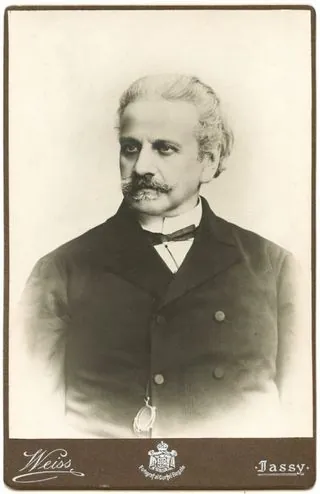
In 1867 Alexandru Odobescu, General Commissioner of the Romanian display, took the hoard to the Paris Universal Exhibition: 12 inventory entries, 16 pieces, in a special vitrine that sank into an iron box. The Romanian press accused him of selling or pawning the treasure – in truth a proxy war between Cezar Bolliac and Ion Bratianu – and Odobescu answered with a published report in 1869.
.jpg)
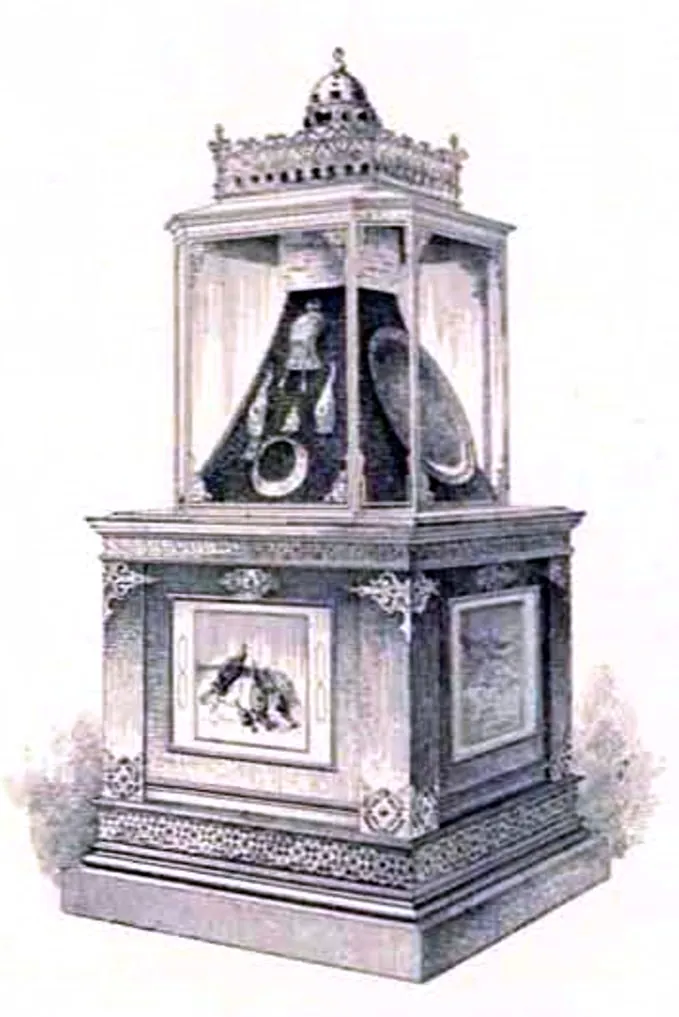

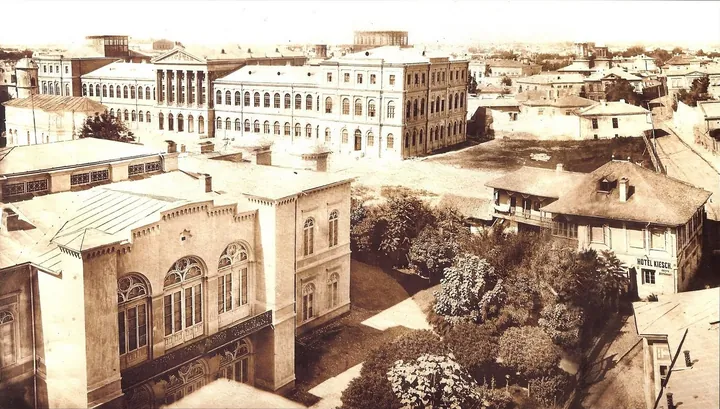
From Paris the hoard went to London's South Kensington Museum for 9 months at Henri Cole's invitation, where it was photographed and copied in galvanoplasty; those 1868 photographs are the only record of its post-Paris state. Vienna followed in 1873, then Bucharest again: the west wing of the old University building, with the Senate sitting directly above.
Bring back and set in their place those precious jewels, those jewels that were our national pride.
Cezar Bolliac, Trompeta Carpatilor, January 1868
Meanwhile Odobescu filed his monograph project on 2 May 1874: 500–800 pages, 500 copies, in French.
Chapter III
The robbery
1875 – 1900 · 1875–1900, robbery, fire, restoration
- Chapter
- 1875 – 1900
- The robbery
- night of 19–20 November 1875
- The sentence
- no. 1603, 7 May 1876
- Berlin
- Telge's report, July 1884
In the night of 19–20 November 1875 the hoard was stolen from the Museum of Antiquities. The thief, 21-year-old Dumitru Pantazescu-Popescu of Titu – a seminary expellee with a record since 1871 – slipped into the Senate Library above, cut the floorboards, let himself down on a rope, diamond-cut the glass, and hauled the treasure up in his trousers tied like a sack. The guarded room below heard nothing.
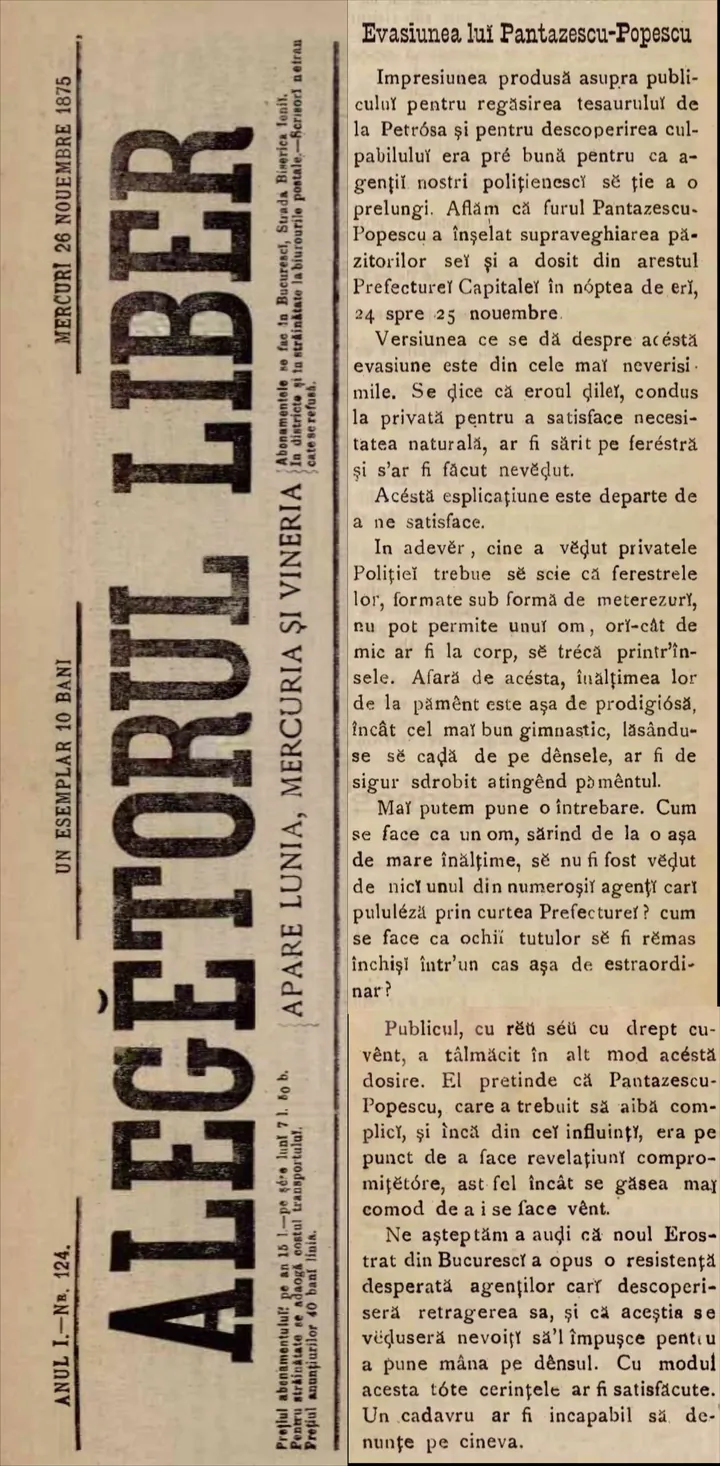
A 5,000-lei reward was posted on 20 November; the police worked through the rogues' register, where Pantazescu topped the list, and found the library key on him. He had entered after 6 in the evening and left after half past 3 at night; most of the hoard turned up at his home. He escaped the Prefecture on 24–25 November, was recaptured on 26–27 November in a Bucharest brothel with 50 galbeni, and the missing tray quarter and inscribed bracelet surfaced on 12 January 1876 at a silversmith's – part of the bracelet melted down.

.jpg)
Sentence no. 1603 of 7 May 1876 gave Pantazescu 6 years and the silversmith Costache Constantinescu 1 year. In the night of 24–25 March 1884 the University Palace burned and the hasty rescue battered the treasure, so Carol I sent it to Paul Telge in Berlin: his July 1884 report found 53 drilled holes in the dodecagonal vessel, parts swapped with the octagonal one, and tin solder to be separated chemically – the previous mender he called a mere patcher.
An immense stir through the whole town announced that the Treasure had been found again.
Romanul, 22–23 November 1875
Meanwhile Pantazescu was shot at Cozia in August 1884, fleeing in disguise; the prison director was suspended.
Chapter IV
Moscow
1916 – 1956 · 1916–1956, the long road
- Chapter
- 1916 – 1956
- The train
- second transport, 3 August 1917
- The return
- 28 July 1956, 39,320 pieces
- The museum
- MNIR, 8 May 1972
Late in 1916, with Bucharest threatened by the Central Powers, Romania evacuated its treasure to Moscow in two transports. The first train – National Bank ingots and Queen Marie's jewels – arrived on 21 December / 6 January 1917; the second, with archives, paintings and the Pietroasa hoard among the museum pieces, arrived on 3 August 1917. What followed were decades of failed claims: the Genoa memorandum of April 1922, the Vienna talks of March–April 1924, and in 1935 a return of 1,443 crates with no Pietroasa in it.
In June 1956 Khrushchev told Dej the Soviet party would return Romania's historic art values – the same spring it returned Dresden's masterpieces to East Germany. A delegation led by Mihai Ralea, with Tudor Arghezi, Andrei Otetea, George Oprescu, Constantin Prisnea and Marius Bunescu, reached Moscow on 28 July 1956; the Kremlin's General Vedenin put the return at 39,320 pieces, the Pietroasa gold alone weighing 19.736 kg.
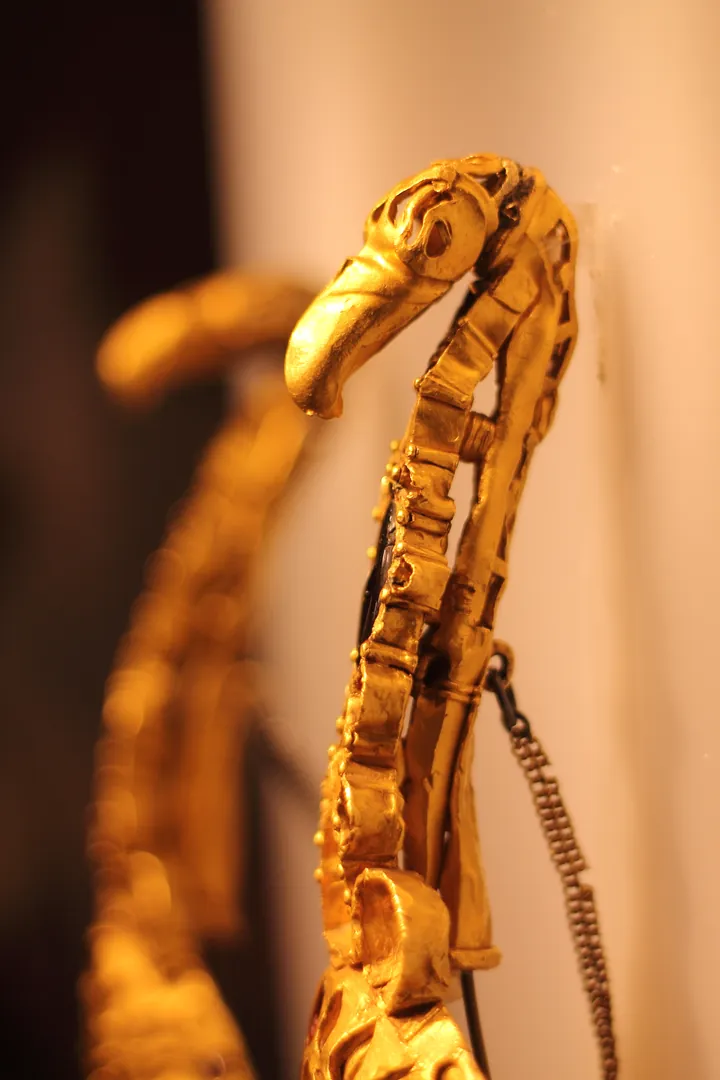


On 23 August 1956 the returned treasure opened to the public at the Art Museum in Bucharest; Scanteia had announced it the day before, and Arghezi, Calinescu, Daicoviciu and Oprescu all wrote for the occasion. The hoard has lived at the National Museum of Romanian History since its inauguration on 8 May 1972 – twelve survivors of twenty-two, 19.75533 kg of gold and stones, the paper trail intact.
Our treasures are coming home.
George Oprescu, 1956
Meanwhile The 1956 return held no bank gold – that story lives on the Moscow treasure page.
Track the hoard
Four moments from the paper trail: the sale, the night, Berlin and the train. Choose, then check against the sources.
-
1
The sale
In 1838 the finders sold the hoard to Anastase the Serb for:
What happened
4,000 lei, split five ways on paper – then the axe: Anastase smashed the pieces until the stones fell out.
-
2
The night
On the night of 19–20 November 1875 Pantazescu reached the treasure:
What happened
Through the ceiling: he cut the library floorboards after 6 in the evening and left after half past 3 with the hoard in his trousers.
-
3
Berlin
For the drilled, wire-tied vessels Telge prescribed in July 1884:
What happened
Bronze: he counted 53 drilled holes in the dodecagonal vessel alone and called the earlier mending a patcher's ruin.
-
4
The train
The Pietroasa hoard reached Moscow:
What happened
With the second: it arrived on 3 August 1917 and came home 39 years later, on 23 August 1956.
Answer a card to begin.
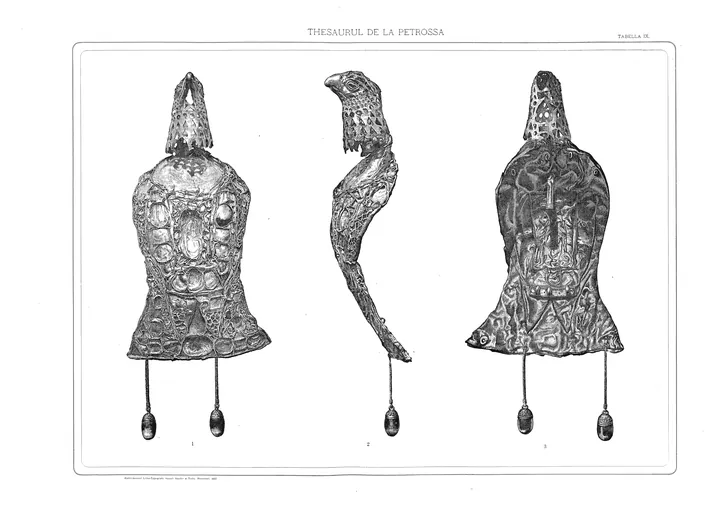
Seven plates of the hoard
Seven images, in the order of the album: the frontispiece, the torcs, the patera, the ewer, the great fibula, the middle pair, the octagonal vessel.
Plate 1889The frontispiece
The frontispiece Henric Trenk, 1889 · Wikimedia Commons - Trenk's frontispiece to Odobescu's Le Tresor de Petrossa, volume one, 1889.
- The hen fibula broods over vessels, torcs and stones.
- Three volumes followed: 1889, 1896 and 1900.
Plate pl. IThe torcs
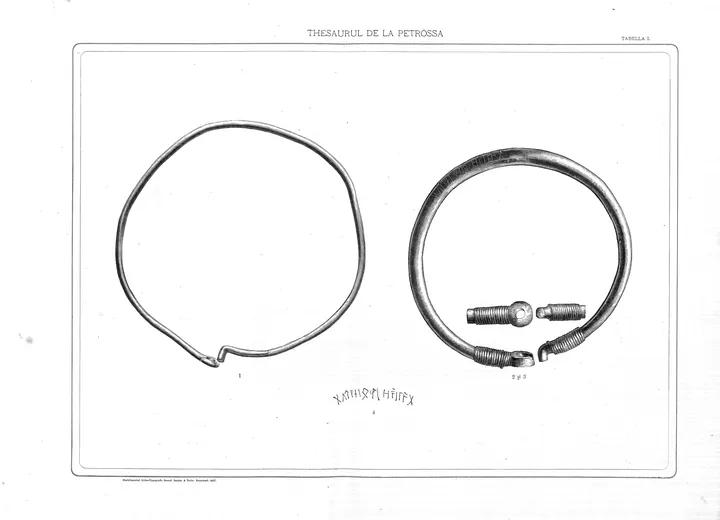
The torcs Henric Trenk · Wikimedia Commons - Table I: the two plain torcs, armillae of twisted gold.
- One carries the Gothic runic inscription.
- Telge found one letter ruined by cutting.
Plate pl. IVThe patera
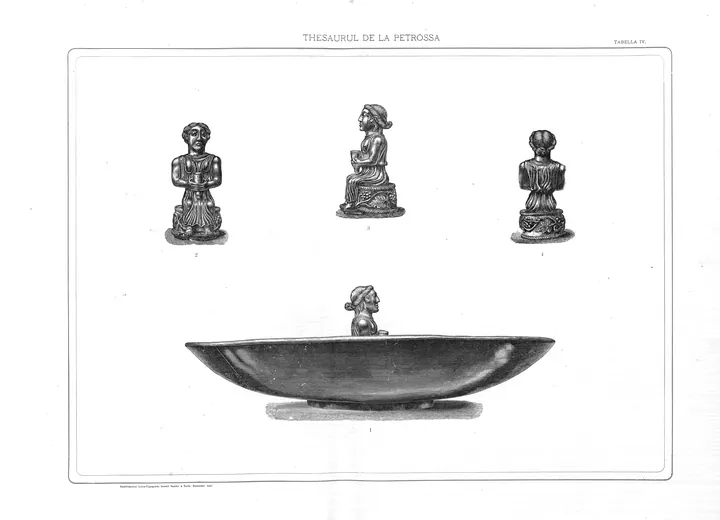
The patera Henric Trenk · Wikimedia Commons - Table IV: the round dish with Orphic figures in relief.
- Sixteen mythological figures ring a goddess on a throne.
- The central statuette holds a small cylindrical cup.
Plate pl. VIThe ewer
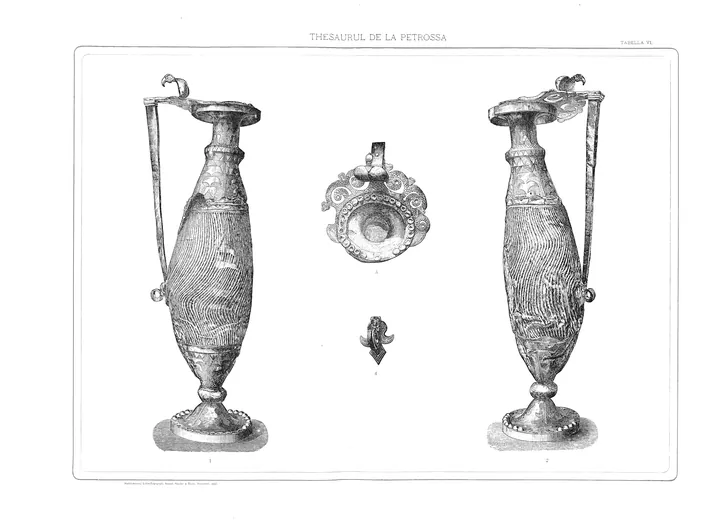
The ewer Henric Trenk · Wikimedia Commons - Table VI: the oenochoe, 36 centimetres tall, 1.7155 kg.
- A single handle, a bird at the hinge.
- Tin solder from an old mending still clung to it when Telge saw it.
Plate pl. IXThe great fibula
The great fibula Henric Trenk · Wikimedia Commons - Table IX: the eagle-headed brooch, the hen herself.
- Almandines and garnets in cloisonne and cabochon settings.
- Old photographs show the head was once detached.
Plate pl. XThe middle pair
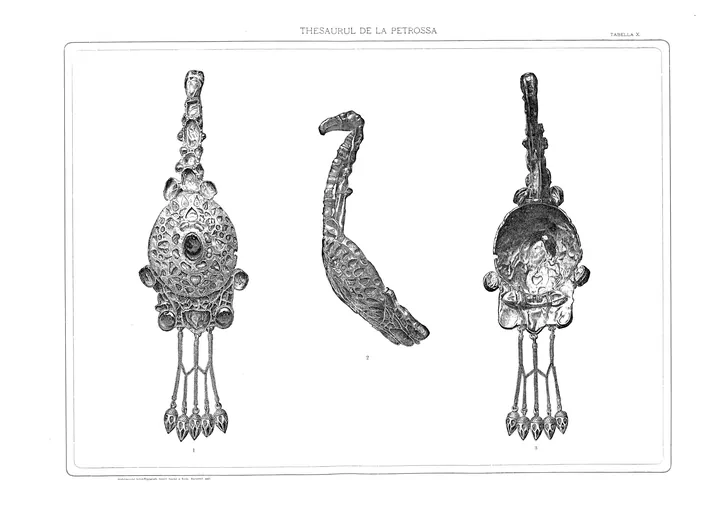
The middle pair Henric Trenk · Wikimedia Commons - Table X: two middle fibulae, once joined by a chain.
- Worn in pairs by Gothic women, says the caption.
- Five pendants hang from braided chains.
Plate pl. XIIIThe octagonal vessel
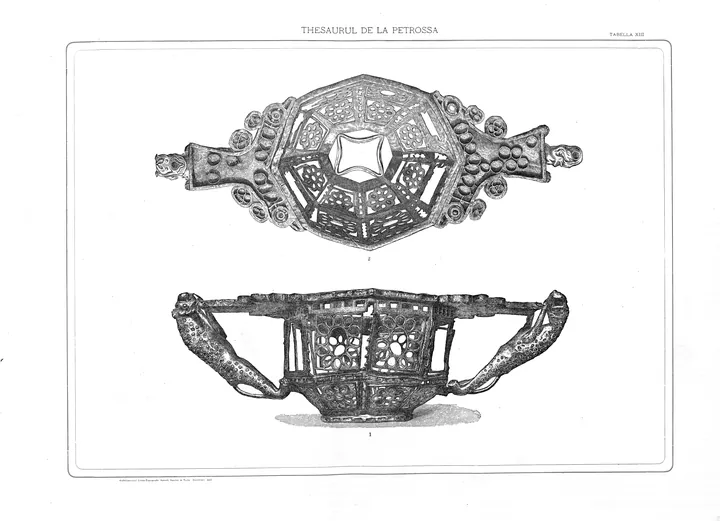
The octagonal vessel Henric Trenk · Wikimedia Commons - Table XIII: the eight-sided openwork vessel.
- Panther handles, one of them rebuilt.
- Telge called it the most ruined piece of the set.


Engravings after Henric Trenk from the Odobescu album (1889–1900), via Wikimedia Commons (public domain). Dates are plate references.
Pietroasa in six numbers
Every figure below comes from the cited histories. The years are the hoard's spine, 1837 to 1956.
- 1,837
- the Lent find at Pietroasa
- 22
- pieces in Lemnaru's count
- 12
- pieces survive at the MNIR
- 1,875
- the ceiling robbery
- 1,916
- the evacuation east begins
- 1,956
- the hoard comes home
Four things people get wrong
The hen is cursed
No period source says so. The documented seed is a joke: after 30 chimney fires next door during the 1900 Paris show, Edmond Pottier sighed with relief to see the “jinx” leave the Louvre – “Le porte-malheur borna là son influence”. Every real wound has a human author: the axe of 1838, the chisel, the melted bracelet, the tin solder.
It was King Athanaric's treasure
Odobescu argued it, following Neumeister – but modern archaeologists cannot connect the hoard with Athanaric, the Therving leader who died in 381. What the set does show is a royal or high-prelate service: no coins, no weapons, vessels and jewels of one stamp.
Odobescu sold it in Paris
A political smear. After the 1867 exhibition Bolliac accused the Bratianu ministry of selling the museum's gold; Odobescu answered with a published account of the Paris and London journey in 1869, and every piece came home.
The finders counted exactly 22 pieces
The 1838 testimonies disagree: the report says 16, Frunzăverde 17, Lemnaru 22 in one deposition and 26 in another. Twenty-two is Lemnaru's count, kept by convention – and twelve is what survives.
Sources and methods
The story follows the two treasure histories (Romanian and English) built on the 1838–1839 inquiry files, Odobescu's 1889–1900 monograph and the museum records; the train and return dates are cross-checked with the Moscow treasure page. All thirteen images are public domain or attribution-licensed CC BY-SA, via Wikimedia Commons.
Quoted testimony keeps the reporters' counts side by side instead of reconciling them; the findspot is given as presumed, because the 1838 Interior itself called it unknown. Translated quotes are marked by their source line.
The runic reading, Telge's shipping date, the 1941 album's outcome and any acid attack on the gold are undocumented here – so none is claimed. What the files do not prove is marked disputed, never invented.
The find
- The Lent 1837 find: Ion Lemnaru and Stan Avram, the Valea Urgoaiei quarry, the two slabs, the black earth
- The 1838 inquiries: order no. 2987 of 10 July, the 4,000-lei sale to Anastase the Serb, the axe, the Câlnău bridge, the 16/17/22/26 counts
- The 1839 trial: the Buzău–Agia–Ilfov files, Anastase's acquittal, the 29 September 1839 sentence
The museum
- Entering the museum: 28 March 1842 at Sfântul Sava, the 7 April 1842 list, 18.7975 kg of gold; the 1838–1840 Bisterfeld restoration
- Paris 1867 (12 entries, 16 pieces), the press accusations and Odobescu's 1869 reply; London 1868, Vienna 1873
- Odobescu's monograph: Le Trésor de Pétrossa, 3 volumes, Paris 1889–1900, Henric Trenk's plates
The robbery
- The robbery of the night of 19–20 November 1875: Pantazescu, the Senate Library ceiling, the rope, the diamond
- The 24–25 November escape, the recapture, the swallowed letter and the melted bracelet; sentence no. 1603 of 7 May 1876
- The 24–25 March 1884 fire and Paul Telge's Berlin restoration: the July 1884 report, the bronze, the chemically separated tin
Moscow
- The 1916–1917 evacuation: two transports, the second train with Pietroasa, Moscow arrival 3 August 1917
- The 1956 return: the June decision, the 28 July delegation, 39,320 pieces, the 23 August 1956 exhibition
- The hoard as a 4th-century Gothic set, the 12 pieces kept in Bucharest, the unconfirmed Athanaric attribution
The seven plates
Images
- Henric Trenk, 1889 · Wikimedia Commons
- Henric Trenk · Wikimedia Commons
- Henric Trenk · Wikimedia Commons
- Henric Trenk · Wikimedia Commons
- Henric Trenk · Wikimedia Commons
- Henric Trenk · Wikimedia Commons
- Henric Trenk · Wikimedia Commons
- Henric Trenk · Wikimedia Commons
- Weiss of Iasi · Wikimedia Commons
- After Henric Trenk · Wikimedia Commons
- Carol Szathmari, 1864 · Wikimedia Commons
- Unknown artist, 1875 · Wikimedia Commons
- CristianChirita, CC BY-SA 3.0 · Wikimedia Commons