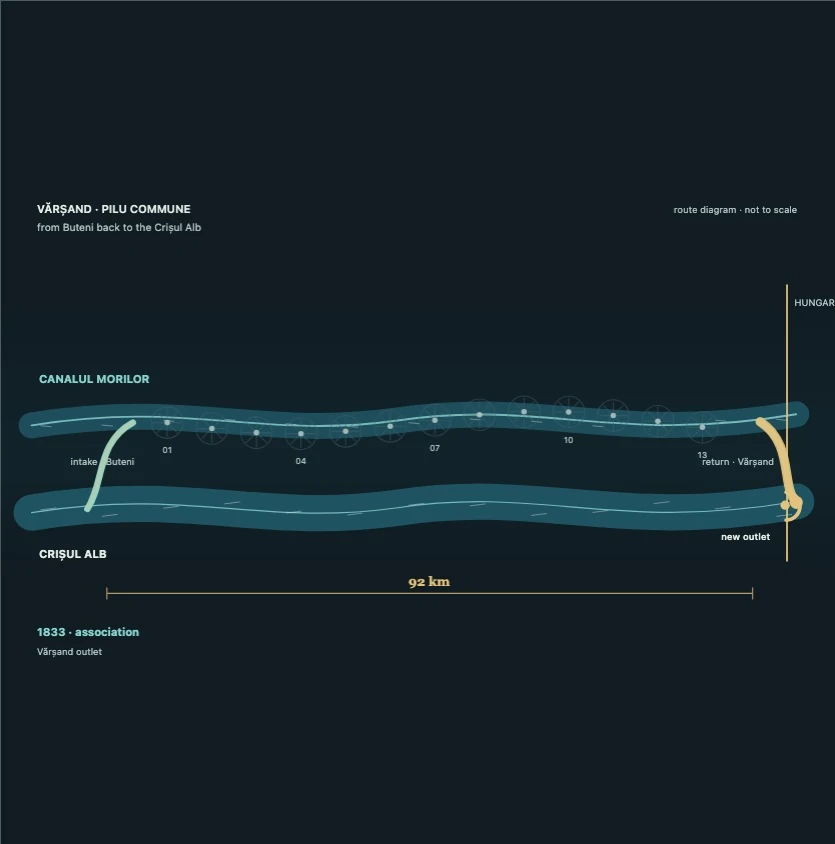
A ribbon of water leaves the Crișul Alb, passes a line of mills and returns to the river at Vărșand.
At Vărșand, the Canalul Morilor flows into the Crișul Alb.

Arad · Vărșand

Here the canal returns to the river

At one end of the route, in Vărșand village within Pilu commune, the canal rejoins the Crișul Alb. At the other, its intake is near Buteni. [1, 2]

Choose which part of the works to follow: the intake, the mills or the return to the river. The drawing traces the circuit; it does not reproduce the canal’s exact shape.

Follow one part of the canal

A route diagram, without scale or precise mill locations.

Start the story

1833 · agreement

Landowners agreed to dig a new channel

Landowners decided on the project in June 1833 and signed the association contract on 30 June. Engineer József Beszédes designed and led the works. 1

The canal was meant to move mills out of the Crișul Alb, use the water for milling and help manage flood flows. 1

1833–1855 · two dates

Sources date the start of operations differently

Aurel Dragoș writes that construction began in October 1833 and the entire channel filled with water on 5 November 1840. He records 13 mills operating then. 1

The Crișuri Water Basin Administration says the first hydraulic works and intake at Buteni were built after 1855. These may describe different phases; the sources cited here do not reconcile them into one opening date. 2

13 water wheels

The flow moved milling away from the river

The local history counts thirteen mills on the canal. Water diverted from the Crișul Alb powered them, while smaller mills were removed from the main channel to leave room for flood flows. 1

In the drawing, the wheels light up one by one. The sequence shows how the network worked; it does not give the precise location of each mill. 1

1920 · Vărșand

A new border changed the canal’s outlet

The Treaty of Trianon set the border between Romania and Hungary in 1920. The canal history records that Vărșand, the last settlement before the frontier, became the point where the channel was redirected into the Crișul Alb. 1

A political border changed the working route of the water. In the drawing, the outlet moves to Vărșand; the line does not claim cadastral precision or show the original channel. 1

1948–2003 · the mills stop

The last mill stopped in 2003

The nationalisation law of 11 June 1948 transferred the canal and mills to the state. The mills became less important after 1950. 1

The history records that the last mill stopped milling in August 2003. The canal remains as infrastructure and a trace in the landscape, with a history shaped by changes to water, ownership and the border. [1, 3]

Sources

The design, thirteen mills and 1840 date come from Aurel Dragoș’s local history, published by the Arad County Library. The Crișuri Water Basin Administration dates hydraulic works and the intake to after 1855. This difference is retained; the route drawing is not a cadastral map.

  1. History of the Canalul Morilor in Arad County

    Aurel Dragoș, a local history published by the Alexandru D. Xenopol Arad County Library: the 1833 project, water filling the canal on 5 November 1840, thirteen mills, its uses and the outlet change at Vărșand after 1920.

  2. Crișuri Water Basin Administration

    The basin administration says the first hydraulic works and the Buteni intake were built after 1855. It describes an 83.5 km channel plus the 8.5 km Ciohoș canal.

  3. Canalul Morilor · Arad County Library

    The County Library summarizes the canal’s role in water management and milling, and documents the infrastructure as a historic remnant.