Ploiești 1857: what did the world's first oil statistic actually count?
275 tonnes of crude in 1857 — the first oil statistic in the world, two years before Drake's well. What the figure counted, who counted it, and what is left of Ploiești's three world firsts once you change the meaning of “first”.
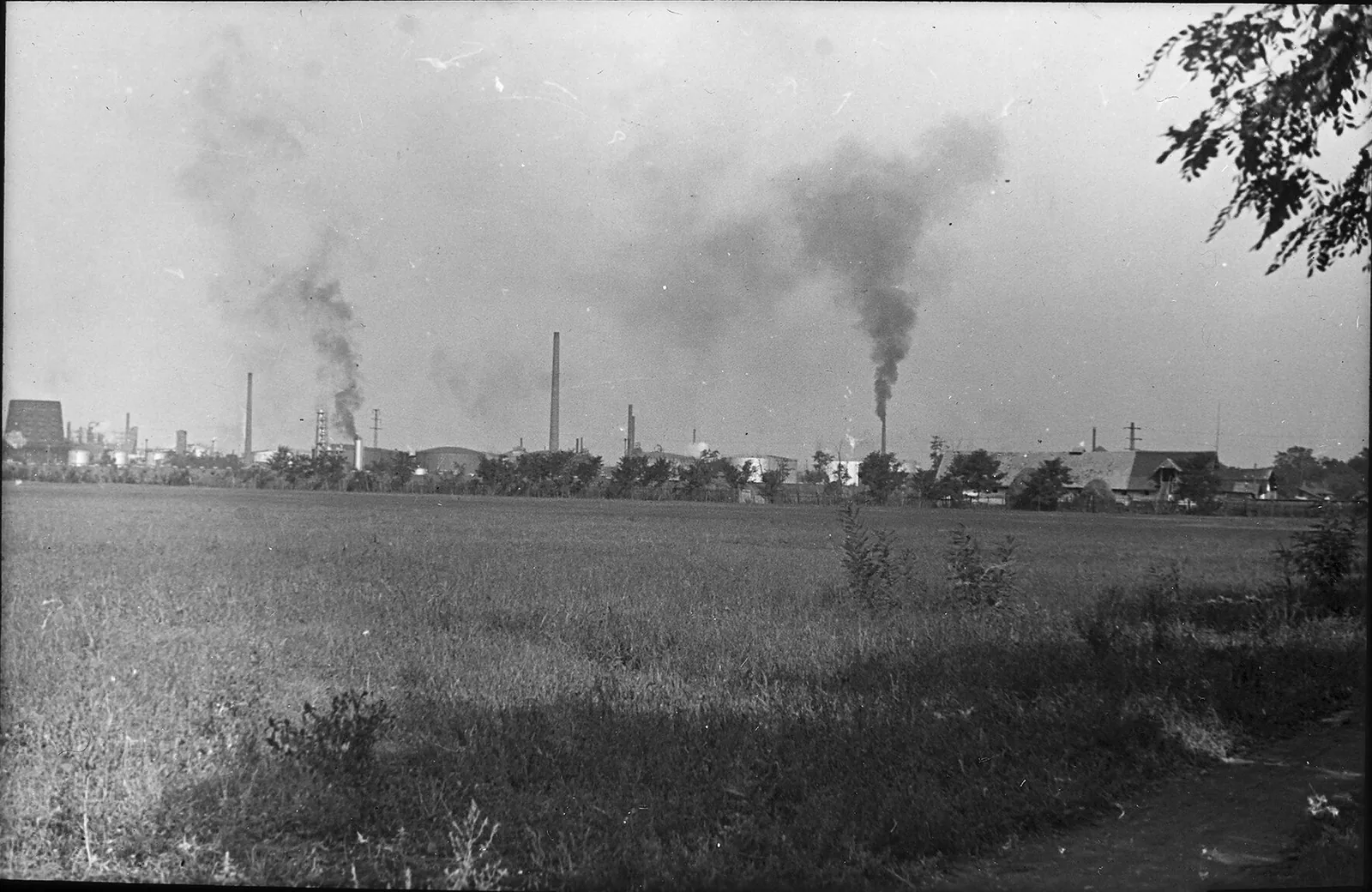
Ploiești from the south-east, 1935: refinery chimneys smoking over the fields — the town the 1857 figure put on the map. (Photo: Leo Wehrli, ETH-Bibliothek, CC BY-SA 4.0; cropped from the original slide.)
The question
Two years before Edwin Drake's well at Titusville, a market town in Wallachia — Ploiești, north of Bucharest — is said to have collected three world firsts in a single year: the first officially recorded crude production in the world's statistics, the first industrial refinery, and the first city with public kerosene street lighting. That is the story of 1857 as manuals and museum brochures print it.
The figure at the centre of the story is 275 tonnes of crude. The “Two Years Early” chronology puts it on Wallachia (Muntenia, the southern principality); the historian Gheorghe Buzatu puts it on both principalities; a petroleum engineers' slide deck prints 257 tonnes. Three sources, two figures, two scopes — for the same year.
First, a correction of names: in 1857 there was no Romania and no United Principalities. Moldavia and Wallachia united in 1859. The “Romania” in the famous sentence is the name pasted later onto the map of 1857 — a detail that overturns nothing, but shows how history gets written.
Until the union, the two principalities had separate princes, administrations and accounts — which is why the figure's scope (Wallachia, or both?) is the question itself, and each rung of the ladder answers it with its exact scope.
Before kerosene, Bucharest's lamps burned colza oil; the October 1856 contract replaces it with the Râfov refinery's products. That is how a refinery by Ploiești comes to hold the capital's lighting, with a signed contract and lamplighters.
The statisticstands
The refineryfalls
The lightingstands
What the ladder shows
Three columns — the statistic, the refinery, the lighting — with the evidence rungs of each claim. The rungs light up in turn as the story goes on; the definition cards move the decisive rungs up or down.
275 t — Buzatu · series
257 t — SPE 2013 · variant
3,760 m³ — 1842 · unverified
USA 274 t — 1859 · the series
MPR 1931 — cited · unopened
Râfov — 1857 · two brothers
7.5 t/day — nameplate
Ulaszowice — 1856 · the rival
three? — TICCIH · tension
1,000 — lamps · 1857
one lamp — Lwów · 1853
Iași · Vienna — 1858 · 1859
The ladder
Each rung below is one version of the story, with its exact scope and what its source counts. Read them all before drawing any line: the verdict comes after the evidence.
Rung 1 of 10 · the figure
275 tonnes, the principalities' output
Buzatu prints the figure with a footnote: the American Geographical Society's World Geography of Petroleum (1950), plus a 1931 supplement of the Romanian Petroleum Monitor. Both stand unopened — the citation chain stops here, for now.
Rung 2 of 10 · the variant
257 tonnes, in the engineers' slide
The Romanian petroleum engineers' presentation prints 257 tonnes a year for the same world title — 6.5% less. Misprint or a different series, nobody says. The two figures stand side by side, unaveraged.
Rung 3 of 10 · who counted
Nobody metered the wells in 1857
The figure covers output declared for tax, not everything that left the ground: local consumption stayed partly unreported. And the scope drifts — Wallachia in some tellings, both principalities in others — with no source showing the boundary.
Rung 4 of 10 · the rival
Baku was already counting, in 1842
The Russian Caspian Chamber is said to have reported 136 wells yielding 3,760 cubic metres a year — 23,600 barrels, 3,210–3,800 tonnes at the barrel rate — 11.7–13.8 times the Ploiești figure. The source is fragile (seen only via Wikipedia, original unverified), but the question stands: what kind of “first” leaves Baku out?
Rung 5 of 10 · the series
The rest of the world joins later: America, Italy, Canada, Russia
In the same international series, the United States appears in 1859 with 274 tonnes — one tonne away from the Ploiești figure — then Italy in 1860, Canada in 1862, Russia in 1863. The series is what keeps the claim standing.
Rung 6 of 10 · the refinery
Râfov: a contract in October 1856, lamps from April 1857
Teodor Mehedințeanu signs with Bucharest in October 1856; the refinery at Râfov, by Ploiești, starts on 1 April 1857, and brother Marin takes over in 1858. Nameplate capacity: 7.5 tonnes a day (2,700 tonnes a year) — ten times the year's figure.
Rung 7 of 10 · the rival
Ulaszowice, 1856: one year earlier
Łukasiewicz lights his lamp in Lwów (now Lviv) in March 1853, digs at Bóbrka in 1854 and builds the Ulaszowice refinery in 1856. Two serious sources — the TICCIH study and a Polish chemistry historian — give him the world title.
Rung 8 of 10 · the tension
Three refineries at Ploiești in 1856?
The same TICCIH study writes that Ploiești already had three refineries in 1856, and dates “first commercial production” only to 1860. It is a draft with internal contradictions — proof that even international texts disagree with themselves.
Rung 9 of 10 · the lamps
1,000 lamps, two dates
Buzatu and the Ploiești industry text give 1 April 1857; the “Two Years Early” chronology gives 30 April. The lamp count is steady — about 1,000, lit and put out every night by lamplighters — the day is not.
Rung 10 of 10 · the measure
One lamp is not a city
In Lwów one lamp burned in 1853; in Bucharest 1,000 lamps burned in 1857, then Iași (the Moldavian capital) in 1858, Vienna in 1859. The gap between a showcase and a network is the only thing that settles Bucharest's title.
The definition
All the evidence stands on the ladder. What is missing is the meaning of “first” — and that is yours to set. Each card asks one question; the answer moves the rungs on the ladder and changes the verdict. The decisive rungs rise or sink, and the verdict is written under each column. Nothing unlocks: it was all there already.
The strict reading is the narrowest definition that leaves each claim standing — or knocks it down.
The lamps
How much kerosene do 1,000 lamps drink in a year? The sum below uses consumption measured on real lamps, not story figures — and sets the result beside the 275 tonnes.
Wick lamps burn between 0.005–0.042 litres an hour, measured on eight laboratory lamps (Mills, 2005). A street lamp has a big burner, at the top of that range or above it: the sum takes 0.030–0.060 litres an hour. Multiply by 900–1,100 lamps, 8–12 hours a night, 365 nights.
The result: 78,840–289,080 litres of kerosene a year — 61.5–234.2 tonnes. Mid-range, 153,300 litres, 121.9 tonnes. The whole band fits inside the 275 tonnes of crude, with room for the still's losses and for other customers.
Room left: 40.8–213.5 tonnes at the official figure. And the 257-tonne variant passes the test at its edge, with 22.8–195.5 tonnes to spare — at the thirsty end, the margin is only 22.8 tonnes. The 18 tonnes between the two printed figures are exactly the margin between a comfortable fit and a tight one.
On the other side, the 275 tonnes are 36.7 days of the Râfov refinery's nameplate (7.5 tonnes a day) — 10.2% of a working year. The figure does not look like a national output at full stretch; it looks like the first year of a lighting business.
In barrels — the oil world's measure — the 275 tonnes come to 2,022 barrels, and the American 274 tonnes to 2,015 barrels: within 0.4% of each other. The world's first two national figures describe, for practical purposes, the same quantity of oil. And in 1857 measure, 275 tonnes are 220,000 ocale.
The room left is not an arithmetic error. Distilling has losses, the refinery sells to other customers besides the town hall, and from April 1858 Iași lights up too. Too tight a fit would be suspicious; the band leaves room precisely for what is unknown.
The lamps' kerosene band (61.5–234.2 tonnes) fits inside the 275 tonnes of crude; the 257-tonne variant passes at its edge. (Bars to a linear scale.)
Assumptions, stated plainly: a street burner above the measured top (the dominant uncertainty), 8–12 hours a night, lamps ±10%, density ±2%. Moonlit nights — when some cities left the lamps unlit — are unknown for Bucharest; the sum takes all 365 nights.
The measure
In 1857 oil was weighed in ocale — old weight units of 1.25 kilograms — and measured in vedre, and the Moldavian vadră ran almost a sixth bigger than the Wallachian one. That is the first trap of old accounts: the same figure in vedre means different quantities on either side of the Milcov, the old border river. Type how many litres you have, and the sum dresses them in 1857 clothes.
Ready-made quantities
Send the result
One oca of oil = 1.25 kilograms (Buzatu); one vadră = 12.88 litres in Wallachia and 15 litres in Moldavia (Stoicescu 1971, seen only via Wikipedia — unverified from the original). Kerosene density: 0.78–0.81 kilograms per litre.
The litres you type go nowhere; the sum is worked out on the spot.
The verdict
Under the strict reading — the narrowest definition that leaves each claim standing — the ladder looks like this:
The statistic
A country's annual figure in the industry's international series
stands — The statistic stands: in the international series, Russia only joins in 1863, and Baku never appears.
The refinery
The first industrial refinery in the world, anywhere
falls — The refinery falls: Ulaszowice, 1856, is one year ahead of Râfov.
The lighting
The first city with a whole public kerosene network
stands — The lighting stands: one lamp in Lwów is not a network of 1,000 lamps.
Two things do not reconcile, and stay unreconciled: the two figures (275 and 257) and the two dates (1 and 30 April). The ladder does not melt them into each other; it holds them side by side, each with its source — because their very mismatch shows how a famous figure travels from book to book.
What would overturn the verdict
Three papers could move the rungs: the 1931 supplement of the Romanian Petroleum Monitor (the figure's source, cited but unopened), the 1842 Caspian Chamber report (the Baku rival, unverified from the original), and the October 1856 contract file (the exact day of the first lit evening). Until then, the verdict above is all that can be honestly said.
And next time a “world first” crosses your path, take Ploiești's two questions with you: what did it count, and who counted it. Tonight, when the lamps go on, look at the first lamp on your street and think of Bucharest's 1,000 lamplighters.
Sources and method
The 275-tonne figure stands on Gheorghe Buzatu (Annals of the Academy of Romanian Scientists), pointing to the World Geography of Petroleum (1950) and the Romanian Petroleum Monitor (1931) — both unopened; the citation chain is shown, not hidden.
The lamps sum: 900–1,100 lamps × 8–12 hours × 365 nights × 0.030–0.060 litres an hour × 0.78–0.81 kilograms per litre = 61.5–234.2 tonnes of kerosene. Every multiplication starts from sourced numbers and can be redone on a pocket calculator.
Every proper name is verified in at least one opened source: Teodor and Marin Mehedințeanu (Buzatu; JPT), Râfov (Buzatu), Łukasiewicz (Mierzecki), Lwów, Bóbrka, Ulaszowice, Baku, Titusville.
Set aside with reasons: the distillation yield (a 54% figure circulates only through unverified citations — the lamps test does not need it), the “1859” dating of the lighting on one museum page (an isolated opinion), output after 1858 (the Oil Roads page's ground).
Old texts are quoted in the cited source's spelling; the English renderings of Romanian sources are Marius Comper's, with the original in the notes.
Still unopened: the 1931 supplement of the Romanian Petroleum Monitor, the World Geography of Petroleum (1950), Boncu's Contribuții (1971) and the Revista Arhivelor article (1967). If any of these papers surfaces in a digitised collection, the verdict is recalculated — every rung shows its paper.
Oil history
Gheorghe Buzatu — Oil and War in Romanian History (Annals AOSR): 275 tonnes, the October 1856 contract, 1 April 1857, Iași 1858, Vienna 1859.
James Douet — The Heritage of the Oil Industry, TICCIH study 2020 (draft): Ulaszowice 1856, Bucharest the first lit city, 1,000 lamps.
R. Mierzecki — Chemical ideas… (Technical Transactions): the March 1853 lamp, Bóbrka 1854, Ulaszowice 1856.
SPE / Journal of Petroleum Technology — Beyond the Looking Glass: 275 tonnes “through its refinery”, 2,700 tonnes a year of capacity.
SPE Romania — Brief history (2013/2023): the 257-tonne-a-year variant.
Trade press and institutions
Aegean Oil Consulting (Ploiești) — history page: 275 tonnes, the USA 1859 – Italy 1860 – Canada 1862 – Russia 1863 series, 1 April 1857.
Energy Industry Review (Lavinia Iancu, 2017): 275 tonnes; the USA in 1859 with 274 tonnes; the Lucăcești distilleries.
The Ministry of Energy of Azerbaijan — history page: industrial extraction at Bibi-Heybat, 1846.
M. F. Mir-Babayev — Azerbaijan's Oil History (Azerbaijan International, 2002): the 1846 well; 1 pood = 16.38 kilograms.
Measures and physics
Evan Mills et al. (LBNL / Science, 2005): measured 0.005–0.042 litres an hour on wick lamps.
Energy Education (University of Calgary): 1 barrel ≈ 159 litres ≈ 0.136 tonnes.
Wikipedia — Kerosene (a physical constant): density 0.78–0.81 g/cm³; Romanian units of measurement: the 12.88 / 15-litre vadră (after Stoicescu 1971, unopened).
Wikipedia — Petroleum industry in Azerbaijan (a weak source, unverified from the original): the 1842 count, 136 wells, 3,760 cubic metres.
Chronologies and neighbours
Two Years Early (mariuscomper.uk): the 1846–1901 chronology that asserts the firsts — 275 tonnes on Wallachia, 30 April 1857, the Lwów–Gorlice concession.
The Oil Roads (mariuscomper.uk): the Prahova valley after 1857 — the story's natural continuation.
First Attestation (mariuscomper.uk): Ploiești, first written down in 1503.
Encyclopaedia Britannica — Romania: the principalities united in 1859.