Marius ComperPodu Iloaiei · Iași
Română

Podu Iloaiei · memory and records

Podu Iloaiei and the 1941 list of victims

On 30 June 1941, a train carrying Jews seized in Iași reached Podu Iloaiei. Survivors began writing down the names of the dead. One was Moise Ițicovici, a tailor from Iași. How did the list survive?

Start with the list ↓
Gravestones on a grassy hill, with the town in the distance.
Gravestones in the cemetery at Podu Iloaiei, photographed in 2007. (Source · Jonathan Jacobi · Wikimedia Commons · CC BY-SA 3.0)

The community

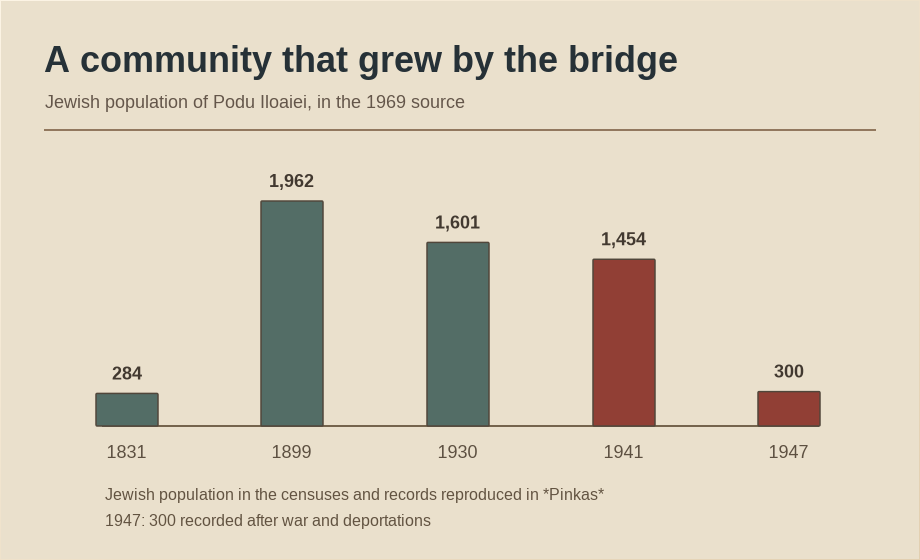
Bar chart of the Jewish population in 1831, 1899, 1930, 1941 and 1947.
Yad Vashem’s community history records growth from 284 Jews in 1831 to 1,962 in 1899. It gives 300 for 1947. This series describes the community’s population, not the number of train victims. (Source)

The community

A town built around a bridge

Podu Iloaiei grew around a bridge over the Bahlui on the road between Iași, Roman and Târgu Frumos. Yad Vashem’s history of the Jewish community says Jews settled here in the early nineteenth century; in 1818, the landowner Palade received a licence to establish the settlement.

The source counted 1,962 Jews in 1899, almost 68% of the population. It recorded 1,601 in 1930 and 1,454 in 1941. The community school had operated since 1899, and the town included bakers, tailors, shoemakers, blacksmiths and fishers. These details put the community’s life in Podu Iloaiei in view before the train arrived.

Bar chart of the Jewish population in 1831, 1899, 1930, 1941 and 1947.
Yad Vashem’s community history records growth from 284 Jews in 1831 to 1,962 in 1899. It gives 300 for 1947. This series describes the community’s population, not the number of train victims. (Source)

The train

30 June 1941

After the Iași pogrom, Romanian authorities sent Jews arrested there by train to Podu Iloaiei. The Centre for the Study of Jewish History in Romania (CSIER) dates the arrival to 30 June. A report by the Iași Gendarmerie Inspectorate, later published in a documentary volume, records 1,974 people received by the prefecture’s delegate.

The report gives 1,198 deaths and 776 survivors; it notes that one survivor was a Romanian Christian and that the other 775 were housed with local Jewish families and in synagogues. This is a record written by an authority of the state involved in persecution. It must be read alongside testimony and the list made by survivors.
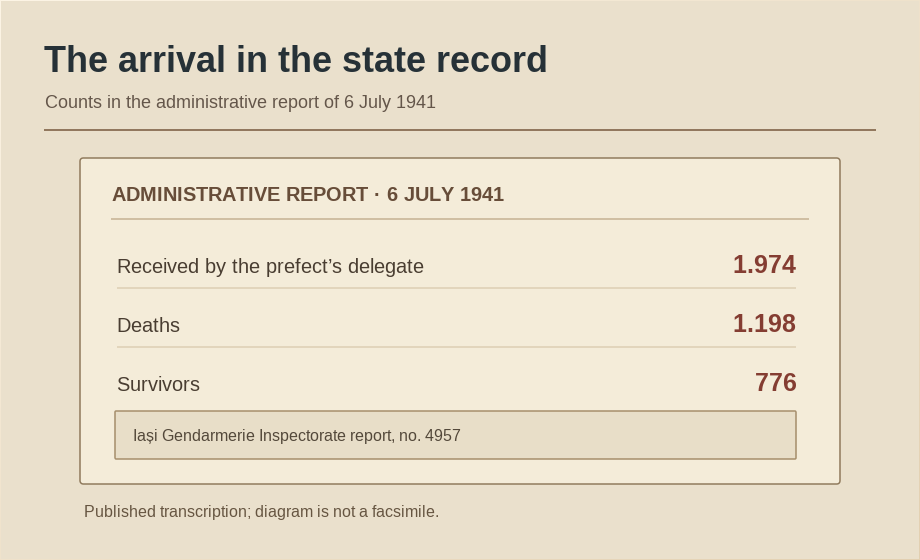
Schematic transcription of the report: 1,974 received, 1,198 dead, 776 survivors.
The Iași Gendarmerie Inspectorate report, reproduced in a 1991 documentary volume, says the prefecture’s delegate received 1,974 people: 1,198 had died and 776 survived. This is a record by a Romanian authority involved in persecution, not a neutral account. (Source)

The list

Names written by survivors

A survivor began writing names after the dead had been unloaded from the train. In testimony recorded by CSIER in 2006, Leizer Finchelstein said some names came from documents found in pockets and others from survivors who recognised people.

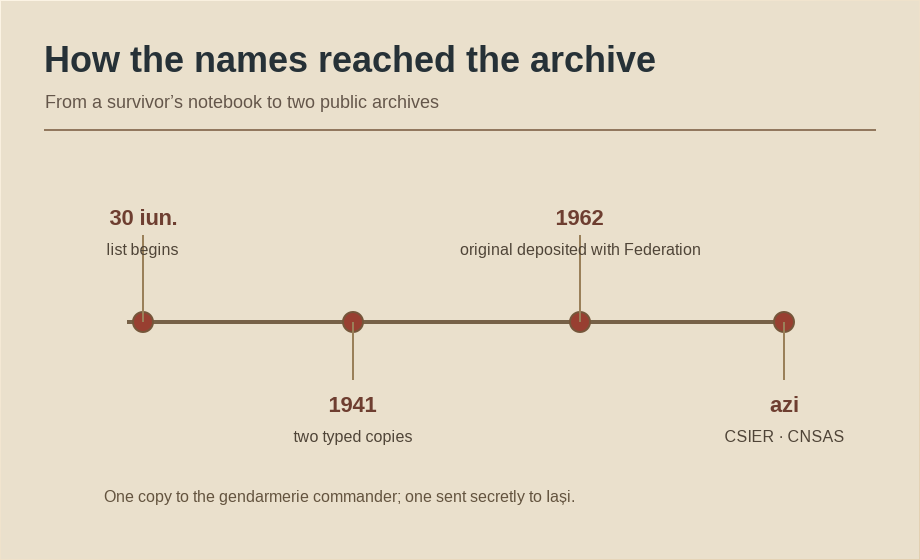
A former employee of the Podu Iloaiei bank typed the list the survivors completed. One copy went to the commander of the gendarmes. Another was smuggled out to Iosef Iacob, president of the Jewish community in Iași. In 1962 the original went into the archive of the Federation of Jewish Communities in Romania. Romania’s National Council for the Study of the Securitate Archives (CNSAS) holds a copy collected by the former secret police.
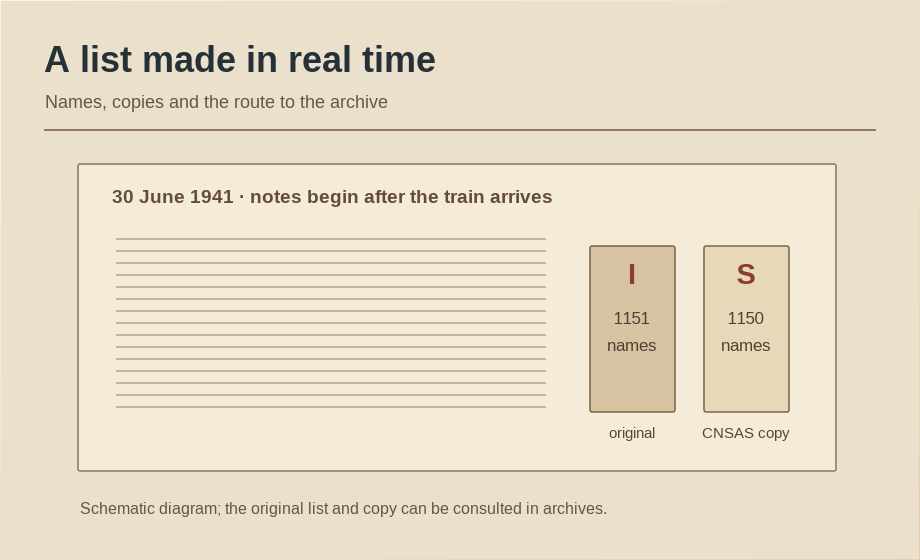
Schematic register with name lines and two cards for the 1,151-name original and 1,150-name copy.
According to CSIER, a survivor began writing down names after the dead were unloaded. In a 2006 interview, Leizer Finchelstein said names came from papers found in pockets and from survivors identifying people. The original has 1,151 names; the Securitate copy has 1,150. (Source)
Timeline from the notebook begun in 1941 through two typed copies, deposit in 1962 and present custody at CSIER and CNSAS.
CSIER says survivors remaining in Podu Iloaiei had the list typed. One copy went to the local gendarmerie commander; another was sent secretly to Iosef Iacob in Iași. In 1962 the document entered the archive of the Federation of Jewish Communities in Romania; the Securitate copy is now held by CNSAS. (Source)

One name

Moise Ițicovici, tailor

Among the people named on the list is Moise Ițicovici, a tailor from Iași. He was married to Clara Croitoru, from Bivolari. On 29 June 1941 he was taken from his home on I. C. Brătianu Street and died on the train to Podu Iloaiei.

Moise’s photograph survives in a work card issued by the Ministry of Labour in January 1940. The Centre for the Study of Jewish History in Romania publishes it alongside his biography. After the war, Clara applied for state help because she was living in poverty.
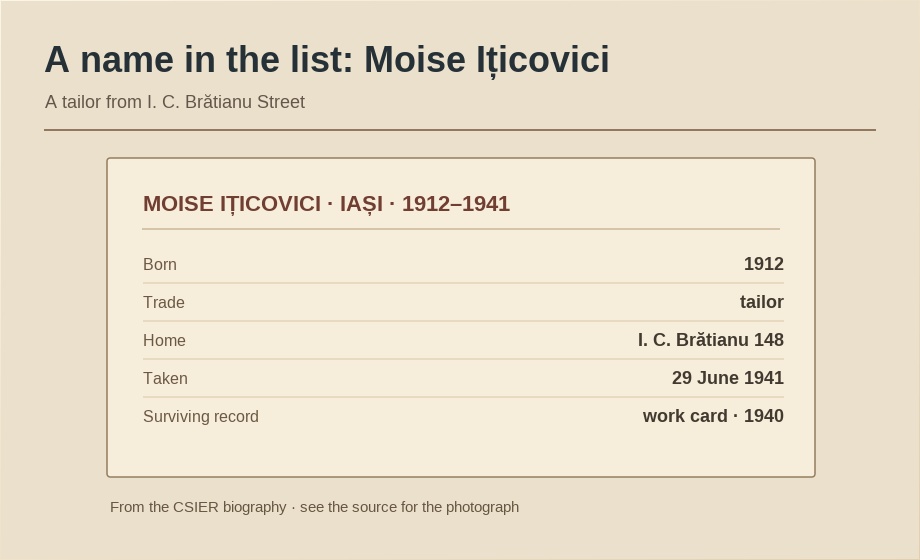
Biographical panel for Moise Ițicovici, giving his profession and the date he was taken.
Biographical details from CSIER. The photograph in the work card is available at the source. (Source)

The burial

A mass grave at the Jewish cemetery

The official report says the dead were unloaded beside the railway and entrusted to the local Jewish community for transport to the cemetery and burial. It describes common graves dug three metres deep, lime poured over the bodies and at least a metre of soil above.

CSIER cites a note in its archive: 1,254 people were buried between 30 June and 4 July 1941. Memorial Museums locates the mass grave at Podu Iloaiei’s Jewish cemetery. The sources used here do not establish the grave’s shape or dimensions.
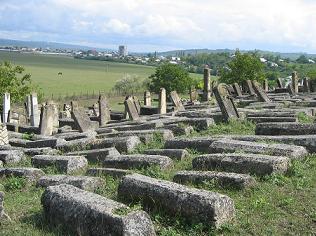
Gravestones on a grassy hill, with the town in the distance.
Gravestones in the cemetery at Podu Iloaiei, photographed in 2007. (Source · Jonathan Jacobi · Wikimedia Commons · CC BY-SA 3.0)
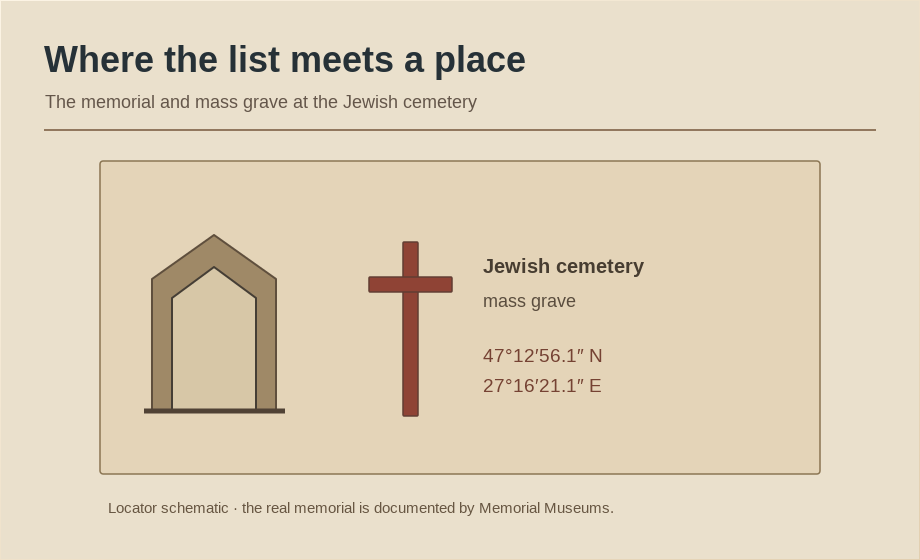
Schematic Jewish cemetery with a memorial marker and the published coordinates of the mass grave.
CSIER describes burials in common graves at Podu Iloaiei. Memorial Museums locates the mass grave at the Jewish cemetery and publishes its coordinates. This is an explanatory locator, not a plan of the cemetery or memorial. (Source)

The counts

Why do the records give different counts?

The gendarmerie report records 1,198 deaths. The CSIER note gives 1,254 burials from 30 June to 4 July. The original list has 1,151 names, and the copy that reached the Securitate has 1,150. In the English translation published by JewishGen, the community history from the Yad Vashem encyclopaedia gives 1,194 deaths on the train.

Some records count the dead or the burials. The survivors’ list records people who were identified. The available records leave some differences between totals unexplained. A name written down by survivors can tell us who died even where the total remains in question.
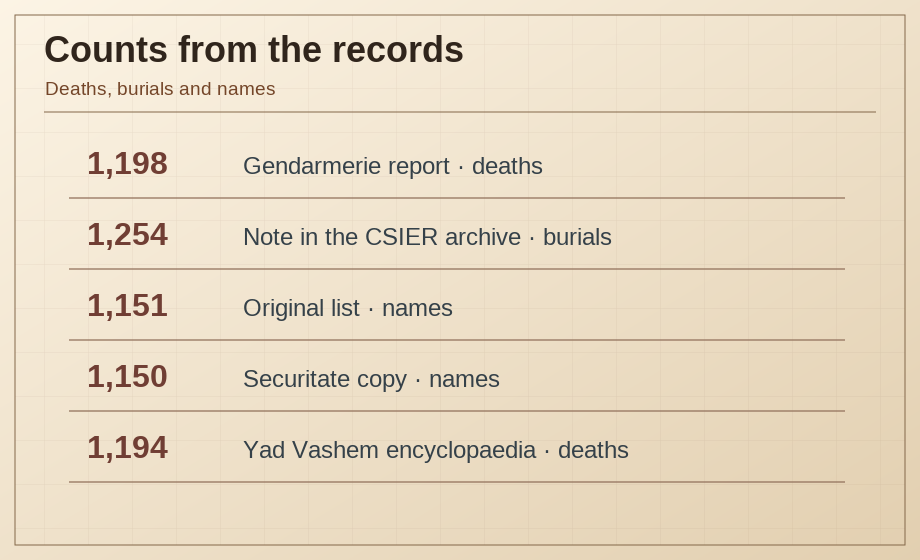
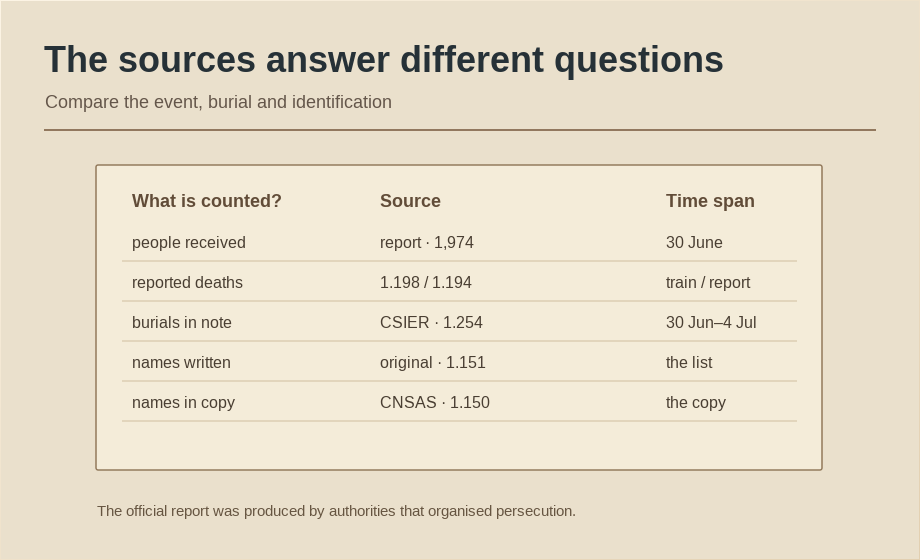
Separate rows for deaths, burials and the named people in the two copies.
Five figures, each with its source and what it counts. (Source)
Table with five rows for people received, deaths, burials and the two name counts.
The table separates people received by the authorities, reported deaths, burials described in a note and names preserved in two copies. The differences remain visible; these records do not yield one verified total that replaces them. (Source)

Sources

At the Jewish cemetery, the memorial marks the burial site. The list held by the Federation of Jewish Communities in Romania and the copy at CNSAS lead back to the survivors who gathered names, had the list typed and sent it to Iași. We can follow what survives about some of those who died, including the tailor Moise Ițicovici.

  1. Center for the Study of Jewish History in Romania (CSIER), digital biographies and documentsDrawing on a 2006 oral-history interview with Leizer Finchelstein and a note in the CSIER archive, this account explains how the Podu Iloaiei list was assembled. It gives 1,254 burials, 1,151 names in the original and 1,150 in a Securitate copy. It also includes Moise Ițicovici’s biography and a photograph of his work card.
  2. Iași Gendarmerie Inspectorate, report no. 4957 of 6 July 1941, reproduced in *The Martyrdom of Romania’s Jews, 1940–1944: documents and testimonies* (1991)Published transcription of an administrative report by the Romanian authority receiving the train. It records 1,974 people received, 1,198 deaths and 776 survivors. This is a record of a state involved in persecution and must be read as such.
  3. Theodore Lavi, “Podul Iloaiei”, *Pinkas Hakehillot Romania*, vol. I (Yad Vashem, 1969), translation hosted by JewishGenSource for community life and the published series of Jewish population figures before and after the war. JewishGen warns that the English translation has not been verified against the original; only its printed figures are used here.
  4. Memorial Museums, memorials to the victims of the June 1941 pogromDocuments the memorial at the Jewish cemetery and gives the Podu Iloaiei mass grave coordinates: 47°12′56.1″N, 27°16′21.1″E.
  5. JewishGen Yizkor Book Project, *The Jewish Community in Podu Iloaiei*, pp. 21–41Testimony about the train stopping near Podu Iloaiei station, burial at the Jewish cemetery and the memorial erected after the war.
  6. Jonathan Jacobi, Jewish cemetery at Podu Iloaiei, 2007View of the gravestones and the town.