Marius ComperRailway bridge over the Borcea branch
Română

Railway bridge over the Borcea branch

The Borcea bridge: how the railway link broke and returned

At Fetești, the bridge over the Borcea branch was one of three railway crossings on the way to Cernavodă. After it was destroyed in 1916, a ferry carried the transfers; normal traffic returned in December 1921 after a reconstruction that reused girders brought from Hungary.

Start the story ↓
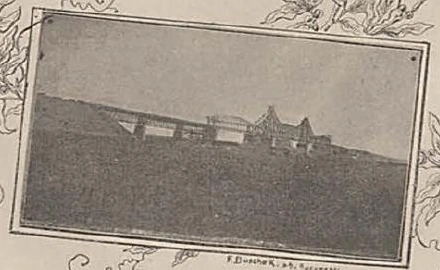
Historical photograph showing the bridge girders rising above the approach viaduct.
Detail from the lower-left photograph. The low floodplain viaduct leads to the taller girders over the channel. (Source · 1896 calendar / National Library of Romania · Public domain)

Where the railway crosses water
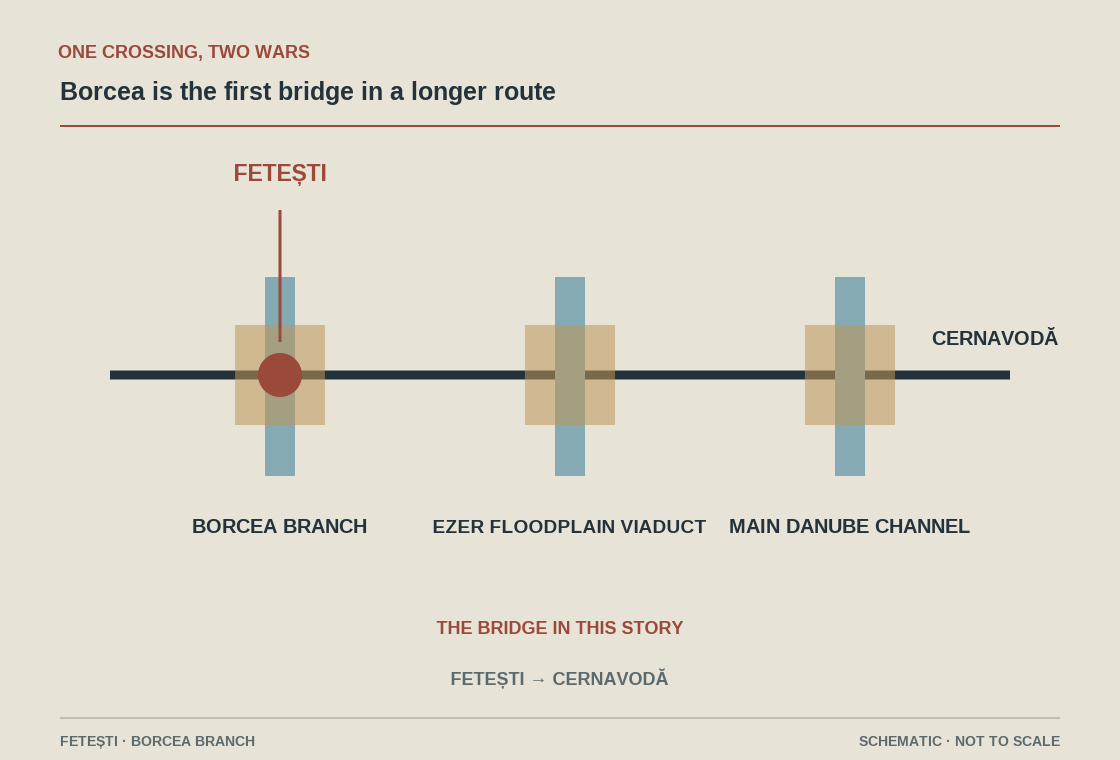
Diagram of three crossings on the Fetești–Cernavodă route; the Borcea bridge is marked beside Fetești.
The diagram separates the Borcea bridge from the floodplain viaduct and the bridge over the main Danube. It shows sequence, not distance. (Source · Original editorial diagram derived from the cited sources; schematic, not to scale.)

Where the railway crosses water

Borcea is not the Danube crossing at Cernavodă

The bridge at Fetești crosses the Borcea branch of the Danube, just east of town. On the way to Cernavodă, trains then crossed the Ezer floodplain and the Danube’s main channel. These were three separate structures, not one long bridge. [1] [5]

This story stops at the first crossing, over Borcea. In 1916 the retreating Romanian army destroyed this bridge for military reasons; the Cernavodă bridge was damaged separately and remained standing. [2]

Diagram of three crossings on the Fetești–Cernavodă route; the Borcea bridge is marked beside Fetești.
The diagram separates the Borcea bridge from the floodplain viaduct and the bridge over the main Danube. It shows sequence, not distance. (Source · Original editorial diagram derived from the cited sources; schematic, not to scale.)

What the Fetești bridge looked like

Three 140-metre spans

The 1945 engineering account gives the Borcea bridge and its floodplain viaducts a combined length of 970 m. The main river channel was crossed by three metal spans, each 140 m long. [1]

The bridge belonged to a 21 km railway route with several crossings and flood-prone ground. This plate enlarges only the bridge over the Borcea channel; the approach viaducts are reduced to a band so the difference between the main spans and floodplain is clear. [1]

In the calendar published after the opening, the lower-left photograph shows the viaducts leading up to the taller girders. The modern photograph looks at the bridge from the later crossing over the same branch. [6] [4]
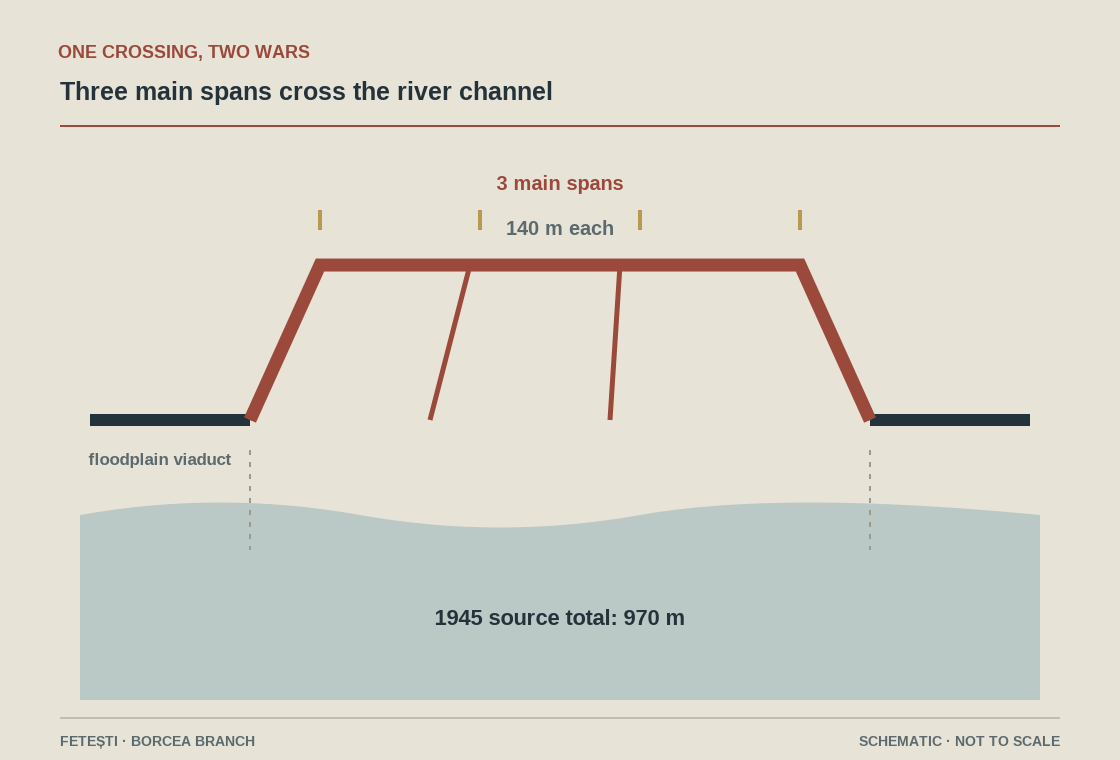
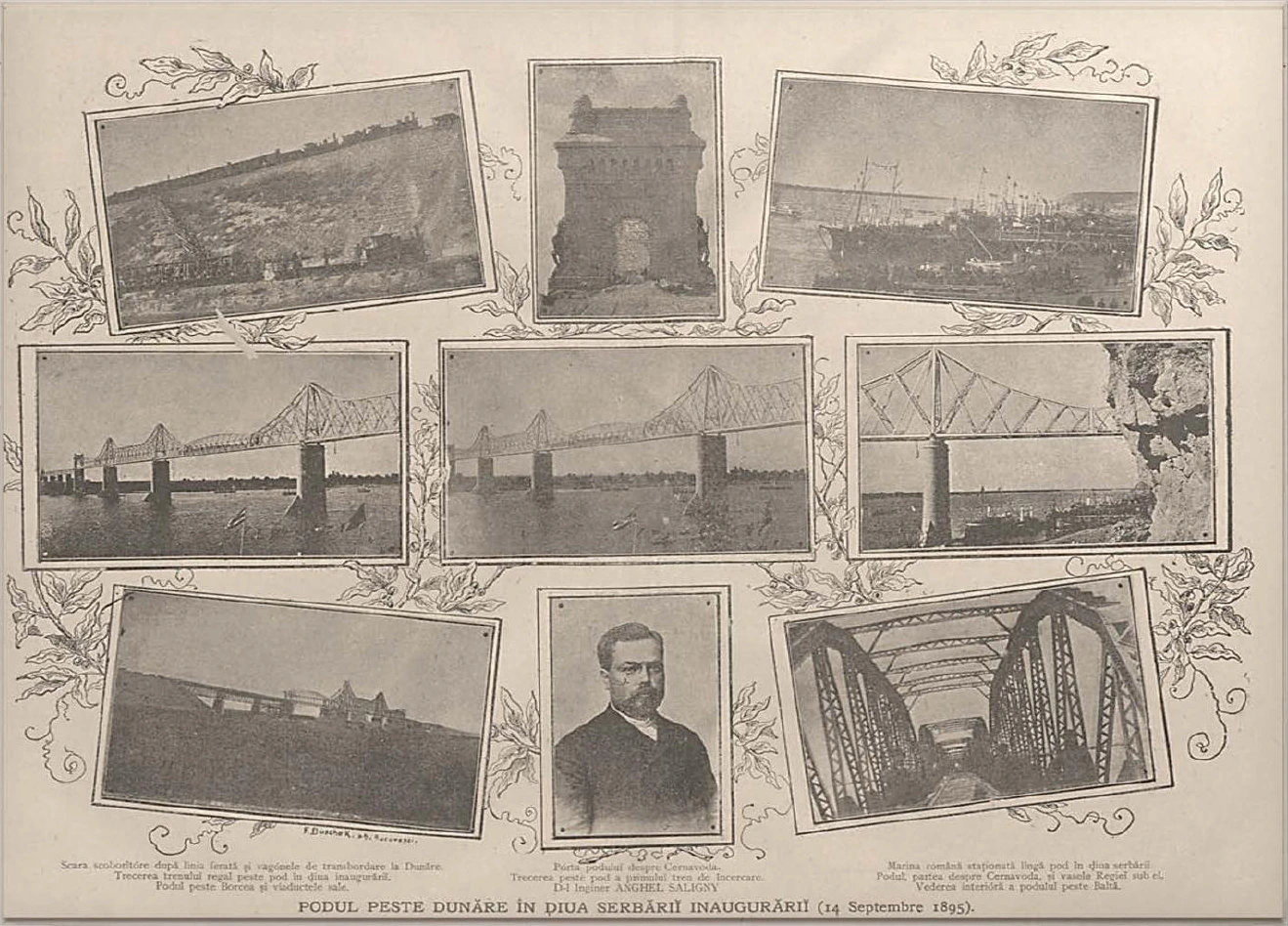
Diagram of a metal bridge with three main spans over water and simplified viaducts on both banks.
Span dimensions follow the engineering account. The 970 m figure is the stated combined length of bridge and viaducts. (Source · Original editorial diagram derived from the cited sources; schematic, not to scale.)
Sepia plate of nine photographs, including bridge decks and a portrait of Anghel Saligny.
The plate gathers photographs from several points on the line. Look in the lower left for the Borcea bridge and its approach viaducts. (Source · 1896 calendar / National Library of Romania · Public domain)
Historical photograph showing the bridge girders rising above the approach viaduct.
Detail from the lower-left photograph. The low floodplain viaduct leads to the taller girders over the channel. (Source · 1896 calendar / National Library of Romania · Public domain)

October 1916

The Borcea spans fall and the railway link breaks

During the Romanian army’s retreat in 1916, the three main spans over Borcea were destroyed. A 1945 engineering article includes a technical photograph of the wreckage and describes separate damage to the bridge at Cernavodă. [2] [1]

The distinction matters: the main-Danube bridge remained standing, although damaged; at Borcea, the central spans fell. Our diagram interprets the written account and figure 7. It is not a copy of the photograph or a blast plan. [2] [1]
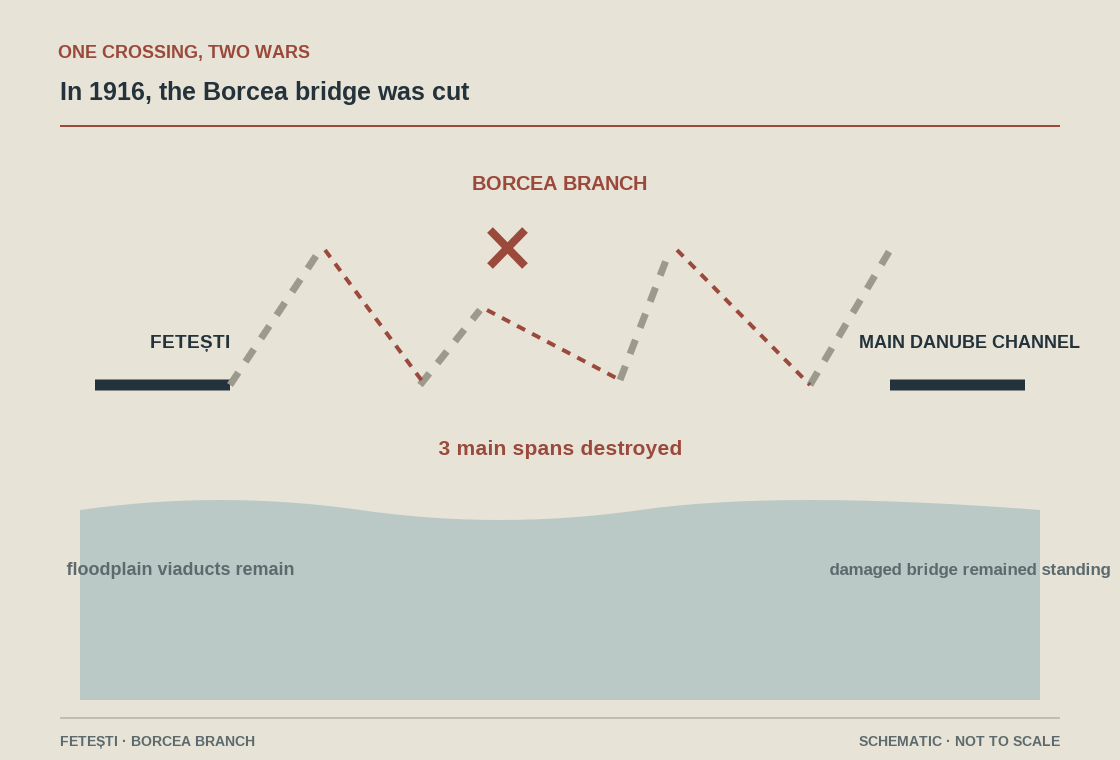
Diagram of broken central Borcea spans, surviving viaducts and the still-standing Cernavodă bridge.
Dashed lines represent the three Borcea spans described as destroyed. The main bridge at Cernavodă is shown separately as damaged but still standing. (Source · Original editorial diagram derived from the cited sources; schematic, not to scale.)

The temporary connection

Trains reached the bank. Freight crossed by ferry

Rail traffic between Fetești and Cernavodă returned in stages. The 1945 engineering account says that after the Cernavodă bridge was repaired in February 1918, locomotives could run as far as Borcea, where passengers and freight changed conveyance. [1]

A later study records a German ferry with improvised railway tracks on both banks. After Romanian administration returned, the ferry was improved and worked until December 1921. Only then did the Fetești–Cernavodă line return to normal service. [2] [1]
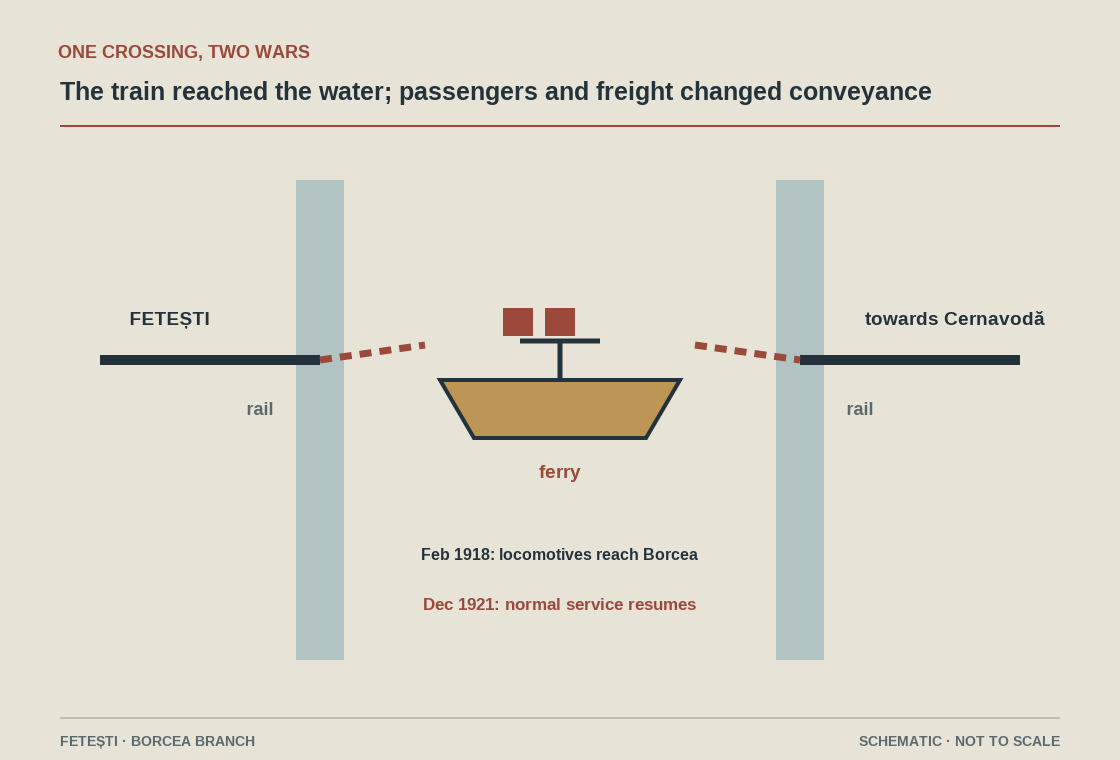
A train reaches the bank, carriages are transferred to a ferry, and the railway continues from the opposite bank.
The diagram shows the train reaching the bank and a transfer across the water. It does not depict a particular ferry or timetable. (Source · Original editorial diagram derived from the cited sources; schematic, not to scale.)

The project approved in 1920

Reconstruction combined new and reused girders

The file reviewed by the Higher Technical Council specified a new girder from Reșița Works and two independent 101.76 m girders brought from Hungary. They were recovered materials received as war reparations. The project was reviewed in April 1920, and Reșița undertook to build and install the new girder within eleven months. [3]

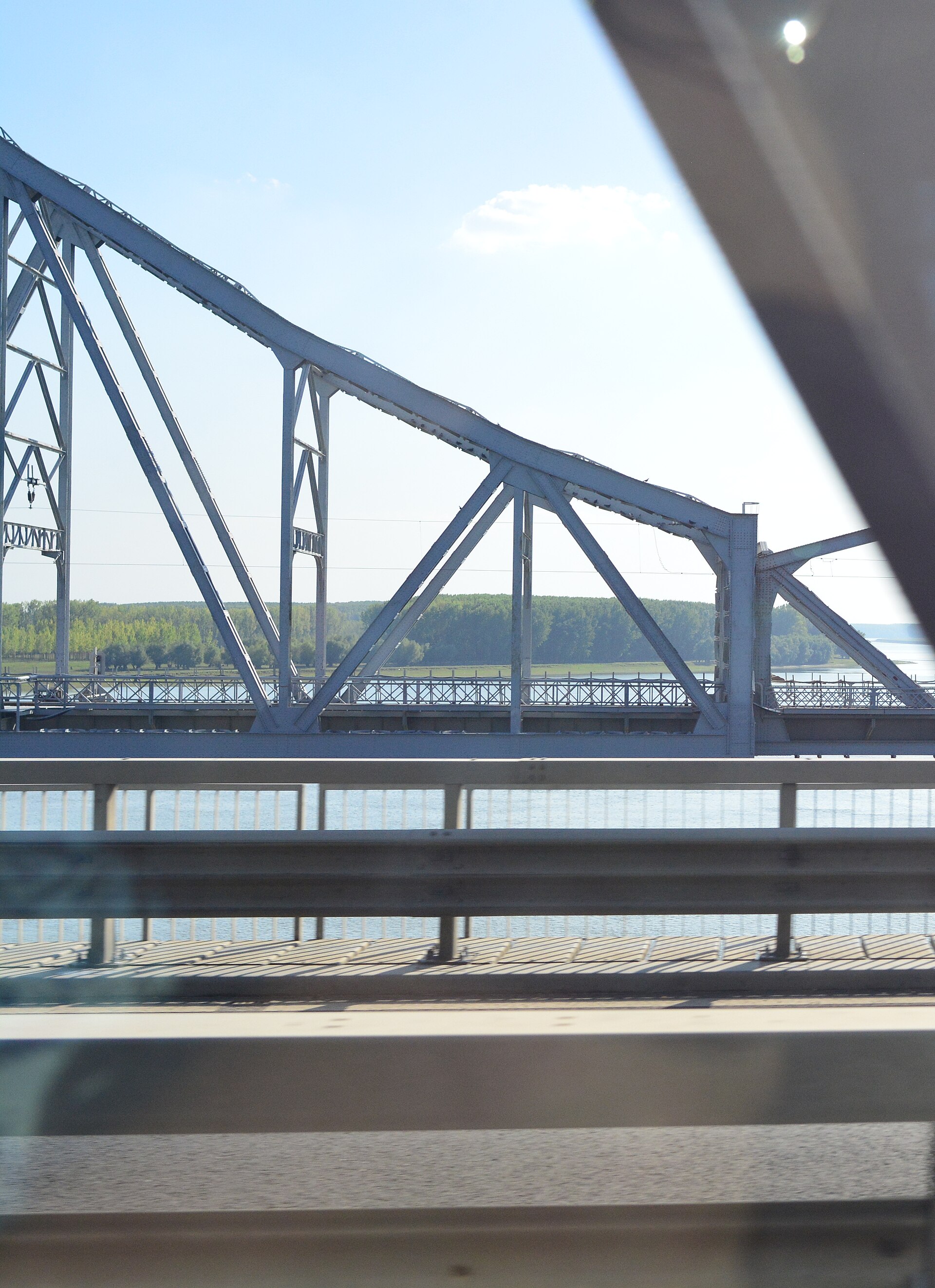
The 1945 engineering account confirms that normal traffic resumed in December 1921. The photograph looks from the newer combined road-and-rail bridge towards the old railway bridge. It shows two neighbouring generations, not the 1895 structure in untouched form. [1] [4]
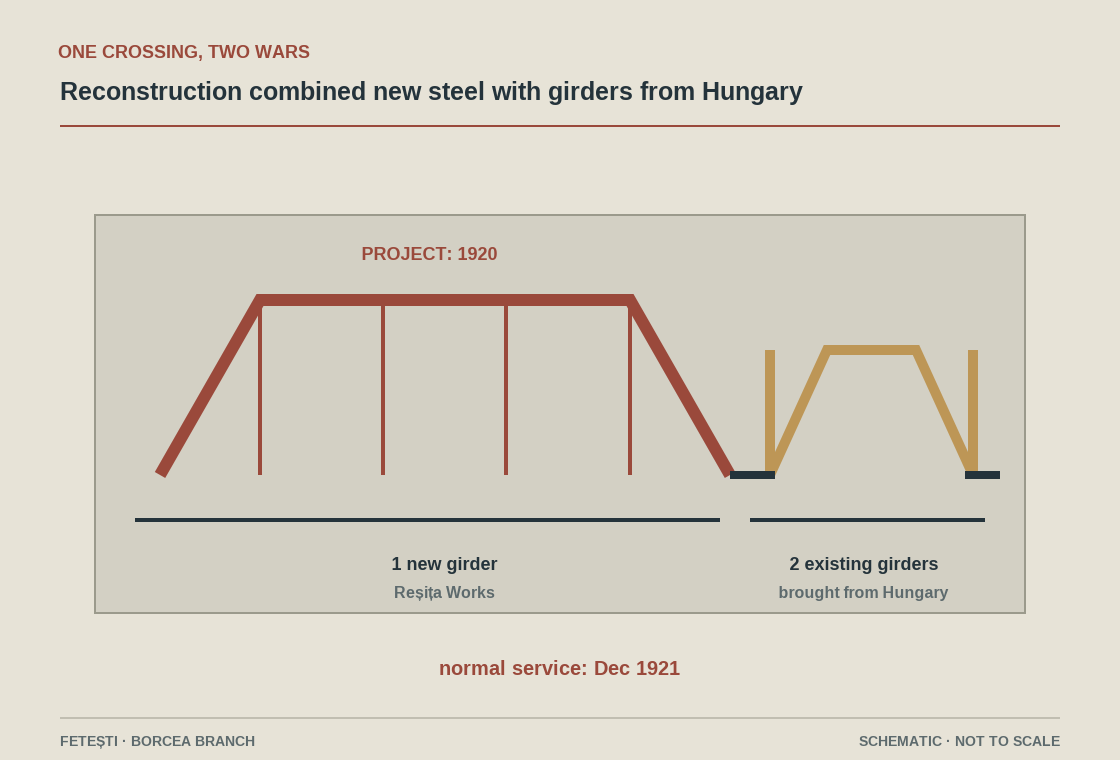
Comparison between a new cantilever girder and two reused independent girders.
The 1920 plan called for one new girder and two independent girders brought from Hungary. Diagram is not to scale. (Source · Original editorial diagram derived from the cited sources; schematic, not to scale.)
View towards two railway bridges over the Borcea branch, photographed from a newer bridge.
Joe Mabel photographed this on 24 September 2024 from the combined bridge built in 1987, looking towards the 1895 railway bridge over the Borcea branch. CC BY-SA 4.0. (2024 photograph · Joe Mabel, Wikimedia Commons. · CC BY-SA 4.0)

Sources

At Fetești, one bridge section once interrupted an entire route. The documents show how a ferry and a staged reconstruction restored the connection.

  1. N. Bujoreanu, “The Fetești–Cernavodă Bridges in Their First 50 Years of Operation”, 1945Engineering account, pp. 291–297; p. 294, fig. 7 shows the Borcea bridge destroyed in 1916; pp. 294–295 describe damage, ferry service, normal traffic returning in December 1921 and the reconstruction girders.
  2. Acta Moldaviae Meridionalis, “The Carol I Bridge”The study distinguishes damage to the Borcea bridge from damage to the main-Danube bridge and describes repairs during German occupation; pp. 342–343.
  3. Revista Construcțiilor, reconstruction of the Borcea bridgeReconstruction based on the Higher Technical Council file: the 1920 project specified one new 140 m cantilever girder and two independent 101.76 m girders brought from Hungary.
  4. Joe Mabel, Fetești Bridge 01Photograph taken on 24 September 2024 from the newer (1987) combined road-and-rail bridge, looking toward the old (1895) railway bridge over the Borcea branch. CC BY-SA 4.0.
  5. OpenStreetMap, Fetești BridgeGeographic reference for the adjacent crossings near Fetești on the Borcea branch. The story follows the historic railway bridge.
  6. Calendar for All Romanians for 1896, pp. 104–105Opening-day plate for 14 September 1895 from the National Library of Romania’s copy. The caption identifies the lower-left image as the Borcea bridge and its viaducts.