Pompeii, AD 72–79
A Pompeii brothel graffito that a Romanian can almost read
On a wall in Pompeii, about two metres above the floor, someone scratched a line of Latin nearly 2,000 years ago. Put it into the dialect of Oltenia, in south-west Romania, and it comes out almost word for word. Here is what reached Romanian, what was lost on the way, and where people still use its tense.
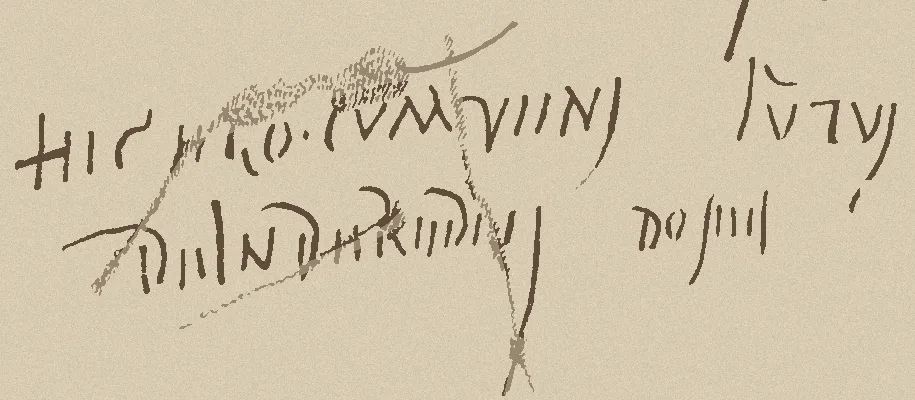
On the wall, in LatinHic ego cum veni futui, deinde redei domi.
In Oltenian RomanianAici eu, cum venii, futui, apoi mersei acasă.
In EnglishWhen I came here, I fucked, and then I went home.
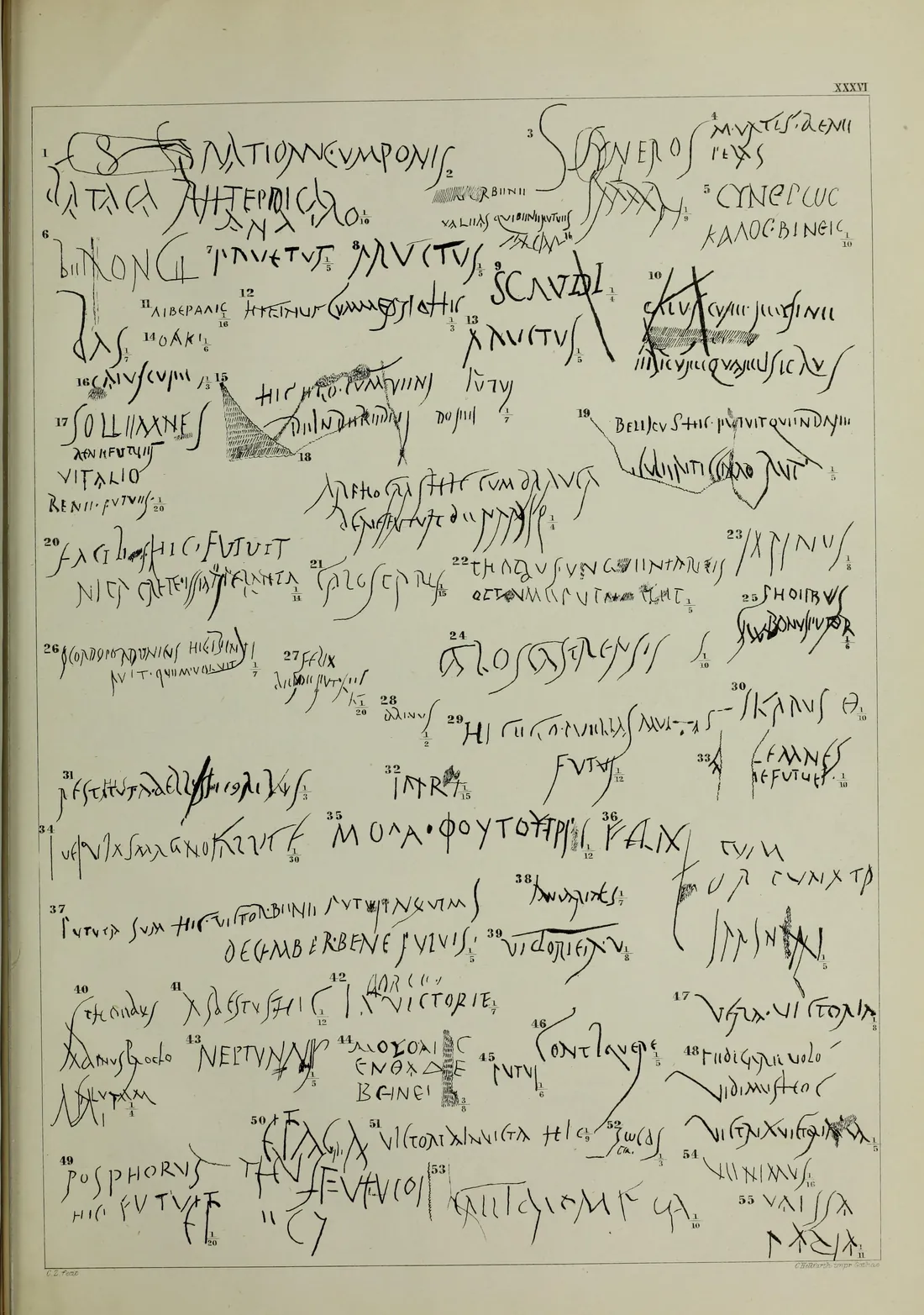
The letters are from the drawing Karl Zangemeister made at the wall, published in 1871 at 1:7; the jagged lines are the cracks he drew. Every E is written as two strokes, II.
Tap a word on the wall or in the lines below to see what it became.
A line written at full stretch, above the bed
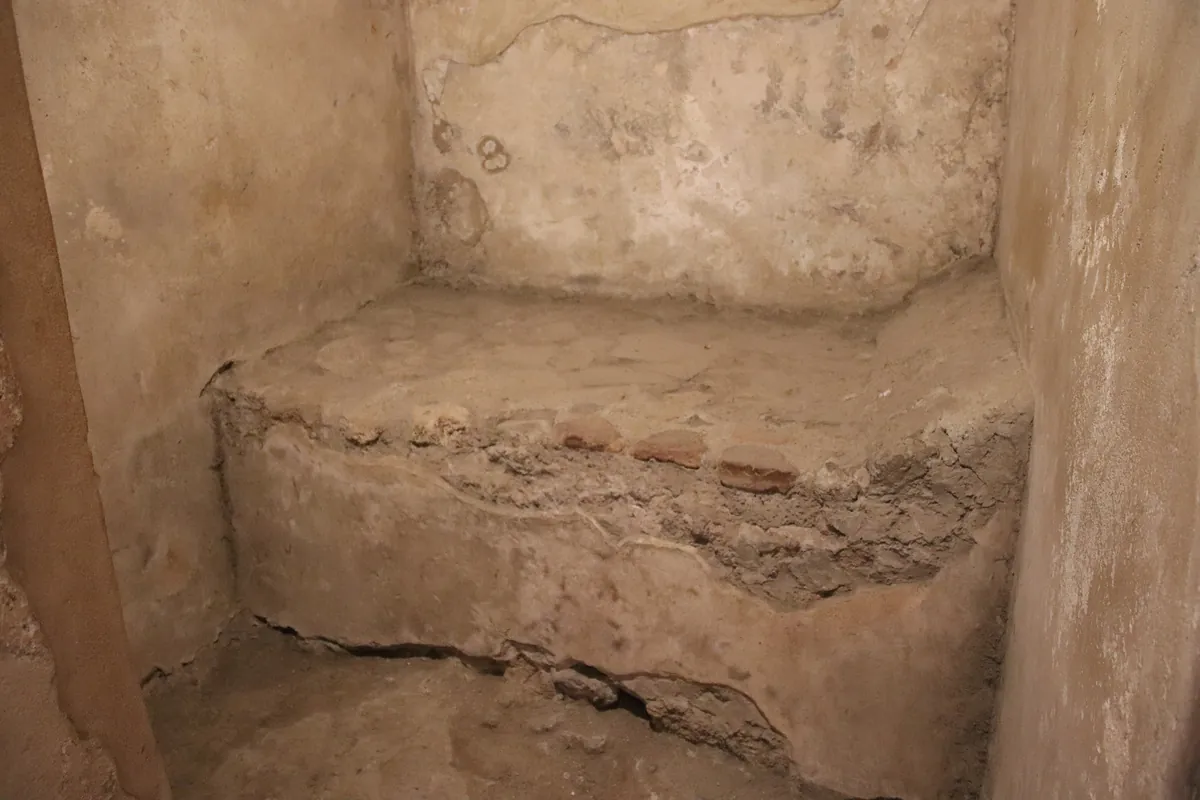
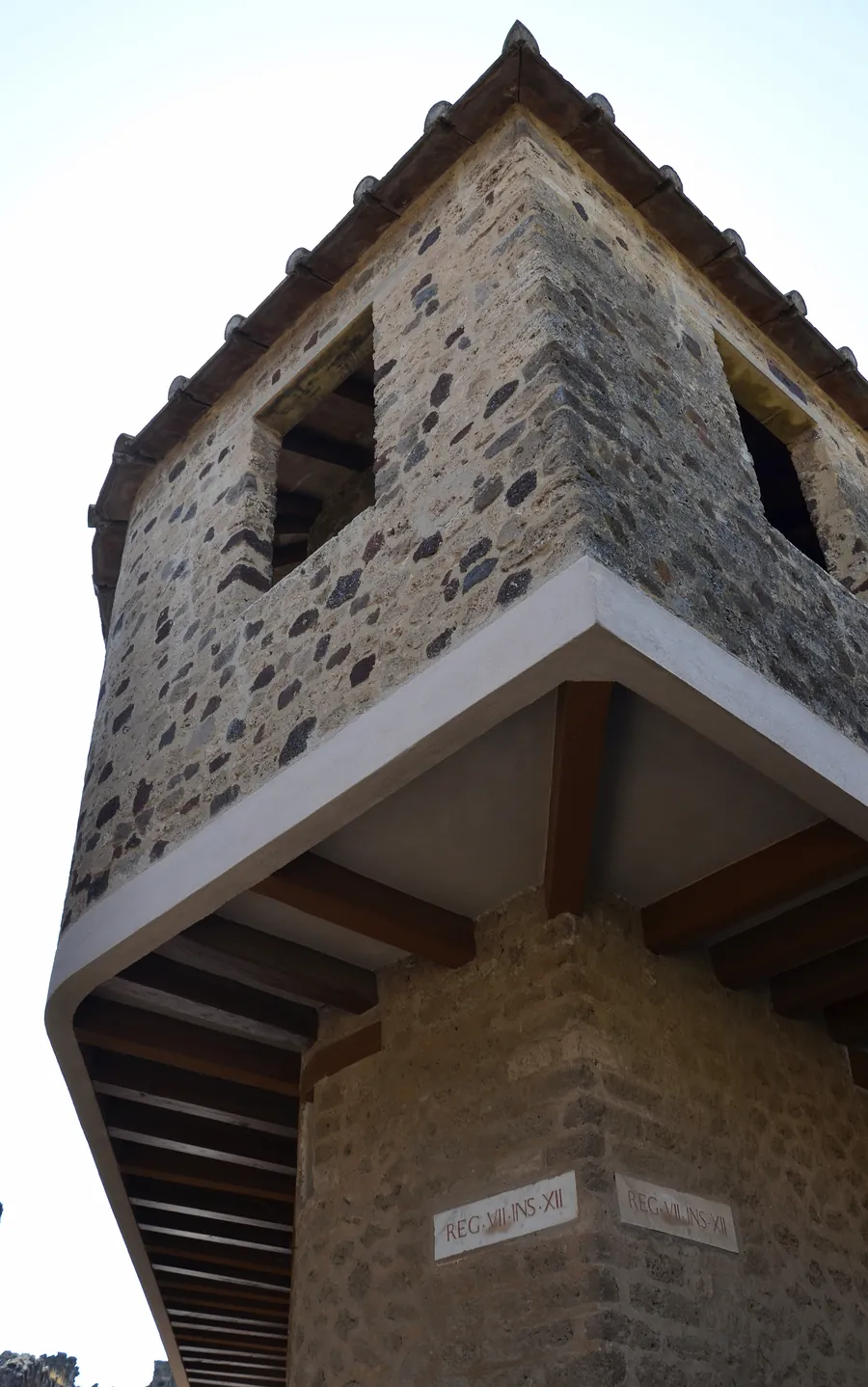
Pompeii's brothel stands at a junction of narrow streets, two blocks from the forum. On the ground floor it has five rooms off a corridor, each with a built masonry bed. Small erotic paintings line the corridor walls. The building was excavated in 1862.
Nearly 150 texts and drawings were found scratched on its walls. Only a third are sexually explicit; names are the largest group. The still-wet plaster also kept round marks that may be fingerprints.
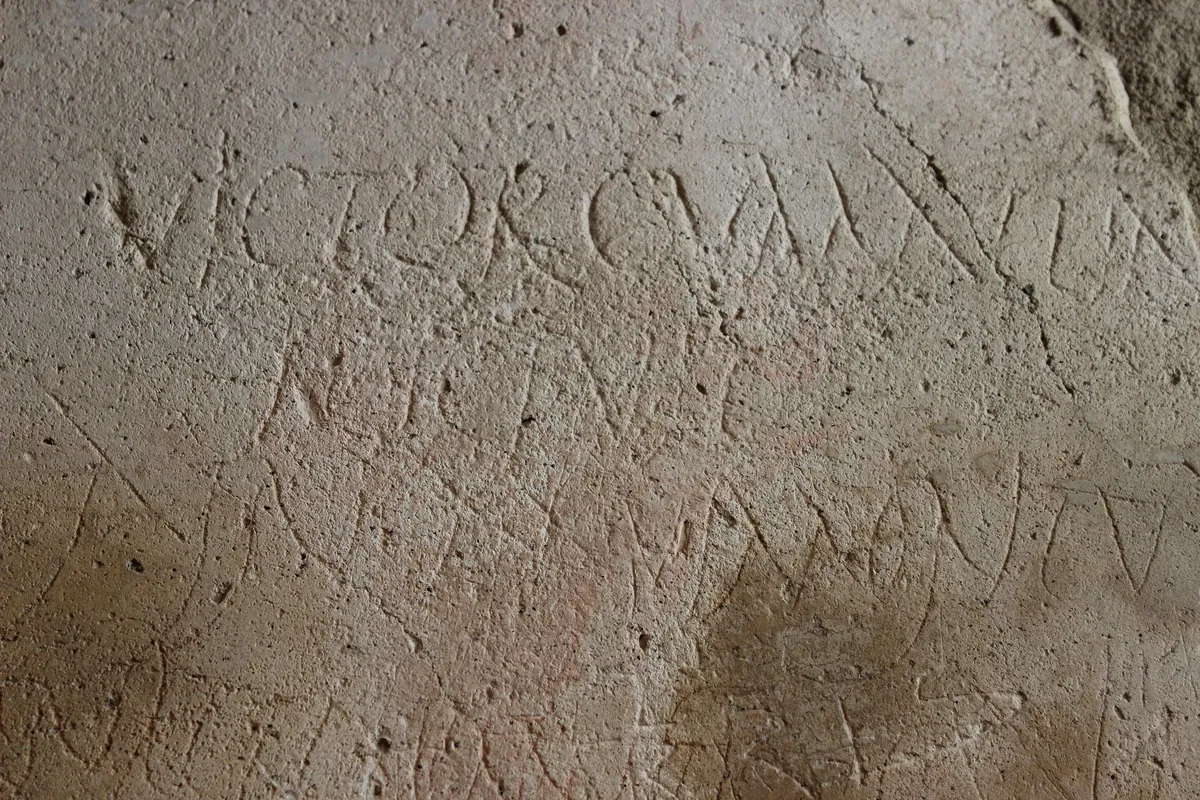
Our line is on the north wall of room e, nearly 7 feet from the floor. The bed does not touch that wall, so the writer, according to Sarah Levin-Richardson, stood at the very foot of it and reached across and up. Just below it someone wrote Bellicus hic futuit, “Bellicus fucked here”.
A coin pressed into the wet plaster of another room dates the brothel's remodelling to AD 72. The line is therefore most likely from the town's last seven years, before Vesuvius buried it in 79, probably in the autumn.
No photograph of it has been published under an open licence. Karl Zangemeister copied it at the wall and printed it in 1871, in volume four of the Corpus Inscriptionum Latinarum, with the note Lectio certa est, “the reading is certain”. The letters at the top of this page are from his drawing.
- Where
- The Lupanar, Regio VII, block 12, entrances 18–20; room e, north wall
- Height
- nearly 7 feet from the floor
- Size
- 17.5 × 46.9 cm, letters 1.5–2.1 cm, measured on the 1871 drawing
- Writing
- scratched into plaster with a point, Roman cursive
- Number
- CIL IV 2246

.jpg)
.jpg)
Eight words: four survived, three were lost, one only looks alike
Pick a word and find it on the wall. The colour says what happened to it between Pompeii and Craiova, the main town of Oltenia.
4 reached Romanian · 1 only looks alike · 3 were lost
- reached Romanian
- a different word, same shape
- lost on the way
reached Romanian “here”
Romanian kept the word with an a stuck to the front: aici comes from spoken Latin *ad-hicce, “right here”. For Maramureș, in the north, the dictionary also records ai, from ad hic.
reached Romanian “I”
Ego became eu: the middle consonant dropped out and the final o closed to u.
a different word, same shape “when”
Here cum means “when”. That word died out in every Romance language. Romanian cum has a different ancestor, quomodo, “in what way”, which had already started to mean “when” in late Latin. The dictionary gives cum venea, “as he was coming”. So cum venii sounds natural in Romanian: the same three letters, a different word.
reached Romanian “I came”
The verb survived: Romanian a veni comes from venire. The form changed on the way. Latin veni had no suffix; venii has the ending of auzii, “I heard”, which comes from audivi.
reached Romanian “I fucked”
Of the words that survived, the only one spelled the same. Romanian a fute comes from futuere, and futui is both the Latin perfect and the Romanian simple past, first person. The stress moved: Romans said FU-tu-i, Romanians say fu-TUI. Other perfects in -ui came through the same way: Old Romanian tăcuiu, “I fell silent”, from tacui.
lost on the way “then”
Deinde left nothing in modern Romanian. Romanian built its own word from Latin parts: apoi comes from ad post, “to after”.
lost on the way “I went back” classical Latin: redii
Redei is redii, “I went back”, spelled with ei for ii. The verb, redire, did not reach Romanian. “I went back” is mă întorsei, from intorquere, “to twist”. The Oltenian version above says mersei, “I went”: Romanian a merge comes from mergere, which in Latin meant “to sink”.
lost on the way “home” classical Latin: domum
Domus, “house”, vanished from Romanian (modern dom, “dome”, is a French loan). Acasă is a plus casă, and Latin casa was a cottage, a hut.
The lost words are all in the second line. The first line came through almost whole; of the second, only the build survived: a verb in the same past tense as veni and futui, which Romanian also has.
The Romanian simple past is the Latin perfect, half rebuilt
Venii, futui, mersei are in the perfect simplu, the Romanian simple past. It continues the Latin perfect, the tense of veni, vidi, vici. Some forms came straight through: auzii, “I heard”, from audivi; cântai, “I sang”, from cantavi; fui, “I was”, from fui.
Others could not. Feci, “I made”, should have become feĉ, and mersi something like merș. Those forms exist: in Old Romanian (feciu, merșu) and today in Aromanian, south of the Danube (feĉu, nerșu). North of the Danube, Romanian rebuilt them on the model of auzii and cântai, which gave făcui, mersei, zisei.
Pick a verb
| Latin | Old Romanian · Aromanian | Today | The verb |
|---|---|---|---|
| — | auzii | a auzicame straight through | |
| — | cântai | a cântacame straight through | |
| — | fui | a ficame straight through | |
| dedeiOld Romanian | dădui | a darebuilt | |
| steteiOld Romanian | stătui | a starebuilt | |
| feciu · feĉuOld Romanian · Aromanian | făcui | a facerebuilt | |
| merșu · nerșuOld Romanian · Aromanian | mersei | a mergerebuilt | |
| dzâșuAromanian | zisei | a zicerebuilt | |
| arșuAromanian | arsei | a arderebuilt | |
| copșuAromanian | copsei | a coacerebuilt |
Today I came; yesterday I have come
In most of Romania the simple past has dropped out of speech; the compound past (am venit, “I have come”) took its place. It survives in the west: Oltenia, the Banat, the Apuseni Mountains, western Muntenia. In Oltenia and south-west Muntenia it also has a special use: it tells what you did earlier the same day. For yesterday speakers usually switch to the compound past, though when telling of older events the simple past can return.
In 1985 the linguist Victorela Neagoe found the same use in villages of the Apuseni Mountains, in Transylvania: Neagra, Gârda, Scărișoara, Arieșeni. That area does not border Oltenia, so, she wrote, Oltenia “can no longer be considered the centre” of the simple past. South of the Danube, in Aromanian, it is, in Grigore Brâncuș's words, “a very frequently used tense”.
In the survey Neagoe describes, Zorița Neag, 28, from Negrești, was asked:
What did you do yesterday?
“ieri n-am făcut mari triabă // am vinit acolo la un cumnat”“yesterday I didn't do much // I have come over there to a brother-in-law”
For yesterday: am vinit, compound past.
And today?
“astăz numa vinii // mă sculai la patru / și luarăm autobuzu”“today I just came // I got up at four / and we took the bus”
For today: vinii, mă sculai, luarăm, simple past.
By that rule, the line on the wall is in exactly the right tense. Whoever wrote it was very likely still in the room when he scratched “then I went home”: it all belonged to the same day. A speaker from Oltenia would tell it the same way, with venii, futui, mersei.
Clean filth: the Latin is tidier than the subject
“Clean filth!” (Curat murdar!) is how the police chief Pristanda agrees with his boss in the first scene of Caragiale's A Lost Letter, the best-known Romanian comedy. The line from Pompeii is the same: dirty subject, nearly clean Latin. A Latin teacher would mark two things.
hic ego cum veni futui, deinde redei domi.
- cum veni Cum with the perfect indicative is classical Latin: Allen and Greenough's grammar gives it as the rule.
- redei The spelling was redii. At Pompeii e often stands for a short i, and inscriptions sometimes have ei for a long one; which habit is at work here is not known.
- domi After a verb of motion, classical Latin wanted domum, “homeward”. Domi means “at home”, where you are. In 1871 Zangemeister set beside it a line of Plautus: pol, quamquam domi cupio, opperiar, “though I long for home, I'll wait”. In Romanian, acasă does both jobs: stai acasă, stay at home; mergi acasă, go home.
Three perfects in a row, with veni first: it is hard not to hear veni, vidi, vici, Caesar's words after the battle of Zela in 47 BC. The link is made by the ear. Sarah Levin-Richardson, who studied the brothel's graffiti, describes it differently: a fairly standard first line, then a humorous coda.
Sources
Etymologies are from the Romanian dictionaries on dexonline (DEX, DER, MDA2). The Oltenian version is one of several; mă întorsei or mă dusei would do as well as mersei.
- K. Zangemeister, Corpus Inscriptionum Latinarum IV, Berlin 1871, no. 2246 and plate XXXVI 15. archive.org/details/inscriptionespari00zang/page/n382/mode/1up
- Epigraphic Database Roma, EDR149452 (CIL IV 2246). www.edr-edr.it/edr_programmi/res_complex_comune.php?do=book&id_nr=EDR1
- The Ancient Graffiti Project, AGP-EDR149452. ancientgraffiti.org/Graffiti/graffito/AGP-EDR149452
- S. Levin-Richardson, The Brothel of Pompeii, Cambridge University Press 2019, ch. “Graffiti”. www.cambridge.org/core/books/brothel-of-pompeii/graffiti/78C406AADBA82
- S. Levin-Richardson, “Facilis hic futuit”, Helios 38.1 (2011), pp. 59–78. doi.org/10.1353/hel.2011.0001
- Parco Archeologico di Pompei, A Guide to the Pompeii Excavations, p. 97. pompeiisites.org/wp-content/uploads/A-Guide-to-the-Pompeii-Excavations
- K. Lapatin, “When Did Vesuvius Erupt?”, Getty, 2019. www.getty.edu/news/when-did-vesuvius-erupt-august-october-24/
- dexonline: the DEX, DER (Ciorănescu) and MDA2 dictionaries for eu, aici, când, cum, veni, fute, apoi, acasă, merge, întoarce, da, sta, fi, face. dexonline.ro/definitie/aici
- N. Saramandu, M. Nevaci, Sinteze de dialectologie română, Bucharest 2013, pp. 25 and 148. lingv.ro/wp-content/uploads/2016/04/4-Saramandu-Nevaci-Sinteze-de-dial
- V. Väänänen, Introducción al latín vulgar, Madrid 1968, §331–338, §379. archive.org/details/vaananen-v.-introduccion-al-latin-vulgar-ocr-1968_
- V. Neagoe, on archaic forms and uses of the Romanian simple past, Anuar de lingvistică și istorie literară, Iași 1985. www.diacronia.ro/ro/indexing/details/A24095
- Gr. Brâncuș, “Aromâna – dialect arhaic”, Fonetică și dialectologie XXXII (2013). www.diacronia.ro/en/indexing/details/A15324
- Allen & Greenough, New Latin Grammar, §427 and §545. dcc.dickinson.edu/grammar/latin/category-search?field_gl_section_numbe
- Plautus, Trinummus, line 842. www.thelatinlibrary.com/plautus/trinummus.shtml
- Lewis & Short, A Latin Dictionary: casa. www.perseus.tufts.edu/hopper/text?doc=Perseus:text:1999.04.0059:entry=
- Suetonius, Life of Julius Caesar 37. www.thelatinlibrary.com/suetonius/suet.caesar.html
- I. L. Caragiale, O scrisoare pierdută (A Lost Letter), act I, scene 1. ro.wikisource.org/wiki/O_scrisoare_pierdut%C4%83
Images
- Karl Zangemeister, CIL IV (1871); scan by the Internet Archive · Internet Archive · public domain
- Carole Raddato · Wikimedia Commons · CC BY-SA 2.0
- Gary Todd · Wikimedia Commons · public domain
- Miguel Hermoso Cuesta · Wikimedia Commons · CC BY-SA 4.0
Type: Cormorant Garamond and Newsreader, under the SIL Open Font Licence.