1843 · the archival trail
1843 · the archival trail
How the brooch reached a Vienna plate
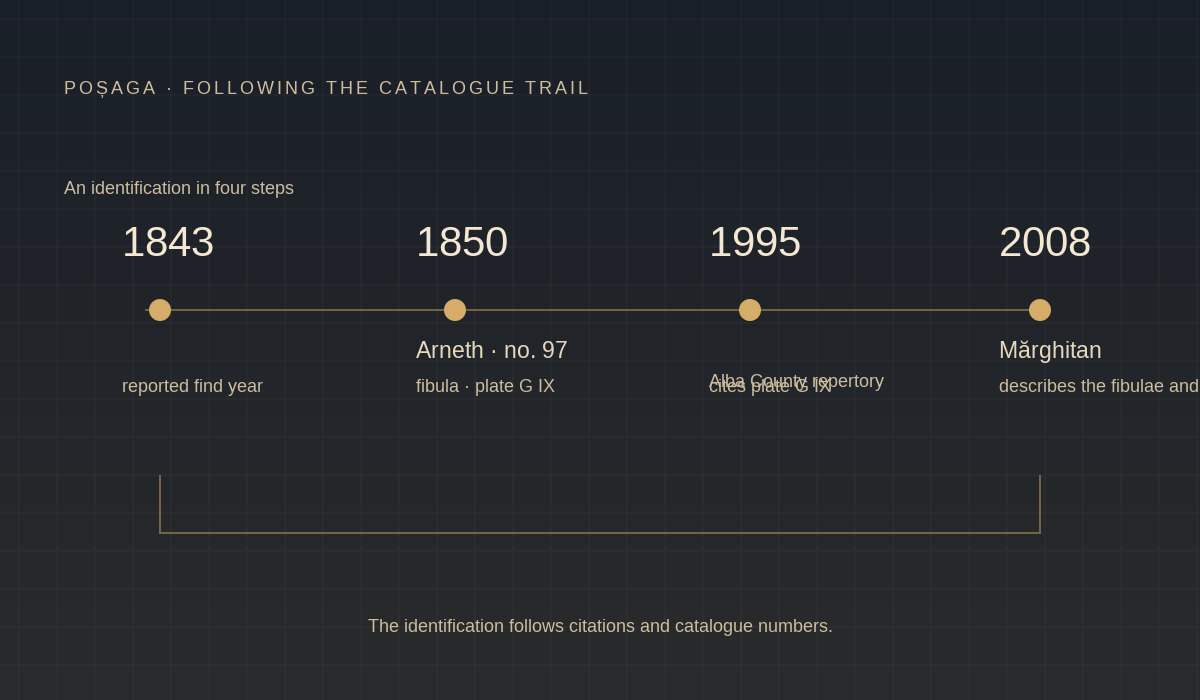
In 1843, a group of silver ornaments was found at Poșaga: two fibulae, a chain and other pieces mentioned briefly in later sources. A fibula was a metal brooch that fastened clothing with a pin and spring. A century and a half later, the Archaeological repertory of Alba County linked one of these fibulae to a drawing published by Joseph Arneth in Vienna in 1850, as object 97 on plate G IX. [2]
The link can be followed through citations, pages and catalogue numbers. The Vienna catalogue calls object 97 a silver fibula and points to plate G IX; its entry also cross-refers to object 94. The 1995 repertory cites it in the Poșaga hoard’s bibliography. The engraving preserves the object’s form, while the locality identification comes through the bibliographic reference. [1] [2]
The object · how it fastened
A long pin, a spring and four knobs
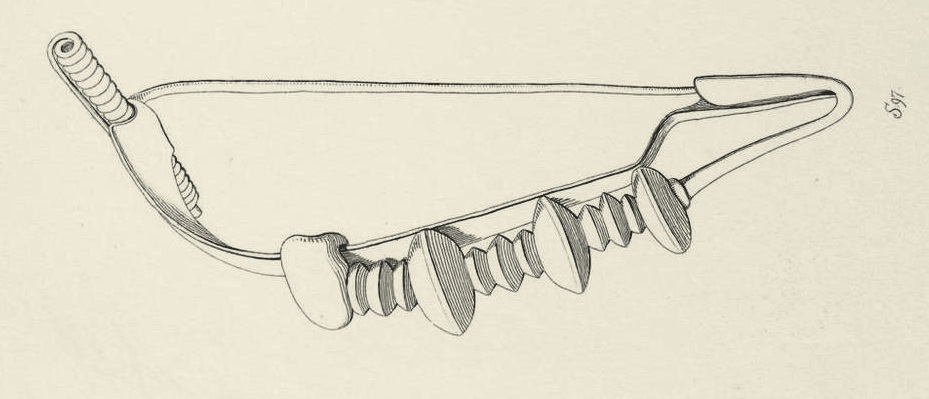
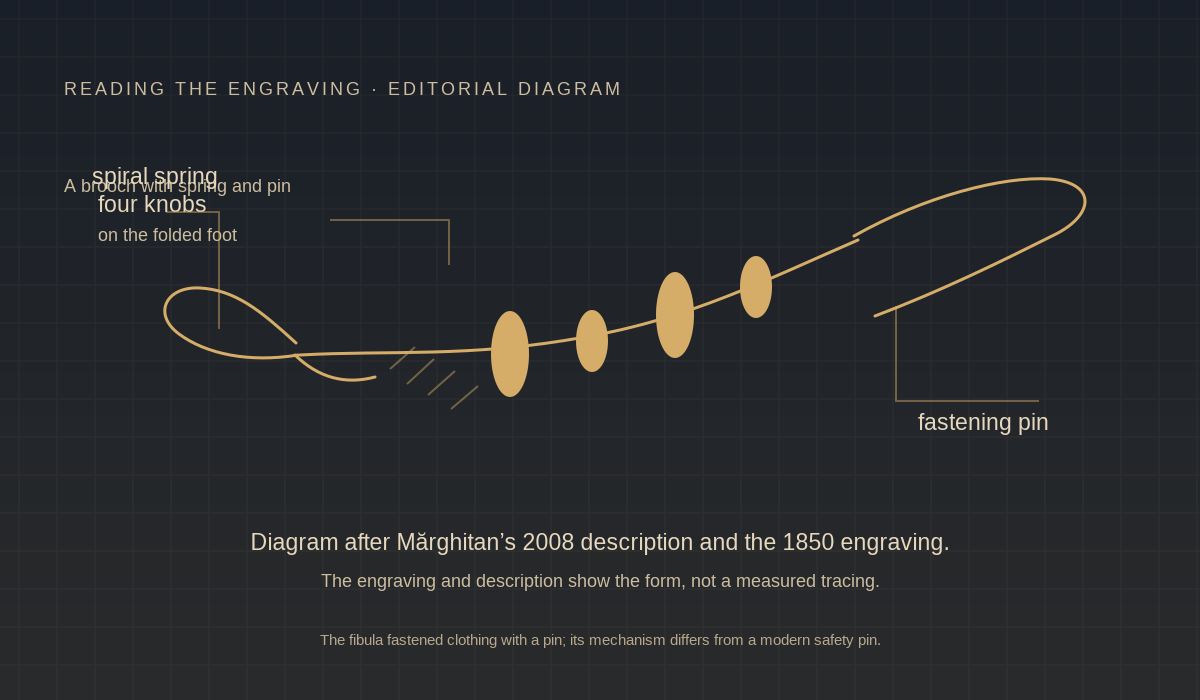
The engraving shows the mechanism that made the fibula useful: a long pin passed through layers of cloth, while the spiral spring at its end held tension. The foot of the object folds back over its bow. Mărghitan’s description counts four disc-shaped knobs; between the last knob and the spring, the bow broadens into a shape compared with a halberd. [3]
The zigzags and crescent incisions on the flattened section are details to look for in the 1850 engraving. The editorial diagram explains them without claiming to reproduce the object to scale. The sources describe its form and length; they do not provide a measured drawing or a reconstruction of how the fibula was worn.
Two descriptions · the measurement
How long is it? The sources give two values
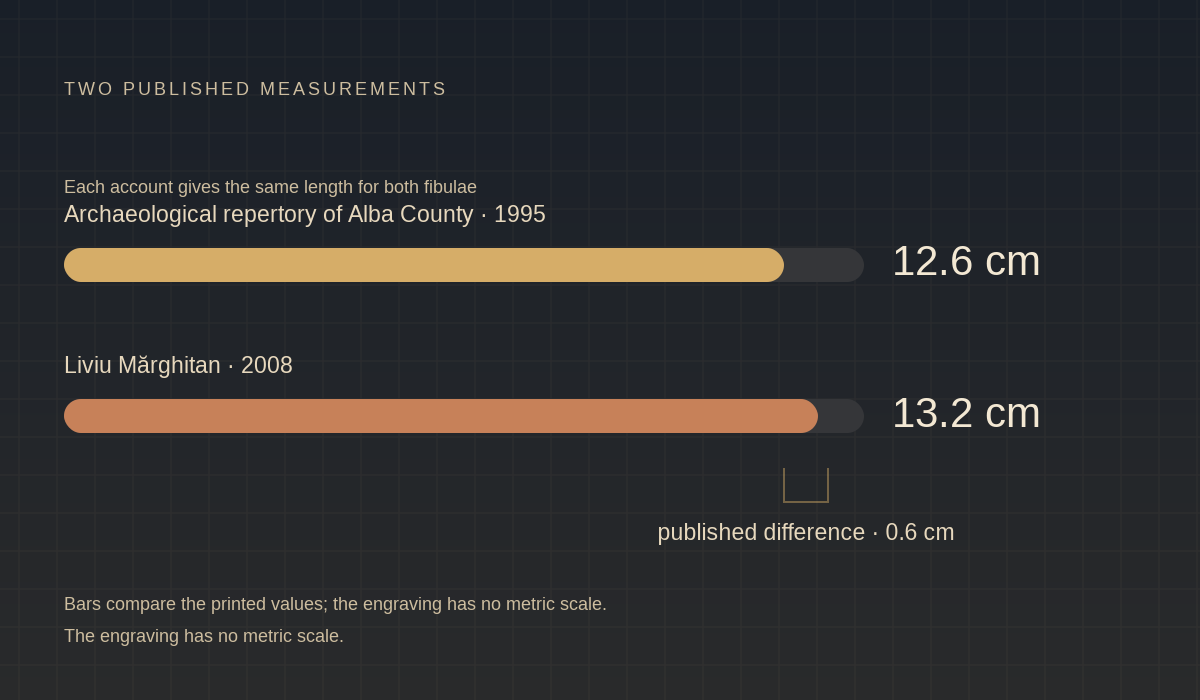
In 1995, the Alba repertory gives each fibula’s length as 12.6 centimetres. In his 2008 catalogue, Mărghitan describes them as an identical pair, each 13.20 centimetres long. The published values differ by six millimetres. We cannot tell whether this comes from a later measurement, a transcription or a different choice of endpoints. [3] [2]
The engraving helps identify the object, but the page has no metric scale. We therefore cannot use the drawing to decide between the two lengths. The graphic compares only what the authors printed: the same object is described in two publications, with close but non-identical values.
The second object · the chain
The chain has 24 links and three pendants
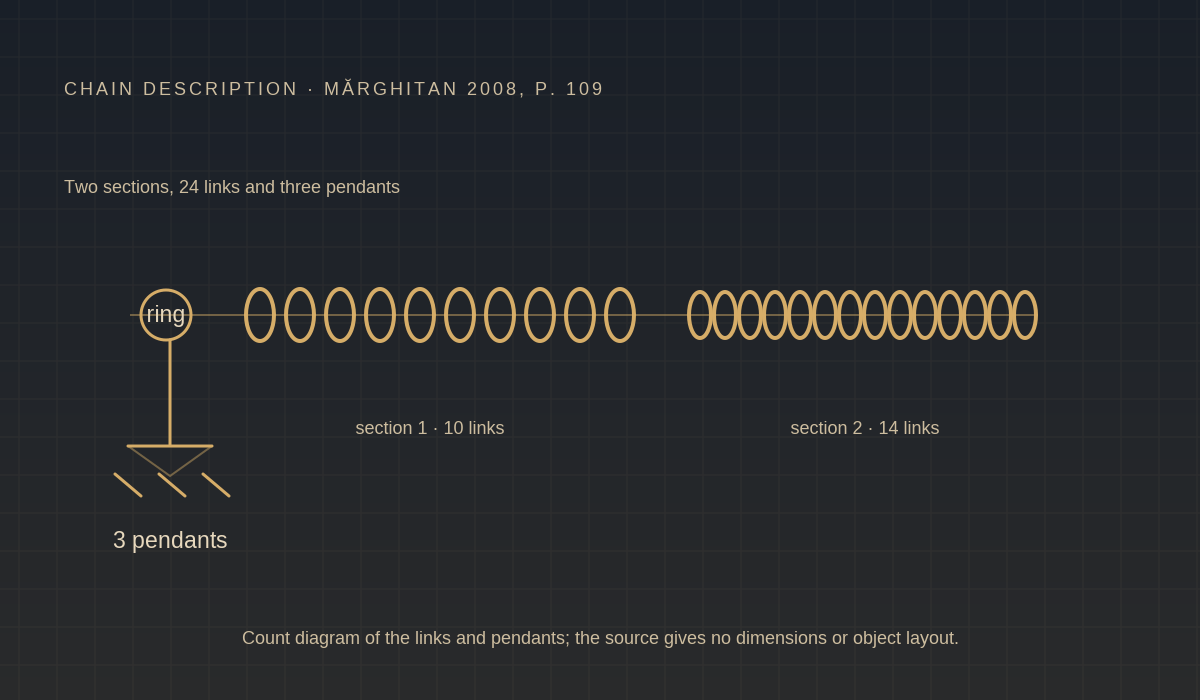
The fibulae were not the only objects in the group. Mărghitan also describes two chain sections made of folded links and attached to a ring: one with ten links, the other with fourteen. Three pendants of silver wire, each shaped like a nail, were attached to the same ring. Counting them turns a brief catalogue phrase into an object that is easier to picture. [3]
The text gives no length for the sections and does not show how they were arranged together. The diagram preserves the link count without inventing a scale or a way of wearing the chain. It shows what can be read in the description and leaves the complete form of the ornament open.
A mention · an undescribed object
The “small jewel” cannot yet be identified
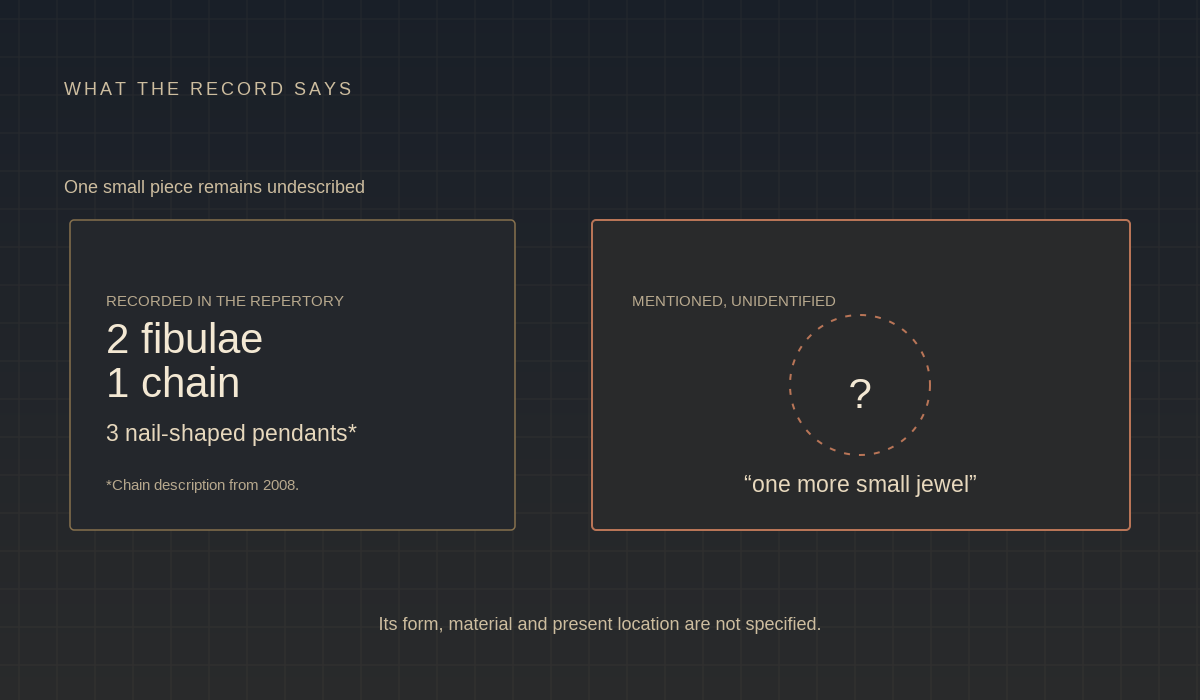
Liviu Mărghitan’s catalogue mentions that the hoard may have included a further small jewel. What it looked like and what it did remain unknown. Mărghitan cites the 1979 volume in which Radu Florescu reported being unable to find it in the Vienna collection. The outcome of the 1979 search is known. The fate of the piece remains unclear. [3]
Drawing an object known only through a brief report would suggest details unsupported by the sources. The panel therefore separates what can be counted from what is only mentioned. Here the empty space is information: it marks the limits of the catalogue and keeps the question open.
Two periods · two collections
The bronze objects at Deva are a different find
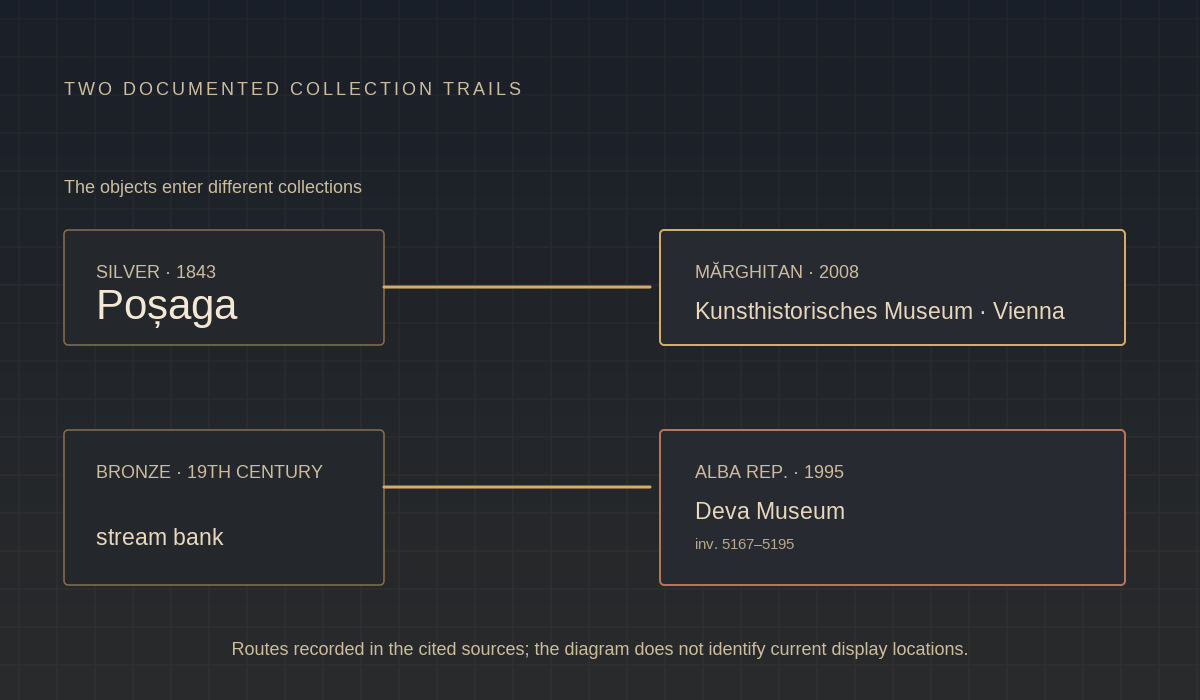
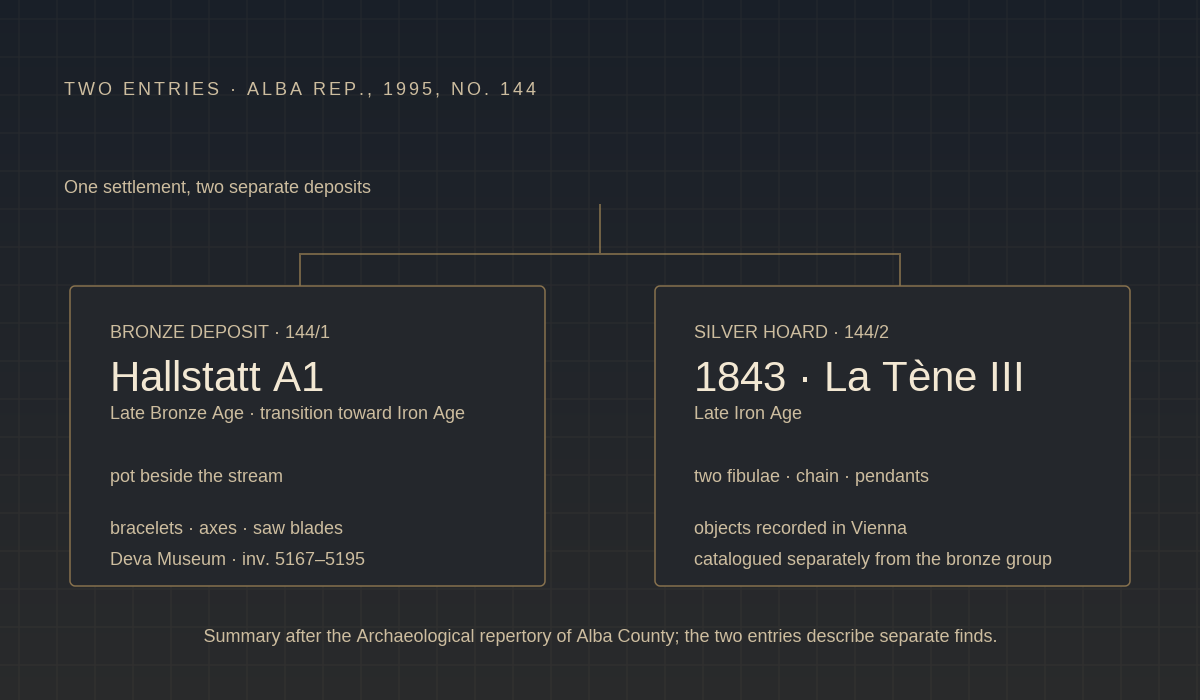
The same repertory entry lists a different group of objects, found in a clay pot on the village stream bank: bracelets, axes, saw-blade fragments, a deformed cauldron and bronze pendants. The authors date it to Hallstatt A1 (Ha A1). For central Transylvania, Horia Ciugudean places this phase in the final part of the Late Bronze Age or a transition toward the Iron Age. The repertory records Deva Museum inventory numbers 5167–5195. This is separate from the 1843 silver hoard, assigned to La Tène III, in the later Iron Age. [2] [4]
The repertory says the bronze deposit was also assigned in publications to names such as Potsag, Poșaga de Jos, Pozsag and Podsaga. The printed entry separates it from the silver with two catalogue numbers, 144/1 and 144/2, two object inventories and different collections. These marks help keep the two histories distinct, even where place names became mixed. [2]
The place · what is known and missing
The village is known; the findspot is not
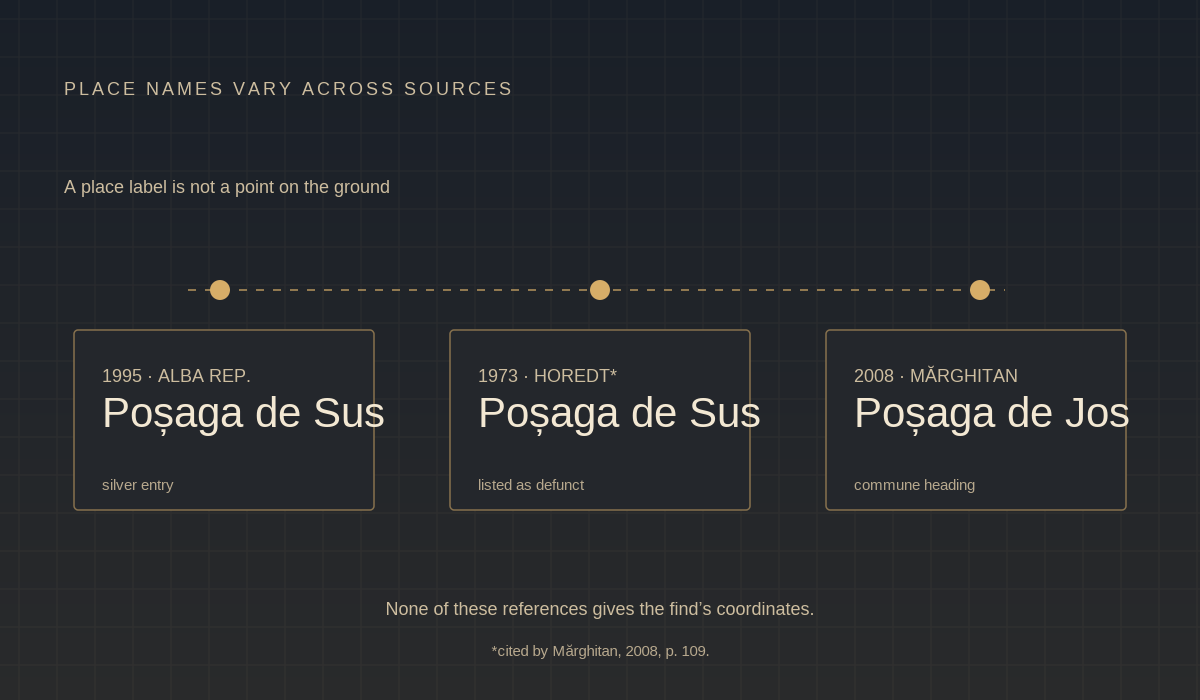
The 1995 inventory puts the silver at Poșaga de Sus. In 2008 Liviu Mărghitan headed his entry “Poșaga de Jos (commune)”, using the name of an administrative area. In the same entry he cites a 1973 publication that used Poșaga de Sus. The two headings have different levels of geographical precision. [2] [3]
The exact place where the silver ornaments were found remains unknown. The pot found by the stream belongs to the bronze discovery. The map marks the village of Poșaga de Jos for orientation. [2] [5]