Câmpulung, 1636
When did churches start speaking Romanian?
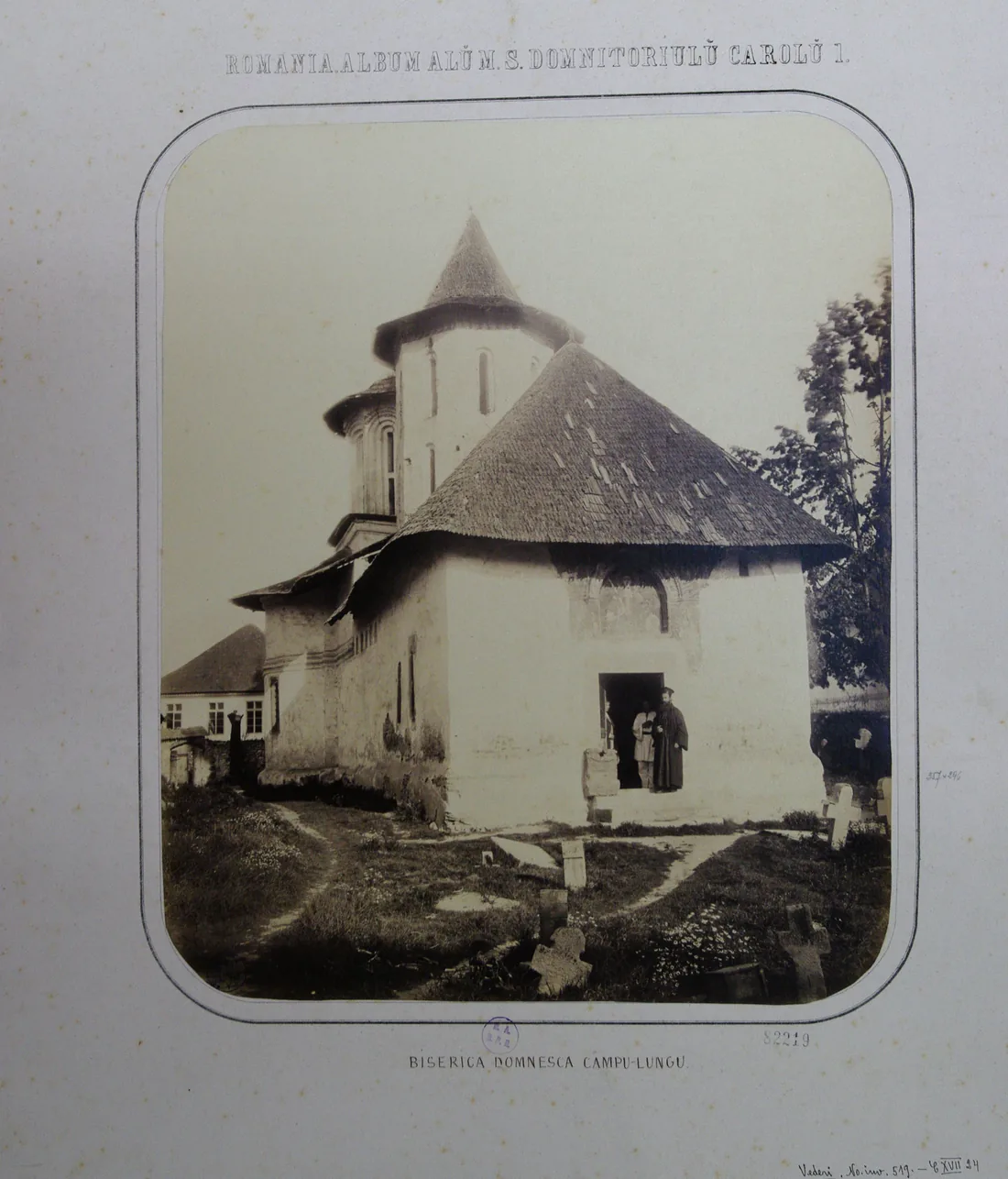
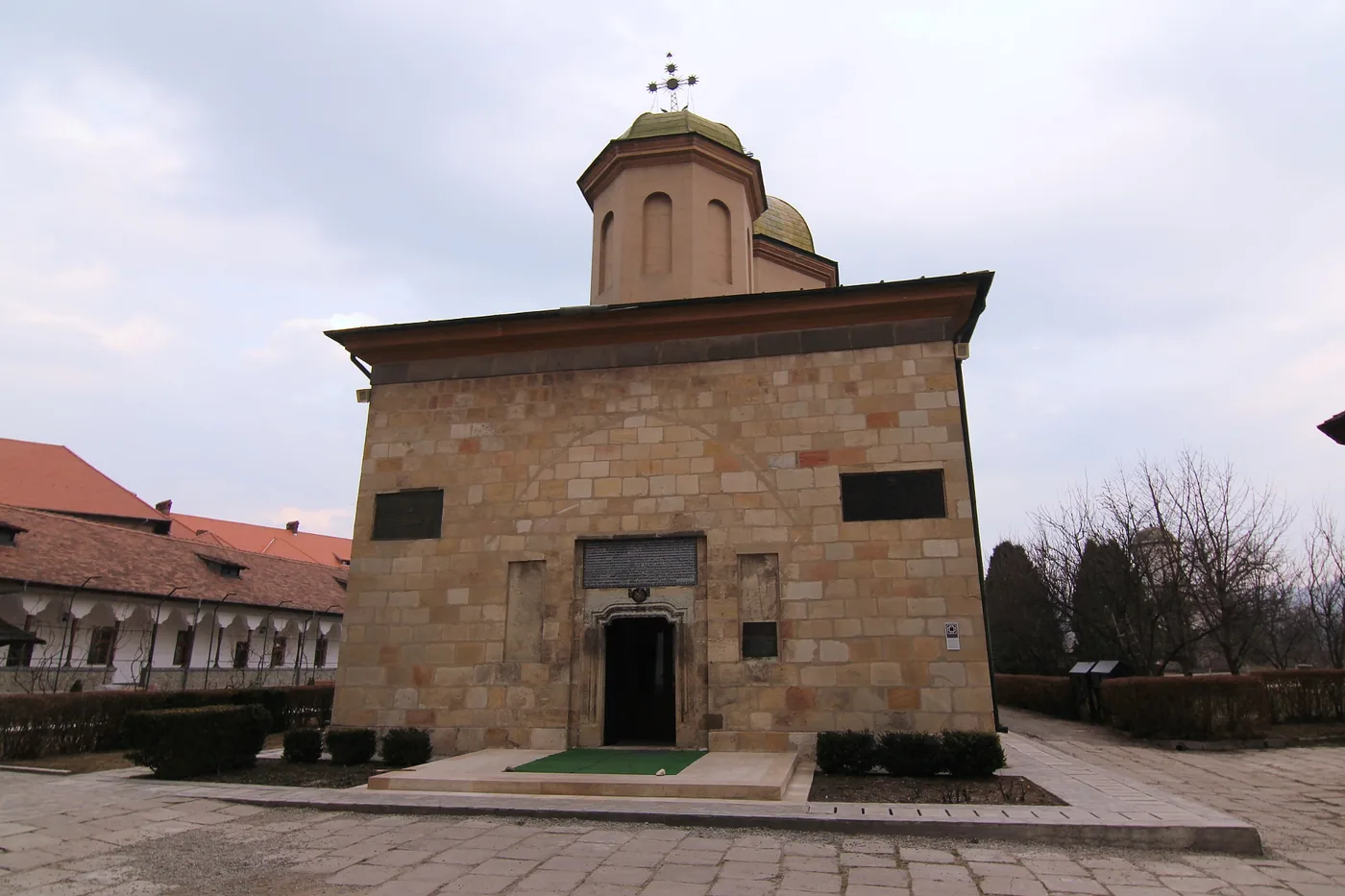
For centuries, the story written on church walls was told in Church Slavonic, the language of the liturgical books. In the summer of 1636, on the freshly raised wall of the princely church in Câmpulung, the foundation story was written in the language of the people walking through the door. It is one of the first Romanian-language pisanii, the inscribed foundation records above church doors.
În zilele dulcelui creștin și de Dumnezeu iubit creștin
Matei Basarab Voevod, gospojda ego Elina,
cu vrerea lui Dumnezeu pus a fi Domn creștin în Țara-Rumânească
The night the church collapsed
On Saint Elijah's day in 1628, at midnight, the princely church in Câmpulung collapsed. That year's earthquake brought down the old walls — “collapsed by God's will”, as the inscription would later put it — and the church stood in ruins for seven years.
Matei Basarab, who had taken the throne in 1632, made Câmpulung one of the early major rebuilding projects of his reign: rebuilding started on 22 June 1635 and finished on 20 August 1636. The ispravnic, the man who ran the site, was Socol the court provisioning officer (clucer) of Cornățeni.
The inscription places Matei in the line of Radu Negru, the legendary founder of Wallachia. The link is political, not proven: in his notes to the corpus, Iorga shows that Radu Negru the founder left barely a trace in history.
- Where
- The princely church in Câmpulung, Negru Vodă Monastery, Argeș county; dedicated to the Dormition of the Mother of God
- When
- 22 June 1635 – 20 August 1636 (years 7143–7144 from Adam)
- Who
- Matei Basarab and his lady Elena; ispravnic Socol the clucer of Cornățeni
- What
- A foundation inscription in the Romanian language, in the Cyrillic alphabet of the time
- Text
- N. Iorga, Inscripții din bisericile României, vol. I, 1905, pp. 128–129
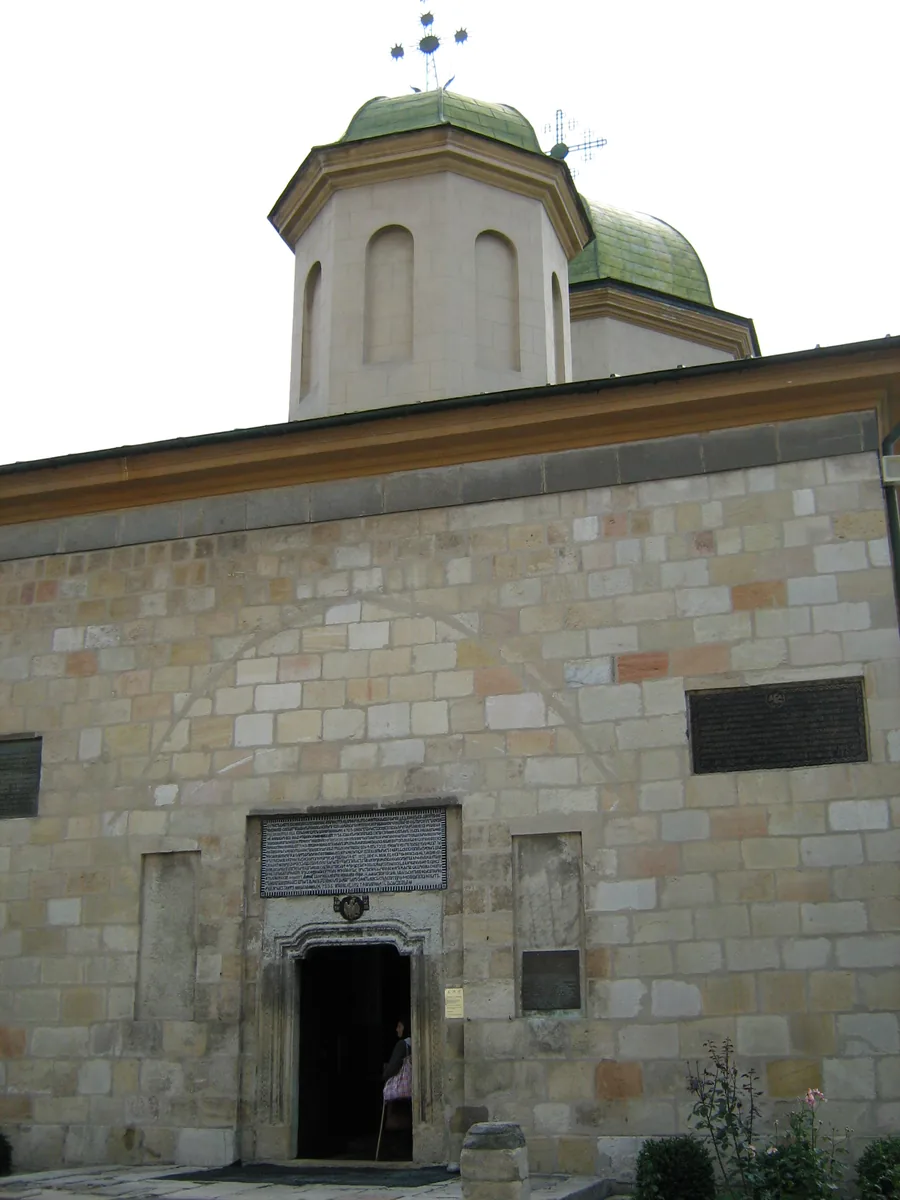
The inscription stood high on the facade, to the left of the entrance, where anyone entering the church could read it. Iorga collected its text in 1905, in the first volume of Inscripții din bisericile României.

Words off the stone
Pick a word from the inscription's first sentence. Four survived into Romanian, one changed, one is pure Slavonic.
- survived into Romanian
- changed
- Slavonic remnant
4 survived · 1 changed · 1 is Slavonic
-
zilele
the days
survived into Romanian
Romanian zi comes from Latin dies. The inscription writes zilele, with the plural definite article, exactly as today. The same formula, “in the days of”, opens the Sadova inscription too.
-
dulcelui
of the gentle
survived into Romanian
Dulce comes from Latin dulcis. Here it speaks of the prince's gentleness: an epithet of benevolent power, paired with milostiv, “merciful”, in the inscription's later lines.
-
vrerea
the will
survived into Romanian
Vrere, “will”, still lives in the language, but the formula moved to voia: “by God's will”. The 1645 Strehaia inscription already writes “după voia și ajutoriul lu Dumnezeu”.
-
gospojda ego
his lady
Slavonic remnant
The only stretch of Slavonic in the sentence: gospojda, “lady”, ego, “his”. Elena, Matei's wife, enters the Romanian inscription through a Slavonic formula: the new language still wrote to old patterns.
-
Rumânească
Românească
changed
The country's name with a u: Țara-Rumânească. Both forms had circulated since the 16th century, and the inscription spells it as people said it. The Govora Code, four years later, prints the same u: “pre limba rumânească”.
-
creștin
Christian
survived into Romanian
From Latin christianus. Matei is called creștin three times in a single sentence: faith is the prince's first listed quality.
Further down the inscription, the dedication stays in Slavonic, while the years are counted “from Adam”, on the Byzantine calendar. But the sentences are Romanian, with subjects, verbs and dates. Anyone who could read could follow the whole story on the wall.

The stone spoke before the law book
The Câmpulung inscription is from 1636. Four years later, the Govora printing press issued the Small Code (Pravila cea Mică) of 1640, the first legal code printed in Romanian in Wallachia. Only then came Varlaam's Homiliary, printed at Iași in 1643, and the Îndreptarea legii of 1652.
The change did not happen all at once. In 1645–1646, Vasile Lupu had the inscription at Stelea, in Târgoviște, written in Slavonic still. In those same years, Matei Basarab had the inscriptions at Strehaia, in 1645, and at Plătărești, in 1646, written in Romanian.
Slavonic did not vanish from the walls at once, but Romanian appears ever more often: the Doamnei church in Bucharest, in 1683, and Fundenii Doamnei, in 1699, both carry their inscriptions in Romanian.
Is Câmpulung the very first? The Sadova inscription claims the year 1633, but the building's dating is questioned in a 2012 study. Until better evidence turns up, Câmpulung remains the oldest Romanian inscription that can be shown with its full date on display: day, month, year and site overseer.

- 1628The Câmpulung church collapses on Saint Elijah's day, at midnight.
- 1632Matei Basarab takes the throne of Wallachia.
- 1633The Sadova inscription claims the year 1633; the dating is disputed.
- 1635–1636The Romanian inscription at Câmpulung: rebuilding starts on 22 June 1635 and ends on 20 August 1636.
- 1640The Govora Code, the first legal code printed in Romanian in Wallachia.
- 1643Varlaam's Homiliary, printed at Iași.
- 1645Strehaia writes its inscription in Romanian; Stelea in Slavonic: the same years, two languages.
- 1646The Romanian inscription at Plătărești, set on 3 April.
- 1652Îndreptarea legii, printed under Matei Basarab.
- 1683The Doamnei church in Bucharest: an inscription in Romanian.
- 1699Fundenii Doamnei: an inscription in Romanian, on 1 May.
Sources
The inscription text follows Iorga's transcription; the modern rendering and the translations from Slavonic are by Marius Comper.
- N. Iorga, Inscripții din bisericile României, vol. I, Bucharest, 1905: Câmpulung (pp. 126–131), Strehaia (p. 211), Stelea (pp. 112–113), Doamnei church (p. 277). archive.org
- Virgiliu Z. Teodorescu, “Ctitorul Matei Basarab, realizator al unor reevaluări…” (in Romanian), București. Materiale de istorie și muzeografie XXVI, 2012 (the Câmpulung inscription, in Romanian; Sadova; Plătărești). bmim.muzeulbucurestiului.ro (PDF)
- Liana Ivan-Ghilia, “Pisanii bucureștene din epoca lui Matei Basarab — relația imagine-text” (in Romanian), București. Materiale de istorie și muzeografie XIII, 1999. bmim.muzeulbucurestiului.ro (PDF)
- Panait I. Panait, “Biserica Fundenii Doamnei, un strălucit monument al epocii brâncovenești” (in Romanian), București. Materiale de istorie și muzeografie XVII, 2003 (the 1 May 1699 inscription). bmim.muzeulbucurestiului.ro (PDF)
- Agnes Erich, “365 de ani de la tipărirea Pravilei lui Vasile Lupu (1646)” (in Romanian), Library and Information Science Research (the first laws in Romanian: Govora 1640, Iași 1646, 1652). lisr.unibuc.ro (PDF)
- Metropolitan Teofil, foreword to the Govora Code (1640): “pre limba rumânească” (in Romanian), quoted in Romanoslavica XLII. apostolov.com (PDF)
- dexonline: DEX and the etymological dictionaries for zi, dulce, creștin and pomană. dexonline.ro/definitie/pomana
- Wikipedia: “Cazania lui Varlaam” (Iași, 1643), “History of the Romanian language” (the rumân and român forms in the 16th century). en.wikipedia.org/wiki/Cazania_lui_Varlaam